
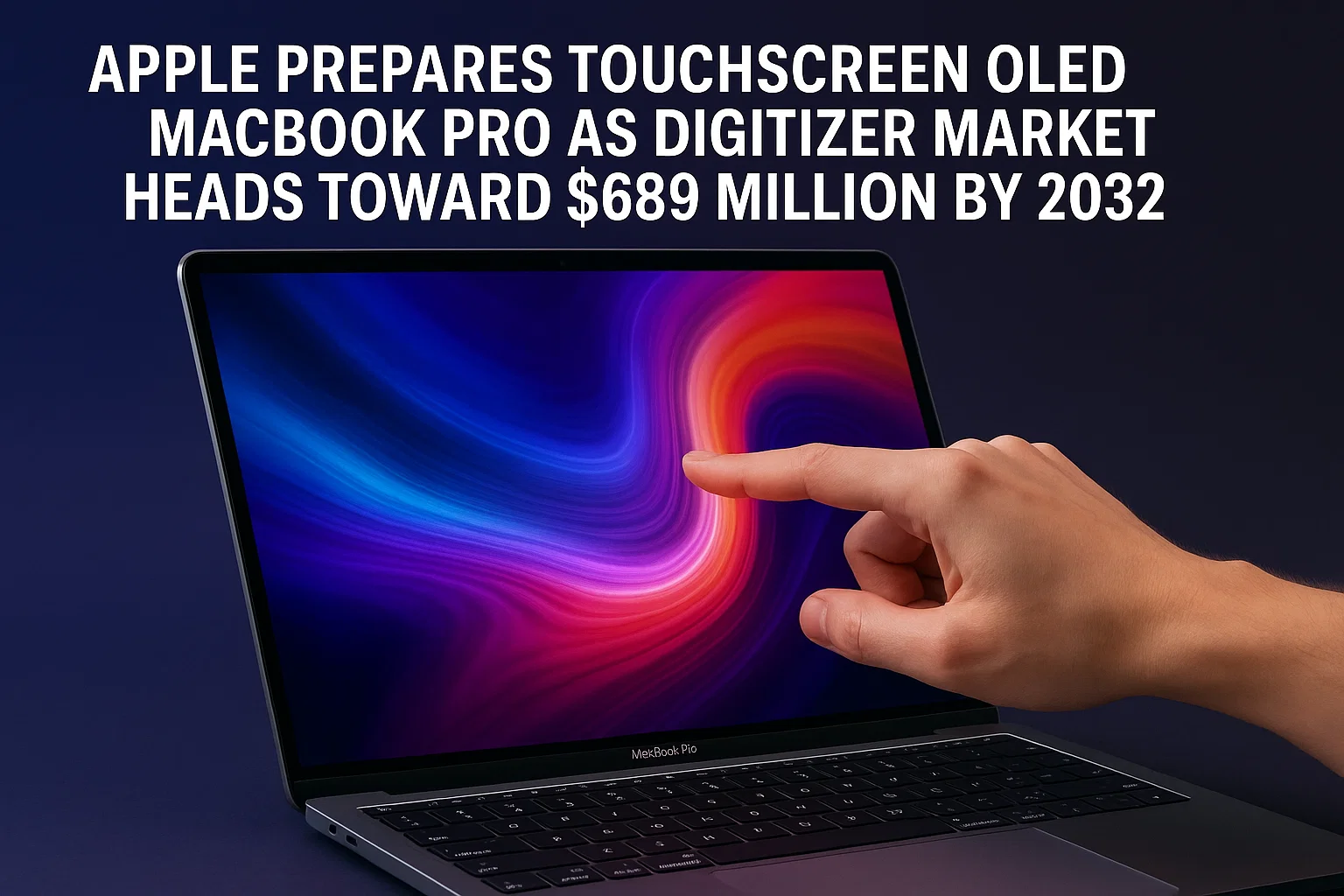
Apple Prepares Touchscreen OLED MacBook Pro as Digitizer Market Heads Toward $689 Million by 2032
Touch screens have moved far beyond being a luxury feature. Once confined to smartphones and tablets, digitizers now power interaction across laptops, vehicles, kiosks, industrial machinery, medical devices, and even digital signage. These thin layers of technology beneath the glass surface interpret touch, gestures, and stylus inputs, making them the invisible backbone of modern digital interaction.
As of 2024, the global Touch Screen Digitizers Market was valued at USD 491 million. By 2032, it is projected to grow to USD 689 million, registering a steady CAGR of 5.2%. This growth is being shaped by a combination of consumer demand for more intuitive interfaces, advancements in display technology, and cross-industry adoption. At the same time, emerging challenges such as higher production costs, durability issues, and the pressure to integrate with new modalities like voice or gesture recognition are pushing manufacturers to innovate faster.
Access Your Free Sample Report- Touch Screen Digitizers Market
1. The Evolution of Touch Screen Digitizers
Digitizers are the unseen yet crucial component beneath every modern touch interface. They translate physical interaction be it a finger tap, a swipe, or a stylus stroke into electronic signals that devices can understand. Over the years, digitizer technology has advanced from resistive touch panels to capacitive touch systems, enabling multi-touch gestures, faster response times, and higher precision.
What makes digitizers increasingly important today is not just their role in smartphones or tablets but their penetration into laptops, automotive dashboards, retail kiosks, ATMs, medical systems, and public displays. Touch has become the universal human-machine interface.
2. Market Snapshot (2024–2032)
- 2024 Market Size: USD 491 million
- 2032 Market Size Projection: USD 689 million
- CAGR:2%
This steady growth reflects not only consumer electronics adoption but also expansion into enterprise, automotive, retail, and healthcare sectors. Growth is strongest in:
- Consumer Electronics: Smartphones, tablets, wearables.
- Enterprise & Retail: Touch kiosks, PoS (point-of-sale) systems, digital signage.
- Automotive: Infotainment displays, navigation, driver-assist dashboards.
- Healthcare: Medical imaging systems, diagnostic tools with touch input.
3. Recent Industry Developments
3.1 Apple’s Shift Toward Touchscreen MacBook Pro
Traditionally, Apple resisted adding touch functionality to its MacBook line, favoring trackpads and the Touch Bar experiment. However, reports now indicate Apple is preparing a MacBook Pro with an OLED display and integrated on-cell touch technology by 2026.
This move is groundbreaking because:
- It will be Apple’s first touchscreen laptop, potentially reshaping expectations in the premium PC market.
- On-cell touch technology integrates touch functionality directly into the display panel, reducing layers, improving response, and lowering thickness.
- Apple’s entry into touchscreen laptops will likely push competitors like Dell, HP, and Lenovo to enhance their digitizer technology in next-gen models.
This development signals a broader shift of touch digitizers into productivity computing, beyond mobile devices.
3.2 Tianma’s Ultra-High Refresh Rate Displays
At Display Week 2025, Tianma unveiled some of the most advanced display-digitizer integrations:
- 16″ WQXGA Oxide panel with 480Hz refresh rate: Designed for gaming laptops, this panel pushes refresh rates to new heights, enabling ultra-smooth visuals. For digitizers, it means faster response times and lower latency in touch inputs.
- Dynamic Refresh (1Hz–360Hz): Panels capable of scaling refresh rates drastically help balance battery life with performance. For digitizers, it ensures that touch responsiveness adapts to activity low power mode for static reading, high responsiveness for gaming or creative drawing.
- Pixel Multiplexing & Optical Pixel Shifting: Techniques that enhance resolution and clarity without increasing pixel count, indirectly improving touch accuracy and display sharpness.
These developments highlight how digitizer performance is tied closely to display innovation.
3.3 Multi-Touch Devices: Growth with Challenges
As multi-touch becomes the norm, from smartphones to interactive walls, the market faces both opportunities and obstacles. Recent industry reports highlight:
- Rising demand for large-format multi-touch panels in retail, education, and public displays.
- Challenges in durability, cost, and environmental resilience outdoor kiosks must withstand weather, while large panels demand higher accuracy and longevity.
- Precision in gesture recognition remains a hurdle; false touches or laggy responses still plague lower-cost systems.
These challenges are pushing companies to experiment with new materials, coatings, and sensor configurations.
Download Sample Report PDF- Touch Screen Digitizers Market
3.4 Expansion into Flexible and Curved Displays
Another frontier is the integration of digitizers with flexible and curved displays:
- Rollable and foldable smartphones (e.g., Samsung Galaxy Z series) rely on flexible digitizers that can bend without breaking.
- Automotive dashboards increasingly feature curved displays where digitizers must maintain accuracy despite irregular surfaces.
- Industrial and medical devices now demand specialized digitizers that can work on non-flat, rugged, or transparent surfaces.
This development expands digitizer applications beyond rectangular panels into more immersive, adaptable form factors.
3.5 Advances in Haptics and User Feedback
Touch interaction is evolving beyond flat responses. Digitizer systems are being paired with advanced haptic feedback technologies to create richer, more tactile experiences:
- Electro-vibration: Simulates texture by modulating electrical signals across the screen surface.
- Electro-adhesion: Creates resistance or stickiness to mimic frictional surfaces.
- Localized haptics: Precise vibrations corresponding to button presses, sliders, or textures.
These advances make touchscreens feel less like glass and more like interactive surfaces, boosting UX in gaming, design, and industrial applications.
3.6 Retail and Public Space Deployment
Digital signage, PoS terminals, and kiosks are increasingly reliant on touch interfaces. Recent deployments focus on:
- Durability: Scratch resistance, vandal-proof coatings.
- Multi-user interaction: Supporting simultaneous touches from multiple people.
- Integration with AI: Dynamic interfaces that adjust content based on usage patterns, demographics, or predictive analytics.
These trends are accelerating in smart cities and retail modernization initiatives.
4. Technology Trends Driving the Future
4.1 On-Cell vs In-Cell Touch Technologies
The industry is gradually moving from traditional add-on digitizers toward on-cell and in-cell integration, where touch sensors are built directly into the display.
- Benefits: Reduced thickness, faster response, lighter devices, and lower power use.
- Drawback: Manufacturing complexity and cost.
Apple’s adoption of on-cell in MacBooks will likely accelerate mainstream acceptance.
4.2 AI and Gesture Recognition
The next wave of digitizers is about multi-modal input:
- AI helps improve gesture recognition, reducing false touches.
- Integration with voice commands and eye tracking expands accessibility.
- Gesture-based interfaces (hover, air-swipe) may become more prevalent in public spaces.
4.3 Ultra-Thin, Flexible Digitizers
Manufacturers are experimenting with polyimide substrates, nano-materials, and graphene layers to create ultra-thin, flexible digitizers. This is crucial for foldable smartphones, AR/VR devices, and wearable displays.
4.4 Sustainable Materials and Energy Efficiency
Digitizer makers are under pressure to adopt:
- Recyclable materials for eco-compliance.
- Low-power touch systems that conserve energy, especially in IoT devices.
- Manufacturing processes with reduced chemical use and emissions.
5. Industry Challenges
- Cost Pressure: Integrating touch into larger or curved displays is expensive.
- Durability: Foldables and outdoor systems need more robust digitizers.
- Competition: With giants like Apple, Samsung, and LG entering, smaller firms must innovate faster or find niche applications.
- Privacy & Security: Public touchscreens in kiosks or ATMs must guard against hacking or data theft via compromised digitizer systems.
6. Regional Outlook
- North America: Driven by premium laptops, automotive infotainment, and retail adoption.
- Europe: Strong growth in industrial, automotive, and medical applications.
- Asia-Pacific: Largest and fastest-growing market, thanks to smartphone and consumer electronics manufacturing in China, South Korea, and Japan.
- Middle East & Africa: Growth driven by smart city initiatives and retail modernization.
Click Here To Download Full Sample Report- Touch Screen Digitizers Market
7. Future Outlook (2025–2032)
The touch screen digitizer market is at an inflection point. By 2032, we will see:
- Mainstream foldable and rollable devices with durable flexible digitizers.
- Touchscreen laptops becoming standard, especially after Apple’s MacBook transition.
- AI-powered adaptive touch systems improving precision, reducing false gestures.
- Immersive tactile interfaces that simulate textures for design, shopping, and gaming.
- Greater penetration in healthcare, education, and industrial systems.
The next decade will not only be about thinner and faster screens but also about creating more human-like, intuitive, and immersive interactions between people and machines. The Touch Screen Digitizers Market, valued at USD 491 million in 2024 and set to reach USD 689 million by 2032, is on a trajectory of steady growth.

Comments (0)