MARKET INSIGHTS
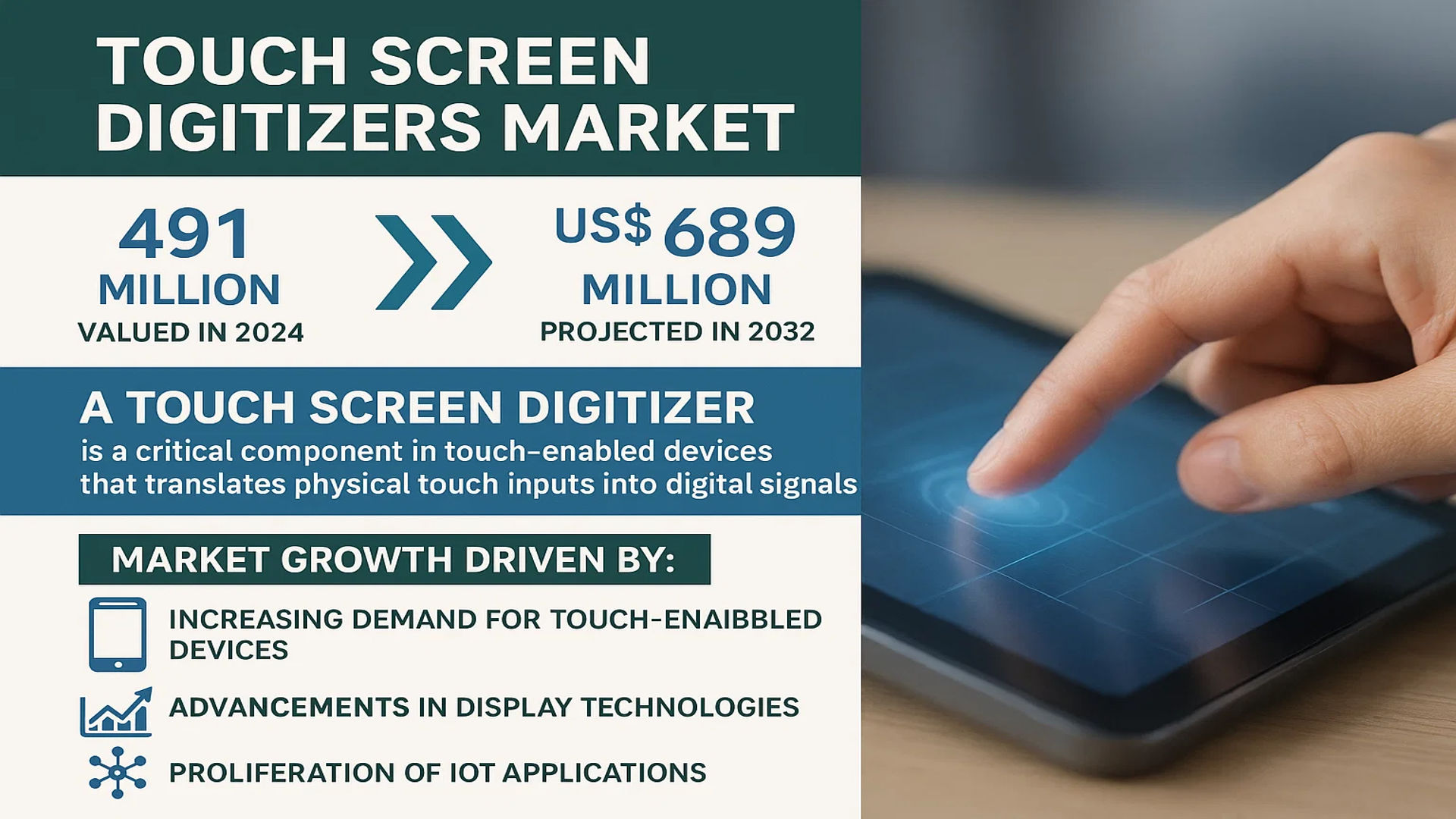
The global Touch Screen Digitizers Market was valued at 491 million in 2024 and is projected to reach US$ 689 million by 2032, at a CAGR of 5.2% during the forecast period.
A touch screen digitizer is a critical component in touch-enabled devices that translates physical touch inputs into digital signals. It consists of a sensor grid that detects finger or stylus movements, enabling precise interaction with smartphones, tablets, laptops, and industrial equipment. The digitizer is essential for the functionality of capacitive touchscreens, which dominate modern consumer electronics due to their responsiveness and multi-touch capabilities.
The market growth is driven by increasing demand for touch-enabled devices, advancements in display technologies, and the proliferation of IoT applications. While the resistive touch digitizers segment continues to hold a niche share, capacitive variants lead the market due to their widespread adoption in consumer electronics. Key players such as Elo Touch Solutions, Panasonic, and Fujitsu are investing in R&D to enhance durability and sensitivity, further accelerating market expansion. The U.S. and China remain dominant markets, contributing significantly to global revenue.
MARKET DYNAMICS
MARKET DRIVERS
Rapid Adoption of Touch-Enabled Devices Fuels Market Expansion
The global touch screen digitizers market is experiencing strong growth driven by increasing demand for touch-enabled devices across multiple sectors. Smartphone adoption continues to rise with over 1.5 billion units shipped annually, while tablet shipments remain stable at approximately 120 million units per year. The consumer electronics segment accounts for nearly 75% of touch screen digitizer demand, with technological advancements enabling thinner, more responsive touch interfaces. Capacitive touch digitizers dominate the market due to their superior multi-touch functionality and durability compared to resistive technologies.
Industrial Automation and Digitalization Accelerate Demand
Industrial sectors are increasingly adopting touch screen solutions for human-machine interfaces (HMIs) in manufacturing equipment and process control systems. The digitizer market benefits from Industry 4.0 implementation, with industrial automation investments projected to grow at 12% CAGR through 2030. Touch interfaces improve operational efficiency in harsh environments when paired with durable digitizer technologies like projected capacitive or infrared solutions. Recent innovations include glove-compatible and water-resistant digitizers that maintain functionality in challenging industrial conditions.
Emerging Applications in Retail and Healthcare Create New Opportunities
The retail sector’s shift toward interactive kiosks and digital signage is driving demand for large-format touch digitizers, with the market for interactive displays expected to reach $15 billion by 2026. In healthcare, touch screen adoption in diagnostic equipment and patient monitoring systems is growing at 8% annually. Antimicrobial touch screen solutions have gained traction in medical environments, addressing hygiene concerns while maintaining precise touch sensitivity requirements for critical healthcare applications.
MARKET RESTRAINTS
High Manufacturing Costs and Complex Supply Chains Limit Market Penetration
While demand grows, the touch screen digitizer market faces challenges from rising material costs and supply chain complexities. The average production cost for premium capacitive digitizers remains 30-40% higher than resistive alternatives, limiting adoption in price-sensitive segments. Supply chain disruptions affecting key components like indium tin oxide (ITO) films have caused price volatility, with some material costs increasing by up to 25% in recent years. These factors create barriers for manufacturers seeking to expand into emerging markets with strict cost constraints.
Other Restraints
Technological Limitations in Extreme Environments
Standard touch digitizers face performance degradation in extreme temperatures or high-moisture environments, restricting applications in certain industrial and outdoor settings. While specialized solutions exist, their premium pricing limits widespread adoption across cost-conscious industries.
Increasing Competition from Alternative Input Technologies
Voice recognition and gesture control systems are emerging as competitors to touch interfaces in some applications, particularly in automotive and smart home segments. Though not replacing touch screens entirely, these alternatives are capturing niche applications that might otherwise use touch digitizers.
MARKET CHALLENGES
Precision and Reliability Requirements Raise Technical Hurdles
Touch digitizer manufacturers face increasing pressure to deliver higher precision while reducing response times. Consumer expectations for near-instantaneous touch response under 10 milliseconds create significant engineering challenges, particularly for large-format displays. Reliability issues such as ghost touches and touch drift remain persistent problems, especially in high-interaction environments like gaming or industrial control panels that may experience millions of touch cycles annually.
Compatibility Challenges with Emerging Display Technologies
The rapid evolution of display technologies presents integration challenges for touch digitizer manufacturers. Flexible and foldable displays require digitizers that can withstand repeated bending without signal degradation – a technical hurdle that has led to multiple industry collaborations between display and touch technology providers. Additionally, the shift toward edge-to-edge displays demands ultra-thin digitizer solutions that maintain accuracy near screen borders while minimizing signal interference.
MARKET OPPORTUNITIES
Growth in Automotive Touch Interfaces Creates New Revenue Streams
The automotive sector represents a major growth opportunity as vehicle dashboards transition to fully digital interfaces. The automotive touch screen market is projected to exceed $15 billion by 2028, with digitizer requirements focusing on durability and high-visibility performance. Haptic feedback integration is emerging as a key differentiator, allowing drivers to maintain focus while interacting with touch controls. Major digitizer manufacturers are developing specialized solutions that combine automotive-grade durability with advanced multi-touch capabilities.
Emerging Technologies Enable Next-Generation Touch Solutions
Innovations in materials science are creating opportunities for next-generation touch digitizers. Development of transparent conductive materials alternatives to ITO, such as silver nanowires and conductive polymers, promise to reduce costs while improving flexibility. Force touch technology adds new dimensions to user interaction, while under-display digitizer solutions enable truly bezel-less designs. The integration of AI for touch prediction and gesture recognition is expected to become standard in premium devices within the forecast period.
TOUCH SCREEN DIGITIZERS MARKET TRENDS
Rising Demand for High-Precision Capacitive Touch Digitizers Drives Market Growth
The global touch screen digitizers market is experiencing substantial growth, primarily fueled by the increasing adoption of capacitive touch digitizers in smartphones and tablets. With a market valuation of $491 million in 2024, the sector is projected to grow at a compound annual growth rate (CAGR) of 5.2%, reaching approximately $689 million by 2032. Capacitive digitizers, known for their multi-touch functionality and superior responsiveness, dominate the market, accounting for over 60% of global shipments in 2024. Innovations such as thin-film technology and flexible digitizers are further enhancing durability and sensitivity, catering to the growing consumer demand for premium touch-screen devices.
Other Trends
Industrial Automation Fuels Growth of Resistive Touch Digitizers
While capacitive digitizers lead in consumer electronics, resistive touch digitizers remain pivotal in industrial applications due to their durability and compatibility with stylus input. The segment is projected to grow steadily, particularly in sectors like automotive interfaces, medical devices, and factory automation. With rising industrial automation in emerging markets, manufacturers are investing in ruggedized digitizer solutions that withstand harsh environments. The demand for high-durability touch interfaces in sectors like logistics, healthcare, and defense is expected to sustain growth in this segment through 2032.
Expansion of Interactive Digital Signage Boosts Infrared and Optical Digitizer Adoption
The rapid expansion of interactive kiosks and digital signage is driving demand for infrared (IR) and optical touch digitizers, which enable large-format touch applications. Retail and hospitality sectors are increasingly deploying touch-enabled displays for self-service kiosks, wayfinding systems, and digital menu boards. Asia-Pacific, particularly China and India, is witnessing heightened adoption due to the rise of smart cities and retail modernization initiatives. By 2025, interactive kiosks are expected to account for nearly 20% of the digitizer market, with IR and optical technologies leading the segment due to their scalability and resistance to environmental interference.
COMPETITIVE LANDSCAPE
Key Industry Players
Major Players Focus on Technological Innovation to Dominate the Evolving Market
The global touch screen digitizers market is characterized by intense competition among established manufacturers and emerging players striving to capture greater market share. Leading companies are investing heavily in capacitive touch digitizers, which currently dominate the segment due to their widespread adoption in smartphones and tablets. The market exhibits a semi-consolidated structure, with the top five players accounting for approximately 35% of revenue share in 2024.
Elo Touch Solutions maintains a strong position in the market through its comprehensive product portfolio and global distribution network. The company’s strategic focus on industrial and commercial applications has allowed it to establish leadership in high-durability digitizers for harsh environments. Meanwhile, Fujitsu and Panasonic are leveraging their expertise in consumer electronics to develop advanced digitizer solutions with improved sensitivity and multi-touch capabilities.
Chinese manufacturers like Wenyuan Information Technology and DMC Co., Ltd. are experiencing rapid growth by offering cost-effective digitizer solutions, particularly for budget smartphones and IoT devices. These companies are gradually expanding their presence in international markets through strategic partnerships with OEMs in Southeast Asia and Europe.
The competitive landscape is further shaped by technological advancements such as edge-to-edge designs and foldable digitizer technologies. Key players are increasingly collaborating with display manufacturers to develop integrated solutions that meet the growing demand for bezel-less displays in mobile devices and automotive applications.
List of Key Touch Screen Digitizer Companies Profiled
- Elo Touch Solutions (U.S.)
- A D Metro (U.S.)
- Xenarc Technologies (U.S.)
- Fujitsu (Japan)
- Panasonic (Japan)
- Nissha (Japan)
- DMC Co., Ltd. (China)
- Higgstec (Taiwan)
- Mildex Optical (Taiwan)
- Wenyuan Information Technology (China)
Segment Analysis:
By Type
Capacitive Touch Digitizers Lead the Market Due to High Adoption in Consumer Electronics
The market is segmented based on type into:
- Resistive Touch Digitizers
- Capacitive Touch Digitizers
- Infrared (IR) Touch Digitizers
- Optical Touch Digitizers
- Acoustic Wave (SAW) Touch Digitizers
- Electromagnetic (EMR) Digitizers
By Application
Smartphones Segment Dominates Due to Mass Adoption of Touchscreen Devices
The market is segmented based on application into:
- Smartphones
- Tablets
- Laptops
- Industrial Equipment
- Interactive Kiosks
By Technology
Multi-Touch Technology Gaining Traction for Enhanced User Experience
The market is segmented based on technology into:
- Single-Touch
- Multi-Touch
By End User
Consumer Electronics Leads as Key Adoption Sector
The market is segmented based on end user into:
- Consumer Electronics
- Industrial
- Healthcare
- Retail
- Others
Regional Analysis: Touch Screen Digitizers Market
Asia-Pacific
The Asia-Pacific region dominates the global touch screen digitizers market, accounting for over 45% of the total revenue share in 2024. This leadership stems from the massive consumer electronics manufacturing ecosystem in China, South Korea, and Japan, coupled with rapidly growing adoption in India. Major smartphone OEMs like Samsung, Xiaomi, and OPPO drive demand for high-performance capacitive digitizers. The region also benefits from lower production costs and strong government support for display manufacturing infrastructure. While China leads in volume production, countries like Vietnam and India are emerging as alternative manufacturing hubs due to trade policies and labor advantages.
North America
North America maintains a strong position in the touch screen digitizers market, primarily due to technological innovation and high adoption rates in enterprise applications. The U.S. is home to leading digitizer technology developers and sees extensive use in medical devices, automotive displays, and industrial control systems. Stricter quality standards and IP protection foster advanced R&D in multi-touch and force-touch technologies. The region also shows growing demand for large-format digitizers in education and digital signage applications, with companies like Elo Touch Solutions and A D Metro driving innovation.
Europe
Europe’s touch screen digitizers market benefits from strong automotive and industrial automation sectors, where ruggedized digitizer solutions are increasingly adopted. Germany and France lead in manufacturing high-precision digitizers for specialized applications. The region shows particular strength in projective capacitive (PCAP) technology for outdoor and harsh environment use cases. While consumer electronics demand is relatively mature, growth comes from smart home devices and interactive retail displays. EU regulations on electronic waste and material usage are pushing manufacturers toward more sustainable digitizer designs.
South America
The South American market is in growth phase, with Brazil and Argentina showing increasing demand for touch-enabled devices. While local digitizer production remains limited, imports of complete display modules continue to rise. Economic volatility affects upgrade cycles in consumer devices, but sectors like banking (ATMs) and point-of-sale systems maintain steady demand. The market shows potential for growth as regional assemblies expand and local sourcing becomes more viable. However, infrastructure limitations and import dependencies currently constrain faster adoption.
Middle East & Africa
MEA represents an emerging but strategically important market for touch screen digitizers. Growth drivers include smart city initiatives in the Gulf Cooperation Council (GCC) countries and increasing mobile device penetration across Africa. The region shows particular interest in sunlight-readable and vandal-resistant digitizer solutions for public installations. While local manufacturing is minimal, distribution networks are expanding to serve the growing demand from education, tourism, and government sectors. Market development is uneven, with advanced infrastructure projects in UAE and Saudi Arabia contrasting with basic needs in other areas.
Report Scope
This market research report provides a comprehensive analysis of the global Touch Screen Digitizers market, covering the forecast period 2024–2032. It offers detailed insights into market dynamics, technological advancements, competitive landscape, and key trends shaping the industry.
Key focus areas of the report include:
- Market Size & Forecast: Historical data and future projections for revenue, unit shipments, and market value across major regions and segments. The global Touch Screen Digitizers market was valued at USD 491 million in 2024 and is projected to reach USD 689 million by 2032, growing at a CAGR of 5.2%.
- Segmentation Analysis: Detailed breakdown by product type (Resistive, Capacitive, Infrared, Optical, Acoustic Wave, Electromagnetic) and application (Smartphones, Tablets, Laptops, Industrial Equipment, Interactive Kiosks) to identify high-growth segments.
- Regional Outlook: Insights into market performance across North America, Europe, Asia-Pacific, Latin America, and the Middle East & Africa, including country-level analysis. Asia-Pacific dominates the market due to high smartphone and tablet production.
- Competitive Landscape: Profiles of leading market participants including Elo Touch Solutions, Fujitsu, Panasonic, Nissha, and Zytronic Displays, covering their product portfolios, R&D investments, and strategic initiatives.
- Technology Trends & Innovation: Assessment of emerging technologies like foldable displays, multi-touch digitizers, and integration with IoT devices.
- Market Drivers & Restraints: Evaluation of factors such as growing demand for touch-enabled devices, technological advancements, and supply chain challenges.
- Stakeholder Analysis: Strategic insights for component suppliers, OEMs, and investors regarding market opportunities and challenges.
The report employs primary and secondary research methodologies, including interviews with industry experts and analysis of verified market data, to ensure accuracy and reliability.
FREQUENTLY ASKED QUESTIONS:
What is the current market size of Global Touch Screen Digitizers Market?
-> Touch Screen Digitizers Market was valued at 491 million in 2024 and is projected to reach US$ 689 million by 2032, at a CAGR of 5.2% during the forecast period.
Which key companies operate in Global Touch Screen Digitizers Market?
-> Key players include Elo Touch Solutions, Fujitsu, Panasonic, Nissha, Zytronic Displays, A D Metro, and Xenarc Technologies.
What are the key growth drivers?
-> Key growth drivers include rising smartphone adoption, increasing demand for interactive displays in industrial applications, and technological advancements in touchscreen technology.
Which region dominates the market?
-> Asia-Pacific is the largest market, driven by high device production in China, South Korea, and Japan, while North America leads in technological innovation.
What are the emerging trends?
-> Emerging trends include development of flexible digitizers for foldable devices, integration of haptic feedback, and increasing use in automotive displays.

Get Sample Report PDF for Exclusive Insights
Report Sample Includes
- Table of Contents
- List of Tables & Figures
- Charts, Research Methodology, and more...
 Download Sample Report PDF