

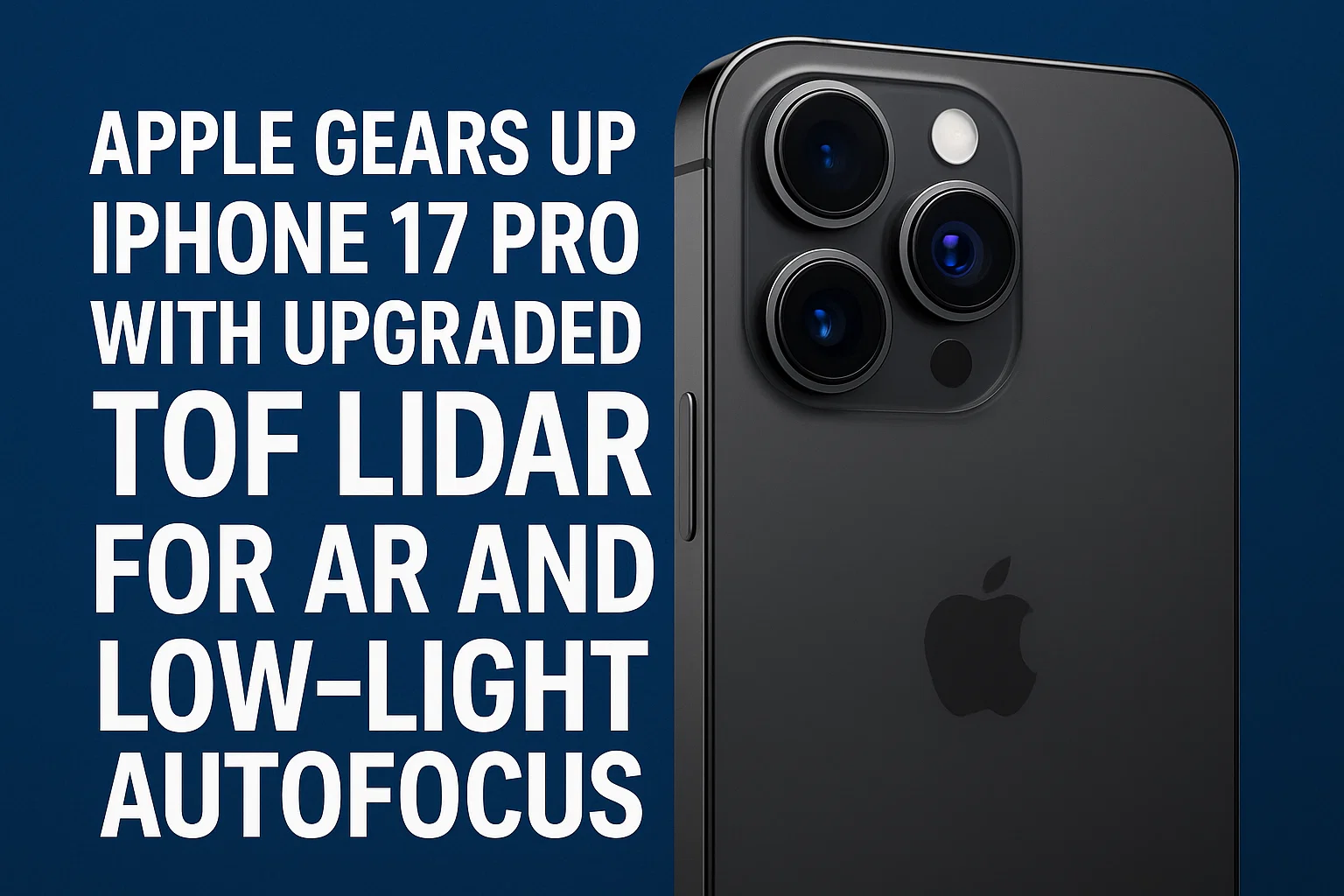
Apple Gears Up iPhone 17 Pro with Upgraded ToF LiDAR for AR and Low-Light Autofocus
Not too long ago, the idea that your phone could “see” the world in three dimensions sounded like science fiction. Yet today, depth-sensing cameras are quietly shaping how we snap photos, unlock devices, and even experience augmented reality (AR). At the heart of this transformation lies an unsung hero: the Time-of-Flight (ToF) 3D image sensor.
For consumers, ToF sensors are not just another spec on a device’s hardware sheet. They’re the backbone of features we take for granted whether it’s a crisp portrait photo with flawless background blur, a smoother Face ID unlock in dim lighting, or a mixed-reality headset that maps your living room in real time. What was once reserved for industrial robotics and automotive safety systems is now slipping into our everyday gadgets.
And the numbers show just how fast this shift is happening. The consumer ToF 3D image sensor market was valued at just $142 million in 2024. By 2032, it’s expected to balloon to $545 million, expanding at a remarkable 21.7% compound annual growth rate (CAGR). That pace outstrips many other consumer tech components, underlining how essential depth sensing is becoming in the era of AR, VR, and computational photography.
But what’s driving this growth? It’s not just hype. Leading consumer tech companies Apple, Samsung, Sony, and Meta are heavily investing in ToF sensors, each leveraging the technology in unique ways. Apple is refining its LiDAR scanners for better iPhone AR performance. Samsung is pushing forward with its ISOCELL ToF line to enhance smartphone cameras. Sony, the global leader in image sensors, is doubling down on stacked direct ToF chips that power everything from headsets to premium smartphones. And Meta, with its Quest 4 headset, is relying on ToF depth sensing for the next generation of immersive mixed reality experiences.
Access Your Free Sample Report- ToF 3D Image Sensor for Consumer Market
The Consumer Market Outlook
While ToF sensors have been around for years in industrial and automotive applications, the consumer industry is now driving the steepest adoption curve. Why? Because the very technologies consumers crave immersive AR, lifelike VR, smart photography, and gesture-based control depend on accurate depth perception.
The consumer segment already accounts for a significant share of ToF adoption, and analysts expect it to lead growth over the next decade. Unlike industrial automation, which moves at a slower pace of adoption, or automotive, where safety certifications stretch timelines, consumer electronics thrive on rapid innovation cycles. Each new smartphone generation or VR headset refresh creates an opportunity to embed the latest ToF sensors.
The numbers tell the story: $142 million in 2024, growing to $545 million by 2032 at a 21.7% CAGR. Much of this surge is attributed to smartphones still the largest consumer device market by volume. As camera performance has become the key battleground for smartphone differentiation, ToF sensors have become indispensable for features like night photography, portrait mode, and AR-based apps.
But smartphones are only the beginning. AR/VR headsets are emerging as another explosive growth vector, with ToF sensors enabling accurate room mapping and hand tracking. Consumer electronics giants are betting big on this sector as AR/VR transitions from niche to mainstream. Likewise, gaming consoles, smart TVs, and even smart home devices are adopting depth sensing for new ways of interacting with technology.
What makes ToF particularly suitable for consumer markets is its balance of accuracy, speed, and compact form factor. Unlike structured light or stereo vision systems, ToF modules can be miniaturized to fit slim devices without compromising performance. That’s why companies like Apple, Samsung, and Meta are standardizing ToF integration across product lines.
Looking ahead, the consumer market is expected to outpace industrial use cases in both revenue and unit shipments. Industrial robots may need precision, but consumers want convenience and they’re willing to pay for it in the form of premium smartphones, AR glasses, and gaming systems. That willingness to upgrade every two to three years ensures ToF sensors will remain at the forefront of consumer innovation.
Recent Developments from Tech Giants
The global leaders in consumer tech are not waiting on the sidelines. From Cupertino to Seoul, Tokyo to Menlo Park, the race to integrate ToF sensors is heating up. Here’s a detailed look at what each major player is doing.
Apple: Refining the LiDAR Advantage
Apple was one of the first to bring ToF sensors into the consumer spotlight when it introduced the LiDAR scanner on the iPhone 12 Pro in 2020. Since then, LiDAR essentially a ToF sensor that measures how long it takes light to bounce back from objects has become a staple of Apple’s Pro lineup.
Recent reports suggest that Apple is upgrading the LiDAR module in the upcoming iPhone 17 Pro models to offer enhanced AR performance and better low-light autofocus. For consumers, this means portrait photos that look more natural and AR apps that run more smoothly. But Apple’s ambitions go beyond photography.
Apple has long been positioning itself for the AR glasses revolution. The company’s LiDAR technology, refined in iPhones and iPads, is laying the groundwork for lightweight AR devices that need accurate, fast depth perception to function seamlessly. By training millions of users to experience LiDAR benefits in their pockets, Apple is priming the market for its next big product category.
Sony: The Quiet Market Leader
While Apple popularized ToF sensors among consumers, it is Sony that dominates the supply chain. The company is already the world’s largest supplier of image sensors, and ToF is no exception.
According to Nikkei Asia, Sony has expanded production of stacked direct ToF sensors, which offer higher accuracy and efficiency. These chips are already finding their way into AR/VR headsets and flagship smartphones. Crucially, Sony isn’t just supplying Apple it’s also a key supplier for Meta’s Quest headsets, making Sony the backbone of multiple consumer ecosystems.
Sony’s strategy is clear: instead of betting on a single application, it’s providing the enabling technology across industries. Whether it’s helping Apple perfect iPhone photography, powering Meta’s hand-tracking, or enabling Samsung’s next-gen phones, Sony’s ToF sensors are everywhere.
Download Sample Report PDF- ToF 3D Image Sensor for Consumer Market
Samsung: Pushing ISOCELL ToF Forward
Samsung has never been shy about experimenting with camera innovations, and ToF is no exception. Its ISOCELL ToF sensors have already appeared in past Galaxy models, and reports from ETNews suggest Samsung is now developing next-generation ToF chips with improved accuracy and energy efficiency.
The motivation is clear. Smartphone buyers increasingly judge devices by their cameras, and features like bokeh effect, AR emoji, and low-light autofocus all rely on depth sensing. For Samsung, ToF isn’t just an add-on it’s a competitive weapon in the battle for smartphone supremacy.
Meta: Depth Sensing for the Metaverse
If Apple and Samsung are leveraging ToF primarily for smartphones, Meta is banking on it for XR (extended reality). The Meta Quest 4 headset, launched in 2025, integrates an upgraded ToF sensor for more accurate hand tracking and mixed-reality passthrough.
For users, this means virtual objects that feel more anchored to the real world and natural hand movements that eliminate the need for controllers in many scenarios. ToF depth sensing allows the headset to “see” walls, furniture, and hands in real time, creating a smoother, more immersive MR experience.
Meta’s bet is simple: if the metaverse is going to be the next big computing platform, it will require flawless spatial awareness and ToF is the key technology to make that happen.
Beyond the Big Four: Expanding Horizons
While Apple, Sony, Samsung, and Meta dominate headlines, ToF sensors are spreading into other consumer categories as well. Smart TVs are exploring gesture control to eliminate the need for remotes. Gaming consoles are building on the legacy of Microsoft Kinect with improved ToF accuracy for motion gaming. Even smart home devices are experimenting with depth sensors for better security monitoring and interactive experiences.
Together, these developments highlight a clear trend: ToF is no longer experimental. It’s becoming a standard feature across consumer electronics, setting the stage for mass adoption.
Applications in Everyday Devices
The beauty of ToF technology lies in its versatility. Here’s how it’s shaping the gadgets we use daily.
Smartphones
From Apple’s LiDAR scanner to Samsung’s ISOCELL modules, ToF sensors are revolutionizing mobile photography. They enable:
- Improved portrait mode with precise background separation.
- Low-light autofocus, allowing faster, sharper captures.
- AR apps that anchor objects more realistically in your environment.
AR/VR Headsets
ToF is indispensable for immersive experiences:
- Hand tracking without controllers.
- Room mapping for safe mixed-reality gameplay.
- Occlusion handling, where virtual objects interact with real-world ones naturally.
Smart Homes
From gesture-controlled smart TVs to security cameras that can differentiate humans from pets, ToF is adding intelligence to everyday appliances.
Gaming
Motion-controlled gaming is making a comeback, with ToF providing the accuracy and low latency required for next-gen XR gaming experiences.
Challenges in Adoption
Despite its promise, ToF isn’t without hurdles.
- Cost and Integration: Embedding ToF sensors adds expense and complexity, limiting their inclusion to premium devices.
- Power Consumption: ToF modules can be power-hungry, making efficiency a key design challenge.
- Privacy Concerns: 3D sensing raises questions about data security, especially in smart homes and AR devices that map personal spaces.
Addressing these challenges will be critical for ToF to move from niche to mainstream.
Click Here To Download Full Sample Report- ToF 3D Image Sensor for Consumer Market
Future Outlook & Innovations
Looking ahead, the ToF story is just beginning. Trends to watch include:
- Miniaturization: Shrinking modules for AR glasses and wearables.
- AI Synergy: Pairing ToF depth data with AI for smarter object recognition.
- Cross-Industry Adoption: Borrowing innovations from automotive safety and applying them to consumer gadgets.
- Beyond 2032: As the market crosses the half-billion mark, ToF could become as ubiquitous as traditional cameras.
Time-of-Flight 3D image sensors are no longer a niche technology they’re becoming a cornerstone of modern consumer electronics. From iPhones to Galaxy devices, Quest headsets to PlayStation peripherals, ToF is enabling the kind of experiences consumers demand: sharper photos, seamless AR, and natural interaction with digital content.
With the consumer ToF market set to grow from $142 million in 2024 to $545 million by 2032, the trajectory is clear. As costs fall and applications expand, ToF sensors will quietly embed themselves in nearly every device we use, shaping the way we see and interact with the digital world.

Comments (0)