
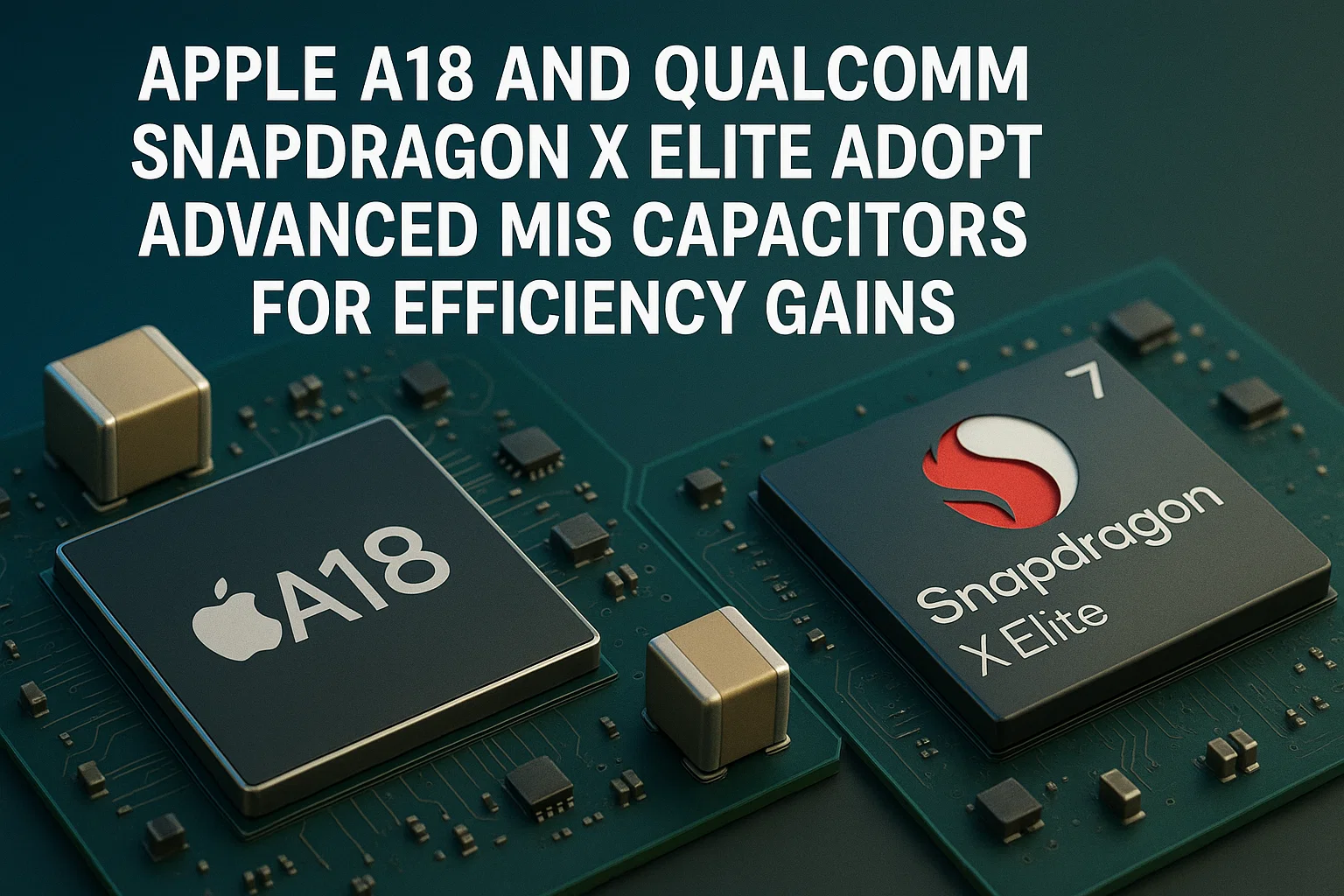
Apple A18 and Qualcomm Snapdragon X Elite Adopt Advanced MIS Capacitors for Efficiency Gains
The semiconductor industry is evolving faster than at any other point in its history. With the race toward 2nm process nodes and beyond, device miniaturization is no longer just about shrinking transistors it’s also about reimagining the passive components that support them. Among these, Metal-Insulator-Semiconductor (MIS) silicon chip capacitors are emerging as a quiet hero.
While capacitors may not capture headlines like GPUs or AI accelerators, their role in power delivery networks (PDNs), energy efficiency, and thermal stability is crucial. As chipmakers such as TSMC, Intel, and Samsung push the boundaries of semiconductor scaling, MIS capacitors are moving from background players to key enablers of innovation.
According to recent estimates, the Semiconductor MIS Silicon Chip Capacitors Market was valued at US$ 776 million in 2024 and is projected to reach US$ 1.1 billion by 2032, reflecting a CAGR of 5.3%. This growth is underpinned not just by demand for consumer electronics, but also by AI computing, 5G, defense technologies, and electric vehicles.
Access Your Free Sample Report- Semiconductor MIS Silicon Chip Capacitors Market
Understanding MIS Silicon Chip Capacitors
Before diving into industry news, it’s important to understand what makes MIS capacitors unique.
- Basic Structure: A thin insulating dielectric material is sandwiched between a semiconductor substrate and a metal electrode.
- Advantages Over Conventional Capacitors:
- High capacitance density in a compact footprint.
- Better thermal and electrical stability at nanoscale.
- Low leakage current thanks to high-k dielectric integration.
- Applications:
- On-chip power delivery for advanced processors.
- Memory devices, especially DRAM and emerging non-volatile memories.
- RF and high-frequency devices where parasitic effects need minimizing.
In short, MIS capacitors are increasingly vital to sustaining the Moore’s Law trajectory, even if transistor scaling slows.
Recent Global Developments (2024–2025)
2.1 TSMC, Intel, and Samsung: Advanced Node Integration
The leading foundries are all racing to integrate high-k dielectric MIS capacitors into their 2nm and sub-2nm technologies.
- TSMC has been refining hafnium oxide-based capacitors to boost PDN performance in next-gen chips. The goal: minimize voltage droop that plagues high-performance AI processors.
- Intel, under its “Five Nodes in Four Years” strategy, is embedding improved MIS capacitors into Intel 18A and 14A process nodes. These capacitors reduce leakage and enhance transistor reliability.
- Samsung is focusing on MIS capacitor solutions for mobile and AI workloads, ensuring long battery life without sacrificing computing power.
Industry Insight: The capacitor innovation race mirrors the transistor arms race. With AI workloads consuming unprecedented energy, even minor efficiency gains in PDNs translate into massive improvements at scale.
2.2 DARPA and U.S. Defense Applications
The U.S. Department of Defense (DoD) and DARPA have earmarked funding (late 2024) for next-generation silicon capacitors, particularly those using 2D materials like hexagonal boron nitride as insulators.
- The aim: capacitors that can withstand extreme temperatures and operate reliably in radiation-heavy environments (space, defense electronics).
- These developments could redefine capacitors not only as passive elements, but also as security-grade components critical for defense supply chains.
2.3 University Research: MIT, imec, and Ferroelectric MIS Capacitors
Academic labs are pushing boundaries further:
- MIT researchers reported breakthroughs in ferroelectric MIS capacitors that deliver 3–5x higher energy density compared to conventional silicon oxide structures.
- imec in Belgium is exploring hafnium-zirconium oxide (HZO) ferroelectrics, which show promise for both embedded memory and high-capacitance PDNs.
These advances could lead to capacitors that don’t just store charge, but actively enable adaptive, self-optimizing chips.
2.4 Apple and Qualcomm: Commercial Deployment
Recent reports from Nikkei Asia and AnandTech highlight that:
- Apple’s A18 Bionic chip (expected in 2025 iPhones) leverages improved MIS capacitor structures for longer battery life.
- Qualcomm’s Snapdragon X Elite processors, targeting AI PCs, rely heavily on on-chip capacitor optimization to manage thermal efficiency.
This marks the commercial mainstreaming of MIS capacitor innovation, proving it’s not just a research curiosity.
Download Sample Report PDF- Semiconductor MIS Silicon Chip Capacitors Market
2.5 Japan and EU Semiconductor Alliances
Both Japan and Europe have recognized capacitors as part of their strategic semiconductor autonomy push:
- Japan’s Rapidus consortium (backed by Sony, Toyota, and the Japanese government) is investing in MIS capacitor scaling as it races to catch up in advanced node manufacturing.
- The EU Chips Act projects emphasize local capacity in ferroelectric and high-k dielectric capacitor R&D, partnering with universities and research hubs.
Industry Insight: These moves aren’t just about technology they’re about supply chain resilience. Capacitors may be small, but they are foundational to chip reliability.
Market Outlook and Growth Drivers
3.1 Market Size and Forecast
- 2024 Market Value: US$ 776 million
- 2032 Projection: US$ 1.1 billion
- CAGR:3%
Growth is steady rather than explosive, reflecting the foundational nature of capacitors. Yet, this CAGR is impressive considering capacitors are traditionally seen as mature, commoditized components.
3.2 Key Growth Drivers
- AI and Data Centers: Explosive demand for stable PDNs in AI accelerators (NVIDIA, AMD, Intel).
- 5G & Beyond: RF circuits benefit from high-density, low-loss MIS capacitors.
- Defense & Aerospace: Radiation-hard capacitor designs are mission-critical.
- Electric Vehicles (EVs): MIS capacitors enable efficient power management in automotive chips.
- Wearables & IoT: Small form factor + high energy efficiency = perfect match for low-power devices.
Challenges in MIS Capacitor Development
- Material Limitations: Finding dielectrics with high capacitance but low leakage is a persistent challenge.
- Integration at 2nm and Below: As nodes shrink, parasitics and fabrication tolerances become critical.
- Cost Pressures: Advanced MIS capacitors increase fabrication complexity, raising costs.
- Global Supply Chains: Dependence on specific high-k materials (like hafnium) raises geopolitical concerns.
Regional Breakdown
- North America: Driven by DARPA funding, Intel R&D, and strong demand from AI data centers.
- Asia-Pacific: TSMC, Samsung, and Rapidus push regional dominance; China also investing in capacitor IP.
- Europe: imec at the forefront; EU policy support under the Chips Act.
- Japan: Focus on resilience and domestic innovation.
Future Outlook
Looking ahead, several trends are clear:
- Ferroelectric Capacitors: Likely to become mainstream by 2027–2028 in commercial chips.
- Integration with 2D Materials: Unlocking ultra-thin, radiation-hard capacitors.
- Capacitors as Security Components: With defense and AI systems, capacitors may be designed for tamper resistance.
- Sustainability: Manufacturers are exploring eco-friendly dielectric materials to reduce environmental impact.
Click Here To Download Full Sample Report- Semiconductor MIS Silicon Chip Capacitors Market
Small Components, Big Impact
The future of computing is being rewritten not only by transistors but also by capacitors. As the Semiconductor MIS Silicon Chip Capacitors Market grows from $776 million in 2024 to $1.1 billion by 2032, its importance is becoming impossible to ignore.
What was once a “background component” is now a frontline enabler of AI, 5G, defense, and next-gen consumer electronics. From DARPA’s defense programs to Apple’s smartphones, MIS capacitors are proving that in semiconductors, even the smallest parts can drive the biggest breakthroughs.

Comments (0)