
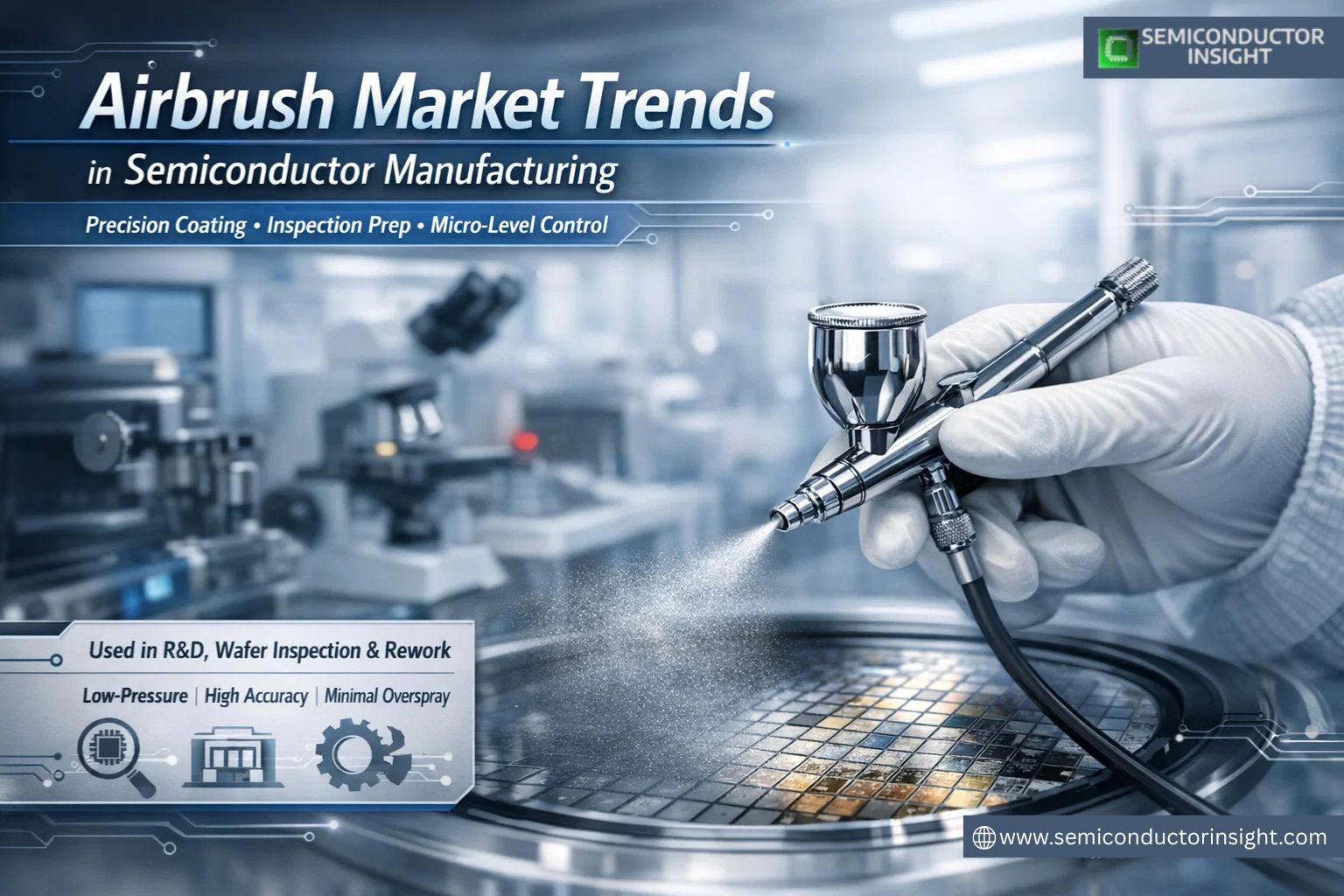
Airbrush Market Top Trends Powering Precision Finishing in Semiconductor Manufacturing
The modern airbrush market is no longer defined by creative industries alone. It is increasingly shaped by high-precision manufacturing environments, where surface control, contamination avoidance, and micron-level consistency are non-negotiable. This shift has repositioned airbrush technology as a niche yet indispensable component in advanced semiconductor workflows.
In semiconductor manufacturing, the smallest actions often make the biggest difference. While billion-dollar lithography systems dominate headlines, a quieter class of tools continues to play a vital supporting role on the factory floor. Airbrush systems long associated with artistic or automotive applications have evolved into precision instruments used in electronics fabrication, inspection preparation, and micro-coating tasks.
Where Airbrush Systems Fit in Semiconductor Operations?
In semiconductor facilities, airbrush systems are typically used for controlled coating, localized cleaning, marking, masking, and inspection preparation. In contrast to bulk spray systems, airbrushes minimize material waste and overspray by enabling operators to apply materials with exceptional precision.
These tools are particularly valuable in:
- Prototype and R&D labs
- Wafer inspection preparation
- Component repair and rework stations
- Precision masking during multi-step processing
What makes airbrush systems attractive is not speed, but control. In an industry where a microscopic defect can compromise yield, that control carries measurable value.
Market Demand Is Being Shaped by Process Miniaturization
As semiconductor components continue to shrink, traditional coating and spraying techniques are often too aggressive or imprecise. Airbrush systems offer a solution by enabling low-pressure, fine-particle application, reducing mechanical stress on delicate surfaces.
This trend aligns with the broader industry shift toward:
- Smaller node sizes
- More complex multilayer structures
- Increased inspection and rework frequency
Airbrush tools are becoming enablers of precision rather than auxiliary accessories.
Technology Evolution Is Quiet but Significant
Today’s airbrush systems bear little resemblance to earlier mechanical designs. Manufacturers are integrating features that align with semiconductor production standards, including:
- Improved nozzle geometry for consistent particle dispersion
- Anti-static materials to reduce charge build-up
- Compatibility with cleanroom-approved coatings and fluids
Rather than dramatic redesigns, innovation in this market is incremental and application-driven. Reliability, repeatability, and operator confidence matter more than flashy upgrades.
Why Manual Precision Still Matters in Automated Fabrications
While semiconductor fabrications are increasingly automated, certain tasks still benefit from human-guided tools. Airbrush systems allow skilled technicians to intervene where automated systems lack flexibility particularly during repair, defect correction, or small-batch experimentation.
This coexistence of automation and manual precision is one reason Airbrush Market remains resilient. Instead of being displaced, airbrush tools are being refined to complement advanced machinery.
Market Structure: Mass Volume vs. Specialized Demand
Airbrush market for semiconductor applications stands apart from consumer or industrial spray sectors, featuring lower volumes but elevated performance demands.
Buyers emphasize consistent spray quality during extended operations, robust chemical compatibility with specialized fluids, and straightforward disassembly for cleaning. This drives suppliers to cultivate enduring partnerships with fabrications, R&D centres, and equipment integrators, where high switching costs lock in qualified vendors once established.
This relationship-driven structure supports stable demand even during cyclical downturns.
You Can Go Through Our Latest Updated Insights Here: https://semiconductorinsight.com/report/airbrush-market/
Regional Patterns Reflect Manufacturing Density
Demand for semiconductor-grade airbrush systems closely mirrors regional manufacturing footprints. Areas with strong semiconductor ecosystems naturally account for higher consumption, particularly where:
- R&D activity is concentrated
- Advanced packaging and testing facilities operate
- Customization and rapid iteration are common
In emerging manufacturing regions, airbrush systems are often introduced early in fab development, supporting pilot lines before full automation scales up.
Competitive Differentiation Happens Below the Surface
Competition in Airbrush Market is less about branding and more about engineering detail. Small improvements in nozzle wear resistance, fluid flow stability, or ergonomics can influence purchasing decisions.
Leading suppliers focus on:
- Application-specific customization
- Training and technical support
- Product longevity in controlled environments
Rather than racing to the bottom on price, the market rewards companies that understand the realities of semiconductor workflows.
Subtle Sustainability Influence
While sustainability is not the primary driver in this market, it plays a growing supporting role. Reduced material waste, longer product life, and compatibility with low-VOC or water-based formulations align airbrush systems with broader fab efficiency goals.
In semiconductor manufacturing, sustainability often shows up as process efficiency, and airbrush tools contribute quietly to that objective.
A Market Defined by Precision, Not Scale
Airbrush Market may never rival major semiconductor equipment segments in size, but its importance is disproportionate to its footprint. It supports critical stages of fabrication, inspection, and rework areas where precision directly impacts yield and cost.
As device complexity increases and tolerances tighten, the need for fine-control tools that bridge automation and human expertise will only grow. In that context, airbrush systems are not legacy tools they are adaptive instruments evolving alongside semiconductor manufacturing itself.
Final Perspective
Airbrush Market in semiconductor applications is a reminder that innovation doesn’t always arrive in large, disruptive packages. Sometimes, it comes through refined tools that enable people to work more accurately within complex systems.
In an industry defined by precision, the ability to control the smallest details often determines the biggest outcomes and that is exactly where airbrush systems continue to prove their value.

Comments (0)