

Air Core vs. Iron Core Solutions in Load Reactor Market Which Fits Modern Semiconductor Facilities
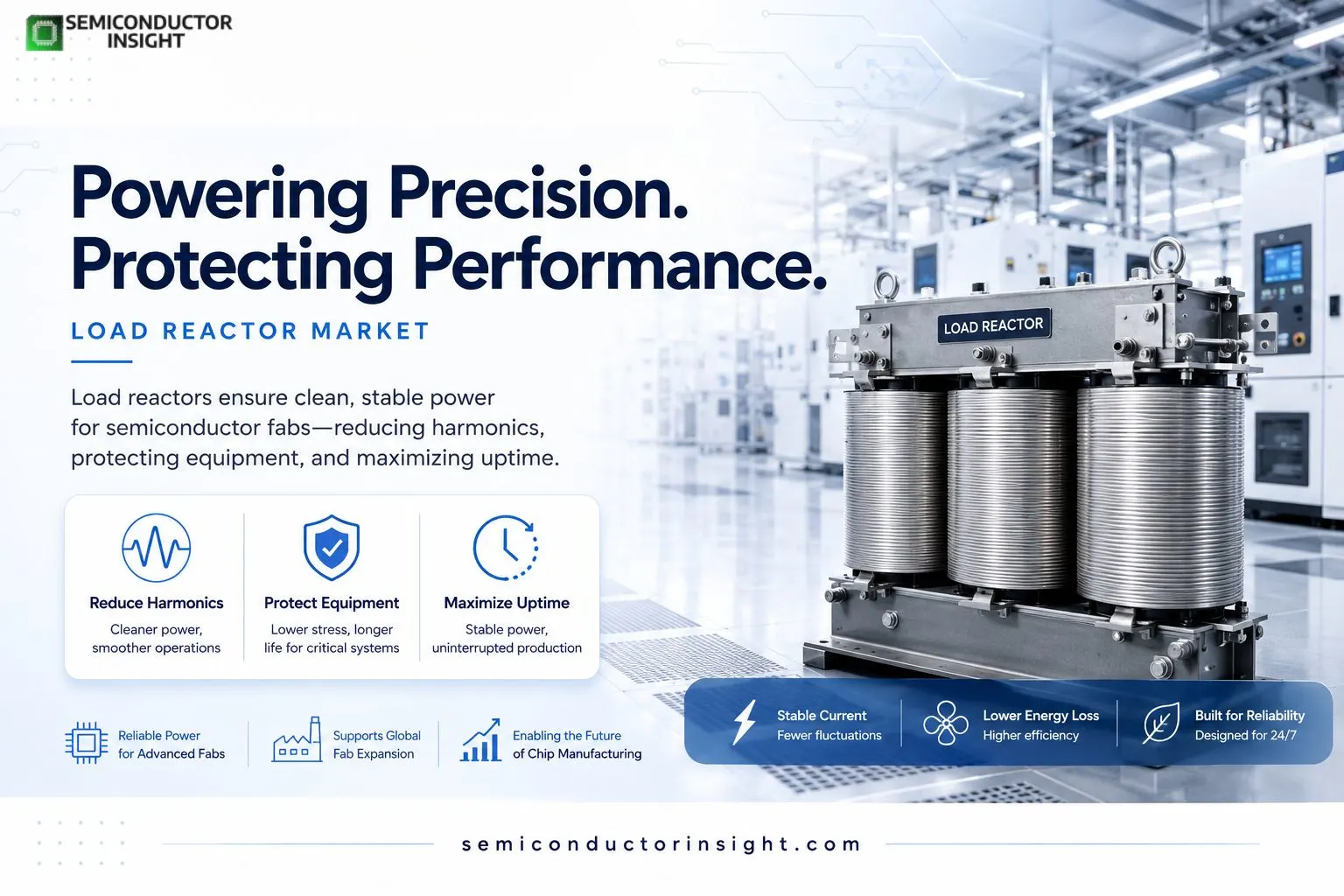
The semiconductor manufacturing industry is frequently associated with extreme ultraviolet lithography, AI chips and advanced packaging technologies. But behind every precision tool on a fabrication floor is an electrical infrastructure designed to deliver uninterrupted, distortion-free power. This is where Load Reactor Market has acquired more importance. Load reactors, used with variable frequency drives (VFDs) and industrial power systems, and are used to control current, reduce harmonics and protect sensitive semiconductor equipment from electrical disturbances.
Governments and chipmakers are pouring billions of dollars into boosting semiconductor manufacturing capacity, and electrical reliability is as important as process innovation. New fabs being built under the U.S. CHIPS and Science Act, and manufacturing ramping up in Taiwan, South Korea, Japan, India and Europe, is creating a growing demand for reliable power conditioning solutions at every new production line.
Why Every New Semiconductor Fab Begins with Reliable Power?
Modern semiconductor fabrication plants operate around the clock, where even a brief voltage fluctuation can interrupt production and affect wafer quality. Advanced process tools including deposition systems, ion implantation equipment, etching machines, and chemical mechanical polishing (CMP) systems depend on stable electrical input to maintain nanometer-level precision.
Load reactors minimize current spikes, suppress harmonic distortion, and extend the operational life of motors and drive systems. Their contribution is especially valuable in HVAC systems, ultrapure water facilities, cleanroom ventilation units, and vacuum pumping systems that support semiconductor production. While these components rarely receive public attention, they help maintain the controlled manufacturing environment essential for producing high-performance chips.
Strong Industry Signals Reinforcing the Value of Power Reliability
The scale of power consumption in semiconductor manufacturing continues to grow with every technology generation.
- An advanced EUV lithography system can require more than 1 megawatt of electrical power during operation, making stable power delivery essential for uninterrupted performance.
- Large semiconductor fabrication plants commonly process 50,000 to over 100,000 silicon wafers every month, depending on production capacity and technology node.
- Semiconductor cleanrooms operate 24 hours a day, 365 days a year, requiring continuous power support for thousands of interconnected systems.
- According to the International Energy Agency, global electricity demand from digital infrastructure including semiconductor production and data centers is rising steadily as AI adoption accelerates.
- Modern fabrication facilities contain thousands of motors, pumps, fans, and automated handling systems, many of which rely on variable frequency drives protected by load reactors.
These figures highlight why electrical power quality has become a core engineering priority rather than a maintenance consideration.
AI Manufacturing Is Raising the Performance Expectations for Power Systems
The global surge in artificial intelligence has triggered an unprecedented wave of semiconductor investment. Companies are expanding production of high-performance processors, advanced memory, and specialized AI accelerators, all of which require increasingly sophisticated manufacturing environments.
In 2025 and 2026, manufacturers such as TSMC, Samsung Electronics, Intel, and Micron continued expanding fabrication capacity to meet rising AI-driven demand. New facilities are being designed with greater automation, higher equipment density, and larger electrical loads than previous generations.
As factories integrate thousands of intelligent sensors, automated material handling systems, and digitally connected production tools, maintaining stable current across the entire electrical network becomes increasingly complex. Load reactors help smooth electrical fluctuations generated by variable frequency drives, reducing stress on critical equipment and improving operational consistency across production lines.
Quiet Engineering That Protects Multi-Million-Dollar Equipment
- A semiconductor fab contains equipment worth hundreds of millions of dollars, making preventive electrical protection an essential investment.
- Load reactors contribute by reducing reflected wave voltage, limiting inrush current, lowering electromagnetic interference, and improving overall power quality. These improvements help reduce wear on motors, cooling systems, compressors, and industrial drives that operate continuously throughout production.
- Engineers increasingly view load reactors as part of a broader strategy to improve equipment uptime rather than simply as electrical accessories. Longer maintenance intervals, fewer unexpected shutdowns, and improved system efficiency translate directly into higher manufacturing productivity.
Factory Expansion Is Creating New Opportunities beyond Traditional Applications
Recent semiconductor investments extend far beyond chip processing equipment. New fabrication plants require extensive supporting infrastructure, including cleanroom climate control, water recycling systems, chemical delivery networks, and advanced utility management.
India’s Semiconductor Mission, the European Chips Act, and continuing investments under the U.S. CHIPS and Science Act are accelerating the construction of manufacturing ecosystems that depend on resilient electrical networks. Every new facility adds demand for dependable power conditioning solutions capable of supporting increasingly automated operations.
At the same time, many manufacturers are integrating renewable energy sources and energy management platforms into their industrial campuses. These evolving electrical architectures place even greater emphasis on harmonic mitigation and stable current flow, further strengthening the role of load reactors within modern semiconductor infrastructure.
For a more thorough report, please contact us using our most recent related report: https://semiconductorinsight.com/report/global-line-and-load-reactors-market/
The Next Chapter Belongs to Intelligent Power Management
- The evolution of Load Reactor Market is no longer centered solely on passive electrical components.
- Manufacturers are developing compact designs, thermally optimized materials, and digitally monitored reactor systems that integrate with smart factory platforms.
- As predictive maintenance, Industrial Internet of Things (IIoT), and AI-enabled facility management become standard across semiconductor fabs, electrical components are also becoming more intelligent.
While processors and memory chips remain the visible products of semiconductor innovation, reliable power management continues to determine how efficiently those chips are manufactured. In an industry where precision is measured in nanometers and uptime defines profitability, load reactors are becoming an indispensable part of the technology ecosystem supporting the next generation of semiconductor manufacturing.

Comments (0)