AI Compressed Dry Air Pressure Dew Point Predictor and Control Chip Market Insights
Global AI compressed dry air pressure dew point predictor and control chip market is projected to grow from USD 0.45 billion in 2025 to USD 0.78 billion by 2034, exhibiting a CAGR of 6.3% during the forecast period.
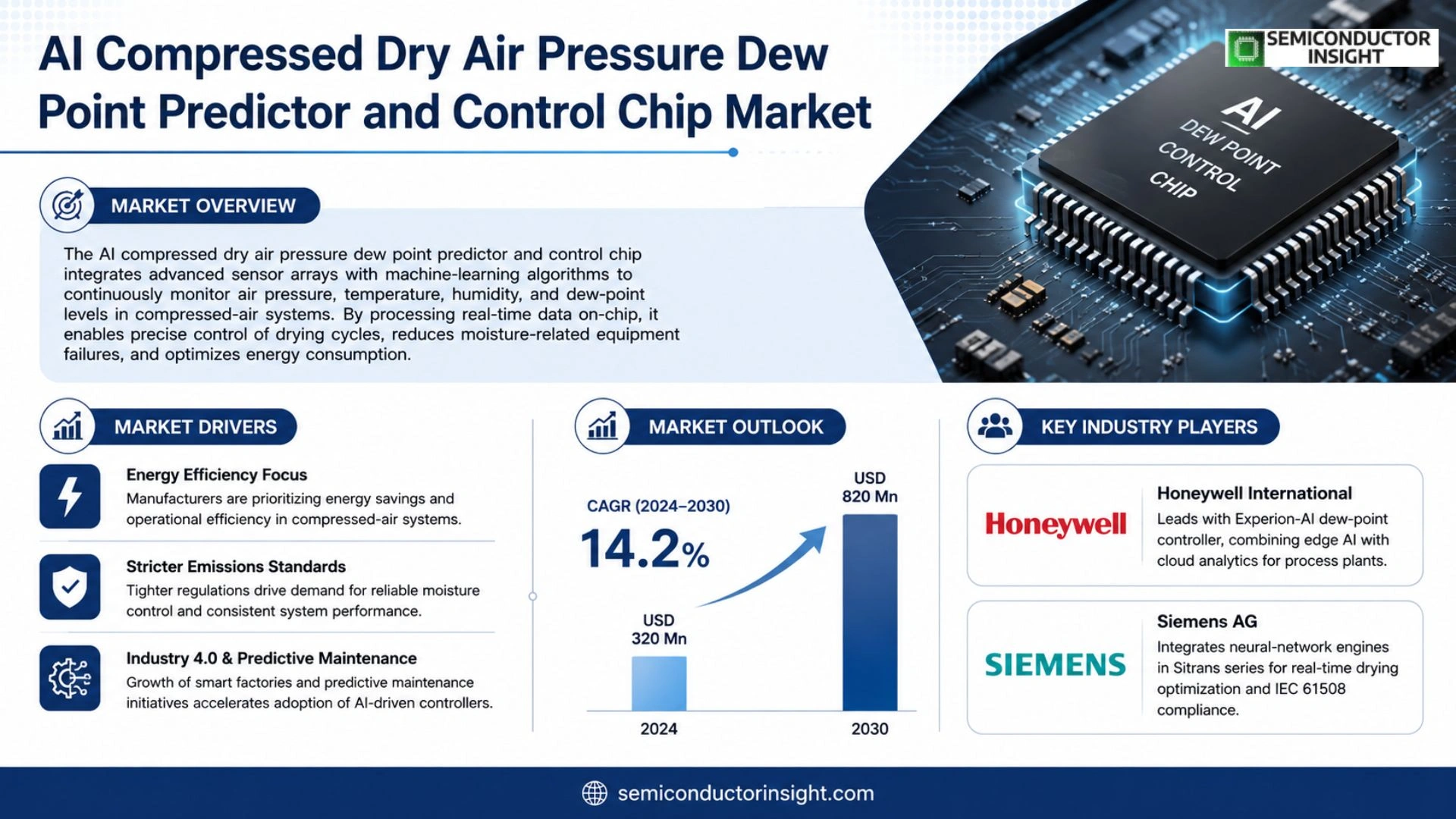
The AI compressed dry air pressure dew point predictor and control chip integrates advanced sensor arrays with machine‑learning algorithms to continuously monitor air pressure, temperature, humidity, and dew‑point levels in compressed‑air systems. By processing real‑time data on‑chip, it enables precise control of drying cycles, reduces moisture‑related equipment failures, and optimizes energy consumption.
The market is experiencing rapid growth because manufacturers are seeking higher energy efficiency and lower operational costs in industrial plants. While the push for stricter emissions standards drives demand for reliable moisture control, advancements in edge AI hardware make these chips more affordable and scalable. Furthermore, the rise of Industry 4.0 initiatives encourages adoption of predictive maintenance solutions that leverage such intelligent controllers.
MARKET DRIVERS
Rising Demand for Energy‑Efficient Air‑Handling Solutions
AI Compressed Dry Air Pressure Dew Point Predictor and Control Chip Market is gaining traction as manufacturers seek to lower operational costs. Advanced AI algorithms enable precise dew‑point prediction, reducing unnecessary compression cycles and cutting electricity consumption by up to 15% in industrial drying plants. This efficiency boost aligns with global sustainability goals and drives wider adoption.
Integration with IoT and Predictive Maintenance Platforms
Modern control chips are designed for seamless connectivity with IoT gateways, allowing real‑time data analytics and remote diagnostics. Plants can now forecast component wear and schedule maintenance proactively, minimizing downtime. The convergence of AI and IoT creates a compelling value proposition for end‑users.
➤ “AI‑driven dew‑point control reduces energy use while improving product quality, making it a cornerstone of next‑generation dry‑air systems.”
Regulatory pressure to meet stricter emissions standards further accelerates investment in these intelligent chips, positioning the market for robust growth over the next five years.
MARKET CHALLENGES
High Initial Capital Expenditure
Deploying AI‑enabled control chips requires upfront investment in hardware, software integration, and staff training. Small‑to‑medium enterprises often struggle to justify the cost despite long‑term savings, slowing market penetration in certain regions.
Other Challenges
Data Quality and Sensor Calibration
Accurate dew‑point prediction hinges on high‑quality sensor inputs. Inconsistent calibration can lead to erroneous forecasts, undermining confidence in AI models and necessitating frequent manual interventions.
Furthermore, legacy equipment compatibility issues create integration bottlenecks, requiring extensive retrofitting that can deter adoption.
MARKET RESTRAINTS
Complexity of AI Model Validation
Regulators are increasingly scrutinizing AI‑based control systems for safety and reliability. The need for rigorous validation protocols adds development time and cost, acting as a restraint on rapid market expansion.
In addition, the shortage of skilled AI engineers familiar with pneumatic and thermodynamic principles limits the speed at which manufacturers can bring new solutions to market.
MARKET OPPORTUNITIES
Expansion into Emerging Industrial Sectors
Emerging industries such as renewable energy storage, semiconductor manufacturing, and advanced food processing are increasingly demanding precise moisture control. These sectors present untapped opportunities for AI Compressed Dry Air Pressure Dew Point Predictor and Control Chip Market, where tighter dew‑point regulation can directly influence product yield and quality.
Strategic partnerships with equipment OEMs and cloud service providers can accelerate rollout, enabling subscription‑based models that lower entry barriers for smaller operators.
AI Compressed Dry Air Pressure Dew Point Predictor and Control Chip Market Trends
Energy Efficiency and Predictive Maintenance
The adoption of AI‑enabled compressed dry air pressure dew point predictor and control chips is accelerating as manufacturers prioritize energy savings and equipment reliability. By embedding sensor arrays and machine‑learning models directly on the chip, users can monitor pressure, temperature, humidity and dew‑point in real time, allowing drying cycles to be tuned automatically. This precision reduces unnecessary compression heating, trims electricity consumption, and lowers the incidence of moisture‑induced wear. Companies that have introduced these intelligent controllers report measurable declines in downtime and a notable shift toward condition‑based maintenance strategies, aligning with broader sustainability goals.
Other Trends
Edge AI Integration
Recent advances in edge AI hardware have made on‑chip inference affordable for a wider range of industrial applications. The chips now support lightweight neural networks that can predict moisture trends several minutes ahead, offering a proactive adjustment of drying parameters. This capability is especially valuable in facilities where compressed‑air systems operate continuously and temperature fluctuations are common. The reduced need for constant cloud connectivity also enhances data security and latency, making edge deployment a preferred choice for plants with strict regulatory requirements.
Industry 4.0 and System Connectivity
Industry 4.0 initiatives are driving the integration of the predictor and control chip into broader plant‑wide IoT ecosystems. The chip’s standardized communication interfaces enable seamless data exchange with supervisory control and data acquisition (SCADA) platforms, allowing operators to visualize moisture metrics alongside other process variables. This holistic view supports cross‑functional optimization, such as synchronizing air drying schedules with production shifts to avoid peak‑load energy charges. Moreover, the aggregated data sets serve as a foundation for advanced analytics, further refining maintenance calendars and improving overall process efficiency.
COMPETITIVE LANDSCAPE
Key Industry Players
AI‑Driven Dew‑Point Prediction in Compressed‑Air Systems
AI Compressed Dry Air Pressure Dew Point Predictor and Control Chip Market is currently dominated by a handful of multinational industrial automation and sensor specialists that combine edge‑AI processing with robust pressure‑sensor families. Honeywell International leads the segment with its Experion‑AI dew‑point controller, leveraging its extensive installed base in process plants to offer integrated hardware and cloud analytics. Siemens AG follows closely, embedding neural‑network inference engines in its Sitrans series, which enables customers to fine‑tune drying cycles in real time while meeting stringent IEC 61508 safety standards. ABB’s Ability™ platform incorporates similar predictive algorithms, positioning ABB as a preferred supplier for large‑scale petrochemical and automotive facilities. These tier‑one players benefit from deep R&D pipelines, global sales networks, and the ability to certify their chips for hazardous environments, shaping a market structure that is top‑down and heavily reliant on long‑term service contracts. The concentration of these manufacturers creates high barriers to entry, as certification and reliability testing add significant cost.
Beyond the dominant tier, several niche innovators are expanding the competitive set by focusing on specialized sensor fusion or low‑cost ASIC solutions. Parker Hannifin’s newly launched DryAir™ line targets mid‑size manufacturers with modular AI modules that can be retrofitted onto existing compressors. Mitsubishi Electric offers a compact AI‑edge chip optimized for high‑altitude operations, while Danfoss provides a proprietary humidity‑prediction algorithm that integrates with its variable‑frequency drives. Emerging semiconductor firms such as NXP Semiconductors and Analog Devices are entering the space with ultra‑low‑power AI cores designed for on‑chip dew‑point calculations, enabling new OEM partnerships. These companies, though smaller in revenue, enhance market dynamism by addressing price‑sensitive segments and driving technology differentiation. Collectively, these challengers contribute to a projected CAGR of over 6 % through incremental adoption across North America, Europe, and Asia‑Pacific.
List of Key AI Compressed Dry Air Pressure Dew Point Predictor and Control Chip Companies Profiled
- Honeywell International
- Siemens AG
- ABB Ltd.
- Parker Hannifin
- Mitsubishi Electric
- Danfoss
- NXP Semiconductors
- Analog Devices
- Texas Instruments
- Bosch Sensortec
- Yokogawa Electric
- Keysight Technologies
- Schneider Electric
- Rockwell Automation
- Emerson Electric
Segment Analysis:
| Segment Category | Sub-Segments | Key Insights |
| By Type |
|
Integrated AI Chip drives market momentum through several qualitative advantages:
|
| By Application |
|
Chemical Processing emerges as the leading application segment, delivering distinct qualitative benefits:
|
| By End User |
|
Industrial Manufacturing dominates the end‑user landscape, driven by qualitative imperatives:
|
| By Deployment Mode |
|
Edge‑Device Standalone is recognized as the leading deployment mode because:
|
| By Functional Capability |
|
Predictive Dew‑Point Control stands out as the primary functional capability, delivering qualitative value:
|
Regional Analysis: AI Compressed Dry Air Pressure Dew Point Predictor and Control Chip Market
The region’s manufacturers are quickly adopting AI‑based predictive analytics embedded within pressure and dew‑point chips. Integration with IIoT platforms enables seamless data aggregation, allowing operators to fine‑tune compressed‑air systems in real time and anticipate maintenance needs before a fault occurs.
Energy‑efficiency mandates from agencies such as the EPA incentivize the deployment of smart control chips. Compliance frameworks reward reduced compressed‑air losses, prompting facilities to invest in AI‑enhanced monitoring to demonstrate measurable savings.
Leading semiconductor firms and specialized sensor manufacturers are forming strategic alliances to co‑develop next‑generation chips. These collaborations accelerate product cycles and expand the ecosystem of compatible software tools for end‑users.
Tightening sustainability targets, rising operational costs, and the need for high‑reliability air supply in critical sectors collectively drive robust demand for AI‑powered pressure and dew‑point prediction solutions across the continent.
Europe
European manufacturers are leveraging AI Compressed Dry Air Pressure Dew Point Predictor and Control Chip Market to meet EU energy‑efficiency directives. Advanced automation in automotive and pharmaceutical plants relies on precise air quality control, prompting widespread adoption of predictive chips. Collaborative research programs funded by the European Commission foster innovation, while standards bodies harmonize data protocols, facilitating cross‑border implementation. Market participants emphasize modular designs that can be retrofitted into legacy systems, allowing gradual transition without major capital outlay.
Asia‑Pacific
In Asia‑Pacific, rapid industrial expansion fuels interest in smart compressed‑air solutions. Countries such as China, Japan, and South Korea invest heavily in AI‑driven factory automation, where accurate pressure and dew‑point monitoring safeguards high‑value production lines. The region’s cost‑conscious manufacturers seek chips that deliver predictive insights while maintaining affordability. Growing awareness of environmental impact further accelerates adoption, as firms aim to reduce compressed‑air waste and align with emerging sustainability benchmarks.
South America
South American economies are beginning to recognize the value of AI‑enabled air‑handling control. Industries like food processing and mining benefit from predictive maintenance, reducing unexpected downtime in remote locations. While overall market penetration remains nascent, local partnerships with North American technology providers are driving knowledge transfer and establishing a foundation for broader deployment in the coming years.
Middle East & Africa
The Middle East & Africa region shows emerging interest, particularly in petrochemical complexes and large‑scale infrastructure projects. Harsh climatic conditions heighten the need for reliable dew‑point management, making AI‑based control chips attractive for maintaining operational stability. Early adopters focus on pilot implementations to validate cost savings and reliability improvements before scaling across wider industrial networks.
Report Scope
This market research report provides a comprehensive analysis of the AI Compressed Dry Air Pressure Dew Point Predictor and Control Chip Market , covering the forecast period 2026–2034. It offers detailed insights into market dynamics, technological advancements, competitive landscape, and key trends shaping the industry.
Key focus areas of the report include:
- Market Overview: The report begins with an overview outlining its current market scenario, key growth indicators, and industry transformation drivers. It discusses macroeconomic factors, demand–supply balance, regulatory landscape, and the strategic role of semiconductors in powering advancements across industries such as automotive, telecommunications, consumer electronics, and industrial automation.
- Market Size & Forecast: Historical data and future projections for revenue, unit shipments, and market value across major regions and segments.
- Segmentation Analysis: Detailed breakdown by product type, technology, application, and end-user industry to identify high-growth segments and investment opportunities.
- Regional Insights: Insights into market performance across North America, Europe, Asia-Pacific, Latin America, and the Middle East & Africa, including country-level analysis where relevant.
- Competitive Landscape: Profiles of leading market participants, including their product offerings, R&D focus, manufacturing capacity, pricing strategies, and recent developments such as mergers, acquisitions, and partnerships.
- Technology Trends & Innovation: Assessment of emerging technologies, integration of AI/IoT, semiconductor design trends, fabrication techniques, and evolving industry standards.
- Market Drivers & Restraints: Evaluation of factors driving market growth along with challenges, supply chain constraints, regulatory issues, and market-entry barriers.
- Stakeholder Insights: Insights for component suppliers, OEMs, system integrators, investors, and policymakers regarding the evolving ecosystem and strategic opportunities.
Primary and secondary research methods are employed, including interviews with industry experts, data from verified sources, and real-time market intelligence to ensure the accuracy and reliability of the insights presented.
FREQUENTLY ASKED QUESTIONS:
What is the current market size of AI Compressed Dry Air Pressure Dew Point Predictor and Control Chip Market?
-> AI Compressed Dry Air Pressure Dew Point Predictor and Control Chip Market was valued at USD 0.45 billion in 2025 and is expected to reach USD 0.78 billion by 2034, exhibiting a CAGR of 6.3%.
Which key companies operate in AI Compressed Dry Air Pressure Dew Point Predictor and Control Chip Market?
-> Key players include Axalta Coating Systems, AkzoNobel, BASF SE, PPG, Sherwin-Williams, and 3M, among others.
What are the key growth drivers?
-> Key growth drivers include railway infrastructure investments, urbanization, and demand for durable coatings.
Which region dominates the market?
-> Asia-Pacific is the fastest-growing region, while Europe remains a dominant market.
What are the emerging trends?
-> Emerging trends include bio-based coatings, smart coatings, and sustainable rail solutions.

Get Sample Report PDF for Exclusive Insights
Report Sample Includes
- Table of Contents
- List of Tables & Figures
- Charts, Research Methodology, and more...