
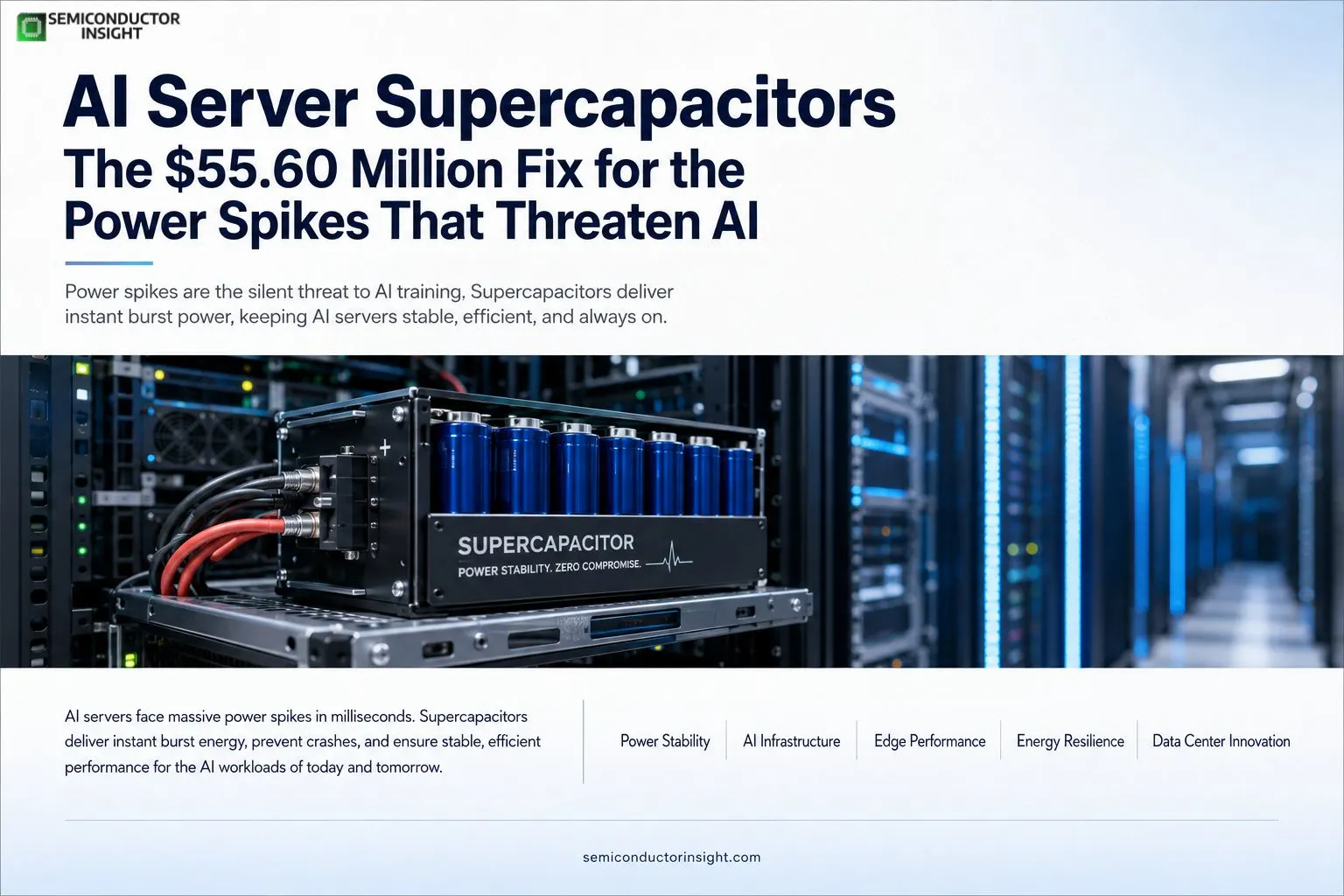
AI Server Supercapacitors Market 2026: The $55.60 Million Fix for the Power Spikes That Threaten AI
The training of a single large language model can draw as much electricity as a small steel mill. But it is not the steady consumption that worries data centre engineers; it is the spikes. When a rack full of GPUs suddenly ramps up to process a batch of matrix multiplications, the current demand can surge by hundreds of amps in a fraction of a millisecond. Power supplies sag, voltage rails wobble, and in the worst case, a multi‑million‑dollar training run crashes. In 2026, an unglamorous component is stepping into this breach: the supercapacitor. The AI server supercapacitors market, valued at roughly USD 46.30 million in 2025, is projected to leap from USD 55.60 million in 2026 to USD 159 million by 2034, a compound annual growth rate of 19.5 percent. That is a growth curve shaped by the runaway power density of artificial intelligence and the physical limits of the hardware that feeds it.
Why AI servers need a burst of energy that batteries cannot deliver
Modern AI training clusters are built around GPUs and custom accelerators that can each consume over a kilowatt of power. When hundreds of these chips are packed into a single rack, the combined load can exceed 100 kilowatts, and the transient spikes as workloads start and stop happen faster than the grid or even the on‑site battery banks can respond. Power supply units (PSUs) can handle the average load, but they need help with the peaks. A voltage dip that lasts only a handful of milliseconds is enough to corrupt data in high‑bandwidth memory or trigger a server reboot.
Supercapacitors, also called ultracapacitors or electric double‑layer capacitors, fill this gap. Unlike batteries, which store energy chemically and release it slowly, supercapacitors store energy in an electric field and can discharge it almost instantaneously. They can absorb a spike in demand and release it in microseconds, smoothing the power delivery to sensitive silicon. They also recharge quickly, making them ready for the next burst. In an AI server rack, a bank of supercapacitors wired to the power distribution bus acts like a shock absorber, levelling out the surges that batteries are too slow to catch.
The 19.5 percent CAGR reflects the speed at which this role is becoming a standard design requirement rather than an optional add‑on. In 2025, supercapacitors were an engineering curiosity in most data centres. By 2026, they are being designed into the power architecture of new AI server platforms, particularly those built around NVIDIA’s latest Blackwell architecture and similar high‑power accelerators.
The three jobs a supercapacitor does inside an AI server rack
To understand the value proposition, it helps to look at the specific tasks supercapacitors are being asked to perform. The first, and most common, is holdup power for memory and storage. When a power failure occurs – even a brief brownout – the server’s main power may drop out before backup generators or battery UPS systems can take over. In that gap, the server’s volatile memory and in‑flight data on SSDs are at risk. A supercapacitor bank can ride through for a few seconds, providing enough power to flush write caches to non‑volatile storage and shut down gracefully.
The second job is peak shaving. AI workloads are bursty by nature; a model may idle at low utilisation and then suddenly fire all tensor cores at full throttle. The resulting current spike can exceed the capacity of the rack’s power supply infrastructure, forcing operators to over‑provision power delivery or throttle performance. Supercapacitors buffer these bursts, allowing the power infrastructure to be sized for the average load rather than the peak, saving on copper, breakers, and cooling.
The third job, still emerging in 2026, is energy recycling. In some server designs, supercapacitors can capture regenerative energy from fans spooling down or from the back‑EMF of motors in liquid cooling pumps, storing it for later use. The efficiency gain is small in percentage terms but meaningful in a facility that measures power in megawatts.
A 2026 signal from the supply side
In early 2026, a major power supply manufacturer – one of the companies that builds the hot‑swap PSUs found in virtually every enterprise server – announced a new family of rack‑level power shelves with integrated supercapacitor modules. The product, aimed squarely at AI clusters, offers a “power ride‑through” feature that can sustain 60 kilowatts of load for three seconds, enough to cover the gap before diesel generators start. The company, which made the announcement at a data centre trade show in San Jose, claimed that adding supercapacitors added less than five percent to the cost of the power shelf while reducing the required UPS battery capacity by nearly thirty percent. That kind of trade‑off – a small upfront cost for a significant reduction in battery infrastructure – is precisely the logic that drives the 19.5 percent growth rate.
On the component side, supercapacitor manufacturers are responding with products tailored for the server environment. Traditionally, supercapacitors were limited by their voltage rating – typically 2.7 volts per cell – requiring many cells in series for server‑grade 48‑volt racks. In 2026, improved packaging and integrated balancing circuits are allowing manufacturers to deliver fully assembled modules that drop into a standard 19‑inch rack. These modules are being qualified by hyperscale cloud operators, and at least one major cloud provider has reportedly specified supercapacitor ride‑through as a requirement for all new AI server bids.
Where the market fits in the broader energy storage landscape
It is important to be clear about what supercapacitors do not do. They are not a replacement for batteries when it comes to bulk energy storage. A lithium‑ion rack can back up a server for minutes or hours; a supercapacitor bank can only back it up for seconds. But in the AI data centre, seconds are what matter. The power disturbances that crash servers – voltage sags, load steps, switchgear transients – last for milliseconds to a few seconds. A technology that can respond within that window without degradation over time offers a different value proposition than a battery that must be oversized to handle peak current.
This is why the market, while still small at USD 55.60 million in 2026, is projected to more than double to USD 159 million by 2034. It is riding the coattails of AI server growth, which is itself one of the strongest trends in technology. Every new megawatt‑scale AI training cluster represents a potential customer for supercapacitor‑enhanced power delivery. As training runs grow longer and more expensive – a single run can now cost tens of millions of dollars in compute time – the cost of a power‑induced failure becomes prohibitive. The supercapacitor, a few hundred dollars per server, becomes cheap insurance.
Challenges that the headline growth rate does not erase
Despite the positive trajectory, the AI server supercapacitors market faces headwinds. The first is form factor. Rack space is precious, and supercapacitor modules, while shrinking, still occupy slots that could otherwise hold compute or storage. The second is temperature tolerance. Supercapacitors, particularly those using organic electrolytes, can degrade more quickly at the elevated ambient temperatures common in dense server racks. Manufacturers are addressing this with improved materials and active cooling, but the long‑term reliability data that operators demand is still being gathered. The third is competition from advances in battery technology. Lithium‑ion batteries are also becoming more power‑dense, and thin‑film solid‑state batteries may eventually encroach on the supercapacitor’s pulse‑power territory.
For now, however, the supercapacitor occupies a niche that is perfectly aligned with the immediate needs of AI infrastructure. It is fast, it is reliable over millions of cycles, and it addresses a problem – power transients – that grows in severity with every increase in GPU wattage. The 19.5 percent CAGR suggests the market recognises this. As AI continues its exponential climb, the components that keep its electrons in line will climb with it, and the humble supercapacitor, after decades of being overshadowed by batteries, is finally finding its moment in the server rack.
Grab our report to stay informed: https://semiconductorinsight.com/report/ai-server-supercapacitors-market/

Comments (0)