

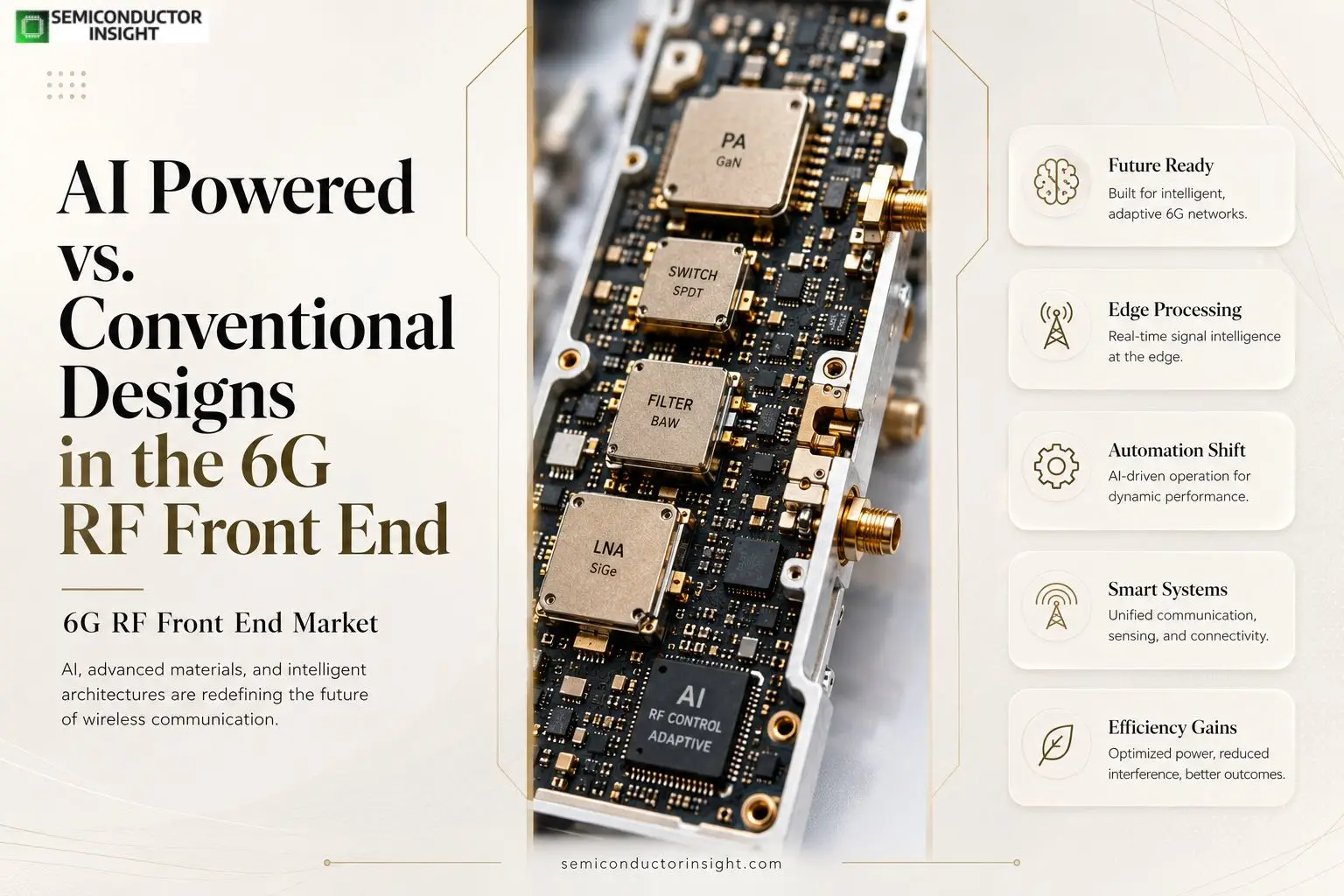
AI Powered vs. Conventional Designs in the 6G RF Front End Market 2026 Complete Comparison
The transition toward sixth generation wireless communication is reshaping semiconductor innovation. While 5G focused on enhanced mobile broadband, 6G aims to combine artificial intelligence, sensing, satellite connectivity, and ultra high speed communications. At the center of this evolution sits the RF front end, a collection of amplifiers, filters, switches, duplexers, and antenna tuning components that manage wireless signals.
A major debate across the semiconductor industry is whether future networks will depend primarily on advanced Sub 7 GHz bands or move aggressively into terahertz frequencies.
Comparing the two technology paths
Sub-7 GHz frequencies provide dependable coverage and work well with existing infrastructure, making them suitable for long-range connectivity and lower signal loss. In contrast, terahertz bands can deliver extremely high data speeds, but they require advanced semiconductor materials, highly sophisticated antenna designs, and greater device complexity.
While Sub-7 GHz is mainly used for mobile and IoT applications, terahertz is better suited for holographic communication and sensing. Industry research groups now view both technologies as complementary, with each serving a distinct role in future wireless systems.
The materials battle shaping chip manufacturing
Traditional silicon technologies remain important, but 6G RF front ends increasingly rely on advanced semiconductor materials.
- Gallium Nitride offers high power efficiency for base stations.
- Silicon Germanium supports high frequency operation with established manufacturing processes.
- Gallium Arsenide remains valuable for mobile power amplifiers.
Research laboratories are also exploring indium phosphide and graphene based devices for terahertz communications.
Recent publications from semiconductor research organizations suggest these materials could support frequencies exceeding 300 GHz under controlled conditions.
Government programs adding momentum
- 6G development has moved beyond academic research.
- The United States launched the Next G Alliance to strengthen wireless leadership.
- The European Union supports the Smart Networks and Services Joint Undertaking for 6G research.
- Japan, South Korea, China, and India have announced national 6G roadmaps.
- India’s national vision targets commercial 6G deployment by the end of the decade while encouraging domestic semiconductor manufacturing.
- Government backed projects are funding prototype RF chips, antenna modules, and advanced packaging
AI changes how RF front ends operate
6G hardware will directly integrate artificial intelligence into signal management, in contrast to earlier generations.
AI enabled RF front ends can
- Select optimal frequency bands
- Reduce interference
- Adjust antenna patterns
- Improve energy efficiency
- Predict network congestion
This shift transforms RF hardware from passive signal processors into adaptive communication systems.
Technology demonstrations have shown that machine learning algorithms can improve wireless spectrum utilization under changing network conditions.
Numbers that highlight the scale of investment
The semiconductor industry is preparing for unprecedented connectivity demands.
According to international telecommunications statistics, global mobile subscriptions exceed 8 billion.
The latest wireless standards work includes thousands of technical contributions from universities, technology companies, and research institutes.
Several governments have committed billions of dollars toward semiconductor manufacturing and advanced communication infrastructure.
Modern smartphone RF front ends already integrate more than 100 individual components, and future 6G platforms could require even higher integration levels as sensing and communication functions merge.
Satellites and terrestrial networks become one ecosystem
One of the biggest differences between 5G and 6G is native satellite integration.
Future RF front ends must communicate with
- Cellular towers
- Low Earth orbit satellites
- Autonomous vehicles
- Smart factories
- Drones
- Maritime systems
Recent direct to device satellite demonstrations highlight the growing need for semiconductor solutions capable of handling multiple communication environments through a single RF platform.
For a more thorough report, please contact us using our most recent report: https://semiconductorinsight.com/report/6g-rf-front-end-market/
Advanced packaging becomes a hidden advantage
Performance is no longer determined only by transistor design.
Three dimensional chip stacking, wafer level packaging, and chiplet architectures are improving RF performance while reducing energy consumption.
Modern packaging allows amplifiers, filters, switches, and AI processors to operate within compact modules suitable for mobile devices and industrial equipment.
Semiconductor manufacturers increasingly view packaging innovation as a strategic differentiator for future wireless hardware.
Universities become the testing ground for commercial products
Leading research institutions worldwide are building experimental 6G networks.
These facilities explore
- Terahertz communication
- Joint sensing and communication
- Digital twins
- Holographic transmission
- Extended reality applications
Many RF front end concepts entering commercial development originate from these collaborative research platforms, shortening the path between laboratory discoveries and industrial deployment.
The comparison that matters for the decade ahead
The evolution of the 6G RF front end market is unlikely to produce a single winning technology. Sub 7 GHz solutions will continue supporting broad coverage and dependable connectivity, while terahertz platforms unlock applications that demand extraordinary bandwidth.
The most successful semiconductor designs may combine both approaches with AI driven control, advanced materials, and integrated satellite communication capabilities. As governments, research institutions, and chipmakers accelerate 6G programs, the RF front end is becoming one of the most strategically important building blocks of the next wireless era.

Comments (0)