
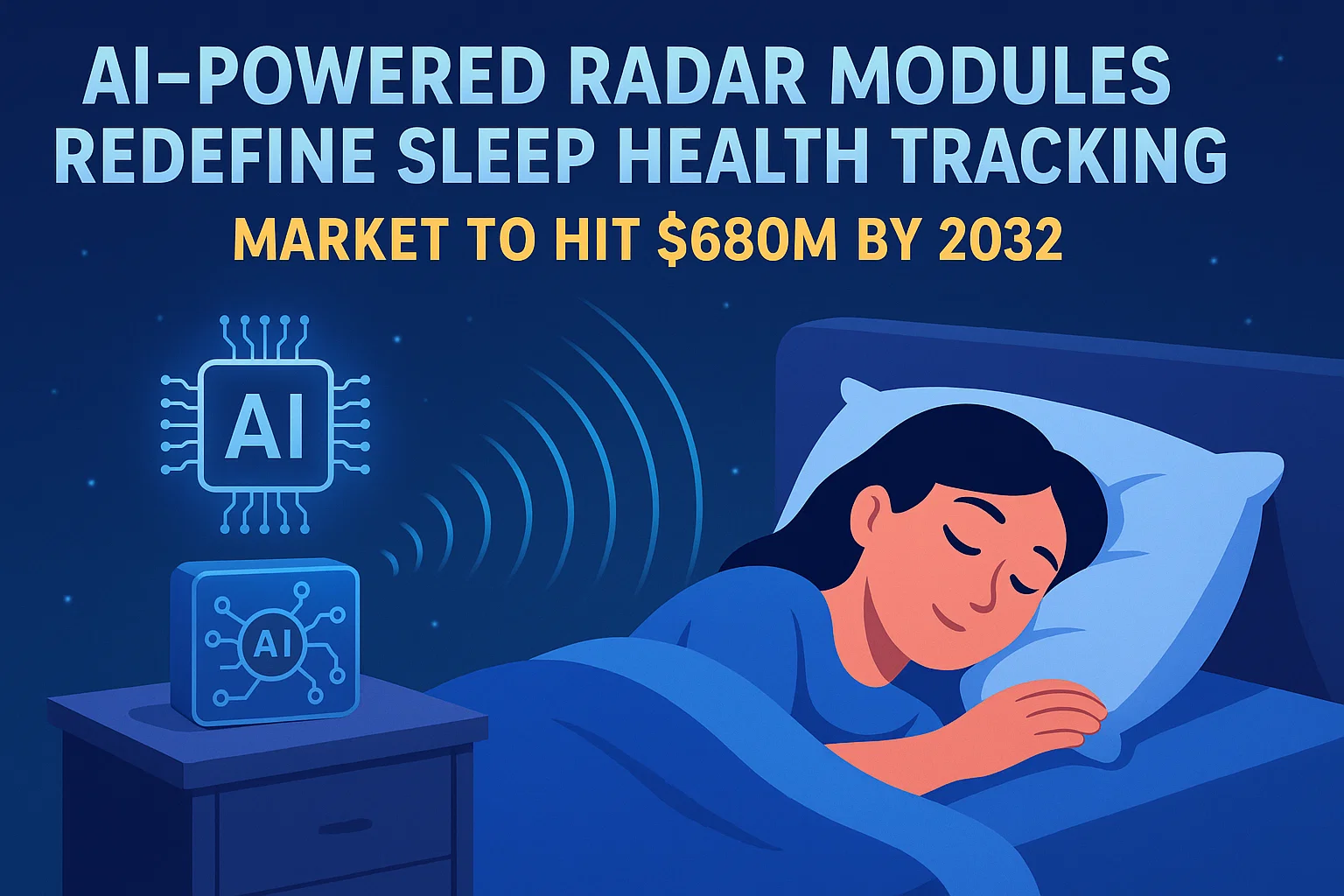
AI-Powered Radar Modules Redefine Sleep Health Tracking, Market to Hit $680M by 2032”
Sleep disorders affect hundreds of millions worldwide, with obstructive sleep apnea (OSA) ranking among the most underdiagnosed conditions. Traditional sleep studies rely on polysomnography (PSG) an intensive process requiring hospital visits, electrodes, and airflow sensors which many patients find uncomfortable. Enter respiratory sleep monitoring radar modules: compact, contactless systems that track breathing patterns, chest wall movement, and even subtle cardiorespiratory parameters during sleep.
According to recent industry estimates, the Respiratory Sleep Monitoring Radar Module market was valued at about US$185 million in 2024 and is projected to surge to US$680 million by 2032, a CAGR of 21.1%. This remarkable growth reflects a convergence of advances in millimeter-wave radar, artificial intelligence, edge computing, and consumer demand for noninvasive sleep monitoring.
Access Your Free Sample Report- Respiratory Sleep Monitoring Radar Module Market
1. Why Radar? The Case for Non-Contact Respiratory Monitoring
Radar modules use either ultra-wideband (UWB) or frequency-modulated continuous wave (FMCW) signals. When aimed at a sleeping person, the returning signal varies subtly with chest and abdominal movement, providing a direct measurement of respiratory effort. This eliminates the need for nasal cannulas or belts, enhancing comfort and compliance.
Benefits of radar modules over traditional sensors include:
- True contactless measurement: No wires, leads, or adhesives.
- Continuous multi-night data collection: Enables better longitudinal assessment.
- Compatibility with home settings: Works under blankets and at variable distances.
- Potential to measure both respiration and heart-rate variability simultaneously.
2. 2024–2025 Research Breakthroughs in Respiratory Sleep Radar
Deep Learning for Event-Level Apnea Detection
A 2024 study demonstrated that FMCW radar combined with a U-Net deep learning architecture augmented with self-attention and squeeze-and-excitation modules can detect apnea/hypopnea events at the event level, not just broad indices. The model also predicted oxygen saturation (SpO₂) as an auxiliary task.
- Performance: F1 scores near 0.80; severity grading accuracy ~91.4%.
- Implication: Radar is evolving from “screening” to near-diagnostic precision.
Meta-Analysis on Diagnostic Accuracy and Frequency Bands
Another major paper compared radar frequency bands versus the gold-standard PSG. Results indicate that certain frequencies, such as 24 GHz FMCW and 60 GHz mmWave, yield higher signal-to-noise ratios under blankets.
- Takeaway for designers: Module selection (frequency band, beam width) strongly affects detection accuracy.
- Market implication: Expect product differentiation around frequency choices and antenna design.
Noncontact Systems Versus Clinical Standard
University of Utah researchers compared a depth-sensing camera “flow” signal to RIPflow, the standard sensor in clinical PSG. The noncontact system showed a strong correlation to traditional respiratory inductance plethysmography (RIP).
- Implication: Hospitals and sleep labs may integrate radar or depth sensors to streamline patient setup, cutting costs and improving throughput.
Waveform Fidelity Breakthrough with Self-Supervised Learning
MobiVital and collaborators introduced a self-supervised autoregressive model combined with biologically informed correction of waveform inversion. Result: 7–34% better fidelity than baseline radar readings.
- Importance: High-fidelity waveforms allow derivation of secondary metrics such as tidal volume estimation or inspiratory/expiratory ratio, opening new diagnostic applications.
Fusion of Radar and Pulse Oximetry (ROSA Model)
The ROSA framework fuses millimeter-wave radar with a fingertip or wrist oximeter, achieving an ICC of 0.9870 versus PSG across multiple apnea-hypopnea index (AHI) thresholds.
- Trend: Combining multiple low-cost sensors to rival the full PSG suite.
- Business opportunity: Partnerships between radar module makers and wearable/oximetry firms.
Tackling Post-Event Irregular Breathing
A new overlapping time-interval averaging technique was proposed to smooth the transition between apnea events and recovery breathing, improving classifier stability in real time.
- Relevance: Real-world data is messy. These algorithms push radar closer to robust 24/7 monitoring.
RestAware: Posture Classification and AI Summaries
The RestAware system integrates 24 GHz FMCW radar with a large language model (LLM) to generate natural-language summaries of nightly sleep. It classifies eight common sleep postures with over 90% accuracy.
- Implication: Moving beyond pure physiology to deliver user-friendly coaching and risk insights.
Wearable Neck Sensor with Machine Learning
Northwestern researchers launched a wireless adhesive device at the base of the neck, which tracks over 140 signals and classifies sleep stages. While not radar, it complements the contactless ecosystem and may combine with radar in hybrid systems.
Download Sample Report PDF- Respiratory Sleep Monitoring Radar Module Market
3. Market Dynamics Driving a 21.1% CAGR
Pandemic-Era Shift to Home Health Monitoring
The COVID-19 era normalized remote and at-home diagnostics. Sleep centers experienced backlogs, prompting telehealth and remote PSG kits. Radar modules fit this trend perfectly.
Regulatory Momentum
While full FDA approval remains limited, several radar-based sleep monitoring systems have entered pilot clinical trials. Regulators are signaling openness to digital health devices that demonstrate equivalent or superior accuracy to PSG.
Semiconductor & Miniaturization Gains
Advances in mmWave chipsets (originally designed for automotive radar and 5G) have slashed cost per channel, enabling low-cost consumer modules. Antenna-in-package (AiP) and system-on-chip (SoC) designs are key.
Integration with Smart Home Ecosystems
Companies are embedding radar modules into smart speakers, bedside devices, and even Wi-Fi routers for passive respiration tracking. This could expand the market well beyond medical devices into consumer wellness.
4. Technology Deep Dive: Hardware and Software Trends
Frequency Choices
- 24 GHz FMCW: Good penetration under blankets, moderate resolution.
- 60–77 GHz mmWave: Higher resolution for chest wall motion but more line-of-sight sensitive.
- UWB Pulsed Radar: Extremely fine range resolution but stricter regulatory constraints.
Antenna Design and Beam Steering
Emerging modules use phased arrays or beamforming to isolate one sleeper from another (helpful for couples). Dual or multiple antenna configurations improve SNR.
Edge AI versus Cloud AI
To maintain privacy and low latency, many radar modules now feature embedded AI accelerators. This also cuts power consumption, crucial for continuous overnight monitoring.
Data Privacy and Encryption
Health data collected via radar modules is highly sensitive. Encryption, on-device processing, and HIPAA/GDPR compliance are differentiators.
5. Clinical and Consumer Use Cases
- Sleep apnea screening for at-risk populations before full PSG.
- Longitudinal monitoring of known OSA patients under CPAP therapy.
- Wellness tracking in consumer electronics, including sleep staging and posture.
- Elderly and infant monitoring for respiratory distress without intrusive wires.
6. Competitive Landscape: Emerging Players and Partnerships
Without citing market-research firms, public news shows that established sensor companies, semiconductor vendors, and digital-health startups are converging:
- Chipmakers provide low-cost radar SoCs originally built for automotive or gesture sensing.
- Medical device firms co-develop radar-based sleep monitors with universities.
- Consumer electronics brands integrate radar into smart speakers and displays (e.g., motion detection in Google Nest Hub already hints at such capabilities).
7. Barriers and Challenges
Clinical Validation at Scale
Many promising algorithms are validated on <100 patients. Multi-center trials are needed to gain medical community trust.
Under-Blanket Artifacts
While radar can penetrate bedding, thick comforters or variable sleeping positions can attenuate signals, requiring robust calibration.
Regulatory and Reimbursement Uncertainty
Even with FDA clearance, reimbursement codes for home radar sleep monitoring remain under development.
Consumer Education
Patients and consumers must understand the difference between “screening” and “diagnosis.” Clear messaging is key to avoid overclaiming.
8. Future Directions (2025–2032)
Multi-Modal Fusion
By 2032, most high-end systems will combine radar, photoplethysmography (PPG), accelerometers, and environmental sensors to generate comprehensive sleep health profiles.
Predictive Analytics and Digital Therapeutics
Radar data could feed AI models to predict cardiovascular risk, respiratory deterioration, or therapy adherence.
Integration with CPAP and Smart Beds
CPAP machines may integrate radar modules to monitor breathing effectiveness, auto-adjusting pressure in real time. Smart beds already track motion; radar could make them clinical-grade.
Regulatory Evolution
Expect clearer FDA pathways for “contactless respiratory monitoring” devices, possibly as Class II with special controls, opening reimbursement doors.
Edge AI and Privacy-Preserving ML
Federated learning and on-device inference will allow continuous model improvement without raw data leaving the home.
Click Here To Download Full Sample Report- Respiratory Sleep Monitoring Radar Module Market
9. Strategic Insights for Stakeholders
- For device makers: Focus on regulatory strategy and clinical validation to differentiate from consumer gadgets.
- For semiconductor firms: Offer integrated radar + AI SoCs optimized for sleep monitoring, not just automotive.
- For healthcare providers: Pilot these technologies in sleep labs to reduce PSG setup time and increase throughput.
- For insurers: Watch for cost savings from remote, noncontact screening to reduce undiagnosed sleep apnea costs.
With a 21.1% CAGR forecast, we can expect the industry to explode with new products, partnerships, and regulatory milestones by 2032. From improved patient comfort to data-rich sleep coaching, radar modules are poised to transform not just sleep medicine but broader respiratory health management.

Comments (0)