
MARKET INSIGHTS
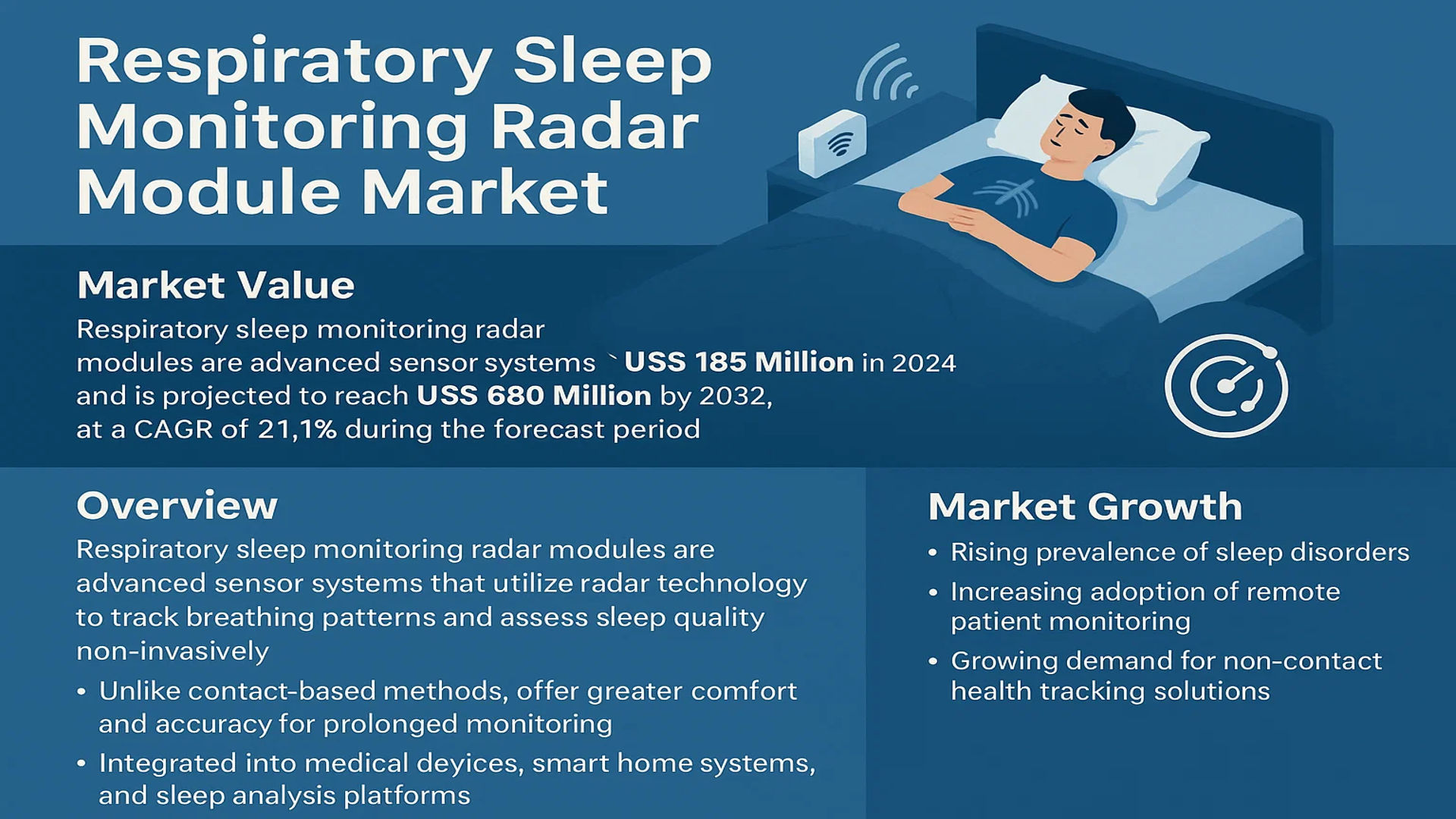
The global Respiratory Sleep Monitoring Radar Module Market was valued at 185 million in 2024 and is projected to reach US$ 680 million by 2032, at a CAGR of 21.1% during the forecast period.
Respiratory sleep monitoring radar modules are advanced sensor systems that utilize radar technology to track breathing patterns and assess sleep quality non-invasively. These devices emit radio waves and analyze their reflections from a person’s chest and abdomen to detect subtle respiratory movements. Unlike traditional contact-based methods, such as wearable sensors, radar-based modules offer greater comfort and accuracy for prolonged monitoring. They are widely integrated into medical devices, smart home systems, and sleep analysis platforms to provide real-time data on respiratory rate, sleep disturbances like apnea, and overall sleep stages.
The market is expanding rapidly due to the rising prevalence of sleep disorders, increasing adoption of remote patient monitoring, and growing demand for non-contact health tracking solutions. The U.S. currently leads the market with a significant share, while China is expected to exhibit the fastest growth. The 24 GHz frequency segment dominates the market due to its balance of range and resolution, though 60 GHz modules are gaining traction for high-precision applications. Key players such as Infineon, Texas Instruments, and Analog Devices are driving innovation, with recent developments including AI-enhanced sleep analytics and miniaturized radar sensors for consumer wearables.
MARKET DYNAMICS
MARKET DRIVERS
Growing Prevalence of Sleep Disorders to Accelerate Market Demand
The increasing global prevalence of sleep disorders is a primary driver for the respiratory sleep monitoring radar module market. Sleep apnea alone affects over 936 million people worldwide , with undiagnosed cases contributing to rising healthcare burdens. Radar-based monitoring offers a non-invasive solution, eliminating discomfort associated with traditional sensors while providing accurate respiration tracking. As awareness of sleep health grows, demand for advanced monitoring technologies is expected to increase significantly. The ability to detect conditions like obstructive sleep apnea without skin contact makes radar modules particularly attractive for long-term monitoring applications in both clinical and home settings.
Technological Advancements in Radar Sensing to Fuel Market Expansion
Recent breakthroughs in radar signal processing and miniaturization are transforming sleep monitoring capabilities. Modern 60GHz radar modules can detect chest movements with sub-millimeter precision , enabling accurate respiration rate measurement without physical contact. These technological improvements coincide with growing adoption of IoT and smart home devices, where non-contact health monitoring is becoming a standard feature. Leading manufacturers are integrating advanced algorithms with radar hardware to distinguish between different sleep stages and breathing patterns, further enhancing diagnostic capabilities. Such innovations position radar modules as a superior alternative to conventional monitoring methods.
Expansion of Remote Patient Monitoring to Drive Market Growth
The rapid growth of telemedicine and remote patient monitoring systems presents significant opportunities for respiratory sleep monitoring technologies. Healthcare providers are increasingly adopting digital health solutions that enable continuous monitoring outside clinical settings. Radar modules provide an ideal solution for remote sleep monitoring due to their contactless operation and ability to integrate with existing telehealth platforms. Regulatory support for remote monitoring reimbursement policies in several countries is further accelerating adoption. This trend is particularly significant for managing chronic respiratory conditions and sleep disorders in aging populations.
MARKET RESTRAINTS
High Development Costs and Pricing Pressure to Limit Market Penetration
While respiratory sleep monitoring radar technology offers numerous advantages, the high development costs associated with advanced radar systems present a significant market challenge. Sophisticated signal processing algorithms and precision hardware components contribute to higher production expenses compared to conventional monitoring devices. This cost factor becomes particularly challenging in price-sensitive healthcare markets and may slow adoption rates in developing regions. Furthermore, intensifying competition among manufacturers is creating pricing pressures that could impact profitability and innovation investments.
Regulatory Approvals and Data Security Concerns to Hinder Market Growth
The medical device regulatory landscape presents another hurdle for respiratory sleep monitoring radar modules. Obtaining necessary certifications for medical-grade applications requires extensive clinical validation and testing, potentially delaying product launches. Additionally, growing concerns about data privacy and wireless signal interference in healthcare environments have prompted stricter regulations regarding device emissions and data handling. Manufacturers must navigate these complex compliance requirements while maintaining product competitiveness, creating additional barriers to market entry and expansion.
MARKET OPPORTUNITIES
Integration with Smart Home Ecosystems to Open New Growth Avenues
The convergence of healthcare technologies with smart home systems presents a significant growth opportunity for respiratory sleep monitoring radar modules. Manufacturers are increasingly developing consumer-friendly versions that integrate seamlessly with home automation platforms. This integration enables features like environmental adjustment based on sleep quality data and automated health reporting. With the global smart home market projected for substantial expansion , incorporating health monitoring capabilities represents a natural evolution that could significantly boost adoption rates of radar-based sleep monitoring solutions.
Advancements in AI-Powered Analytics to Enhance Market Potential
The incorporation of artificial intelligence and machine learning algorithms represents a transformative opportunity for the respiratory sleep monitoring radar module market. Advanced analytics can extract more comprehensive health insights from radar-collected data, potentially detecting early signs of respiratory conditions beyond basic sleep metrics. This capability enhancement could expand applications from sleep monitoring to broader respiratory health assessment, creating additional value propositions for healthcare providers and consumers alike. The development of predictive analytics models based on long-term respiration pattern analysis could further differentiate radar-based solutions in the competitive health monitoring market.
MARKET CHALLENGES
Technical Limitations in Complex Environments to Pose Implementation Challenges
Despite technological advancements, respiratory sleep monitoring radar modules face implementation challenges in real-world environments. Signal interference from multiple occupants in shared sleeping spaces or movement artifacts can compromise data accuracy. Additionally, variations in mattress materials and bedroom layouts may affect signal penetration and reflection patterns. These technical limitations require continuous refinement of signal processing algorithms and hardware configurations to maintain reliable performance across diverse use cases. Overcoming these challenges is essential for broader clinical adoption and consumer confidence in radar-based monitoring solutions.
Consumer Awareness and Behavior Patterns to Impact Adoption Rates
Market growth faces challenges from limited consumer awareness about radar-based sleep monitoring technologies and resistance to adopting new health monitoring methods. Many potential users remain unfamiliar with the benefits of contactless monitoring compared to traditional solutions. Additionally, concerns about radio wave exposure, despite being within regulatory safety limits, may influence purchasing decisions. Developing effective educational campaigns and ensuring transparent communication about technology safety and benefits will be crucial for overcoming these adoption barriers and realizing the market’s full potential.
RESPIRATORY SLEEP MONITORING RADAR MODULE MARKET TRENDS
Increasing Adoption of Non-Invasive Sleep Monitoring Solutions to Drive Market Growth
The respiratory sleep monitoring radar module market is experiencing significant growth due to the rising demand for non-invasive sleep monitoring technologies. Traditional methods, such as polysomnography, require multiple contact sensors, which can be uncomfortable for patients undergoing long-term sleep studies. In contrast, radar-based monitoring systems utilize low-power radio waves to detect subtle chest movements associated with breathing, eliminating the need for direct skin contact. The global market is projected to grow at a CAGR of 21.1% from 2024 to 2032, reaching a valuation of $680 million by 2032. This growth is fueled by advancements in radar sensitivity and signal processing algorithms that improve detection accuracy, particularly in diagnosing sleep disorders like obstructive sleep apnea.
Other Trends
Integration with Smart Home and IoT Ecosystems
The increasing integration of respiratory sleep monitoring radar modules with smart home devices and Internet of Things (IoT) platforms is reshaping consumer accessibility to sleep health management. Companies like Huawei, Aqara, and Innopro are incorporating these modules into bedside monitors, smart lighting systems, and alarm clocks to provide real-time sleep quality metrics. This trend is particularly prominent in North America and Asia-Pacific, where smart home adoption rates exceed 30% in urban households. Beyond comfort, these solutions allow for continuous data collection, enabling healthcare providers to analyze long-term sleep patterns remotely without disrupting user routines.
Technological Advancements in 60 GHz Radar for Medical Applications
The shift toward 60 GHz radar modules is gaining momentum in medical-grade respiratory monitoring due to superior motion detection resolution at millimetric wavelengths. Compared to the more common 24 GHz systems, 60 GHz technology provides enhanced sensitivity to micro-movements as small as 0.1 mm, making it ideal for neonatal monitoring and post-surgical patient observation. Key players like Infineon and Texas Instruments are investing heavily in this segment, with the 60 GHz category expected to exhibit the highest growth rate among all frequency types. Furthermore, regulatory approvals for medical use in regions like Europe and the U.S. are accelerating clinical adoption, creating new revenue streams for manufacturers.
COMPETITIVE LANDSCAPE
Key Industry Players
Innovation and Strategic Expansion Drive Competition in the Radar Sleep Monitoring Market
The global respiratory sleep monitoring radar module market is moderately fragmented, with established semiconductor companies and emerging tech firms competing for dominance. Infineon Technologies leads the market, holding approximately 18% revenue share in 2024. Their leadership stems from early investments in 60GHz radar technology and successful integrations with home automation systems. Similarly, Texas Instruments has gained significant traction through its low-power radar solutions that are increasingly adopted in medical-grade sleep monitors.
Chinese manufacturers like Huawei and HIKVISION are rapidly expanding their market presence by offering cost-competitive 24GHz modules, particularly in emerging Asian markets. These companies benefit from strong regional supply chains and government support for smart healthcare technologies. Meanwhile, Analog Devices maintains technological leadership in high-precision radar sensors, favored by clinical sleep diagnostic equipment manufacturers.
The competitive landscape is witnessing three key trends: miniaturization of modules for wearable applications, development of AI-powered sleep analytics, and strategic partnerships with telehealth platforms. While larger players focus on technical innovation, smaller firms like Seeed Technology and Shenzhen Ferry Smart are carving niches through customizable solutions for specialized applications such as neonatal monitoring.
List of Key Respiratory Sleep Monitoring Radar Module Manufacturers
- Infineon Technologies (Germany)
- Texas Instruments (U.S.)
- Analog Devices (U.S.)
- AxEnd (Israel) – Specialized in military-grade sleep monitoring for personnel
- Huawei Technologies (China)
- HIKVISION (China) – Dominant in smart home sleep monitoring solutions
- Seeed Technology (China)
- WHST (South Korea) – Emerging leader in baby monitoring radar tech
- Shenzhen Ferry Smart (China) – Focused on affordable medical solutions
- Uniview (China) – Integrates radar with video for senior care applications
- Tsingray (Taiwan) – Specializes in ultra-thin radar modules
- Microbrain Intelligent (China) – AI-driven sleep pattern recognition
Market consolidation is expected to accelerate as larger firms seek to acquire specialized radar startups, particularly those with proprietary algorithms for sleep disorder detection. The coming years will likely see tighter competition in accuracy standards and regulatory compliance, especially for medical applications in North American and European markets.
Segment Analysis:
By Type
24 GHz Segment Leads Due to Wider Adoption in Consumer and Medical Applications
The market is segmented based on type into:
- 24 GHz
- 60 GHz
- Others
By Application
Medical Segment Dominates Owing to Increasing Demand for Sleep Disorder Diagnosis
The market is segmented based on application into:
- Medical
- Home Use
- Others
By Technology
Contactless Monitoring Gains Traction for Non-Invasive Sleep Analysis
The market is segmented based on technology into:
- Continuous Wave Radar
- Pulse Radar
- Frequency Modulated Continuous Wave (FMCW)
By End User
Hospitals and Sleep Clinics Lead Market Adoption for Professional Diagnosis
The market is segmented based on end user into:
- Hospitals
- Sleep Clinics
- Home Care Settings
- Research Institutions
Regional Analysis: Respiratory Sleep Monitoring Radar Module Market
North America
North America leads the global Respiratory Sleep Monitoring Radar Module market, driven by advanced healthcare infrastructure, a high prevalence of sleep disorders, and strong R&D investments. The U.S. accounts for the largest share in the region due to growing adoption of non-contact sleep monitoring solutions in both clinical and home settings. Major players like Texas Instruments and Analog Devices are headquartered here, accelerating innovation in 60 GHz radar modules for precise respiratory tracking. The region benefits from favorable reimbursement policies for sleep diagnostics and increasing integration of radar technology into smart home ecosystems. With an estimated 15.4 million Americans suffering from sleep apnea, demand for continuous monitoring solutions remains robust, positioning North America as the most mature market.
Europe
Europe holds the second-largest market share, propelled by stringent patient safety regulations and growing elderly population requiring sleep disorder management. Germany and the U.K. are key adopters, with hospitals incorporating radar-based monitoring to reduce infection risks from contact sensors. The EU’s focus on digital health initiatives, including the European Health Data Space (EHDS) framework, encourages adoption of remote patient monitoring technologies. However, slower reimbursement approvals for novel diagnostic tools compared to North America slightly restrain market growth. Companies like Infineon are developing ultra-low-power radar chips compliant with EU radiation standards, catering to the region’s emphasis on safety and energy efficiency.
Asia-Pacific
APAC demonstrates the fastest growth rate (projected CAGR exceeding 24% through 2032), led by China’s booming smart home market and Japan’s aging demographics. Chinese manufacturers like Huawei and HIKVISION are mass-producing cost-effective 24 GHz modules for consumer sleep trackers, while India shows potential with increasing awareness about sleep health. Japan’s focus on elderly care technologies drives hospital adoption, though price sensitivity in Southeast Asia limits penetration of high-end 60 GHz systems. The region benefits from localized manufacturing clusters that reduce module costs by 30-40% compared to Western counterparts, making APAC the hub for volume production.
South America
Market growth in South America remains moderate due to economic volatility and fragmented healthcare access. Brazil dominates regional demand, with private hospitals adopting radar modules for premium patient monitoring services. However, public healthcare systems prioritize basic diagnostics, delaying widespread adoption. Mexico shows promise as a manufacturing base for North American companies seeking nearshoring advantages. The lack of local component suppliers creates dependency on imports, increasing final product costs by 20-25% compared to other regions. Despite challenges, increasing smartphone penetration and telehealth initiatives are creating opportunities for home monitoring solutions in urban centers.
Middle East & Africa
MEA presents a nascent but high-growth potential market, with Gulf nations like UAE and Saudi Arabia leading adoption through smart city projects and hospital modernization programs. The prevalence of obesity-related sleep disorders aligns well with radar monitoring applications, though market education remains a barrier. Israel’s medtech startups are developing innovative radar algorithms for early apnea detection. Africa’s growth is constrained by limited healthcare budgets, though South Africa shows gradual uptake in private clinics. The region benefits from minimal regulatory hurdles for device approvals, enabling faster market entry compared to developed economies.
Report Scope
This market research report provides a comprehensive analysis of the global Respiratory Sleep Monitoring Radar Module market, covering the forecast period 2024–2032. It offers detailed insights into market dynamics, technological advancements, competitive landscape, and key trends shaping the industry.
Key focus areas of the report include:
- Market Size & Forecast: Historical data and future projections for revenue, unit shipments, and market value across major regions and segments. The global market was valued at USD 185 million in 2024 and is projected to reach USD 680 million by 2032, growing at a CAGR of 21.1%.
- Segmentation Analysis: Detailed breakdown by product type (24 GHz, 60 GHz, Others), application (Medical, Home Use, Others), and end-user industry to identify high-growth segments and investment opportunities.
- Regional Outlook: Insights into market performance across North America, Europe, Asia-Pacific, Latin America, and the Middle East & Africa, including country-level analysis where relevant. The U.S. and China are key growth markets.
- Competitive Landscape: Profiles of leading market participants including Infineon, Texas Instruments, Analog Devices, Huawei, and HIKVISION, covering their product offerings, R&D focus, manufacturing capacity, and recent developments.
- Technology Trends & Innovation: Assessment of radar-based sleep monitoring technologies, integration with smart home systems, and advancements in non-contact respiratory monitoring.
- Market Drivers & Restraints: Evaluation of factors such as rising sleep disorder prevalence, smart home adoption, and healthcare digitization along with challenges like regulatory hurdles and data privacy concerns.
- Stakeholder Analysis: Insights for semiconductor manufacturers, medical device companies, smart home solution providers, investors, and policymakers regarding strategic opportunities.
Primary and secondary research methods are employed, including interviews with industry experts, data from verified sources, and real-time market intelligence to ensure the accuracy and reliability of the insights presented.
FREQUENTLY ASKED QUESTIONS:
What is the current market size of Global Respiratory Sleep Monitoring Radar Module Market?
-> Respiratory Sleep Monitoring Radar Module Market was valued at 185 million in 2024 and is projected to reach US$ 680 million by 2032, at a CAGR of 21.1% during the forecast period.
Which key companies operate in Global Respiratory Sleep Monitoring Radar Module Market?
-> Key players include Infineon, Texas Instruments, Analog Devices, Huawei, HIKVISION, Seeed Technology, and WHST, among others.
What are the key growth drivers?
-> Key growth drivers include rising prevalence of sleep disorders, increasing adoption of non-contact monitoring solutions, and growing smart home integration.
Which region dominates the market?
-> North America currently leads the market, while Asia-Pacific is expected to witness the fastest growth during the forecast period.
What are the emerging trends?
-> Emerging trends include AI-powered sleep analysis, integration with IoT ecosystems, and development of millimeter-wave radar solutions for enhanced accuracy.

Get Sample Report PDF for Exclusive Insights
Report Sample Includes
- Table of Contents
- List of Tables & Figures
- Charts, Research Methodology, and more...
 Download Sample Report PDF




