
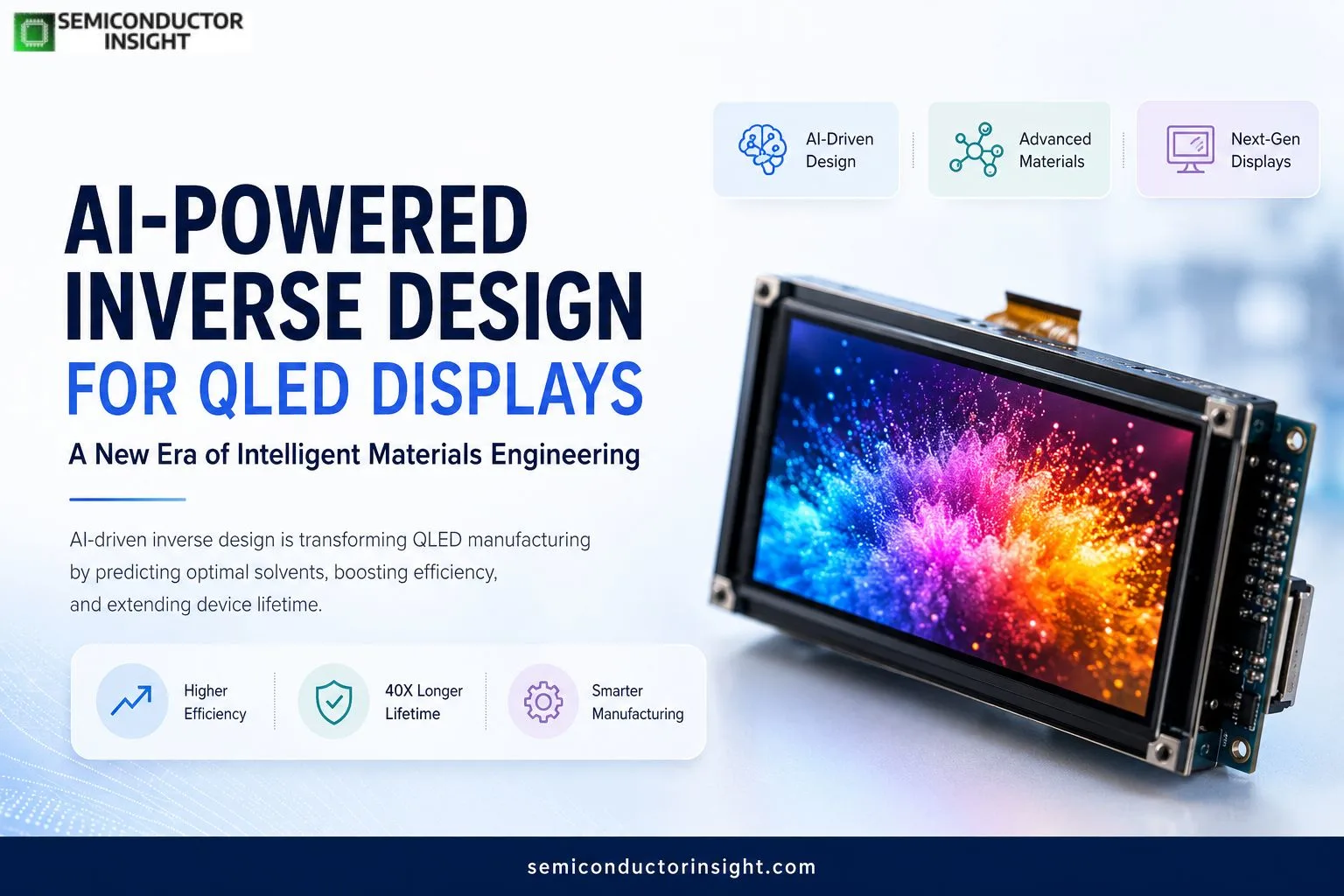
AI-Powered Materials Design Opens New Possibilities for Longer-Lasting Quantum-Dot Displays
A breakthrough at the intersection of artificial intelligence and advanced materials research is set to accelerate the evolution of next-generation display technologies. Researchers from Seoul National University College of Engineering, in collaboration with Sungkyunkwan University, have developed an AI-driven inverse design platform capable of identifying optimal processing conditions for quantum-dot light-emitting diodes (QLEDs), significantly improving both device efficiency and operational lifetime.
The research introduces a new approach to materials engineering by replacing the conventional trial-and-error method with a data-driven AI model that predicts the ideal solvent characteristics required to fabricate highly uniform quantum-dot films. When implemented in QLED production, the optimized process approximately doubled device efficiency while extending operational lifetime by more than 40 times, demonstrating the transformative potential of artificial intelligence in semiconductor and display manufacturing.
Quantum-dot LEDs are widely regarded as one of the most promising technologies for future display applications due to their exceptional color purity, high brightness, and compatibility with solution-based manufacturing techniques. Unlike traditional fabrication methods, QLEDs can be produced using liquid-based coating processes, offering opportunities for lower production costs and scalable manufacturing of large-area displays. However, achieving consistent device performance has remained a major challenge because the microscopic arrangement of quantum dots is highly sensitive to solvent selection during fabrication.
- To address this complexity, the research team developed a machine learning model capable of understanding the relationship between solvent properties and the resulting structure of quantum-dot thin films.
- By analyzing parameters such as vapor pressure, viscosity, density, and dielectric constant alongside film morphology data obtained through atomic force microscopy, the AI platform learned to predict the optimal solvent characteristics required to produce densely packed and uniformly distributed quantum-dot layers.
- Rather than relying on a single commercially available solvent, the AI recommended a carefully engineered combination of multiple solvents capable of reproducing the desired processing conditions. This optimized formulation, which would have been extremely difficult to identify through conventional laboratory experimentation, enabled the fabrication of significantly higher-performing QLED devices.
- The achievement demonstrates how artificial intelligence is becoming an increasingly valuable tool for materials discovery and process optimization. Instead of conducting hundreds of time-consuming experimental iterations, researchers can now leverage predictive algorithms to rapidly identify manufacturing parameters that maximize device performance while reducing development costs and accelerating commercialization.
Beyond quantum-dot displays, the inverse design methodology has broad implications for the wider advanced materials industry. Similar AI-driven optimization techniques could support the development of OLED displays, solar cells, semiconductor devices, advanced coatings, energy storage materials, and other nanotechnology-based applications, where precise control of material properties plays a critical role in determining performance.
The research also reflects a growing global trend toward integrating artificial intelligence into chemical and materials engineering workflows. As industries increasingly seek faster innovation cycles and more sustainable manufacturing methods, AI-assisted materials design is emerging as a key enabler for next-generation product development across electronics, energy, and advanced manufacturing sectors.
Supported by South Korea’s Ministry of Science and ICT and the National Research Foundation of Korea, the study was published in the internationally recognized journal Reports on Progress in Physics, highlighting its scientific significance and potential industrial impact.
As display manufacturers continue pursuing higher efficiency, longer product lifetimes, and more cost-effective production methods, innovations that combine machine learning with materials science are expected to redefine how future electronic materials are designed. The success of this AI-driven inverse design platform illustrates how digital technologies are reshaping traditional materials research and opening new pathways for the commercialization of advanced display technologies.
Gain Valuable Insights from Our Newly Updated Relevant Research: https://semiconductorinsight.com/report/quantum-dot-display-qled-market/

Comments (0)