
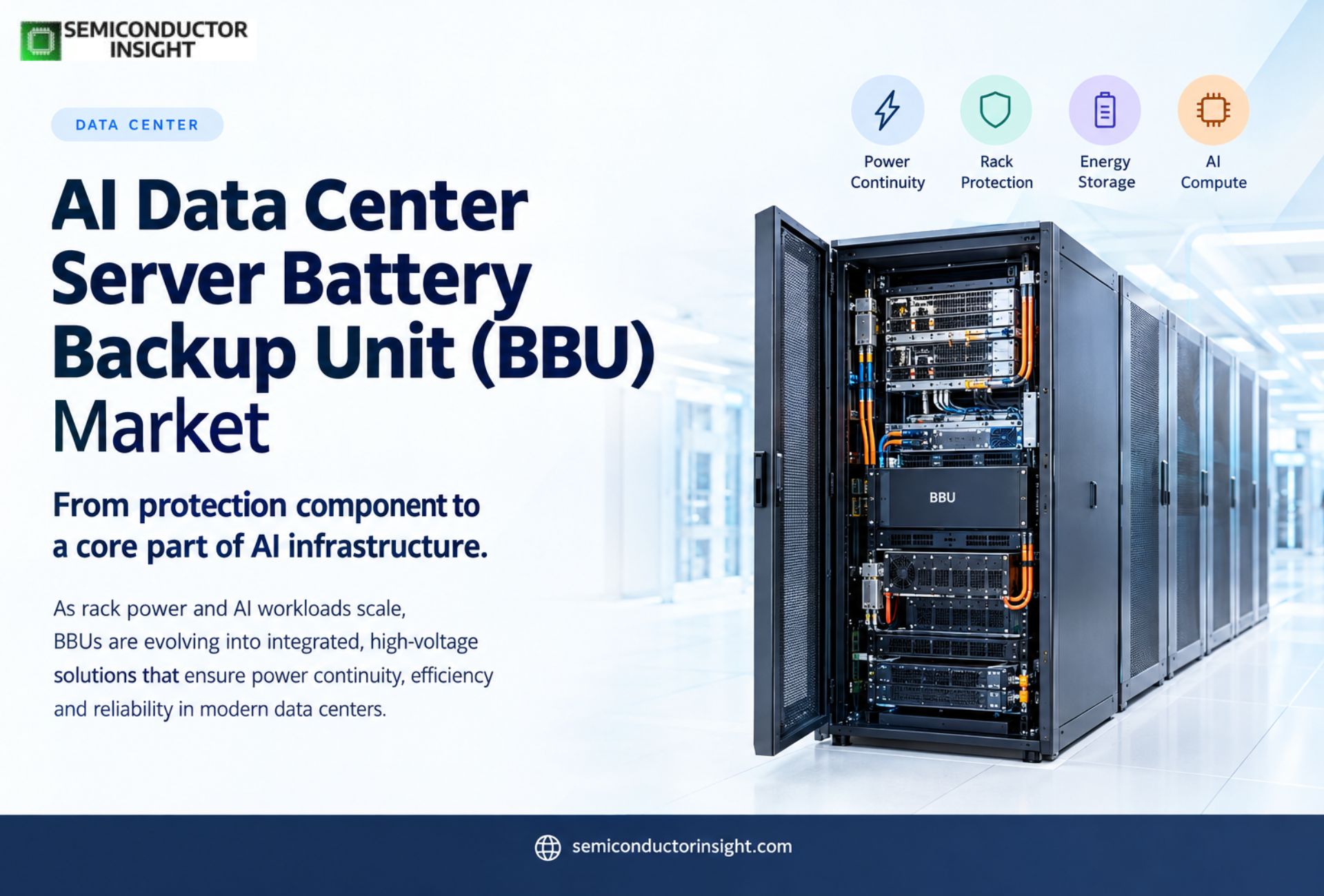
AI Data Center Server Battery Backup Unit (BBU) Market in 2026 Moves from Backup Power to Rack-Level Energy Control
Artificial intelligence is changing the electrical architecture of the data center almost as quickly as it is changing computing architecture. AI servers now operate with highly concentrated power requirements, rapid workload fluctuations and increasingly dense rack configurations. That shift is turning the Battery Backup Unit from a conventional protection component into an increasingly integrated part of server and rack power design.
The International Energy Agency estimates that global data-center electricity consumption will roughly double from 485 TWh in 2025 to about 950 TWh in 2030. Electricity consumption from AI-focused data centers is expected to grow even faster, tripling over the same period.
The BBU Is Moving Closer to the Compute
- A server BBU provides short-duration energy during power disturbances, allowing computing equipment to continue operating while another power source takes over or enabling an orderly shutdown.
- Google describes this role directly in its data-center infrastructure and reported more than 100 million lithium-ion cells deployed across its global data-center battery fleet by February 2025.
- Google also states that its 48 VDC rack systems use integrated BBUs.
- This architecture is particularly relevant for AI because even a brief interruption can affect large-scale training, inference workloads and data integrity.
AI Rack Density Is Changing the Numbers
NVIDIA’s GB200 NVL72 illustrates the direction of modern accelerated computing. The platform combines 36 Grace CPUs and 72 Blackwell GPUs into a single liquid-cooled rack-scale system.
As rack power increases, the electrical system supporting the compute cannot remain static. Higher current at lower voltage creates greater distribution losses and places additional demands on conductors, busbars and power-conversion equipment.
That is one reason the industry is examining high-voltage DC architectures.
The 800 VDC Shift Is the Defining Architecture Story
- In May 2025, Vertiv announced alignment with NVIDIA’s roadmap for 800 VDC infrastructure, with its 800 VDC portfolio planned for the second half of 2026.
- Vertiv specifically noted that conventional 54 VDC in-rack distribution was designed around kilowatt-scale racks, while emerging accelerated-computing infrastructure is moving toward much larger power requirements.
The change can be viewed as a simplified power pathway:
Grid Power → AC/DC Conversion → High-Voltage DC Bus → Energy Storage → DC/DC Conversion → Server Power Delivery → GPU and CPU
BBUs therefore become part of a broader DC power ecosystem rather than functioning as an isolated backup component.
A 660 kW Rack Demonstrates Where the Market Is Heading
Delta provided one of the clearest 2026 demonstrations of this transition at NVIDIA GTC. Its 800 VDC in-row power rack is rated at 660 kW and incorporates 480 kW of embedded BBU capacity. Delta also reported AC-to-DC efficiency of up to 98%.
The same announcement included a 2.4 MW coolant distribution system, highlighting an important reality of AI infrastructure. Power delivery and thermal management are increasingly being engineered as one integrated system.
From Seconds of Backup to Millisecond Response
Traditional backup systems are generally associated with maintaining power until generators or alternate sources become available. AI infrastructure introduces another requirement: managing very rapid changes in electrical load.
Delta’s 2025 AI data-center solutions included a 22 kW, 2RU battery backup system supporting 48 VDC systems with up to 60 seconds of backup time. The company also reported 97.5% efficiency for that system.
This demonstrates the diversity of BBU requirements. Some applications emphasize compact rack integration and short ride-through periods, while emerging high-density architectures are moving toward much larger integrated energy-storage blocks.
Our most recent updated related study is available for free at this link: https://semiconductorinsight.com/report/ai-data-center-server-battery-backup-unit-bbu-market/
Battery Chemistry Is Becoming an Infrastructure Decision
- Lithium-ion technology has become particularly important because energy storage must fit inside increasingly space-constrained infrastructure.
- Google says its move from lead-acid to lithium-ion allowed it to deploy one-quarter as many batteries while achieving twice the life, twice the power and half the volume compared with its previous-generation batteries.
- For AI data centers, however, battery chemistry is only one part of the engineering equation.
- Thermal behavior, monitoring, protection, rack integration, fault isolation and fire safety all become important when thousands or millions of cells operate across a facility.
India Is Also Moving Toward AI Factory Scale
The infrastructure transition is not limited to North American hyperscalers. In February 2026, NxtGen AI announced a national-scale sovereign AI factory in India using more than 4,000 NVIDIA Blackwell GPUs through Dell integrated rack systems. Vertiv is supplying the power and thermal infrastructure for the deployment.
Projects of this scale demonstrate why server-level backup systems are increasingly being considered alongside rack architecture, power conversion, cooling and facility-level energy systems.
What the BBU Becomes in the AI Era?
Power continuity → transient response → rack protection → energy buffering → intelligent power management
That progression is changing how BBUs are specified. Capacity remains important, but response time, voltage architecture, power density, efficiency, thermal performance and integration are becoming equally significant.
With data-center electricity consumption projected to approach 950 TWh globally by 2030 and AI-focused facilities expanding rapidly, the BBU is becoming part of the engineering foundation supporting accelerated computing.
The most significant development is therefore not simply that data centers need more batteries. It is that battery backup is moving closer to the compute itself, becoming an active component of the rack-level power architecture that allows increasingly dense AI systems to operate reliably.

Comments (0)