
Advancements in Semiconductor Filtration Driving the Photoresist Filters Market
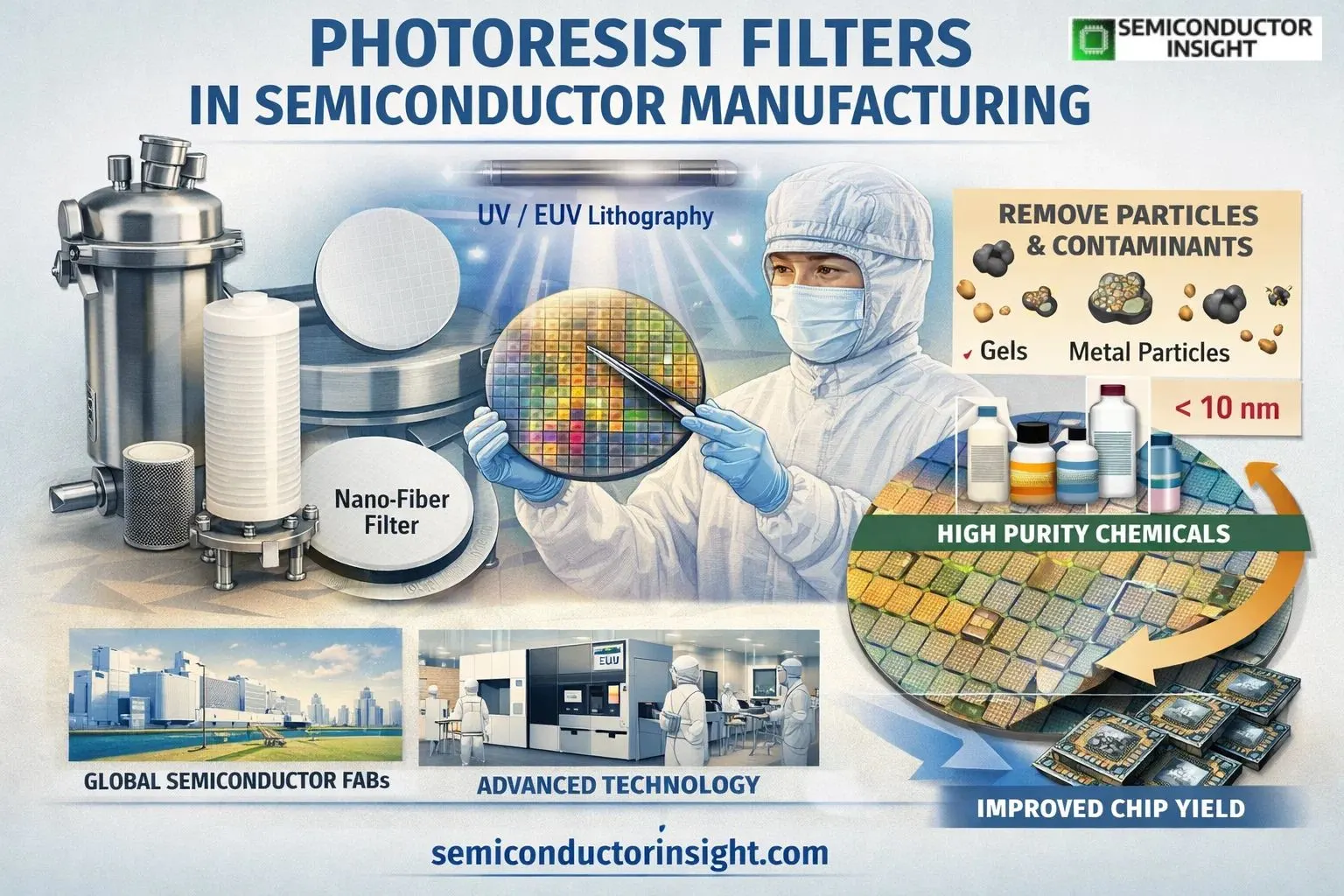
In semiconductor manufacturing, even extremely small particles can cause defects during photolithography. Photoresist filters are specialized filtration components designed to remove micro-particles, gels, and metallic contaminants from photoresist chemicals before they are applied to silicon wafers. These filters play a critical role in maintaining ultra-clean processing conditions during chip fabrication.
Modern semiconductor fabs operate under strict contamination control standards. In advanced lithography environments, particle tolerance levels have dropped by nearly 70-80% over the past decade as chip nodes shrink to smaller geometries. Ultra-pure filtration systems are now capable of removing particles smaller than 10 nanometers with efficiency levels exceeding 99.9%, ensuring consistent pattern formation on wafers.
As semiconductor devices become more compact and complex, the importance of high-precision filtration continues to increase. This has strengthened the demand for specialized filtration materials such as PTFE membranes, polymer cartridges, and nanofiber filters used in the photoresist filtration process.
Role of Filtration in Advanced Photolithography
- Photolithography relies on photoresist chemicals that react to ultraviolet or extreme ultraviolet light to create micro-patterns on semiconductor wafers. If contaminants are present in the resist solution, they can disrupt pattern formation and reduce chip yield.
- Modern fabrication plants process thousands of wafers daily, and each wafer requires high-purity chemical handling. A single fabrication facility may consume thousands of liters of photoresist chemicals and slurry materials every day, making reliable filtration infrastructure essential.
- Another trend influencing filtration demand is the shift to extreme ultraviolet (EUV) lithography. EUV processes require chemical purity levels above 99.99%, which has pushed filter manufacturers to develop membranes capable of capturing contaminants at the sub-5 nanometre level.
- These technical requirements explain why photoresist filtration systems are considered essential components in modern semiconductor fabrication plants.
Semiconductor Manufacturing Expansion Supporting Demand
The growth of semiconductor fabrication facilities worldwide is one of the main factors influencing Photoresist Filters Market. Global semiconductor production continues to expand due to increasing demand for electronics, artificial intelligence processors, and automotive chips.
Industry data indicates that more than 200 semiconductor fabrication plants operate across major manufacturing regions including Taiwan, South Korea, China, Japan, and the United States. These facilities represent over 50% of global filtration demand, particularly in Asia-Pacific where the majority of chip production is concentrated.
Recent investments in advanced chip production have further accelerated the need for high-purity chemical filtration. Between 2023 and 2025, more than 25 new semiconductor fabs were announced globally, many of which integrate advanced filtration technologies for lithography processes.
As chip architectures continue to evolve toward smaller nodes such as 5 nm and below, contamination control becomes increasingly important, reinforcing the demand for advanced filtration systems.
You Can Freely Surf Our Latest Updated Report Here: https://semiconductorinsight.com/report/photoresist-filters-market/
Key Companies Operating in the Photoresist Filters Industry
Several specialized filtration and semiconductor equipment companies are involved in manufacturing photoresist filtration systems and related chemical purification technologies.
Some of the Major companies include:
- Pall Corporation
- Entegris
- Cobetter Filtration Group
- 3M
- ADVANTEC
- Shanghai Pullner Filtration Technology
- Membrane Solutions
- Critical Process Filtration
- Others
These companies develop filtration membranes, cartridge filters, and purification systems designed specifically for semiconductor chemical processing.
In addition, semiconductor equipment manufacturers such as ASML, Tokyo Electron, and Nikon Corporation support the lithography ecosystem by integrating advanced filtration technologies into their photolithography systems.
The industry is moderately concentrated, with the top five companies accounting for nearly 40% of global shipments, highlighting the importance of specialized technology and certification requirements in semiconductor manufacturing supply chains.
Recent Developments and Technology Instances
- Recent innovations in semiconductor filtration technology highlight how manufacturers are improving contamination control and operational efficiency.
- For example, Entegris introduced advanced filtration systems designed for semiconductor slurry and chemical purification processes. These products were developed to extend filter life cycles and improve chemical throughput efficiency.
- Another example involves Pall Corporation, which launched a gas filtration system capable of removing particles at approximately 3-nanometer retention levels, targeting EUV lithography environments where contamination tolerance is extremely low.
- Manufacturers are also incorporating digital monitoring technologies into filtration equipment. More than 110 semiconductor fabs worldwide now deploy smart filters equipped with sensors that monitor pressure, flow rate, and contamination levels in real time. These systems allow predictive maintenance and reduce unplanned production downtime.
The evolution of semiconductor fabrication toward advanced nodes, artificial intelligence chips, and high-density memory technologies continues to raise purity requirements for chemical processing systems.
Advanced filtration membranes capable of removing particles below 3 nanometers are already appearing in next-generation fabrication environments. Additionally, new filter designs with extended operational lifetimes are reducing replacement frequency by approximately 15%, improving operational efficiency in large semiconductor fabs.
With semiconductor manufacturing expanding rapidly and chip geometries becoming increasingly complex, high-performance filtration systems will remain a critical element of contamination control in modern semiconductor production facilities.

Comments (0)