
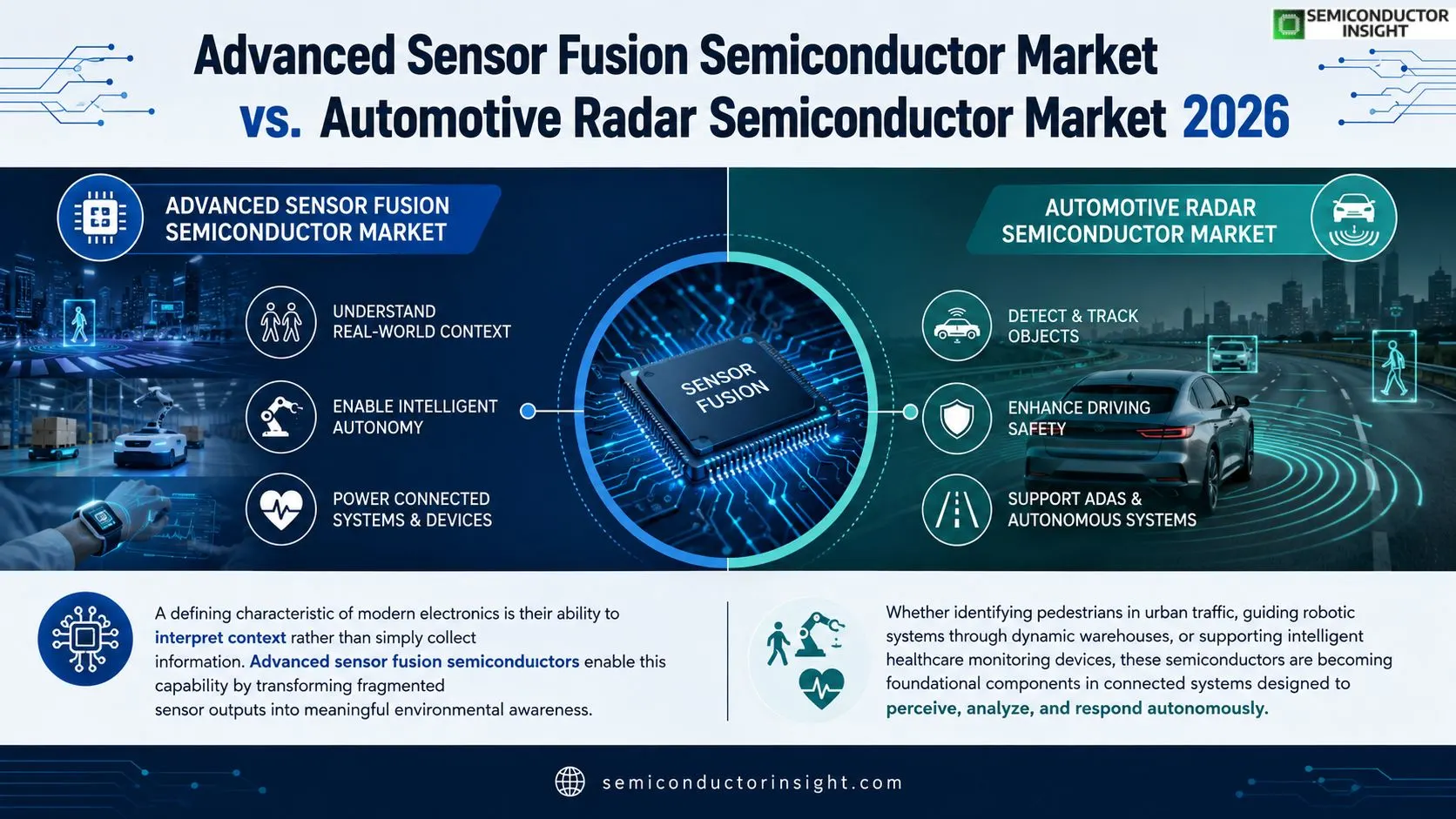
Advanced Sensor Fusion Semiconductor Market vs. Automotive Radar Semiconductor Market 2026
The semiconductor industry is entering a phase where devices are expected to understand environments rather than simply detect them. This transition is placing the Advanced Sensor Fusion Semiconductor Market at the center of innovation. Unlike standalone sensors that operate independently, sensor fusion semiconductors combine inputs from multiple sensing technologies including cameras, radar, LiDAR, ultrasonic modules, inertial measurement units, and environmental sensors to create a unified view of surroundings.
From autonomous vehicles and industrial robots to smart factories and wearable devices, advanced sensor fusion chips are becoming the decision-making layer that transforms raw signals into actionable intelligence.
The Semiconductor Brain behind Machine Perception
Modern sensor fusion architectures process multiple streams of information simultaneously. Instead of relying on a single source, fusion semiconductors compare, validate, and interpret data in real time.
Perception Integration Chain
Camera Data
+
Radar Signals
+
LiDAR Mapping
+
Motion Sensors
+
Environmental Inputs
↓
Sensor Fusion Semiconductor
↓
Object Recognition
↓
Decision Engine
↓
Automated Action
This approach significantly improves reliability in complex environments where individual sensors may experience limitations.
A Technology Race Fuelled by Autonomous Systems
- Recent developments across transportation and robotics illustrate how sensor fusion is moving from experimental platforms into commercial deployment.
- Autonomous vehicle developers increasingly integrate radar, cameras, and LiDAR into centralized fusion processors. Similarly, warehouse robotics operators are deploying fusion-enabled navigation systems capable of identifying obstacles, workers, and inventory simultaneously.
- Several next-generation electric vehicles introduced during 2024–2026 feature sensor suites containing more than 20 sensing components operating through centralized semiconductor platforms. This architecture represents a substantial evolution from earlier driver-assistance systems that relied on isolated sensor processing units.
Where Sensor Fusion Creates the Greatest Difference?
Standalone sensors provide independent measurements through single-point detection, isolated processing, and limited environmental awareness, which can result in a higher risk of false detection. In contrast, sensor fusion semiconductors combine multiple data sources for contextual analysis, multi-source verification, comprehensive perception, enhanced accuracy, and unified decision making.
The ability to cross-reference multiple data streams allows fusion platforms to perform effectively under varying weather, lighting, and operational conditions.
Semiconductor Architectures Are Becoming More Specialized
A notable trend within the Advanced Sensor Fusion Semiconductor Market is the development of dedicated architectures optimized for perception workloads.
Emerging Chip Design Priorities;
- Real-time processing capability
- Low-latency data integration
- On-chip AI acceleration
- Energy-efficient computation
- Functional safety compliance
- High-bandwidth sensor connectivity
Manufacturers are increasingly integrating neural processing engines directly within sensor fusion chips, reducing dependence on external computing resources.
Beyond Automotive Applications
Although autonomous mobility remains a major application area, sensor fusion adoption is accelerating across several industries.
Expanding Deployment Ecosystem
Smart Manufacturing
→ Machine Monitoring
→ Predictive Actions
Healthcare Devices
→ Motion Tracking
→ Patient Insights
Agricultural Equipment
→ Terrain Analysis
→ Precision Operations
Logistics Robots
→ Warehouse Navigation
→ Inventory Movement
Smart Cities
→ Traffic Monitoring
→ Infrastructure Intelligence
This diversification is broadening the commercial relevance of advanced sensor fusion technologies far beyond transportation.
The Rise of Context Aware Electronics
A defining characteristic of modern electronics is their ability to interpret context rather than simply collect information. Advanced sensor fusion semiconductors enable this capability by transforming fragmented sensor outputs into meaningful environmental awareness.
Whether identifying pedestrians in urban traffic, guiding robotic systems through dynamic warehouses, or supporting intelligent healthcare monitoring devices, these semiconductors are becoming foundational components in connected systems designed to perceive, analyze, and respond autonomously.
Lastly before we wrap up, don’t forget to look at our most recent exclusive report for in-depth insights: https://semiconductorinsight.com/report/advanced-sensor-fusion-semiconductor-market/
What Makes Advanced Sensor Fusion Different From Earlier Semiconductor Generations?
Previous semiconductor generations focused primarily on processing speed and computational efficiency. Advanced sensor fusion platforms add another dimension: perception. They do not simply calculate they interpret. By integrating diverse sensing technologies into a unified analytical framework, these semiconductors are helping create machines capable of understanding increasingly complex physical environments.
As intelligent systems continue expanding across mobility, industrial automation, healthcare, aerospace, and consumer electronics, advanced sensor fusion semiconductors are emerging as one of the most strategically important building blocks in the evolution of machine intelligence.

Comments (0)