
Advanced RF Signal Processing Innovations Shaping Dual Mode SAW Filter Market in 5G and Wireless Systems
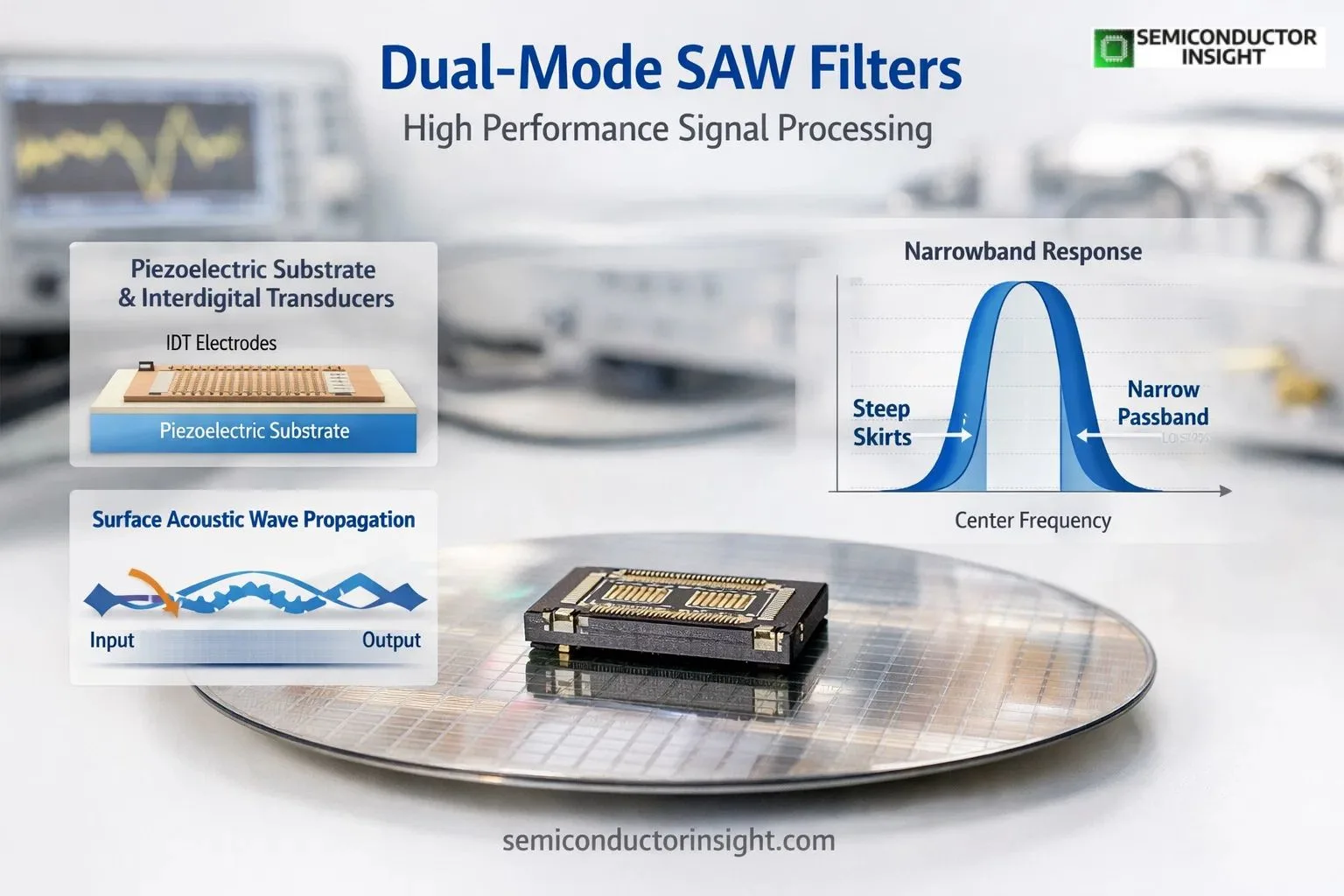
Dual mode SAW filters deliver compact, high-performance signal conditioning by leveraging two acoustic resonances within a single piezoelectric structure. Engineers design these devices to achieve narrow passbands with steep skirts while maintaining low insertion loss, making them valuable for RF front-ends where space and power efficiency matter.
The technology converts electrical signals into surface acoustic waves that propagate along a carefully cut crystal substrate, then reconverts them at the output with precise frequency selectivity.
Piezoelectric Substrate Fundamentals and Acoustic Wave Propagation in Dual Mode Designs
- The core of any dual mode SAW filter rests on piezoelectric materials that translate voltage into mechanical vibration. Common substrates include 42° YX lithium tantalate for leaky-wave behavior and quartz cuts for superior temperature stability with a turnover point near room temperature.
- Surface acoustic wave velocity typically reaches around 3158 m/s on ST-quartz, while lithium niobate variants push higher phase velocities.
- In dual-mode configurations, designers excite both a primary mode and a secondary resonance often through longitudinally coupled resonators or distributed gaps between long interdigital transducers.
- This creates a hiccup-type resonance that narrows the effective bandwidth to 1-2% of center frequency while preserving insertion loss near 1.5 dB in optimized prototypes.
- The interdigital transducer finger width directly sets the operating wavelength and sampling frequency, with power handling tied to electrode thickness and metal choice.
Manufacturing Precision Techniques for Interdigital Transducers and Temperature Compensation
Fabrication begins with photolithography on polished piezoelectric wafers to pattern aluminum or copper electrodes with micron-level accuracy. For temperature-compensated variants, engineers deposit a silicon dioxide overlay on lithium niobate to flatten the frequency-temperature curve, reducing drift to levels suitable for demanding mobile environments.
Recent hybrid approaches combine dual-mode resonators with hetero-acoustic layers, such as LiTaO3-on-quartz, to boost quality factor while controlling spurious bulk-wave leakage. Wafer-level packaging further miniaturizes the devices, enabling footprints under 1 mm² for integration into dense RF modules. Government and standards bodies emphasize rigorous testing for insertion loss, typically targeting under 3 dB in production, alongside side-lobe suppression exceeding 30-40 dB to prevent interference in crowded spectrum bands.
Dual Resonance Mechanisms Enabling Narrowband Selectivity and Low Loss Performance
In double-resonance architectures, long transducers generate a synchronous resonance while short distributed-gap sections create a localized secondary peak. This combination yields passbands as tight as 25 MHz at 1575 MHz center frequencies with minimum insertion loss around 1.07 dB in balanced configurations.
Amplitude balance stays within 0-2 dB and phase imbalance 1-3.5 degrees across the passband, supporting balun functionality without extra components. The design suppresses triple-transit echoes signals that reflect and regenerate by optimizing aperture and finger count relative to the electromechanical coupling coefficient K². Bulk acoustic wave scattering remains a key control point; proper reflector placement and damping materials absorb unwanted energy traveling into the substrate depth.
Feel Free to Reach Our Most Recent Updates of the Report: https://semiconductorinsight.com/report/dual-mode-saw-filter-market/
Integration Strategies with RF Front-End Modules and Signal Chain Optimization
- Modern RF architectures place dual mode SAW filters early in the receive chain to provide sharp channel selection before low-noise amplification.
- Their compact size allows seamless pairing with low-noise amplifiers and switches in multi-band modules handling sub-1 GHz to 2.5 GHz ranges where SAW technology maintains clear advantages in size and cost.
- In radar and navigation systems, these filters support pulse compression by introducing controlled time delays across frequency components, sharpening return signals for better range resolution.
- Designers sequence the dual resonances to align with specific communication standards, ensuring steep roll-off that rejects adjacent-channel interference while passing the desired 1-2% bandwidth with minimal distortion.
Hybrid integration with thin-film bulk acoustic resonators extends coverage into higher frequencies, creating tiered filtering solutions that optimize each technology’s strengths.

Comments (0)