

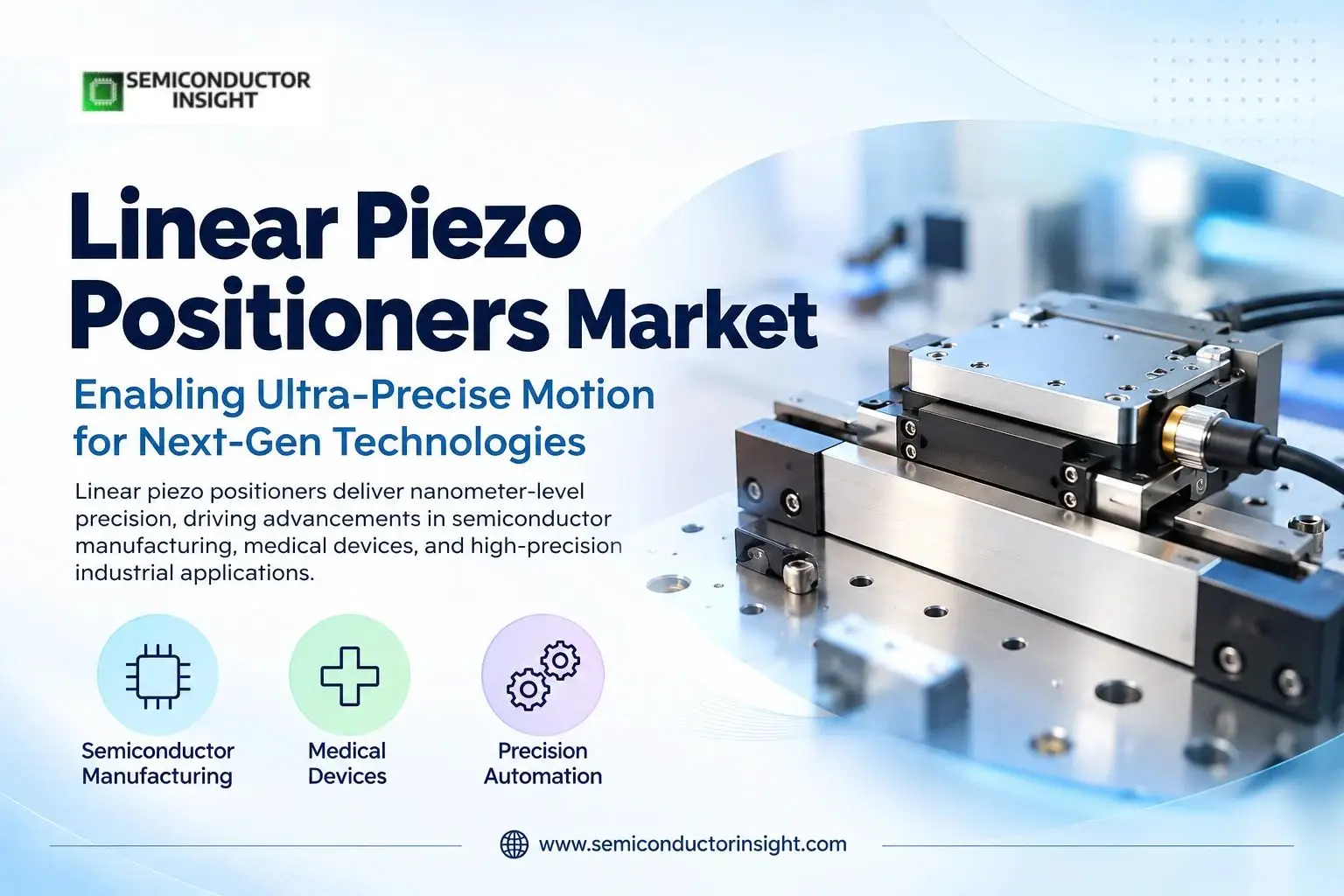
Advanced Lithography and linear piezo positioners market driving the Race for Sub-Nanometer Precision
Linear piezo positioners market is gaining relevance as semiconductor manufacturers pursue tighter alignment tolerances, faster inspection cycles and increasingly complex chip architectures. Linear piezo positioners convert electrical energy into extremely small mechanical movements, enabling precise positioning in wafer inspection, optical alignment, semiconductor metrology and advanced manufacturing equipment.
Piezoelectric nanopositioners are excellent at short-range movement, quick settling, and precise motion control, in contrast to traditional motorized stages built for larger travel distances. Wherever a small positioning inaccuracy can impact measurement precision, pattern alignment, or defect identification, their significance is increasing.
High-NA EUV Brings Precision Motion into Focus
A significant industry development arrived in July 2026, when ASML announced that Intel Foundry had entered high-volume manufacturing for selected Intel Core Ultra Series 3 processor layers using its High-NA EUV lithography technology. In September, Intel and ASML reported further progress, including more than one million wafers processed across certification, testing, research and development, and selected production activities. These milestones highlight the increasingly demanding motion and measurement requirements of advanced lithography. ASML.
Linear piezo positioners are not equivalent to the large wafer stages inside lithography scanners. Instead, they can serve complementary functions in precision alignment, optical inspection, and calibration and metrology subsystems. As lithography systems evolve, supporting equipment must maintain exceptional accuracy without introducing unwanted vibration or thermal drift.
The Difference between Resolution and Repeatability
- In precision motion control, resolution describes the smallest detectable or commanded movement, while repeatability describes how consistently a position can be reached. Neither specification alone guarantees system-level accuracy.
- Physik Instrumente’s published linear piezo flexure-stage specifications illustrate the scale of performance available. Its PIHera positioners include travel ranges from tens of micrometres to 1,800 micrometres, with bidirectional repeatability specified down to 1 nanometre on selected models.
- Some compact piezo stages offer resolution down to 0.2 nanometres. These are product-specific specifications, not universal performance levels across the market. PI linear piezo stages.
- For equipment designers, the practical task is to match travel range, payload, settling time and feedback accuracy to the measurement process rather than selecting a stage based on resolution alone.
Why Flexure Guidance Matters Inside Inspection Tools?
Traditional sliding mechanisms can introduce friction, backlash and wear. Flexure-guided piezo positioners instead use elastic deformation within a mechanical structure to guide movement, helping eliminate sliding friction and reversal play.
This design is particularly useful in semiconductor metrology, where positioning must remain stable during repeated scanning. Capacitive sensors and closed-loop controllers can measure actual movement and compensate for deviations from the commanded position.
PI’s published nanopositioning systems include configurations for semiconductor inspection, interferometry and wafer metrology, with options for multi-axis movement and vacuum-compatible operation. Such capabilities help equipment developers integrate fine positioning into demanding measurement environments. PI semiconductor motion solutions
Don’t Forget to Surf Our Updated Report for More Detailed Analysis: https://semiconductorinsight.com/report/linear-piezo-positioners-market/
AI Chip Investment Expands the Precision Equipment Ecosystem
- The wider semiconductor equipment industry provides useful context for this niche market.
- SEMI reported that worldwide semiconductor manufacturing equipment sales reached $135.1 billion in 2025, up 15% from 2024.
- Its July 2026 forecast projected total equipment sales of $165.9 billion for 2026, supported by investment in advanced logic, memory, AI computing and high-bandwidth memory.
- These figures represent the overall semiconductor equipment industry, not linear piezo positioners market.
- However, continued investment in advanced manufacturing and inspection creates opportunities for specialized motion-control components used within selected tools. SEMI equipment outlook
The Next Engineering Frontier Is Faster and More Stable Motion
The next generation of linear piezo positioners will be judged by how effectively precision, speed and stability work together. Higher scanning frequencies, multi-axis alignment, compact stage architecture and improved sensor feedback are becoming important design considerations.
For semiconductor equipment manufacturers, the priority is not simply achieving sub-nanometre resolution under ideal laboratory conditions. It is sustaining repeatable performance under production conditions, where vibration, heat, payload changes and continuous operation can influence results.
As advanced lithography and semiconductor metrology continue to evolve, linear piezo positioners remain a specialized but important enabling technology. Their value lies in making tiny movements predictable, measurable and repeatable, supporting the inspection and alignment systems needed to manufacture increasingly sophisticated chips.

Comments (0)