Key Statistics
Key Takeaways
- Power ultrasonic transducers form the strongest growth path because industrial cleaning, welding, liquid processing and medical therapeutic systems need high electromechanical power conversion and robust operation at defined resonance.
- Industrial manufacturing and healthcare provide two different but durable demand engines: factories use ultrasound for process, sensing and non-destructive applications, while medical imaging and therapeutic systems rely on precisely controlled transducers for acoustic generation and detection.
- Asia Pacific is the largest region, supported by electronics manufacturing, industrial automation, automotive output and a dense piezoceramic supply base. IFR recorded 401,665 industrial robots installed in Asia in 2024, equal to 74% of global installations.
- Lead-content regulation is a material technology constraint. EU Directive 2025/2363 retains an exemption for lead in PZT piezoelectric ceramics through 31 December 2027, while suppliers continue developing lead-free materials to prepare for tighter environmental requirements.
- Application engineering is a major competitive differentiator. Material formulation, geometry, electrode design, resonance tuning, acoustic matching and housing integration determine transducer performance, so suppliers compete through custom engineering as much as through ceramic manufacturing scale.
Piezoelectric Ceramic Transducer Market Overview
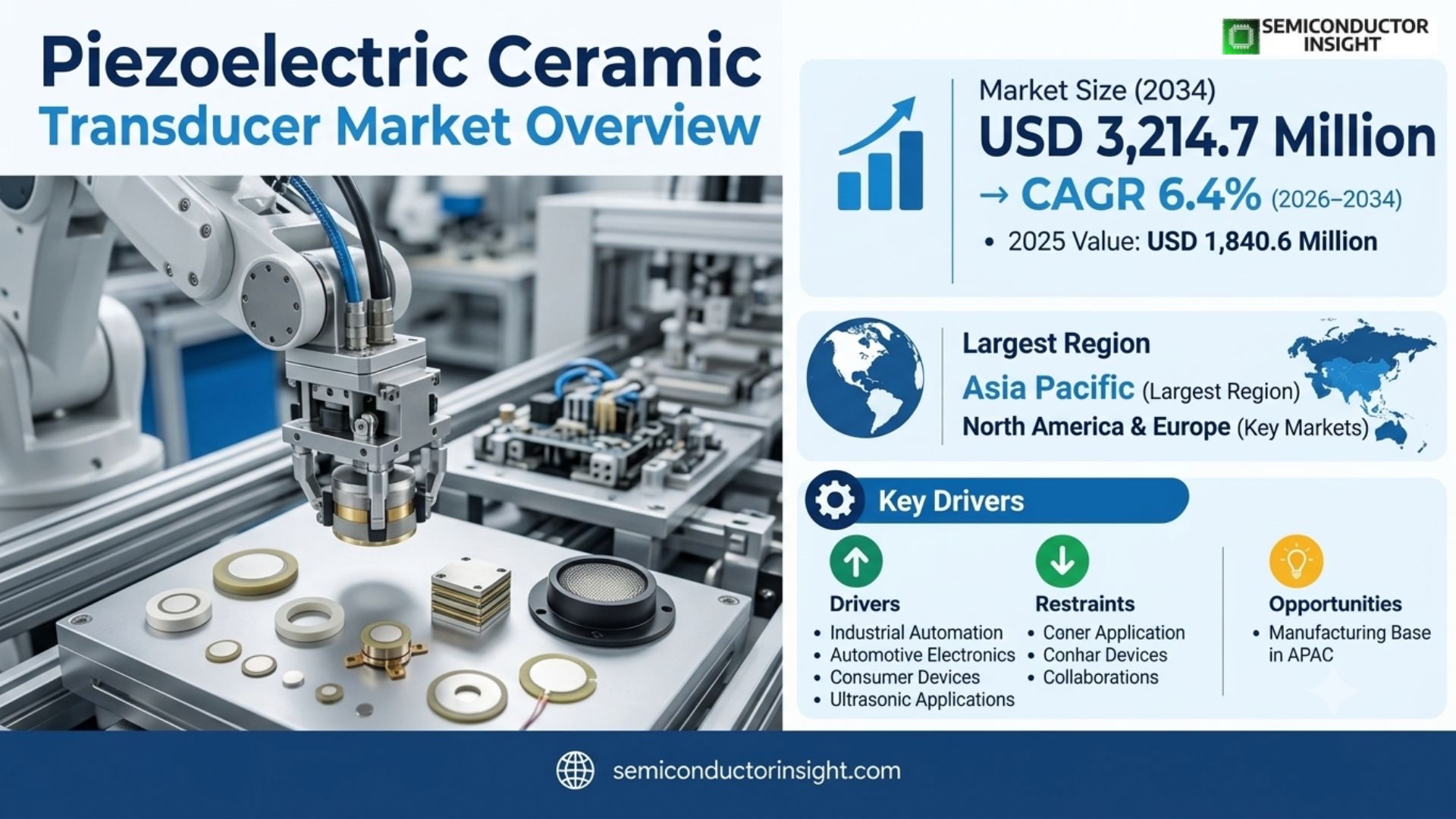
Piezoelectric Ceramic Transducer market is rebased to USD 1,840.6 million in 2025 and is projected to reach USD 3,214.7 million by 2034, representing a 6.4% CAGR during 2026–2034. Asia Pacific is the largest region, with demand supported by industrial automation, automotive electronics, consumer devices and a broad manufacturing base for piezoceramic components and ultrasonic systems.
Piezoelectric ceramic transducers convert electrical energy into mechanical strain or vibration and can also perform the reverse conversion from mechanical stress into an electrical signal. This bidirectional behavior allows one material platform to serve actuators, ultrasonic emitters, receivers, pressure or vibration sensing and precision motion functions. Commercial performance depends on the ceramic composition, poling, geometry, electrode system, resonance mode, mechanical preload and acoustic coupling, so the transducer is often engineered as part of the customer’s system rather than purchased as a generic component.
The demand base is diversified. Industrial systems use power ultrasound for cleaning, welding and processing, while test transducers support non-destructive evaluation and thickness or flaw measurement. Medical ultrasound uses a transducer probe to transmit and receive high-frequency sound, producing real-time images without ionizing radiation exposure according to the U.S. FDA. Automotive applications include ultrasonic sensing and other electromechanical functions, while consumer and industrial products use piezo elements for switches, printing, vibration control and compact sensing.
Automation strengthens the industrial case. The International Federation of Robotics recorded 542,000 industrial robots installed worldwide in 2024, with Asia accounting for 74% of deployments and China alone installing 295,045 units. These robot figures do not represent transducer shipments, but they quantify the scale of automated manufacturing environments that use ultrasonic welding, precision sensing, inspection and process-control technologies. At the same time, material suppliers face regulatory pressure to reduce lead while preserving the strong performance of PZT ceramics.
Segment Analysis: By Type
By type, the market is segmented into Power Ultrasonic Transducers and Test Ultrasonic Transducers. Power devices are designed to transmit meaningful acoustic energy into a process, while test devices prioritize controlled pulse generation, sensitivity, bandwidth and repeatable signal reception. The commercial requirements therefore differ: power products compete on robustness and energy transfer, while test products compete on signal quality, calibration and measurement reliability.
| Type | Technical role | Market position and purchasing logic |
|---|---|---|
| Power Ultrasonic Transducers | Power ultrasonic transducers use piezoceramic stacks or rings to create high-amplitude vibration for processes such as cleaning, welding, sonochemistry, liquid treatment and medical therapeutic applications. Designs must manage resonance, heat generation, mechanical preload and acoustic coupling while maintaining stable performance under repeated high-energy cycles. | This segment is positioned for faster growth because automation and precision processing expand the number of applications where ultrasound replaces mechanical, thermal or chemical processes. PI specifies power consumption up to 4,000 W at 20 kHz in noncontinuous operation for certain designs, illustrating the engineering intensity. Buyers value application tuning, reliability, converter/horn compatibility and service support more than ceramic cost alone. |
| Test Ultrasonic Transducers | Test transducers generate and receive controlled ultrasonic pulses for non-destructive testing, thickness measurement, flaw detection and material characterization. Contact, immersion and delay-line configurations allow engineers to optimize acoustic coupling and inspection geometry. , center frequency, sensitivity and repeatability are key performance variables. | Test transducers serve aerospace, energy, industrial manufacturing and maintenance applications where inspection integrity has high value. Demand is linked to asset quality and safety rather than production volume alone. Supplier differentiation comes from calibration, probe geometry, acoustic matching, ruggedness and the ability to design application-specific frequencies or housings for automated inspection systems. |
End-user engineering requirements
The report also identifies Automotive, Healthcare, Consumer Electronics, Industrial Manufacturing and Aerospace & Defense as end-user industries. These markets place different demands on piezoceramic technology: automotive emphasizes cost, temperature robustness and high-volume quality; healthcare emphasizes acoustic performance and regulatory control; consumer electronics values miniaturization; industrial manufacturing values durability and process integration; and aerospace and defense require high reliability in demanding environments. A supplier’s ability to adapt material, geometry and packaging to these application regimes is a core source of margin.
Segment Analysis: By Application
By application, the market is segmented into Piezo Switches, Ink Printing Head, Video Triggers, Piezoelectric Gyrometer and Others. The categories range from high-volume compact components to precision engineered sensing systems. Demand is therefore not governed by one unit-volume curve; value follows the amount of material engineering, calibration, packaging and reliability assurance required by each application.
| Application | Demand characteristics and commercial implication |
|---|---|
| Piezo Switches | Piezo switches use a ceramic element to detect mechanical force without conventional moving contacts. Their sealed construction can be attractive in industrial, medical and harsh-environment interfaces where ingress protection, long cycle life and compact form factor matter. Commercial demand depends on integration into finished control panels and devices, with suppliers competing on force response, mounting design, environmental sealing and repeatable electrical output. |
| Ink Printing Head | Piezoelectric inkjet heads use precisely controlled deformation to eject droplets, enabling industrial printing, graphics, textile, coding and functional-material deposition. The application requires tight dimensional control and repeatable actuation across many channels. Component value is tied to frequency response, lifetime, chemical compatibility and manufacturing uniformity, so qualified material and actuator suppliers can become deeply embedded in a printhead platform. |
| Video Triggers | Video-trigger and related event-sensing applications use piezo elements to detect shock, vibration or mechanical events and convert them into electrical signals. These are smaller niches but demonstrate the sensor versatility of ceramic transducers. Purchasing criteria emphasize sensitivity, response consistency and mechanical packaging, and demand is usually tied to the design cycle of a broader instrument or monitoring platform rather than stand-alone component replacement. |
| Piezoelectric Gyrometer | Piezoelectric gyrometers and vibration-based inertial devices use resonant structures to detect rotation or motion. They compete with MEMS and other inertial technologies, so piezoelectric designs must offer a clear advantage in stability, environmental tolerance or application-specific performance. The market opportunity is concentrated in specialized systems rather than broad consumer inertial sensing, making engineering differentiation and long-term customer qualification central to commercial success. |
| Others | Other applications include ultrasonic sensing, medical imaging, non-destructive testing, actuators, nebulization, energy harvesting and specialty instrumentation. This category is commercially significant because many high-value piezoelectric uses are application-specific and do not fit a single mass-market classification. Suppliers with rapid prototyping, materials expertise and acoustic or mechanical simulation can convert fragmented engineering projects into recurring production programs. |
Regional Analysis
Asia Pacific leads the Piezoelectric Ceramic Transducer market through its combination of electronics manufacturing, industrial automation, automotive production and piezoceramic supply. Europe has a strong industrial, automotive and precision-engineering base, while North America is important in medical, aerospace, industrial and technology applications. South America and Middle East & Africa remain smaller and more import dependent, with demand centered on industrial, healthcare, automotive and infrastructure systems.
How do measurable downstream indicators explain regional transducer demand?
Regional transducer demand can be assessed through the industries that consume ultrasonic and piezoelectric devices. IFR reported 542,000 industrial robots installed in 2024: 74% in Asia, 16% in Europe and 9% in the Americas. OICA reported 96.38 million vehicles produced in 2025, including 59.21 million in Asia-Oceania, 17.20 million in Europe and 3.17 million in South America. These statistics are not transducer market shares; they indicate the scale of automation and automotive production that creates downstream sensing, welding and control applications.
| Region | Market position | Growth outlook | Demand profile | Key evidence / access factor |
|---|---|---|---|---|
| Asia Pacific | Largest | Highest | Manufacturing and automation led | 401,665 industrial robots were installed in Asia in 2024; Asia-Oceania produced 59.21 million vehicles in 2025. |
| Europe | Second major demand base | Steady | Industrial, automotive, medical | 85,006 industrial robots installed in 2024; 17.20 million vehicles produced in 2025. |
| North America | High-value | Steady | Medical, aerospace, automotive, industrial | The Americas accounted for 9% of 2024 robot installations; U.S. vehicle output was 10.24 million in 2025. |
| South America | Smaller | Selective | Automotive and industrial | 3.17 million vehicles produced in 2025, led by Brazil at 2.64 million. |
| Middle East & Africa | Smaller | Project led | Industrial, healthcare and infrastructure | Africa produced 1.23 million vehicles in 2025; transducer supply remains strongly import dependent. |
Key Piezoelectric Ceramic Transducer Manufacturers and Competitive Landscape
Piezoelectric ceramic transducer competition is application-engineering intensive. Ceramic composition determines the fundamental electromechanical properties, but finished performance also depends on geometry, poling, electrode design, mechanical preload, acoustic matching, bonding and housing. Suppliers that can control the full design chain can solve customer problems faster and command higher value than vendors selling undifferentiated ceramic shapes.
The profiled supplier group spans Asian ultrasonic specialists, European precision-motion and piezo technology companies, and North American custom piezoceramic manufacturers. This fragmentation reflects the market’s application diversity. A company strong in high-power cleaning transducers may not compete directly with a supplier focused on medical imaging, non-destructive testing or precision sensing. Technical credibility in the target application is therefore more important than a broad catalog alone.
PI illustrates the engineering model: its technical documentation covers materials selection, electrode options, bonding, acoustically matched coatings and housings, while the company also states that it is developing lead-free materials. That breadth is commercially relevant because customers often need a complete transducer solution rather than a bare ceramic element. Suppliers that reduce customer integration work can defend margin and become involved earlier in system design.
Material regulation is becoming a competitive factor. PZT remains widely used because of its strong performance, but its lead content creates compliance risk. The EU’s current exemption runs through the end of 2027 for the specified PZT use. Companies investing in lead-free alternatives can position for future regulation, but they must prove that new compositions meet lifetime, temperature and electromechanical requirements before customers will requalify established systems.
Tier structure
| Competitive tier | Representative companies | How they compete |
|---|---|---|
| Integrated piezo technology leaders | PI (Physik Instrumente), TG (Tokyo Denpa), NTK and other material-to-component specialists | Compete through material formulation, precision processing, custom engineering and the ability to deliver complete transducer or actuator solutions. Their advantage is deep application knowledge and control of critical process steps. |
| Ultrasonic specialists | HC Sonic, Siansonic, Hongsheng Acoustics, Kesen, Henbo, SWT | Focus on power ultrasonics, industrial systems and application-specific transducers. They compete on power handling, resonance tuning, cost, response speed and integration with converters, horns or process equipment. |
| Custom North American specialists | APC International, Piezo Technologies, SE (Sensitron) | Serve medical, aerospace, industrial and research applications where geometry, material, documentation and lower-volume customization are important. Customer relationships can be sticky because requalification of a tuned transducer is costly. |
Key companies profiled
TG (Tokyo Denpa), HC Sonic, PI (Physik Instrumente), SE (Sensitron), Hongsheng Acoustics, Kesen, Devey, Henbo, SWT, NTK, Siansonic, APC International, Piezo Technologies.
Piezoelectric Ceramic Transducer Production Capacity Analysis
Production capacity is constrained by qualified ceramic and transducer processing rather than raw ceramic tonnage alone. Powder preparation, calcination, forming, sintering, machining, electrode deposition, poling, bonding and final acoustic or electrical testing all influence yield. For power and medical devices, assembly steps such as preload, matching layers and housing can become the bottleneck even when piezoceramic element capacity is available.
Piezoceramic production requires tight control of composition and microstructure because dielectric, coupling and mechanical properties can shift with processing conditions. Batch consistency matters for customers that tune electronics or mechanical systems to a narrow resonance range. As a result, usable capacity is the volume that meets the target property window, not simply the number of sintered parts a factory can produce.
Power ultrasonic transducers add mechanical assembly constraints. Bolted Langevin-style stacks, for example, depend on preload, ring geometry and metal interfaces. PI’s published power-transducer range includes designs above 20 kHz with maximum power consumption up to 4,000 W at 20 kHz in noncontinuous operation. Such performance requires controlled assembly and test, limiting the degree to which generic ceramic capacity can be converted instantly into qualified high-power output.
Regulatory change can also influence capacity strategy. If customers accelerate migration toward lead-free materials, suppliers may need parallel material lines, new sintering recipes and separate qualification programs. Until performance equivalence is proven, companies may need to support both conventional PZT and alternative compositions, increasing development complexity and reducing the fungibility of production equipment and test resources.
| Capacity factor | Technical constraint | Commercial consequence |
|---|---|---|
| Material formulation and sintering | Small composition or process changes alter coupling, dielectric loss, Curie temperature and mechanical quality factor. | Qualified capacity is tied to stable material recipes; rapid supplier substitution can require system retuning and reliability validation. |
| Poling, machining and electrode quality | Geometry and polarization define active behavior, while electrode integrity affects current delivery and long-term reliability. | Precision processing and in-line test can constrain output for tight-tolerance medical, industrial and sensing applications. |
| Assembly and acoustic matching | Finished transducer performance depends on preload, bonding, matching layers, housings and coupling to the customer’s medium. | Integration know-how creates a higher barrier to entry than bare ceramic production and supports custom-engineering margins. |
Piezoelectric Ceramic Transducer Market Dynamics: Drivers, Restraints and Opportunities
Market growth is supported by industrial automation, ultrasonic processing, medical imaging, automotive sensing and broader use of precision electromechanical components. The main restraints are material regulation, performance sensitivity to manufacturing variation, competition from MEMS or electromagnetic alternatives and the engineering effort required for custom integration. Opportunities lie in lead-free materials, automated inspection, high-power ultrasound and miniaturized sensing.
MARKET DRIVERS
Drivers Impact Analysis*
| Factor | Direction / Intensity* | Commercial transmission mechanism |
|---|---|---|
| Industrial automation and ultrasonic processing | High | More automated manufacturing creates demand for welding, cleaning, inspection and process-control transducers. |
| Medical ultrasound and therapeutic applications | Medium–High | Imaging and treatment systems require highly engineered acoustic transducers with strong performance and qualification barriers. |
| Automotive sensing and manufacturing | Medium | Vehicle electronics and automated production lines support ultrasonic sensing, joining and inspection use cases. |
| Miniaturization of sensing and actuation | Medium | Thin and compact piezo devices enable new wearable, medical and embedded applications. |
Industrial automation expands the addressable ultrasonic process base
Factories increasingly automate joining, cleaning, inspection and process monitoring. IFR’s 542,000 industrial robot installations in 2024 quantify the scale of automation investment, with Asia accounting for 74%. Piezoelectric transducers benefit where ultrasound improves cycle time, cleanliness, precision or non-destructive measurement. The commercial value lies in process performance, so suppliers that can tune a transducer to the customer’s equipment can defend higher margins than generic component vendors.
Medical ultrasound sustains high-value engineering demand
Diagnostic ultrasound relies on transducer probes to transmit and receive sound, and the FDA notes that the technique provides real-time imaging without ionizing radiation. Medical transducers require carefully controlled materials, element geometry, matching and acoustic performance. Qualification, clinical system integration and reliability create high switching costs, making healthcare an attractive market for suppliers with materials expertise and manufacturing consistency.
Automotive electrification and electronics increase sensing content
Vehicles and vehicle factories use sensors and ultrasonic processes across parking assistance, object sensing, manufacturing and quality control. OICA recorded 96.38 million vehicles produced globally in 2025. The transducer opportunity depends on the electronic architecture and production process of each platform, but rising sensor content and automated manufacturing provide a broad demand base for rugged piezoelectric devices.
Material and form-factor innovation opens new designs
Flexible and miniaturized piezo elements can convert subtle force or vibration into electrical signals in spaces where conventional sensors are difficult to integrate. Murata’s Picoleaf demonstration is one example of thin piezoelectric sensing. As packaging and electronics shrink, suppliers that can deliver thinner structures, new electrode patterns and application-specific mechanical integration can access wearable, medical and industrial designs that were previously impractical.
MARKET RESTRAINTS
Restraints Impact Analysis*
| Factor | Direction / Intensity* | Commercial transmission mechanism |
|---|---|---|
| Lead-content regulation and material transition | High | PZT performance is strong, but regulatory pressure can force costly material redesign and customer requalification. |
| Manufacturing variability and tuning requirements | Medium–High | Small material or assembly deviations can shift resonance and reduce system efficiency or sensitivity. |
| Competition from MEMS/electromagnetic sensors | Medium | Alternative technologies can win when integration, cost or digital interface matters more than piezoelectric performance. |
| Custom engineering burden | Medium | Application-specific design lengthens sales cycles and makes scaling fragmented programs more difficult. |
PZT regulation creates a technology-transition risk
Lead zirconate titanate remains a dominant piezoceramic because of its strong electromechanical properties, but lead content creates environmental and regulatory pressure. The EU exemption under 7(c)-VI expires at the end of 2027. If rules tighten further, suppliers and customers may need to requalify lead-free compositions, which can change coupling, temperature stability, aging and process behavior and therefore raise engineering cost.
Performance is sensitive to process and mechanical integration
A transducer is a resonant electromechanical system. Variations in ceramic properties, dimensions, electrode thickness, bonding or preload can shift resonance or acoustic output. This makes high-yield manufacturing more difficult than producing a passive ceramic part. Customers often require tight binning or calibration, so suppliers need strong statistical process control and final testing that can limit throughput and increase cost.
Alternative sensing and actuation technologies compete application by application
MEMS, capacitive, electromagnetic and optical technologies can replace piezoelectric solutions when semiconductor integration, digital output, very low cost or different force/displacement behavior is more important. Piezoelectric ceramics retain advantages in force density, dynamic response and ultrasonic generation, but suppliers must prove those benefits in each design rather than assuming a universal technology preference.
MARKET OPPORTUNITIES
Lead-free piezoceramic materials
The approaching regulatory horizon in Europe creates a strategic opportunity for suppliers that can deliver lead-free materials with credible performance and reliability data. PI states that it is developing lead-free compositions. Early customer sampling can reduce future requalification risk and create preferred-supplier positions, but success depends on showing stable coupling, temperature behavior, aging and manufacturability rather than simply removing lead.
High-power ultrasonic processing
Ultrasonic welding, cleaning, liquid processing and medical power applications reward efficient energy conversion and robust resonance control. Suppliers that combine ceramic materials with complete stack, horn and converter engineering can sell a higher-value system function. Automation investment expands the potential customer base because high-throughput factories value repeatable, clean and precisely controlled joining or processing methods.
Automated non-destructive testing
Industrial quality systems are becoming more automated, using scanners, robotics and data analytics to inspect welds, composites and critical components. Test ultrasonic transducers can benefit from higher inspection throughput and more permanently installed monitoring. The opportunity favors probes with stable calibration, high bandwidth and geometry optimized for automated fixtures rather than manual inspection alone.
Thin and flexible sensing
Ultra-thin piezo sensors can be integrated into surfaces, wearables, medical devices and human-machine interfaces. These applications need low profile, sensitivity and mechanical compliance. Suppliers able to combine ceramic or composite materials with flexible electrodes, packaging and signal conditioning can move beyond traditional bulk transducers and participate in emerging form factors where sensor placement was previously constrained.
Piezoelectric Ceramic Transducer Supply Chain Analysis
Material formulation is the first major value point because the ceramic determines coupling, loss, mechanical quality and temperature behavior. A supplier can use multiple formulations to optimize high-power operation, sensitivity or actuator behavior, but each material introduces its own processing window. Customers often qualify a specific formulation, so changing powder chemistry is not a simple purchasing substitution and can require system retuning.
Element fabrication adds precision and yield risk. Sintered ceramics are hard and brittle, while final electrical behavior depends on dimensional tolerances, electrodes and poling. High-volume standard parts can be automated, but custom medical or industrial elements may require specialized machining and inspection. The economic challenge is to maintain repeatability while supporting a wide range of sizes, shapes and electrode configurations.
Transducer assembly captures additional value because acoustic and mechanical integration determine system performance. Matching layers, backing materials, housings and preload can change bandwidth and efficiency substantially. Suppliers that offer complete engineered assemblies reduce the customer’s integration burden and gain more influence over the final design, which can create stronger long-term relationships than selling bare ceramics through a catalog.
Recent Developments in the Piezoelectric Ceramic Transducer Market
The World Robotics 2025 release showed Asia captured 74% of new industrial robot deployments, Europe 16% and the Americas 9%. This is important to the piezoelectric transducer market because automated factories are major users of ultrasonic joining, precision sensing and non-destructive inspection. The data provide an external measure of the manufacturing environment supporting industrial transducer demand.
Murata’s showcase included Picoleaf, an ultra-thin flexible piezoelectric sensor designed to detect subtle pressing forces, alongside automotive and medical sensing technologies. The development demonstrates how piezoelectric materials are moving into thinner and more integrated sensing formats, creating opportunities beyond conventional rigid ultrasonic transducers.
Commission Delegated Directive (EU) 2025/2363 adds exemption 7(c)-VI for lead used in piezoelectric PZT ceramics and sets expiry at 31 December 2027. The decision creates a defined compliance horizon for European electronics and increases the strategic value of lead-free material development, qualification planning and customer communication.
REPORT SCOPE & SEGMENTATION
| Attribute | Coverage |
|---|---|
| Market | Piezoelectric Ceramic Transducer |
| Base year / forecast | 2025 base; 2026 estimate; 2034 forecast; 6.4% CAGR for 2026–2034 |
| By Type | Power Ultrasonic Transducers, Test Ultrasonic Transducers |
| By Application | Piezo Switches, Ink Printing Head, Video Triggers, Piezoelectric Gyrometer, Others |
| By End-User Industry | Automotive, Healthcare, Consumer Electronics, Industrial Manufacturing, Aerospace & Defense |
| Regions | North America, Europe, Asia Pacific, South America, Middle East & Africa |
| Companies profiled | TG (Tokyo Denpa), HC Sonic, PI (Physik Instrumente), SE (Sensitron), Hongsheng Acoustics, Kesen, Devey, Henbo, SWT, NTK, Siansonic, APC International, Piezo Technologies |
Frequently Asked Questions
What is the current size of the Piezoelectric Ceramic Transducer market?
The Piezoelectric Ceramic Transducer market is rebased to USD 1,840.6 million in 2025 and is projected to reach USD 3,214.7 million by 2034, representing a 6.4% CAGR during 2026–2034. Growth is supported by industrial automation, power ultrasonics, medical imaging, non-destructive testing, automotive sensing and specialized electromechanical applications. The market is engineering-intensive because material properties, resonance, geometry and acoustic or mechanical integration determine the performance of the finished device.
Which region leads the Piezoelectric Ceramic Transducer market?
Asia Pacific leads because it combines piezoceramic manufacturing, electronics production, automotive output and the world’s largest industrial automation base. IFR recorded 401,665 industrial robots installed in Asia during 2024, equal to 74% of global installations, while OICA recorded 59.21 million vehicles produced in Asia-Oceania in 2025. These broader industrial indicators support a large downstream environment for ultrasonic processing, inspection, sensing and precision transducer applications.
What are the main transducer types in the report?
The report segments the market into Power Ultrasonic Transducers and Test Ultrasonic Transducers. Power transducers convert electrical input into high-amplitude acoustic energy for welding, cleaning, processing and therapeutic applications. Test transducers are optimized for controlled pulse generation and reception in non-destructive testing and measurement. The first category prioritizes power handling and mechanical robustness, while the second prioritizes sensitivity, bandwidth, repeatability and calibration across defined inspection geometries.
Which applications are included in the Piezoelectric Ceramic Transducer market?
The report covers Piezo Switches, Ink Printing Head, Video Triggers, Piezoelectric Gyrometer and Others. It also identifies Automotive, Healthcare, Consumer Electronics, Industrial Manufacturing and Aerospace & Defense as end-user industries. The diversity is important because each application needs a different balance of coupling, force, displacement, frequency, bandwidth, temperature behavior and packaging. Suppliers therefore compete through material and application engineering rather than a single standardized transducer specification.
How does industrial automation support piezoelectric transducer demand?
Industrial automation creates demand for ultrasonic welding, cleaning, precision sensing, vibration control and non-destructive inspection. IFR recorded 542,000 industrial robots installed worldwide in 2024, demonstrating the scale of automated manufacturing investment. Piezoelectric transducers do not scale directly with robot count, but automated production lines increasingly use sensor-rich process equipment and tightly controlled joining or inspection methods. This expands the addressable market for transducers that improve repeatability, cycle time and quality assurance.
Why are piezoelectric transducers important in medical ultrasound?
The U.S. FDA describes ultrasound imaging as a real-time technique using high-frequency sound without ionizing radiation. A transducer probe sends sound into the body and receives reflected signals that are processed into an image. This function requires controlled acoustic transmission and sensitivity, making the transducer a core performance component. Medical applications can therefore support high value per device, but they also require strong manufacturing consistency, documentation and integration with the broader imaging or therapeutic system.
What is the significance of lead regulation for PZT ceramics?
PZT provides strong piezoelectric performance but contains lead. Commission Delegated Directive (EU) 2025/2363 provides an exemption for lead used in PZT piezoelectric ceramics under 7(c)-VI through 31 December 2027. This creates a defined regulatory horizon for European products. Suppliers are developing lead-free alternatives, but customers must validate that substitute materials meet electromechanical, temperature, aging and reliability requirements before changing established transducer designs, making the transition a multi-year engineering issue.
Which companies are profiled in the Piezoelectric Ceramic Transducer report?
The report profiles TG (Tokyo Denpa), HC Sonic, PI (Physik Instrumente), SE (Sensitron), Hongsheng Acoustics, Kesen, Devey, Henbo, SWT, NTK, Siansonic, APC International and Piezo Technologies. The companies span material specialists, ultrasonic manufacturers and custom transducer suppliers. Competitive strength varies by application and depends on ceramic formulation, machining, electrode technology, acoustic design, power handling, calibration, documentation and the ability to deliver customer-specific assemblies at repeatable production quality.
What are the major restraints on the market?
The main restraints are lead-content regulation, sensitivity to manufacturing variation, competition from MEMS or electromagnetic technologies and the engineering burden of custom designs. Piezoceramic performance can shift with composition, dimensions, electrodes, bonding and preload, so high-yield production requires tight process control. At the application level, customers will select another sensing or actuation technology when semiconductor integration, digital output, cost or a different motion profile is more important than the force density or ultrasonic performance of piezoelectric ceramics.
What is the 2026 market estimate for Piezoelectric Ceramic Transducers?
The rebased market series places the 2026 Piezoelectric Ceramic Transducer market at USD 1,958.2 million, between the USD 1,840.6 million 2025 base and the USD 3,214.7 million 2034 forecast. The corresponding 6.4% CAGR reflects diversified growth rather than dependence on one application. Industrial power ultrasound, healthcare, automated inspection, automotive sensing and emerging flexible piezo devices each contribute different demand and qualification cycles over the forecast period.
Research Sources & Evidence Base
View research sources used for this overview.
- International Federation of Robotics. World Robotics 2025 – Industrial Robots, 2024 global and regional industrial-robot installations, 25 September 2025.
- OICA. World Motor Vehicle Production by Country/Region and Type 2025, 2025 regional and country vehicle-production data used as downstream demand indicators.
- U.S. Food and Drug Administration. Ultrasound Imaging, ultrasound transducer function and non-ionizing imaging description.
- European Union / EUR-Lex. Commission Delegated Directive (EU) 2025/2363, PZT lead exemption 7(c)-VI and 31 December 2027 expiry.
- Murata Manufacturing. Murata to showcase sensing innovations enabling global connectivity at Sensors Converge 2025, Picoleaf flexible piezoelectric sensor and sensing product examples, 9 June 2025.
- PI Ceramic. Piezo Components for Ultrasonic Transducers, materials, medical applications and lead-free development.
- PI Ceramic. Power Ultrasonic Transducers for Industry and Medical Technology, power-ultrasound technical range including up to 4,000 W at 20 kHz noncontinuous operation.
Get Sample Report PDF for Exclusive Insights
Report Sample Includes
- Table of Contents
- List of Tables & Figures
- Charts, Research Methodology, and more...
 Download Sample Report PDF