

7 Key Innovations in AI-Driven Active Damping for Next-Gen Semiconductor Fabs
The semiconductor industry’s relentless pursuit of smaller nodes, specifically the transition to 3nm and 2nm processes, has transformed environmental stability from a standard requirement into the critical bottleneck for manufacturing yields. When a single vibration event can misalign a EUV lithography process and ruin millions of dollars worth of wafers, the equipment supporting these tools must achieve near-perfect silence.
- The market for active vibration isolation systems, specifically the control chips that power them, is no longer a niche segment but a cornerstone of advanced fab infrastructure.
- Industry data indicates that the demand for these specialized chips is experiencing a significant surge as fabrication facilities globally upgrade to handle the sensitivity of next-generation equipment.
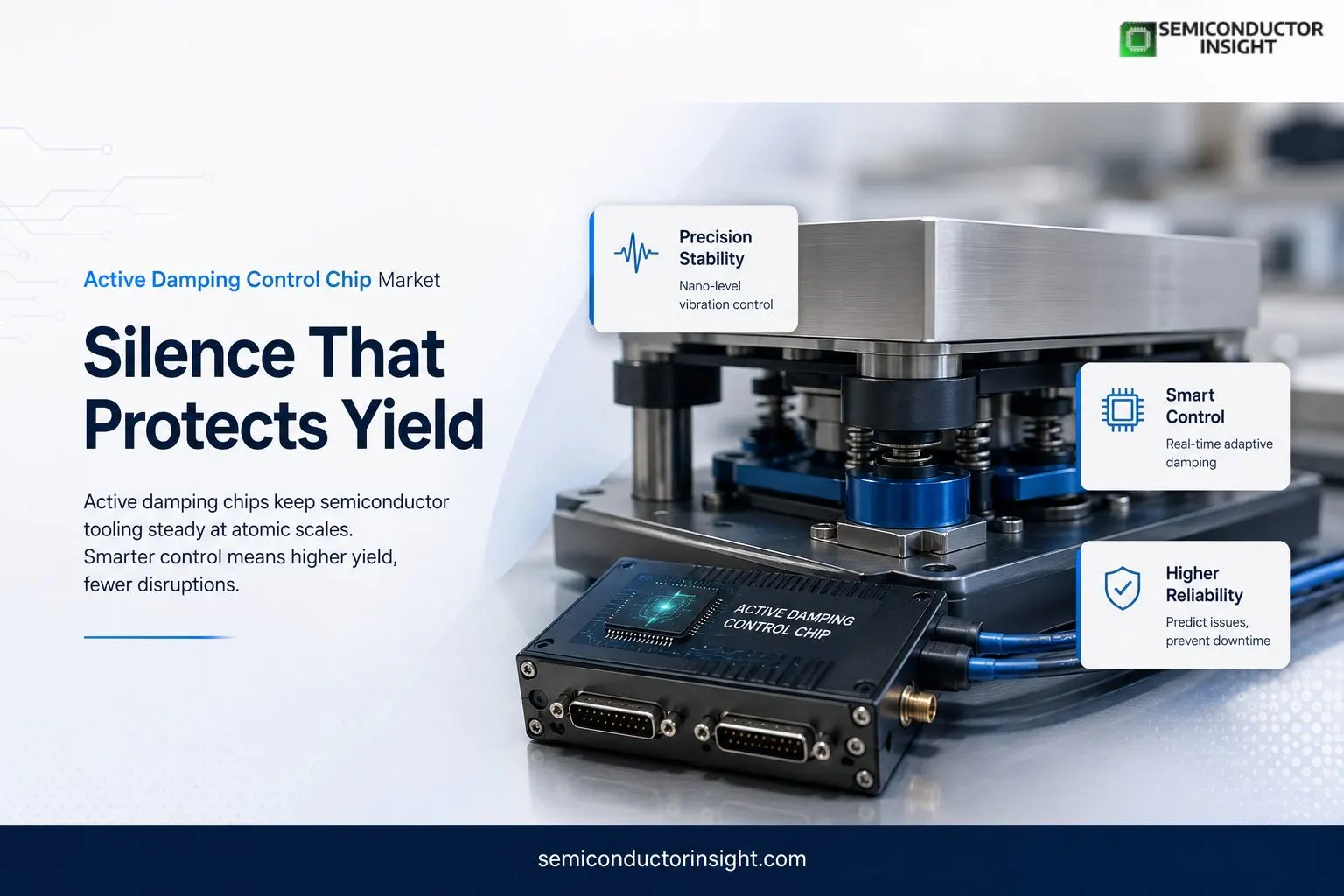
- This technology relies on a closed-loop control system where sensors detect vibration, a control chip processes the signal using complex algorithms, and an actuator generates a counteracting force, effectively canceling out ambient noise in real-time.
The Role of Active Damping in Defect Reduction
Vibration control in semiconductor manufacturing is categorized into passive and active methods. While passive systems use springs and rubber to absorb energy, active damping systems are essential for countering low-frequency vibrations that plague high-precision photolithography and inspection tools. These active systems are heavily dependent on the performance of the control chip, which acts as the brain of the operation.
The main technologies enabling these systems include piezoelectric actuators and MEMS-based (Micro-Electro-Mechanical Systems) sensors, and the choice between them often dictates the system’s sensitivity and response time. For instance, in a recent upgrade of a 28nm chip production line, the integration of an AI-enabled active isolation system, powered by next-generation control chips, successfully reduced overlay errors from 0.3nm to 0.12nm, demonstrating a tangible and direct improvement in yield and process capability.
Competitive Landscape and Regional Demand
- The global market for these high-precision solutions is seeing a notable shift in regional demand and manufacturing capabilities.
- Historically dominated by established players, the competitive landscape now includes a growing number of specialized firms focusing on system integration.
- Key players in this ecosystem range from large-scale equipment manufacturers to niche companies that provide dedicated vibration control solutions for specific tools.
- The market is also witnessing a shift in the supply chain for core components.
- While high-precision sensors and controllers have traditionally depended on imports from regions like Europe and Japan, there is a concerted push from domestic manufacturers to accelerate the development and production of these critical components.
- This local shift aims to reduce dependency and foster a more resilient supply chain for the global semiconductor industry.
- The value of this market continues to grow alongside the complexity of chip design.
To Stay Tuned with More meaningful and In-Depth Insights, Do Visit here: https://semiconductorinsight.com/report/ai-fab-vibration-isolation-table-active-damping-control-chip-market/
The Strain on Manufacturing Infrastructure
As chip designs become more complex and fabs operate around the clock, unscheduled downtime from equipment failure is a massive cost driver. The industry is moving toward predictive maintenance, where advanced control chips do more than just react; they analyze vibration data to predict potential equipment breakdowns before they occur.
This capability is becoming a key differentiator, as companies that integrate AI pre-judgment algorithms into their active damping systems report a substantial reduction in equipment fault response times by as much as 65% according to some industry reports. This transformation positions the active damping chip not just as a stabilizer, but as a strategic tool for improving overall equipment effectiveness (OEE) and managing operational costs.
A Critical Component in the Chip Manufacturing Ecosystem
- The importance of environmental control extends beyond just the lithography step.
- As packaging technologies become more sophisticated to meet the demands of high-performance computing and AI accelerators, the need for ultra-stable manufacturing environments in advanced packaging facilities is creating new growth vectors for the vibration isolation market.
- The industry’s gross profit margin for these specialized solutions remains healthy, ranging between 30% and 40%, which incentivizes continued investment and innovation.
The ongoing push toward improving semiconductor manufacturing processes ensures that the market for active damping solutions and their control chips remains a focal point for investment and technological development.

Comments (0)