
5G RF Transceiver Chip Market Powering the Invisible Backbone of Ultra-Fast Connectivity
5G RF transceiver chip market sits at the heart of modern wireless communication quietly enabling everything from ultra-fast smartphone downloads to industrial automation. These chips act as translators, converting radio frequency signals into digital data and back again, forming the essential bridge between physical networks and digital experiences.
With over 1.4 billion active 5G connections recorded by early 2024, the demand for high-performance RF transceivers has intensified across telecom infrastructure and consumer devices. What makes this market particularly dynamic is not just growth in device numbers, but the increasing complexity of communication standards, frequency bands, and real-time data requirements.
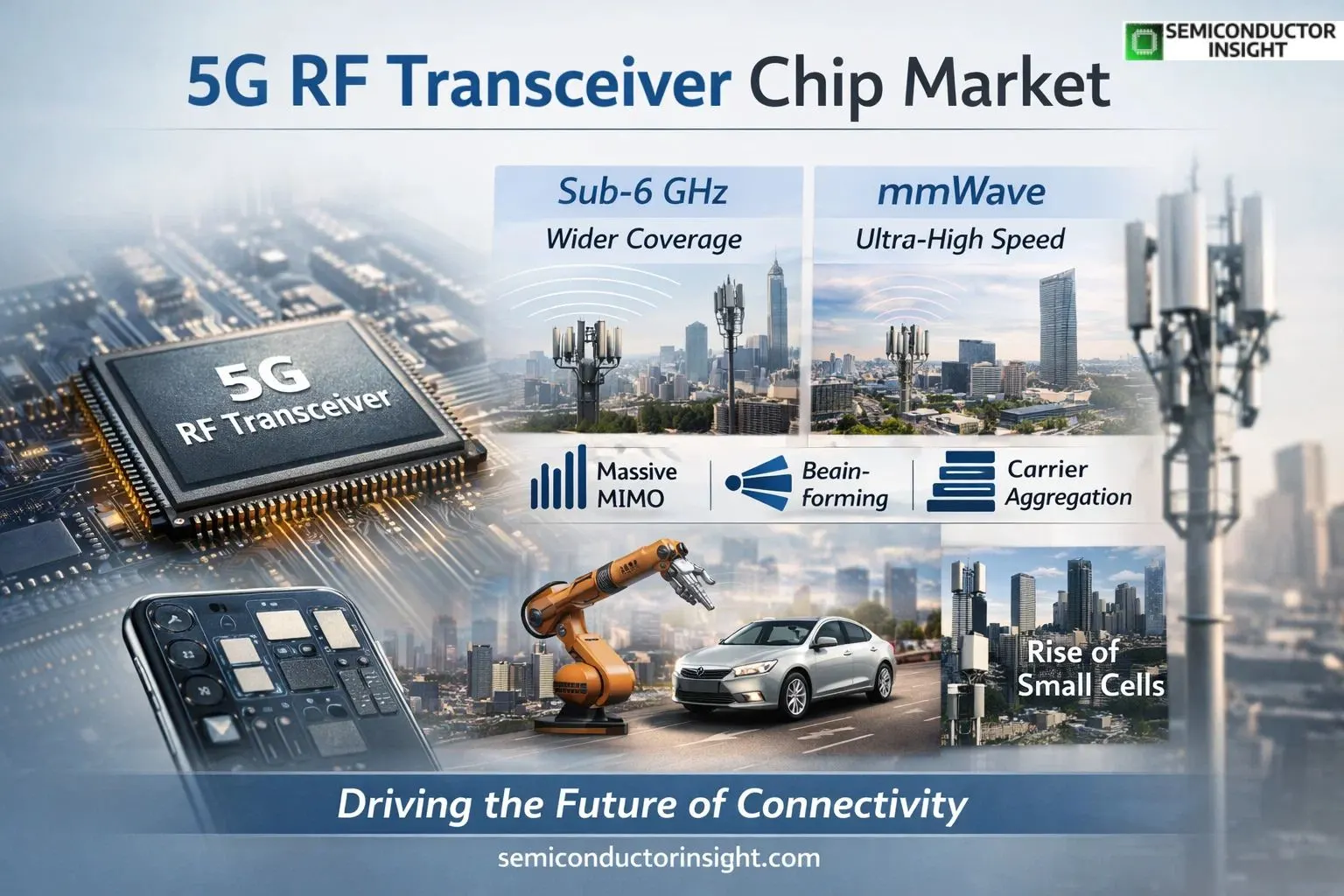
In contrast to previous generations, 5G brings a dual-frequency ecosystem, mmWave for ultra-high speeds and Sub-6 GHz for extensive coverage putting RF transceiver chips at the forefront of technological progress.
Inside the Chip How 5G Signals Are Engineered?
At a technical level, 5G RF transceiver chips are far more advanced than their 4G predecessors. A typical 5G smartphone today contains 40-50% more RF components than a 4G device, reflecting the added complexity of handling multiple frequency bands and higher data throughput.
These chips operate across a broad spectrum. Sub-6 GHz frequencies deliver stable connectivity across cities and rural regions, while mmWave bands generally above 24 GHz unlock extremely high data speeds but require dense infrastructure due to limited signal range.
What makes modern transceivers remarkable is their ability to support technologies like:
- Massive MIMO (multiple antennas handling simultaneous signals)
- Beamforming (directing signals toward users instead of broadcasting widely)
- Carrier aggregation (combining multiple frequency bands for higher speeds)
This combination allows devices to seamlessly switch between coverage and performance modes depending on the environment.
Let’s Go Through Sub-6 GHz vs mmWave Reality
5G RF transceiver chip market is deeply shaped by the competition between frequency bands. Sub-6 GHz continues to dominate global deployments due to its balanced coverage and cost efficiency, making it ideal for early-stage network expansion.
In contrast, mmWave operates in highly specific bands such as 24-30 GHz, 37-43.5 GHz, and up to 86 GHz, with the 37-43.5 GHz segment alone accounting for over 32% of mmWave usage in upcoming deployments.
However, mmWave introduces engineering challenges. Signals weaken quickly, often covering only short distances and requiring dense networks of small cells. This has led to hybrid deployment strategies where RF transceiver chips must dynamically adapt between frequency layers an area where innovation is accelerating rapidly.
For More Detailed Insights You Can Surf Our Latest Report Here: https://semiconductorinsight.com/report/5g-rf-transceiver-chip-market/?add_to_wishlist=4464
Smartphones as RF Laboratories
The modern smartphone has become the largest testing ground for RF transceiver innovation. Today, nearly 68% of total RF transceiver demand is driven by smartphones, making them the primary volume driver in the market.
What’s changing is not just volume, but architecture. Mid-range smartphones once limited to basic connectivity now integrate advanced multi-mode transceivers capable of handling both Sub-6 GHz and mmWave. This shift is expanding access to high-speed connectivity beyond premium devices.
Additionally, the internal design of smartphones is evolving. Engineers must now optimize antenna placement, thermal performance, and power efficiency, all while fitting increasingly complex RF modules into thinner devices.
Infrastructure Density and the Rise of Small Cells
- Beyond consumer devices, the rollout of 5G infrastructure is reshaping the RF transceiver landscape. 5G networks, in contrast to 4G towers, mainly rely on tiny cell deployments, particularly in urban areas where high-frequency signals have trouble travelling great distances.
- This shift means that a single city may require thousands of additional RF-enabled nodes, each powered by transceiver chips capable of handling high data loads and low latency communication.
- Airports, stadiums, and smart cities are emerging as key use cases. In these environments, RF transceivers must manage dense user traffic, often delivering gigabit-level speeds in confined spaces.
Advancing Industrial and Automotive Connectivity
The role of 5G RF transceiver chips is expanding beyond telecom and smartphones into sectors like automotive and industrial IoT.
In connected vehicles, these chips enable real-time communication between cars, infrastructure, and cloud systems supporting applications like collision avoidance and autonomous driving. Meanwhile, in industrial settings, the power smart factories where machines communicate instantly, reducing downtime and improving efficiency.
The integration of RF transceivers into these systems highlights a broader trend: wireless connectivity is becoming embedded in critical infrastructure, not just consumer technology.
Innovation at the Edge: Speed, Efficiency, and Future Possibilities
Recent breakthroughs suggest that RF transceiver technology is far from reaching its limits. Experimental designs have demonstrated wireless transmission speeds of up to 120 Gbps (15 GB per second) using advanced silicon-based transceivers operating at extremely high frequencies around 140 GHz.
These developments hint at a future where wireless communication could rival fiber optics in speed transforming industries like cloud computing and data centers.
At the same time, energy efficiency is becoming a key focus. New designs aim to reduce power consumption while maintaining performance, addressing one of the biggest challenges in RF engineering.
The Expanding Complexity of Wireless Ecosystems
The evolution of 5G RF transceiver chip market reflects a broader transformation in how communication systems are designed. No longer limited to simple signal transmission, these chips now operate within highly dynamic environments, balancing speed, coverage, and energy efficiency in real time.
As networks grow denser and applications become more demanding, RF transceivers are evolving into intelligent communication hubs quietly shaping the future of connectivity while remaining invisible to end users.

Comments (0)