

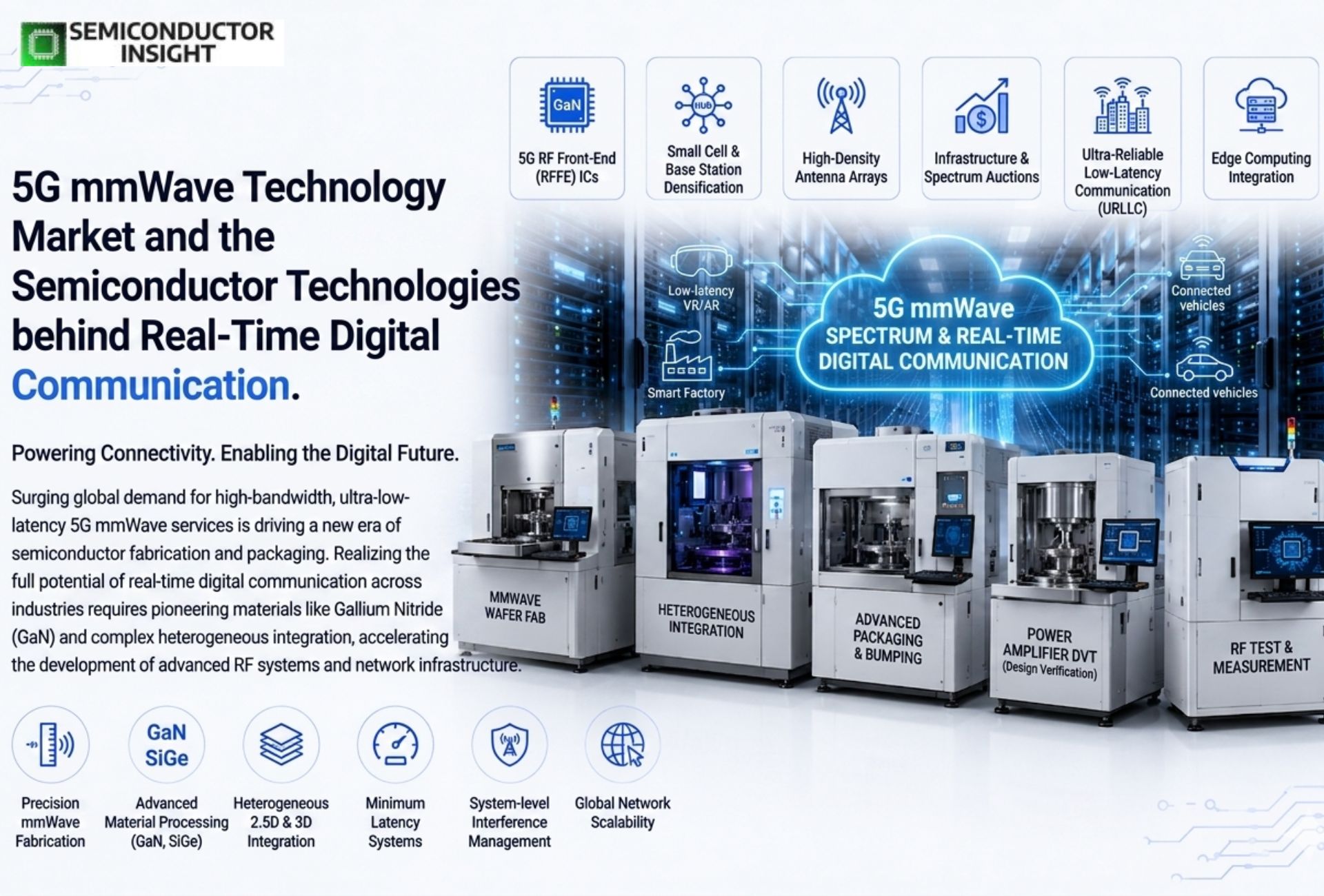
5G mm Wave Technology Market and the Semiconductor Technologies behind Real-Time Digital Communication
The semiconductor industry is rapidly transitioning toward high-frequency communication technologies as global data consumption reaches unprecedented levels. At the center of this shift is the 5G mm Wave technology market, where ultra-fast wireless transmission is becoming essential for connected infrastructure, industrial automation, immersive entertainment, and intelligent mobility systems.
Millimetre wave spectrum, commonly operating between 24 GHz and 100 GHz, enables significantly faster data transfer speeds and lower latency compared to traditional sub-6 GHz networks. Semiconductor companies are now designing specialized RF chips, beam forming modules, antenna arrays, and advanced packaging systems capable of supporting these demanding frequencies.
The technology is gaining momentum across dense urban deployments, stadiums, airports, manufacturing facilities, and smart transportation corridors where network congestion and real-time responsiveness are critical.
Want to learn more about the report? Check out our latest related updated version for free: https://semiconductorinsight.com/report/5g-mmwave-transparent-antenna-market/
Why mm Wave Semiconductor Design Is Becoming More Complex?
In contrast to traditional wireless systems, millimeter-wave communication adds significant semiconductor-level engineering complexity. For chip manufacturers, signal attenuation, temperature control, propagation constraints, and power efficiency are now crucial design factors.
To address these limitations, semiconductor developers are increasingly investing in advanced materials including gallium nitride (GaN), silicon germanium (SiGe), and RF CMOS technologies. These materials improve signal amplification and thermal stability while supporting compact device architectures.
Beamforming has also become a defining innovation within the 5G mm Wave ecosystem. Instead of broadcasting signals uniformly, beamforming chips direct concentrated wireless signals toward devices dynamically, improving reliability in crowded network environments.
The International Telecommunication Union (ITU) claims that cloud services, AI-driven apps, and high-definition video streaming are all contributing to the continued rapid growth of mobile data traffic worldwide. The requirement for semiconductor devices that can handle ultra-high bandwidth communication is growing as a result of this expansion.
Five Major Companies Shaping the 5G mm Wave Technology Market
- Qualcomm
- Qualcomm remains one of the most influential companies in mm Wave modem and RF front-end semiconductor development.
- Its Snapdragon platforms continue supporting premium smartphones and connected edge devices requiring ultra-fast wireless performance.
- NVIDIA
- NVIDIA’s AI infrastructure and edge computing technologies are increasingly connected with high-speed wireless networking environments where mm Wave capabilities support low-latency AI processing.
- Samsung Electronics
- Samsung continues investing heavily in mm Wave-enabled mobile chipsets, network infrastructure equipment, and advanced semiconductor fabrication technologies supporting 5G deployment.
- Broadcom
- Broadcom develops RF semiconductor solutions and networking technologies supporting high-capacity wireless communication across enterprise and telecom environments.
Stadium Networks and Smart Cities Are Becoming Real Time Test Zones
One of the most visible applications of mm Wave technology is emerging inside densely populated environments where conventional wireless infrastructure struggles under extreme traffic demand.
Major sports arenas and entertainment venues are increasingly deploying mm Wave-enabled networks to support thousands of simultaneous users streaming high-definition content. In several international airports, telecom providers are testing ultra-fast wireless systems capable of supporting AI-assisted navigation, biometric processing, and connected security systems.
Smart city initiatives are also contributing to semiconductor demand. Traffic monitoring systems, connected surveillance networks, autonomous mobility platforms, and industrial IoT deployments require extremely low latency communication environments where mm Wave semiconductors play a critical role.
Semiconductor Packaging Is Quietly Becoming a Strategic Battleground
- Advanced semiconductor packaging has become one of the most important yet less visible trends shaping the 5G mm Wave technology market.
- Traditional packaging methods often struggle at extremely high frequencies due to signal losses and thermal constraints. Semiconductor manufacturers are now adopting advanced heterogeneous integration techniques that combine RF chips, AI processors, memory components, and antenna systems within compact architectures.
- According to SEMI, the global semiconductor manufacturing ecosystem continues expanding investments in advanced wafer fabrication and packaging facilities to support next-generation wireless applications.
- Chiplet-based architectures are also gaining attention because they enable modular semiconductor scaling while improving power efficiency and reducing development complexity.
Data Centers and Edge AI Are Expanding the Need for Faster Wireless Infrastructure
The rapid growth of AI inference workloads and edge computing is indirectly accelerating demand across the mm Wave semiconductor ecosystem.
Modern AI applications increasingly require real-time data exchange between connected devices, local edge servers, and cloud infrastructure. Autonomous robotics, industrial automation systems, and immersive mixed-reality environments all depend on ultra-fast communication networks capable of handling enormous data volumes with minimal delay.
Cisco’s global networking studies have previously estimated that connected devices worldwide would exceed tens of billions of active endpoints, placing substantial pressure on wireless semiconductor infrastructure.
As enterprises continue deploying AI-driven systems closer to users, mm Wave communication is becoming increasingly important for maintaining low-latency operational performance.
The Smartphone Ecosystem Is Pushing Semiconductor Miniaturization Further
- Smartphone manufacturers remain among the largest adopters of mm Wave semiconductor technologies. However, integrating mm Wave antennas, RF modules, thermal systems, and battery-efficient chipsets into slim mobile devices remains technically demanding.
- Engineers are working aggressively to reduce antenna module size while improving energy efficiency and signal consistency. This has intensified innovation around compact RF front-end architectures and integrated antenna-in-package technologies.
- Several flagship smartphones launched globally during the past two years have incorporated advanced mm Wave support for faster streaming, cloud gaming, and real-time collaboration tools.
Universities and Research Labs Are Accelerating Next Generation Wireless Experiments
Research institutions worldwide are now exploring semiconductor architectures that may eventually support early 6G experimentation and terahertz communication.
Universities in the United States, South Korea, Japan, and Europe are collaborating with semiconductor companies on ultra-high-frequency transistor research, intelligent reflective surfaces, and adaptive wireless networks.
These research programs are helping expand the scientific foundation for future wireless ecosystems while creating new opportunities for semiconductor innovation beyond current 5G deployments.

Comments (0)