5G mmWave Transparent Antenna Market Insights
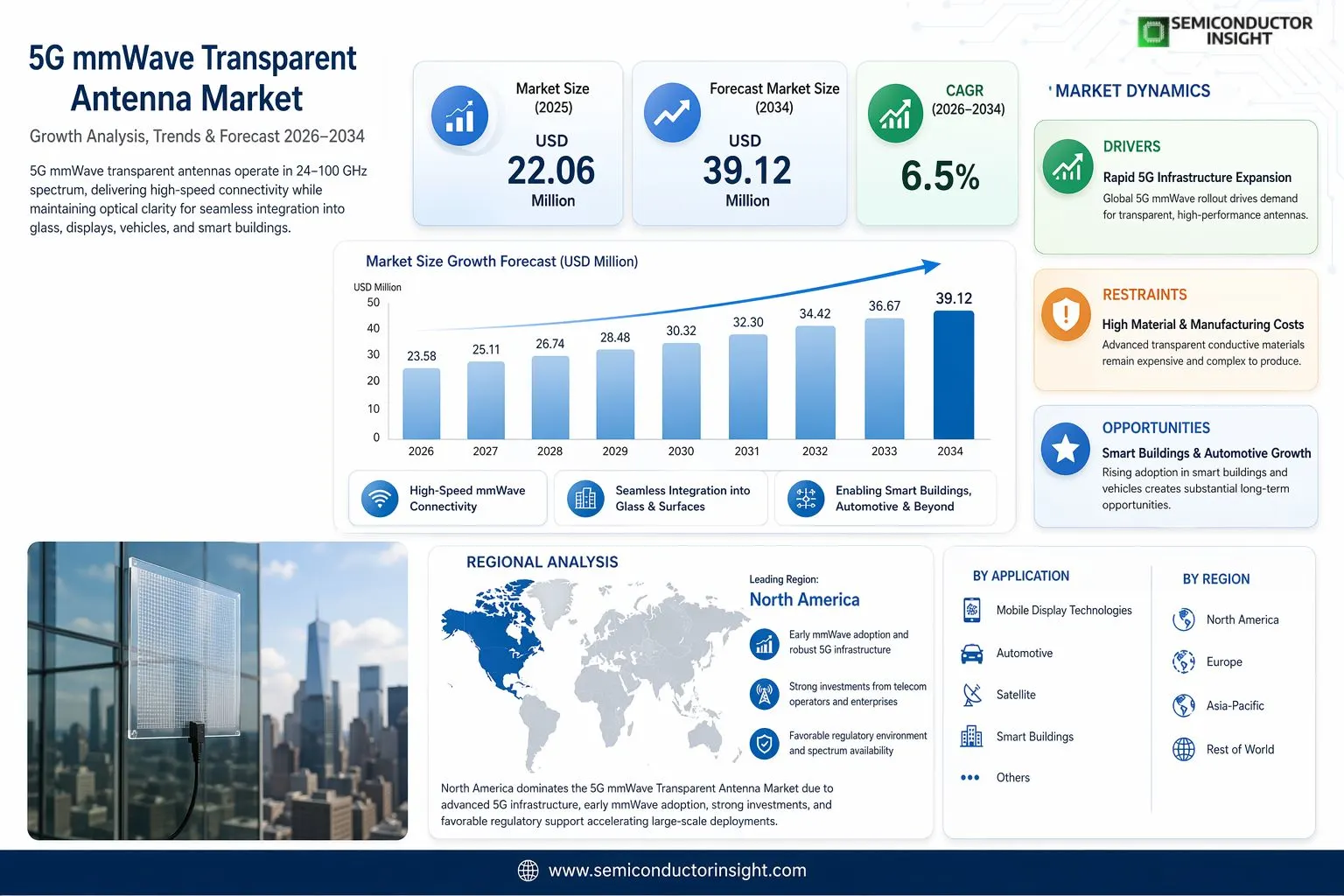
Global 5G mmWave Transparent Antenna market size was valued at USD 22.06 million in 2025. The market is projected to grow from USD 23.58 million in 2026 to USD 39.12 million by 2034, exhibiting a CAGR of 6.5% during the forecast period.
A 5G mmWave Transparent Antenna is a specialized type of antenna used in 5G communication systems that operates in the millimeter wave (mmWave) frequency range, typically between 24 GHz and 100 GHz, offering significant advantages for high-speed wireless communications due to its large available bandwidth. These antennas are engineered using advanced transparent conductive materials , such as indium tin oxide (ITO), metal mesh, and carbon nanotube films , enabling them to transmit and receive mmWave signals while maintaining optical clarity. Their unique combination of RF performance and visual transparency makes them particularly suited for integration into glass surfaces, displays, automotive windshields, and smart building infrastructure.
The market is gaining momentum driven by the accelerating global deployment of 5G networks, rising adoption of connected devices, and growing demand for aesthetically unobtrusive antenna solutions across automotive, smart building, and mobile display applications. Furthermore, the shift toward intelligent surfaces and transparent electronics is expanding the addressable market for mmWave-compatible antenna designs. Key manufacturers actively shaping the competitive landscape include Meta Materials Inc., CHASM Advanced Materials, ALCAN Systems, AGC, DONGWOO FINE-CHEM, Dengyo, VENTI Group, Taoglas, Nippon Electric Glass, and Kreemo (and Sivers Semiconductors), among others, each contributing differentiated material technologies and system-level integration capabilities to meet evolving industry requirements.
MARKET DRIVERS
Rapid Expansion of 5G Infrastructure Fueling Demand for mmWave Transparent Antenna Solutions
The accelerating global rollout of fifth-generation wireless networks has emerged as one of the most significant drivers propelling 5G mmWave Transparent Antenna Market. Telecom operators across North America, Asia-Pacific, and Europe are actively investing in dense small cell deployments to support millimeter wave frequency bands, typically spanning 24 GHz to 100 GHz. These high-frequency bands deliver exceptional data throughput and low latency but require line-of-sight or near-line-of-sight installations, making transparent antenna technology a strategically critical component. When integrated into glass surfaces such as windows, facades, and storefronts, transparent antennas allow mmWave signals to penetrate built environments without obstructing architectural aesthetics, significantly lowering the physical and regulatory barriers to urban 5G densification.
Smart Building and Automotive Integration Creating High-Growth Application Segments
The convergence of 5G mmWave connectivity with smart building ecosystems and next-generation vehicle architectures is generating substantial commercial momentum. In commercial real estate, building owners and facility managers are increasingly specifying transparent antenna-embedded glazing systems to support in-building wireless coverage without visible hardware clutter. This is particularly relevant for airports, stadiums, hospitals, and corporate campuses where aesthetic standards are stringent. Simultaneously, the automotive sector is incorporating mmWave transparent antenna arrays into windshields and side windows to enable vehicle-to-everything communication, advanced driver assistance systems, and connected infotainment, creating a diversified demand base that extends well beyond traditional telecommunications infrastructure.
➤ The integration of transparent conductive materials such as indium tin oxide and silver nanowire meshes into antenna substrates is enabling transmission efficiencies that closely rival conventional opaque antenna designs, making the value proposition of 5G mmWave transparent antenna technology increasingly compelling for system integrators.
Government-backed spectrum allocation policies and regulatory frameworks supporting mmWave band licensing are further reinforcing market expansion. Regulatory bodies in the United States, South Korea, Japan, and across the European Union have allocated dedicated mmWave spectrum blocks, providing carriers with the long-term investment certainty needed to commit to large-scale transparent antenna procurement programs. This policy tailwind, combined with declining material costs as production scales, is expected to sustain robust demand growth across 5G mmWave Transparent Antenna Market through the foreseeable forecast horizon.
MARKET CHALLENGES
High Material and Manufacturing Complexity Constraining Broader Market Penetration
Despite strong demand fundamentals, 5G mmWave Transparent Antenna Market faces notable technical and commercial challenges rooted in manufacturing complexity. Achieving the required electromagnetic performance at millimeter wave frequencies while simultaneously maintaining optical transparency above acceptable thresholds demands precise control over conductive film thickness, mesh geometry, and substrate uniformity. Even minor deviations during fabrication can result in significant signal insertion loss or degradation of visible light transmittance, both of which are commercially unacceptable in most end-use applications. This manufacturing sensitivity limits yield rates and elevates per-unit costs, particularly for large-format architectural glazing panels, making it difficult for transparent antenna solutions to compete on pure cost terms against conventional hidden or surface-mounted antenna approaches.
Other Challenges
Limited Ecosystem Standardization
The absence of universally adopted performance standards specific to mmWave transparent antenna systems creates procurement and interoperability uncertainty. Buyers across the construction, automotive, and telecom sectors lack a consistent technical benchmark against which to evaluate competing supplier offerings, prolonging procurement cycles and increasing qualification costs. Without harmonized testing protocols covering both RF performance and optical clarity, market adoption in cost-sensitive segments remains structurally constrained.
Signal Attenuation in Adverse Environmental Conditions
Millimeter wave frequencies are inherently susceptible to atmospheric attenuation from rain, humidity, and airborne particulates, a challenge that is amplified when signals must also pass through transparent conductive substrates. In outdoor-facing architectural applications, cumulative losses from environmental factors and the antenna substrate itself can reduce effective link budgets to a degree that requires additional small cell densification, increasing overall system deployment costs and partially offsetting the convenience advantages that 5G mmWave transparent antenna integration is intended to deliver.
MARKET RESTRAINTS
Elevated Production Costs and Supply Chain Constraints for Advanced Transparent Conductive Materials
One of the primary restraints affecting 5G mmWave Transparent Antenna Market is the elevated cost structure associated with advanced transparent conductive materials. Indium tin oxide, a widely used conductive coating, is derived from indium, a relatively scarce element with geographically concentrated production. This supply concentration introduces procurement risk and price volatility that directly impacts the bill of materials for transparent antenna manufacturers. While alternative materials including silver nanowire networks, graphene films, and metal mesh structures are under active development, none have yet achieved the combination of electrical conductivity, optical transparency, and processing scalability needed for mass market deployment at cost points acceptable to mainstream construction and automotive customers.
Regulatory and Certification Barriers in Building and Automotive Applications
The integration of 5G mmWave transparent antenna technology into safety-critical substrates such as automotive windshields and structural building glazing introduces a distinct set of regulatory and certification restraints. Automotive glazing must comply with rigorous safety standards governing optical distortion, impact resistance, and defrosting performance, all of which can be compromised by the addition of conductive antenna structures. Similarly, building-integrated antenna glazing must satisfy fire safety codes, thermal insulation requirements, and in many jurisdictions, specific electromagnetic compliance certifications. Navigating this multi-standard regulatory environment adds considerable time and cost to product development cycles, effectively slowing the pace at which new transparent antenna solutions can reach commercial deployment in the 5G mmWave ecosystem.
MARKET OPPORTUNITIES
Rising Demand for Aesthetically Integrated Connectivity in Commercial Real Estate and Retail Environments
The accelerating adoption of 5G mmWave transparent antenna technology in commercial real estate represents one of the most strategically significant near-term market opportunities. Property developers and retail brands are increasingly prioritizing seamless, visually unobtrusive connectivity infrastructure as a competitive differentiator. Glass-heavy architectural designs that characterize modern commercial and mixed-use developments are fundamentally incompatible with conventional external antenna hardware, creating a structural demand gap that transparent antenna solutions are uniquely positioned to fill. As tenant expectations for high-density in-building wireless coverage intensify alongside the proliferation of connected devices and immersive digital experiences, demand for building-integrated mmWave transparent antenna systems is expected to strengthen considerably across premium commercial segments.
Emerging Applications in AR/VR, Industrial IoT, and Next-Generation Transportation Infrastructure
Beyond conventional telecommunications, 5G mmWave Transparent Antenna Market stands to benefit significantly from emerging application domains that place exceptional demands on wireless bandwidth and latency. Augmented and virtual reality platforms designed for enterprise training, remote collaboration, and consumer entertainment require the ultra-low latency and multi-gigabit throughput that only mmWave spectrum can reliably deliver in dense user environments. Similarly, industrial IoT deployments in manufacturing facilities and logistics centers are increasingly specifying private 5G mmWave networks to support real-time machine control and autonomous guided vehicle coordination. Transparent antenna integration into facility infrastructure in these environments reduces installation complexity and enables rapid network densification without structural modification. The continued maturation of autonomous vehicle technology and smart transportation corridors further expands the total addressable market for 5G mmWave transparent antenna solutions well into the next decade.
Trends
Rising Demand for High-Speed Connectivity Driving 5G mmWave Transparent Antenna Market
5G mmWave Transparent Antenna Market is witnessing significant momentum as global telecommunications infrastructure continues to evolve rapidly. Operating within the millimeter wave frequency range of approximately 24 GHz to 100 GHz, these antennas deliver substantial bandwidth advantages that are increasingly critical for next-generation wireless communication systems. The surge in mobile data consumption, combined with the accelerating rollout of 5G networks across key geographies including North America, Europe, and Asia, is creating sustained demand for advanced transparent antenna solutions that can be seamlessly integrated into modern architectural and electronic environments.
Other Trends
Integration into Smart Buildings and Architectural Surfaces
One of the most prominent trends reshaping 5G mmWave Transparent Antenna Market is the growing adoption of these antennas in smart building infrastructure. Because these antennas maintain optical transparency while enabling high-frequency signal transmission, they can be embedded into glass facades, windows, and display panels without compromising aesthetics or natural light. This capability is driving interest from commercial real estate developers and urban infrastructure planners who are seeking to deploy 5G connectivity without visible hardware. The smart buildings application segment is expected to see notable growth as cities worldwide pursue connected building initiatives.
Expansion Across Automotive and Mobile Display Applications
The automotive sector represents a rapidly emerging application area for 5G mmWave Transparent Antenna Market. As connected and autonomous vehicles require reliable, high-bandwidth communication for navigation, safety systems, and infotainment, transparent antennas offer an elegant solution that can be integrated directly into windshields and windows. Similarly, in mobile display technologies, these antennas are being explored for integration into device screens, enabling sleeker form factors without sacrificing 5G performance. These dual-application trends are broadening the addressable market for transparent antenna manufacturers significantly.
Competitive Innovation and Material Advancements Shaping Market Trajectory
Leading players in 5G mmWave Transparent Antenna Market, including Meta Materials Inc, CHASM Advanced Materials, ALCAN Systems, AGC, Taoglas, and Nippon Electric Glass, among others, are actively investing in material science innovations to enhance transparency levels and signal efficiency. The market currently segments products by transparency level, notably the 90% Transparent and 98% Transparent categories, with higher transparency variants gaining traction in consumer electronics and premium automotive applications. Competitive differentiation is increasingly centered on achieving superior radio frequency performance while maintaining near-complete optical clarity. Additionally, regional expansion efforts, particularly in Southeast Asia, South Korea, and Germany, are intensifying as manufacturers seek to capture emerging 5G infrastructure investments. These combined technological and geographic trends are expected to define the competitive landscape of 5G mmWave Transparent Antenna Market through the coming years.
COMPETITIVE LANDSCAPE
Key Industry Players
5G mmWave Transparent Antenna Market , Competitive Dynamics and Leading Manufacturers Analysis
Global 5G mmWave Transparent Antenna market, valued at approximately USD 22.06 million in 2025 and projected to reach USD 34.88 million by 2032 at a CAGR of 6.9%, is characterized by a relatively concentrated competitive landscape with a handful of technologically advanced players commanding the majority of revenue share. Meta Materials Inc and CHASM Advanced Materials are widely recognized as frontrunners in this space, leveraging proprietary nanomaterial-based transparent conductive film technologies to deliver high-performance antennas capable of operating in the 24–100 GHz mmWave frequency bands. These companies have made significant investments in R&D, strategic partnerships, and capacity expansion to align their offerings with the rapidly evolving 5G infrastructure ecosystem. AGC, a global leader in glass and advanced materials, brings substantial manufacturing scale and material science expertise to the market, reinforcing its competitive positioning across smart building and automotive transparent antenna applications. ALCAN Systems, recognized for its liquid crystal-based electronically steerable antennas, has carved out a strong niche in the satellite and mobile display segments, further intensifying competition among tier-one players.
Beyond the leading players, several specialized and emerging companies are making meaningful contributions to 5G mmWave Transparent Antenna Market. DONGWOO FINE-CHEM, a South Korean chemical and materials manufacturer, and Nippon Electric Glass, a Japanese glass technology firm, are both leveraging their deep materials expertise to develop competitive transparent antenna substrates suited for high-frequency applications. Dengyo and the VENTI Group are gaining recognition for their innovative deployment solutions tailored to smart building integration and urban 5G densification. Taoglas, a globally established antenna design and manufacturing company, continues to expand its mmWave antenna portfolio to address growing demand from IoT and connected device manufacturers. Kreemo, operating in collaboration with Sivers Semiconductors, is also positioning itself as a notable innovator in integrated mmWave antenna module solutions, combining semiconductor-level integration with transparent form factors. Collectively, these players are advancing the market through product diversification, regional expansion, and technology differentiation across key application segments including automotive, satellite, mobile display technologies, and smart buildings.
List of Key 5G mmWave Transparent Antenna Companies Profiled
- Meta Materials Inc
- CHASM Advanced Materials
- ALCAN Systems
- AGC
- DONGWOO FINE-CHEM
- Dengyo
- VENTI Group
- Taoglas
- Nippon Electric Glass
- Kreemo (and Sivers Semiconductors)
Segment Analysis:
| Segment Category | Sub-Segments | Key Insights |
| By Type |
|
90% Transparent antennas represent the leading segment in 5G mmWave Transparent Antenna Market, driven by their well-established manufacturing scalability and cost-effectiveness relative to higher transparency variants.
|
| By Application |
|
Smart Buildings emerge as the leading application segment, reflecting the accelerating global trend of embedding connectivity infrastructure directly into architectural materials.
|
| By End User |
|
Telecommunications Operators represent the dominant end-user segment, as they are the primary drivers behind Global rollout of 5G mmWave infrastructure and indoor small cell deployments.
|
| By Material Technology |
|
Metal Mesh-Based transparent antennas lead this segment, offering a compelling combination of high conductivity, mechanical flexibility, and optical transparency that makes them particularly well-suited for mmWave frequency operation.
|
| By Deployment Environment |
|
Indoor Deployments constitute the leading segment by deployment environment, underpinned by the well-documented challenge that 5G mmWave signals face in penetrating building materials, necessitating dedicated indoor antenna infrastructure.
|
Regional Analysis: 5G mmWave Transparent Antenna Market
North America
North America’s regulatory framework is among the most advanced globally for high-band 5G spectrum management. Proactive licensing by the FCC, combined with clear policies on millimeter wave spectrum utilization, has empowered network operators to accelerate transparent antenna deployments. This streamlined regulatory environment significantly reduces time-to-market for new antenna technologies and fosters confidence among investors and infrastructure developers operating in 5G mmWave Transparent Antenna Market.
Enterprise verticals across North America are among the earliest and most enthusiastic adopters of 5G mmWave transparent antenna solutions. Industries such as retail, hospitality, healthcare, and smart manufacturing are integrating these antennas into building facades and interior surfaces to enable seamless, high-throughput connectivity. The aesthetic compatibility of transparent antennas with modern architectural designs has made them particularly attractive to commercial real estate developers and facility managers.
A dense network of research institutions, technology startups, and established telecom vendors in North America drives continuous innovation in 5G mmWave transparent antenna design. Collaborative programs between universities, national laboratories, and private sector players are accelerating breakthroughs in conductive transparent materials, antenna miniaturization, and beamforming capabilities. This innovation pipeline ensures that North America maintains a competitive advantage in antenna performance and product differentiation well into the forecast period.
Capital allocation toward 5G infrastructure in North America remains at elevated levels, with major carriers committing to expansive mmWave network densification programs across metropolitan areas. This investment wave is directly stimulating demand for transparent antenna systems that can be discreetly embedded into urban furniture, glass facades, and transit infrastructure. Federal broadband initiatives further complement private investment, creating a multi-layered funding environment that supports broad 5G mmWave transparent antenna market growth.
Europe
Europe represents a strategically significant region within 5G mmWave Transparent Antenna Market, characterized by a strong regulatory push toward spectrum harmonization and a deeply embedded culture of technology standardization. Key markets including Germany, the United Kingdom, France, and the Nordic countries are at the forefront of mmWave pilot programs, with transparent antenna integration gaining traction in smart building projects, public transportation networks, and high-density venues. The European Union’s digital connectivity agenda has injected considerable momentum into national 5G rollout plans, indirectly creating demand for advanced antenna form factors. European manufacturers and research consortia are actively engaged in developing transparent antenna materials that align with stringent environmental and building regulations. The region’s emphasis on design aesthetics and sustainability further amplifies the appeal of transparent antenna solutions that minimize visual impact while maximizing network performance. Although adoption is somewhat more measured than in North America due to spectrum auction timelines and varied national rollout speeds, Europe’s long-term trajectory in 5G mmWave Transparent Antenna Market remains strongly positive.
Asia-Pacific
Asia-Pacific is emerging as one of the most dynamic growth frontiers in Global 5G mmWave transparent antenna market, propelled by the scale and speed of 5G infrastructure deployment across China, Japan, South Korea, and Australia. China’s ambitious national 5G strategy, supported by state-backed carriers and domestic equipment manufacturers, is driving rapid adoption of advanced antenna technologies at an unprecedented scale. Japan and South Korea, both early leaders in mmWave commercialization, are advancing transparent antenna integration within smart cities, automated factories, and consumer electronics ecosystems. The region’s manufacturing prowess provides a cost-competitive advantage in producing transparent conductive materials and antenna components, supporting both domestic deployment and global supply chains. India is progressively building its 5G mmWave foundation, with transparent antenna applications anticipated to expand as urban density and enterprise connectivity demands intensify. Asia-Pacific’s combination of scale, manufacturing capability, and government-led 5G mandates ensures its central role in shaping Global 5G mmWave transparent antenna market trajectory through 2034.
South America
South America occupies an emerging position in 5G mmWave Transparent Antenna Market, with Brazil and Chile serving as the primary engines of regional momentum. While large-scale mmWave deployment remains at an earlier stage compared to North America and Asia-Pacific, foundational spectrum auctions and operator investments are gradually creating the conditions necessary for transparent antenna adoption. Brazil’s extensive urban population centers and growing enterprise digitalization programs represent a compelling long-term demand base for 5G mmWave solutions. Infrastructure challenges, including terrain complexity and uneven power grid reliability in certain areas, present considerations for network planning that transparent antenna deployments must accommodate. Nonetheless, increasing foreign direct investment in regional telecom infrastructure, combined with improving regulatory frameworks, is steadily advancing South America’s readiness. As enterprise and government awareness of 5G mmWave transparent antenna capabilities grows, the region is expected to accelerate its adoption trajectory during the latter half of the 2026–2034 forecast period.
Middle East & Africa
The Middle East & Africa region presents a nuanced and evolving opportunity landscape within 5G mmWave Transparent Antenna Market. The Gulf Cooperation Council countries , particularly the United Arab Emirates, Saudi Arabia, and Qatar , are investing heavily in smart city development, luxury commercial real estate, and world-class event infrastructure, all of which are natural application environments for transparent antenna solutions. These nations benefit from ambitious national digital transformation agendas and the financial capacity to deploy cutting-edge network technologies. South Africa leads the African continent’s 5G development narrative, though mmWave-specific deployments remain concentrated in premium commercial districts and major urban centers. Across the broader African region, infrastructure maturity and investment levels vary considerably, tempering near-term adoption potential. However, the long-term outlook is constructive, particularly as global equipment costs decline and regional telecom operators recognize the strategic value of integrating 5G mmWave transparent antennas into next-generation connectivity projects targeting high-value commercial and hospitality sectors.
Report Scope
This market research report provides a comprehensive analysis of 5G mmWave Transparent Antenna Market, covering the forecast period 2026–2034. It offers detailed insights into market dynamics, technological advancements, competitive landscape, and key trends shaping the industry.
Key focus areas of the report include:
- Market Overview: The report begins with an overview outlining its current market scenario, key growth indicators, and industry transformation drivers. It discusses macroeconomic factors, demand–supply balance, regulatory landscape, and the strategic role of 5G mmWave Transparent Antennas in powering advancements across industries such as automotive, telecommunications, smart buildings, and satellite communications.
- Market Size & Forecast: Historical data and future projections for revenue, unit shipments, and market value across major regions and segments.
- Segmentation Analysis: Detailed breakdown by product type (90% Transparent, 98% Transparent, Others), application (Mobile Display Technologies, Automotive, Satellite, Smart Buildings, Others), and end-user industry to identify high-growth segments and investment opportunities.
- Regional Insights: Insights into market performance across North America, Europe, Asia-Pacific, Latin America, and the Middle East & Africa, including country-level analysis where relevant.
- Competitive Landscape: Profiles of leading market participants, including their product offerings, R&D focus, manufacturing capacity, pricing strategies, and recent developments such as mergers, acquisitions, and partnerships.
- Technology Trends & Innovation: Assessment of emerging technologies, integration of AI/IoT, mmWave antenna design trends, fabrication techniques, and evolving industry standards.
- Market Drivers & Restraints: Evaluation of factors driving market growth along with challenges, supply chain constraints, regulatory issues, and market-entry barriers.
- Stakeholder Insights: Insights for component suppliers, OEMs, system integrators, investors, and policymakers regarding the evolving ecosystem and strategic opportunities.
Primary and secondary research methods are employed, including interviews with industry experts, data from verified sources, and real-time market intelligence to ensure the accuracy and reliability of the insights presented.
FREQUENTLY ASKED QUESTIONS:
What is the current market size of 5G mmWave Transparent Antenna Market?
-> Global 5G mmWave Transparent Antenna Market was valued at USD 22.06 million in 2025 and is projected to reach USD 34.88 million by 2032, growing at a CAGR of 6.9% during the forecast period.
Which key companies operate in 5G mmWave Transparent Antenna Market?
-> Key players include Meta Materials Inc, CHASM Advanced Materials, ALCAN Systems, AGC, DONGWOO FINE-CHEM, Dengyo, VENTI Group, Taoglas, Nippon Electric Glass, and Kreemo (and Sivers Semiconductors), among others.
What are the key growth drivers?
-> Key growth drivers include rapid 5G network deployments, increasing demand for high-speed wireless communications in the millimeter wave (mmWave) frequency range (24 GHz to 100 GHz), growing adoption in automotive, satellite, smart buildings, and mobile display technologies, and the large available bandwidth offered by mmWave frequencies.
Which region dominates the market?
-> Asia is a significant region in 5G mmWave Transparent Antenna Market, with China and Japan being key contributors, while North America, led by the U.S., also holds a substantial market share driven by advanced 5G infrastructure investments.
What are the emerging trends?
-> Emerging trends include development of highly transparent antenna solutions (90% and 98% transparency levels), integration into mobile display technologies and smart building infrastructure, expanded use in automotive and satellite communications, and ongoing R&D by leading players to enhance antenna performance in the mmWave spectrum.

Get Sample Report PDF for Exclusive Insights
Report Sample Includes
- Table of Contents
- List of Tables & Figures
- Charts, Research Methodology, and more...
 Download Sample Report PDF