
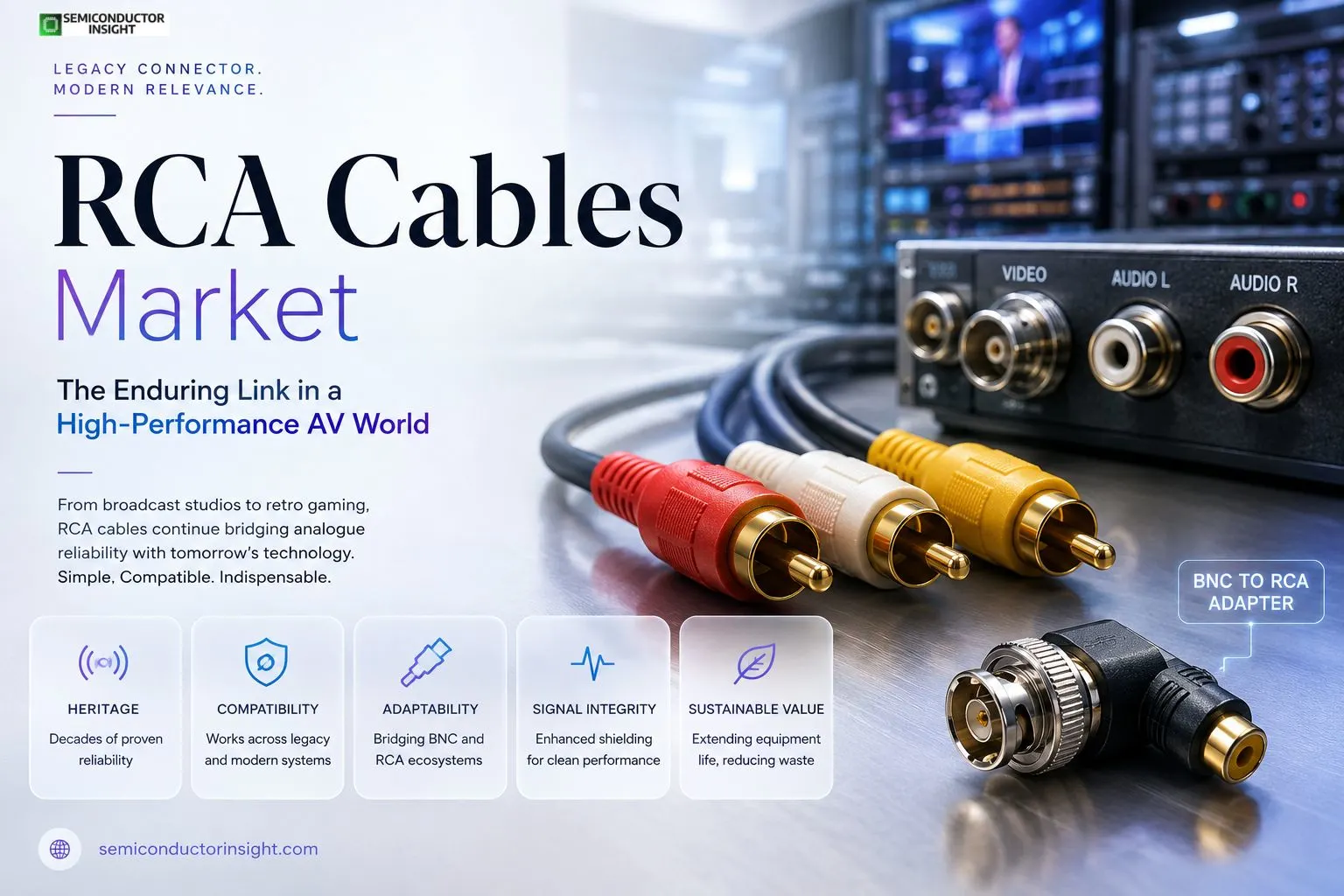
5 Consistent Factors Maintaining the Market Relevance of RCA Cables in 2026 Semiconductor Ecosystems
RCA connector traces its roots to the Radio Corporation of America, which introduced the design in the 1930s primarily for internal connections in radio-phonograph systems. Over the decades, it became the go-to interface for carrying analogue audio and composite video signals in consumer and professional equipment.
Historical engineering references note its simple phono plug construction featuring a central pin surrounded by a barrel-shaped ground contact, making it cost-effective and easy to implement across amplifiers, turntables, DVD players, and early game consoles.
- In today’s semiconductor-driven audiovisual landscape, these cables maintain relevance despite the shift toward digital interfaces.
- Manufacturers continue producing enhanced versions with better shielding and low-capacitance materials to minimise interference in mixed-signal environments.
- This persistence reflects ongoing demand in setups where full digital conversion isn’t practical or necessary.
Origins and Technical Foundations of RCA Connectivity
Engineers originally developed the RCA connector for audio-frequency use inside pre-World War II equipment. Its design prioritised affordability and sufficient performance for line-level signals rather than high-frequency precision. Government and Smithsonian archives document RCA’s broader contributions to electronics, including cathode ray tubes for radar during wartime, underscoring the company’s foundational role in signal transmission technologies.
The connector’s unbalanced 75-ohm characteristic suits composite video, while stereo audio variants use colour-coded plugs, red for the right channel, white for the left, and yellow for video. This standardisation simplified consumer connections but also created interoperability needs with professional systems.
BNC to RCA Adapter: Practical Bridging in Real Deployments
- A frequent discussion in technical forums and AV integration guides centres on the BNC to RCA adapter.
- Professionals rely on these adapters to link BNC-equipped broadcast cameras or security systems to RCA inputs on monitors, recorders, or consumer displays.
- In the mid-1980s, professional televisions and production gear, BNC connectors provided more secure, locking connections for video signals, yet many workflows still required conversion to RCA for playback or distribution.
- Installers in churches, schools, and small studios frequently use BNC to RCA adapter cables during hybrid upgrades.
- For example, integrating older surveillance cameras with newer control systems often involves these adapters to avoid full equipment replacement. The adapter preserves signal quality for standard-definition video while enabling quick field connections without custom cabling.
Role in Professional Broadcasting and Production
Broadcast facilities continue incorporating RCA cables alongside modern standards for specific monitoring and backup paths. SMPTE-related discussions highlight how legacy analogue paths support redundancy in live event production. Production teams in film and television use RCA-terminated cables for quick audio checks or intercom feeds where balanced lines aren’t essential.
Case examples from university media labs show students learning signal flow by patching RCA connections between mixers and recording devices. This hands-on approach builds foundational understanding before advancing to IP-based systems.
Integration with Semiconductor Advances in AV Chips
Semiconductor manufacturers design modern AV processors with backwards-compatible analogue inputs to support installed bases of equipment. RCA interfaces appear in system-on-chip solutions for set-top boxes and soundbars, allowing seamless playback from vintage sources. Articles on AV technology trends note that even as HDMI and SDI dominate, analogue fallback options remain embedded for compatibility testing and service applications.
In 2025-2026, retro gaming communities drove renewed interest, with enthusiasts restoring classic consoles using premium RCA cables featuring gold-plated connectors and oxygen-free copper conductors for reduced noise.
Stay connected for additional in-depth information right here: https://semiconductorinsight.com/report/high-flexible-flat-cable-for-cleanroom-market/
Applications in Education, Government, and Surveillance
Federal and state facilities often maintain RCA-based systems in training rooms and command centres for reliability in non-networked scenarios. Educational institutions deploy them in classrooms for connecting document cameras or media players. Security integrators note that many CCTV installations still terminate with RCA on the recorder side, using BNC to RCA adapter solutions at the camera end for standardised cabling.
Global examples include European public broadcasting archives preserving analogue masters via RCA-equipped digitisation stations, and Asian manufacturing plants using them for quality control testing of audio components.
Materials Evolution and Performance Enhancements
Contemporary RCA cables incorporate advanced dielectrics and multi-layer shielding to combat electromagnetic interference common in dense semiconductor environments. Manufacturers focus on 75-ohm impedance matching for video variants to reduce reflections. Industry publications describe testing protocols where cables undergo thousands of insertion cycles while maintaining contact resistance below specified thresholds.
In high-humidity regions, corrosion-resistant plating extends service life in outdoor or marine monitoring setups. These improvements help RCA cables support clearer signal transmission even as data volumes from sensors and cameras increase.
Hybrid Systems and Transitional Workflows
- Many organisations operate hybrid environments where digital main paths coexist with analogue monitoring. RCA cables facilitate these transitions by providing straightforward signal tapping points. Live streaming setups for events sometimes route preview feeds through RCA connections to secondary displays or recording devices.
- Ongoing examples from 2026 AV reports illustrate installations in corporate boardrooms retaining RCA inputs for guest devices alongside wireless presentation systems. This flexibility reduces downtime during technology refreshes.
Sustainability and Long-Term Value Considerations
With emphasis on reducing electronic waste, reusing existing RCA infrastructure through adapter solutions extends equipment lifespan. Government procurement guidelines in some regions favour maintaining compatible legacy systems rather than wholesale replacements. This approach aligns with circular economy principles in the electronics sector.
Technicians report that well-maintained RCA setups deliver consistent performance for years with minimal maintenance, particularly in controlled environments like data centres or labs.
The RCA cables sector continues demonstrating adaptability, supporting everything from high-fidelity audio enthusiasts to critical professional video links through practical tools like the BNC to RCA adapter. Its enduring presence alongside semiconductor innovations highlights the importance of thoughtful integration across generations of technology.

Comments (0)