MARKET INSIGHTS
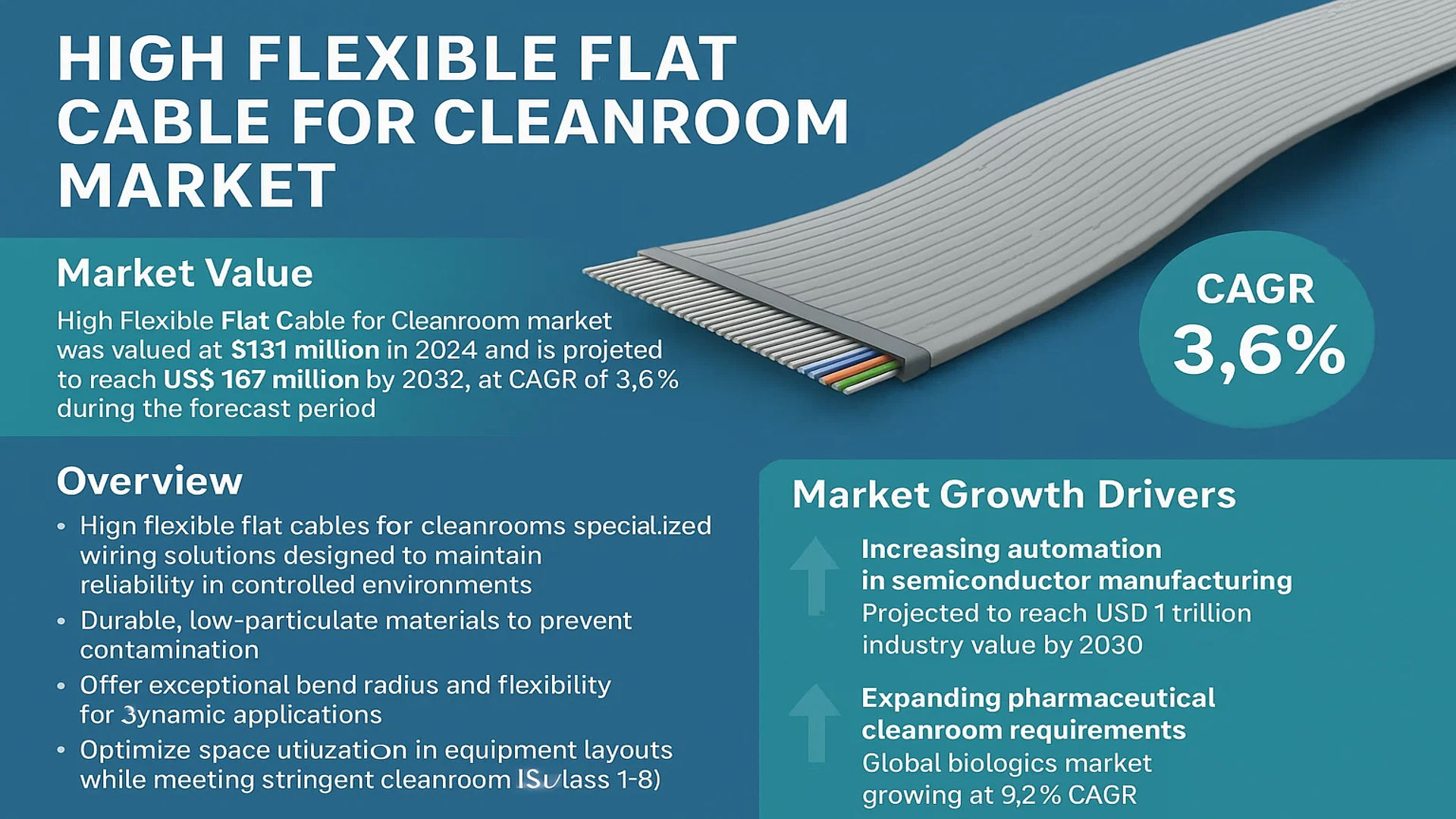
The global High Flexible Flat Cable for Cleanroom market was valued at 131 million in 2024 and is projected to reach US$ 167 million by 2032, at a CAGR of 3.6% during the forecast period.
High flexible flat cables for cleanrooms are specialized wiring solutions designed to maintain reliability in controlled environments. These cables feature durable, low-particulate materials that prevent contamination while offering exceptional bend radius and flexibility for dynamic applications. Their flat profile optimizes space utilization in equipment layouts while meeting stringent cleanroom ISO classification standards (typically Class 1-8).
The market growth is driven by increasing automation in semiconductor manufacturing (projected to reach USD 1 trillion industry value by 2030) and expanding pharmaceutical cleanroom requirements (global biologics market growing at 9.2% CAGR). Recent innovations include Igus’ chainflex series with 36 million double bends lifetime and Gore’s ultra-low outgassing cables for vacuum environments. Key players like BizLink Group and Axon Cable are expanding production capacity to meet demand from Asian semiconductor fabs and North American biotech facilities.
MARKET DYNAMICS
MARKET DRIVERS
Expanding Semiconductor and Electronics Manufacturing to Accelerate Market Demand
The global semiconductor industry’s projected growth to over $1 trillion by 2030 is creating unprecedented demand for high flexible flat cables in cleanroom environments. These specialized cables are critical for maintaining signal integrity and power distribution in advanced chip fabrication equipment where even nanometer-scale contamination can compromise production yields. The shift toward smaller process nodes below 7nm requires cabling solutions that can withstand tens of thousands of flex cycles while preventing particulate generation – a key advantage of high-performance flat cable designs.
Stringent Cleanroom Standards Fueling Adoption of Specialized Cabling
Regulatory requirements in pharmaceutical and biologics manufacturing are driving the market, with ISO Class 5-8 cleanrooms demanding cables that meet strict outgassing and chemical resistance standards. The global biopharma cleanroom technology market exceeding $4 billion annually creates substantial demand for flat cables that maintain performance during repeated sterilization cycles. Recent advances in material science have enabled cables that withstand hydrogen peroxide vapor decontamination while maintaining flexibility across temperature ranges from -40°C to 105°C.
Rising Automation in Cleanroom Environments Creating New Applications
The integration of collaborative robots and automated material handling systems in cleanrooms is generating demand for high-flex cables with integrated data transmission capabilities. Modern flat cable designs now incorporate multiple conductor types in unified assemblies, reducing clutter while providing reliable power and signal transmission for sensitive instrumentation. This trend aligns with industry migration toward Industry 4.0 standards, where real-time data collection requires robust cabling solutions for continuous operation.
MARKET RESTRAINTS
High Material and Certification Costs Limiting Market Penetration
Specialized fluoropolymer materials required for cleanroom-compatible cables can cost 3-5 times more than standard cables, presenting adoption barriers in price-sensitive markets. Compliance with certifications such as USP Class VI, FDA 21 CFR, and ISO 10993 adds significant testing and validation expenses. These cost factors create challenges in emerging markets where budget constraints often lead to compromises in cable specifications for critical applications.
Complex Installation Requirements Hindering Widespread Adoption
Proper installation of high-flex flat cables requires specialized tooling and trained personnel, with improper strain relief being a leading cause of premature failure. The need for controlled routing paths and specific bend radius guidelines often necessitates custom fixturing, adding to total system costs. These technical requirements can delay project timelines and create resistance among operations teams accustomed to conventional cabling solutions.
MARKET OPPORTUNITIES
Emerging Battery Manufacturing Sector Creates New Growth Potential
The rapid expansion of lithium-ion battery production for electric vehicles presents significant opportunities, with gigafactories requiring thousands of meters of cleanroom-grade cabling per production line. Battery formation and testing equipment increasingly demands flat cables capable of handling high currents while resisting electrolyte exposure. This emerging application sector is projected to grow at nearly 25% annually as global EV production scales to meet decarbonization targets.
Advancements in Composite Material Technology Enabling New Applications
Recent developments in hybrid polymer compounds allow for flat cables that combine extreme flexibility with enhanced chemical resistance. These material innovations are opening doors in pharmaceutical freeze-drying applications and semiconductor wet processes where conventional cables would degrade. Manufacturers investing in proprietary material formulations are gaining competitive advantage in high-margin specialty applications.
MARKET CHALLENGES
Supply Chain Vulnerabilities for Specialty Materials
Reliance on limited suppliers for high-performance fluoropolymers creates inventory risks, with lead times extending beyond 6 months during periods of high demand. The concentrated nature of the specialty chemicals industry means production disruptions can have cascading effects on cable manufacturers. These vulnerabilities complicate inventory planning and create pricing volatility in the market.
Balancing Flexibility with EMI/RFI Performance
Designing flat cables that maintain signal integrity in electrically noisy cleanroom environments while preserving flexibility represents an ongoing engineering challenge. The conflicting requirements of thin-profile construction and effective shielding create design trade-offs that can limit performance in sensitive measurement applications. Solutions incorporating novel shielding geometries and conductive coatings are emerging but add complexity to manufacturing processes.
HIGH FLEXIBLE FLAT CABLE FOR CLEANROOM MARKET TRENDS
Semiconductor Industry Expansion Driving Market Growth
The increasing demand for high flexible flat cables in semiconductor manufacturing cleanrooms is a major driver of market growth. These cables are critical for maintaining ultra-low particulate environments while ensuring reliable signal and power transmission in precision equipment. With the global semiconductor market projected to exceed $700 billion by 2025, manufacturers are adopting cables with contamination-resistant materials like fluoropolymers. Recent product innovations include flame-retardant jackets meeting ISO Class 1 cleanroom standards, reducing maintenance costs by 15-20% compared to conventional cables. Furthermore, the push toward Industry 4.0 automation in fabs has increased demand for cables with 10+ million flex cycles.
Other Trends
Miniaturization in Electronics Manufacturing
The trend toward smaller, high-density electronics is accelerating the need for flat cables with sub-millimeter pitch spacing. Flexible flat cables now support high-speed data transmission up to 40 Gbps in applications like chip mounting robots and wafer inspection systems. Leading manufacturers are developing shielded variants to mitigate electromagnetic interference in sensitive cleanroom environments, improving yield rates by 3-5% in PCB assembly lines. Additionally, the surge in flexible hybrid electronics (FHE) for wearables and medical devices is creating new opportunities for ultra-thin cable solutions under 0.3mm thickness.
Pharmaceutical and Biologics Sector Adoption
Stringent regulatory requirements in pharmaceutical cleanrooms are fueling demand for sterilization-compatible cables that withstand repeated autoclaving at 121°C. The biologics market, expected to grow at 8.3% CAGR through 2028, particularly relies on these cables for bioreactor control systems and filling machines. Recent advancements include silicone-free designs to prevent outgassing, which can compromise sterile environments. Manufacturers are also integrating real-time cable health monitoring via embedded sensors, reducing unplanned downtime by 25% in GMP facilities. This aligns with the industry’s shift toward predictive maintenance under FDA 21 CFR Part 11 compliance.
Regional Production Shifts Influencing Demand
The restructuring of global supply chains, particularly in Southeast Asia, is reshaping cable procurement strategies. With China accounting for 35% of cleanroom cable demand in 2024, local suppliers are gaining traction through cost-competitive solutions. Meanwhile, North American manufacturers are focusing on onshore production to mitigate logistics risks, with U.S. cleanroom construction investments surpassing $4 billion annually. Europe’s emphasis on sustainable cable materials, such as recyclable thermoplastic elastomers, is driving innovations catering to ISO 14000-certified facilities. These regional dynamics are compelling global players to diversify product portfolios and localized supply networks.
COMPETITIVE LANDSCAPE
Key Industry Players
Innovation and Strategic Expansion Drive Market Leadership in Cleanroom Cable Solutions
The global high flexible flat cable for cleanroom market features a dynamic competitive environment where established manufacturers and emerging innovators vie for market share. Gore and Igus currently dominate the space, leveraging their extensive expertise in high-performance cable solutions for semiconductor and pharmaceuticals applications. Gore, in particular, has strengthened its position through new material innovations that enhance flexibility while maintaining durability in ultra-clean environments.
BizLink Group and Axon Cable have emerged as strong challengers, especially in the Asia-Pacific region where cleanroom infrastructure development accelerates. These companies benefit from vertical integration strategies that allow better control over supply chains and production quality – critical factors for cables used in sensitive environments. Meanwhile, Cicoil maintains technological leadership in flat cable design with patented layered architectures that outperform conventional solutions in flex life testing.
Market consolidation is gaining momentum as players seek to broaden their application coverage. Recent strategic moves include Tsubaki Kabelschlepp’s acquisition of a specialty polymers manufacturer to enhance its cleanroom cable formulations, while WINYE RUBBER&PLASTIC TECHNOLOGY has expanded production capacity to meet surging demand from Chinese semiconductor fabs. Such developments indicate an industry-wide shift toward both technological specialization and global scalability.
The competitive intensity continues rising as end-users demand cables supporting higher data transmission rates for Industry 4.0 applications. This technological arms race advantages innovators like Huizhou Zhongke Intelligent Technology, whose recent EMI-shielded flat cables now penetrate European biomedical markets. However, pricing pressures persist as mid-tier Asian manufacturers challenge premium brands with cost-competitive alternatives, creating a bifurcated market landscape.
List of Key High Flexible Flat Cable Manufacturers
- Gore (U.S.)
- Igus (Germany)
- BizLink Group (Taiwan)
- LICHTZEN (Germany)
- Cicoil (U.S.)
- Tsubaki Kabelschlepp (Germany)
- Axon Cable (France)
- WINYE RUBBER&PLASTIC TECHNOLOGY (China)
- Huizhou Zhongke Intelligent Technology (China)
Segment Analysis:
By Type
Dual-pod Cable Leads the Market Due to High Demand in Compact Applications
The market is segmented based on type into:
- Dual-pod Cable
- Subtypes: Standard, high-flex, and anti-static variants
- Multi-pod Cable
- Subtypes: Shielded and non-shielded configurations
By Application
Semiconductor Segment Dominates Due to Critical Cleanroom Requirements
The market is segmented based on application into:
- Semiconductor
- Electronic
- Pharmaceuticals & Biologics
- New Energy
- Others
By Flexibility Rating
High Flex Cables Show Strong Adoption in Dynamic Cleanroom Environments
The market is segmented based on flexibility rating into:
- Standard Flexible
- High Flexible
- Ultra-flexible
By Material Composition
LCP-based Cables Gain Traction in High-Temperature Cleanroom Applications
The market is segmented based on material composition into:
- PVC-based
- TPU-based
- LCP-based
- Other specialty materials
Regional Analysis: High Flexible Flat Cable for Cleanroom Market
Asia-Pacific
The Asia-Pacific region leads the global high flexible flat cable market, driven by rapid industrialization and significant investments in semiconductor and electronics manufacturing. China dominates the region, accounting for over 40% of the regional market share due to its extensive cleanroom facilities. Key manufacturers like WINYE RUBBER&PLASTIC TECHNOLOGY(SHANGHAI) and Huizhou Zhongke Intelligent Technology are expanding production capabilities to meet rising demand. Japan and South Korea follow closely, with their advanced semiconductor industries requiring high-performance cabling solutions. The increasing adoption of automation in pharmaceutical manufacturing across India and Southeast Asia further fuels market growth, though cost sensitivity remains a limiting factor for premium solutions.
North America
North America’s market is characterized by stringent cleanroom standards and technological innovation. The U.S. holds the largest share, with major players like Gore and Cicoil offering specialized solutions for semiconductor and pharmaceutical applications. The region is witnessing growing demand from the energy sector, particularly in lithium-ion battery production facilities which require contamination-free environments. While the market growth is steady at around 3.8% CAGR, regulatory compliance and the need for customization are pushing manufacturers to develop advanced solutions with better durability and chemical resistance.
Europe
Europe’s market is driven by strong pharmaceutical and biologics industries, particularly in Germany and Switzerland where cleanroom standards are exceptionally strict. The region shows preference for eco-friendly cable materials, aligning with EU environmental directives. Igus and Axon Cable lead the market with innovative designs that combine flexibility with low particulate generation. The growing adoption of Industry 4.0 practices in manufacturing is creating new opportunities for smart cabling solutions that can integrate with automated monitoring systems, though high production costs compared to Asian alternatives remain a challenge.
Middle East & Africa
This emerging market is seeing gradual growth, primarily in pharmaceutical production facilities and select electronics manufacturing zones in the UAE and Saudi Arabia. The region benefits from strategic investments in healthcare infrastructure, though adoption lags behind other regions due to limited local production capabilities. Most demand is currently met through imports from Europe and Asia. However, planned industrial cities and special economic zones focusing on advanced manufacturing are expected to drive future growth, particularly in the UAE and Turkey where cleanroom standards are being upgraded.
South America
The South American market remains the smallest globally, with Brazil accounting for the majority of demand from its pharmaceutical and medical device industries. Economic instability has hampered significant investments in cleanroom technologies, leading to reliance on imported cabling solutions. Argentina shows potential in biotech applications, but currency fluctuations and infrastructure limitations continue to restrict market expansion. Local manufacturers are gradually emerging, particularly for cost-effective solutions serving the region’s growing generic drug production sector.
Report Scope
This market research report provides a comprehensive analysis of the Global High Flexible Flat Cable for Cleanroom Market, covering the forecast period 2024–2032. It offers detailed insights into market dynamics, technological advancements, competitive landscape, and key trends shaping the industry.
Key focus areas of the report include:
- Market Size & Forecast: Historical data and future projections for revenue, unit shipments, and market value across major regions and segments. The market was valued at USD 131 million in 2024 and is projected to reach USD 167 million by 2032, growing at a CAGR of 3.6%.
- Segmentation Analysis: Detailed breakdown by product type (Dual-pod Cable, Multi-pod Cable), application (Semiconductor, Electronic, Pharmaceuticals & Biologics, New Energy, Others), and end-user industry to identify high-growth segments.
- Regional Outlook: Insights into market performance across North America (U.S., Canada, Mexico), Europe (Germany, France, U.K., Italy, Russia), Asia-Pacific (China, Japan, South Korea, India), and other regions.
- Competitive Landscape: Profiles of leading market participants, including Gore, Igus, BizLink Group, LICHTZEN, and Cicoil, with analysis of their product offerings, market share, and strategic initiatives.
- Technology Trends & Innovation: Assessment of material advancements, miniaturization trends, and cleanroom-specific cable solutions.
- Market Drivers & Restraints: Evaluation of factors such as growing semiconductor industry, stringent cleanroom standards, and supply chain challenges.
- Stakeholder Analysis: Strategic insights for manufacturers, suppliers, and end-users in the high-flex cable ecosystem.
The research employs both primary and secondary methodologies, including interviews with industry experts and analysis of verified market data, ensuring reliable and actionable insights.
FREQUENTLY ASKED QUESTIONS:
What is the current market size of Global High Flexible Flat Cable for Cleanroom Market?
-> High Flexible Flat Cable for Cleanroom market was valued at 131 million in 2024 and is projected to reach US$ 167 million by 2032, at a CAGR of 3.6% during the forecast period.
Which key companies operate in this market?
-> Key players include Gore, Igus, BizLink Group, LICHTZEN, Cicoil, Tsubaki Kabelschlepp, and Axon Cable.
What are the key growth drivers?
-> Growth is driven by expanding semiconductor manufacturing, increasing cleanroom applications in pharmaceuticals, and demand for miniaturized cable solutions.
Which region dominates the market?
-> Asia-Pacific leads the market due to semiconductor industry growth, while North America maintains significant demand.
What are the emerging trends?
-> Emerging trends include development of ultra-thin flat cables, anti-static solutions, and integration with Industry 4.0 automation systems.

Get Sample Report PDF for Exclusive Insights
Report Sample Includes
- Table of Contents
- List of Tables & Figures
- Charts, Research Methodology, and more...