
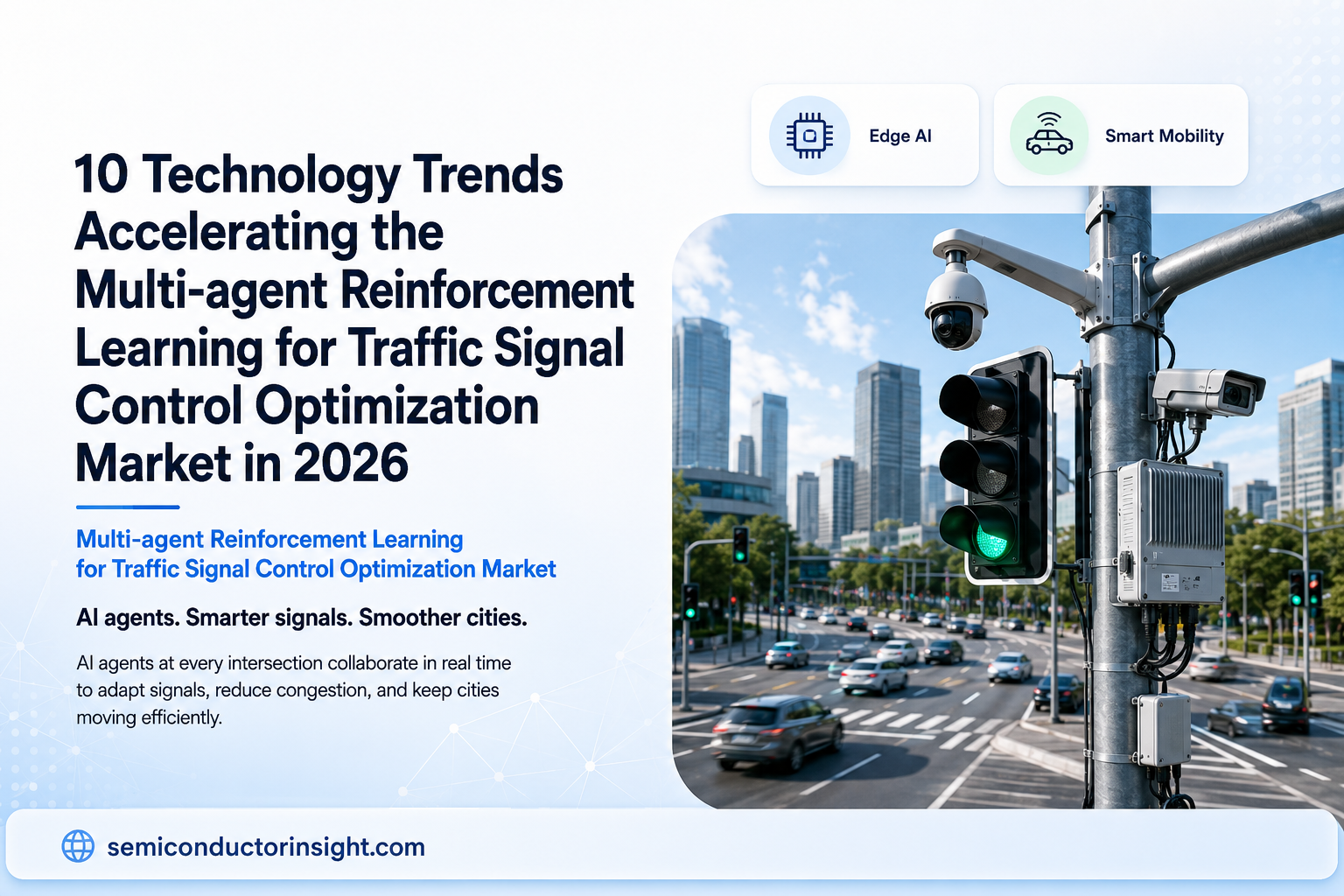
10 Technology Trends Accelerating the Multi-agent Reinforcement Learning for Traffic Signal Control Optimization Market in 2026
Traffic intersections are evolving into intelligent computing nodes. As cities deploy connected cameras, vehicle sensors, roadside units, and digital infrastructure, traffic management is increasingly dependent on semiconductor-powered artificial intelligence systems.
Within this transformation, the Multi-agent Reinforcement Learning for Traffic Signal Control Optimization Market is emerging as a specialized segment where multiple AI agents collaborate to manage signal timing dynamically rather than relying on predefined schedules.
Multi-agent reinforcement learning (MARL) allows each intersection to operate as an independent decision-making entity while cooperating with nearby intersections, in contrast to traditional traffic control systems. This shift is creating demand for high-performance processors, AI accelerators, edge computing chips, networking semiconductors, and low-latency communication hardware.
The Semiconductor Layer behind Intelligent Intersections
Modern traffic optimization systems require continuous processing of data generated by cameras, radar units, connected vehicles, and environmental sensors. The computational workload includes object detection, vehicle counting, congestion forecasting, route optimization, and agent coordination.
Semiconductor technologies supporting these functions include:
- AI accelerators for inference processing
- GPUs for large-scale training environments
- Edge processors for roadside deployment
- Network processors supporting vehicle-to-infrastructure communication
- Memory solutions for real-time traffic analytics
- Sensor interface chips connecting cameras and detection equipment
As cities move toward intelligent transportation ecosystems, intersections increasingly resemble distributed data centers operating at the edge of the network.
Numbers Defining the Scale of Urban Traffic Intelligence
According to the International Transport Forum and urban mobility studies from major metropolitan authorities, large cities routinely manage thousands of signalized intersections. New York City alone operates more than 13,000 traffic signals, while London manages over 6,000 signal-controlled junctions.
Meanwhile, the United States Department of Transportation estimates that Americans collectively spend billions of hours annually in traffic congestion. Processing this growing traffic complexity requires AI systems capable of evaluating millions of data points daily across connected road networks.
For semiconductor manufacturers, every smart intersection represents a deployment opportunity involving processors, communication modules, sensors, memory components, and power-management devices.
Digital Twins Enter the Traffic Control Conversation
- One of the fastest-growing developments is the use of digital twins for transportation infrastructure. Before deploying reinforcement learning agents in real environments, municipalities increasingly test algorithms within virtual replicas of city road networks.
- Cities and research institutions are utilizing simulation platforms capable of reproducing traffic flow patterns, signal timing scenarios, pedestrian movements, and emergency vehicle routing. These simulations require substantial computational resources powered by advanced semiconductor architectures.
- The integration of digital twins with MARL systems allows engineers to train thousands of traffic-management scenarios before implementation, reducing operational risks while accelerating deployment cycles.
Want to learn more about the report? Check out our latest updated version for free: https://semiconductorinsight.com/report/multi-agent-reinforcement-learning-for-traffic-signal-control-optimization-market/
Real-World Deployments Moving Beyond Research Labs
Multi-agent reinforcement learning is no longer confined to academic publications. Transportation agencies and technology developers are conducting pilot programs that combine AI decision-making with connected infrastructure.
In China, several smart-city initiatives have tested AI-controlled traffic systems capable of coordinating multiple intersections simultaneously. Singapore continues to expand intelligent transportation capabilities using extensive sensor networks and data-driven traffic management approaches. Across Europe, urban mobility programs increasingly explore adaptive signal systems designed to respond dynamically to changing traffic conditions.
These deployments create demand for semiconductors capable of supporting real-time inferencing at scale while maintaining low power consumption and high reliability.
Edge AI and Cloud Computing Compete for Control
A key industry discussion centers on where intelligence should reside.
Edge AI architectures process traffic data directly at intersections, reducing latency and enabling immediate signal adjustments. This approach relies heavily on embedded AI processors and specialized semiconductor solutions designed for roadside environments.
Cloud-based systems, meanwhile, aggregate information from multiple intersections and optimize traffic patterns across larger geographic regions. These architectures benefit from high-performance computing platforms and advanced server-grade processors.
Many cities are adopting hybrid approaches in which edge devices handle immediate traffic decisions while cloud platforms coordinate broader transportation strategies.
Mobility Data Becomes a Strategic Asset
- Connected vehicles, public transportation systems, navigation platforms, and infrastructure sensors collectively generate enormous volumes of mobility data.
- Multi-agent reinforcement learning systems convert this information into actionable decisions, making data processing efficiency a critical requirement.
- Semiconductor innovation increasingly determines how effectively these systems can analyze traffic streams, predict congestion, and coordinate thousands of simultaneous decisions across urban networks.
As transportation infrastructure becomes more intelligent, the relationship between advanced semiconductors and traffic optimization continues to strengthen, positioning the Multi-agent Reinforcement Learning for Traffic Signal Control Optimization Market as a notable intersection between AI computing and next-generation mobility systems.

Comments (0)