Market Insights
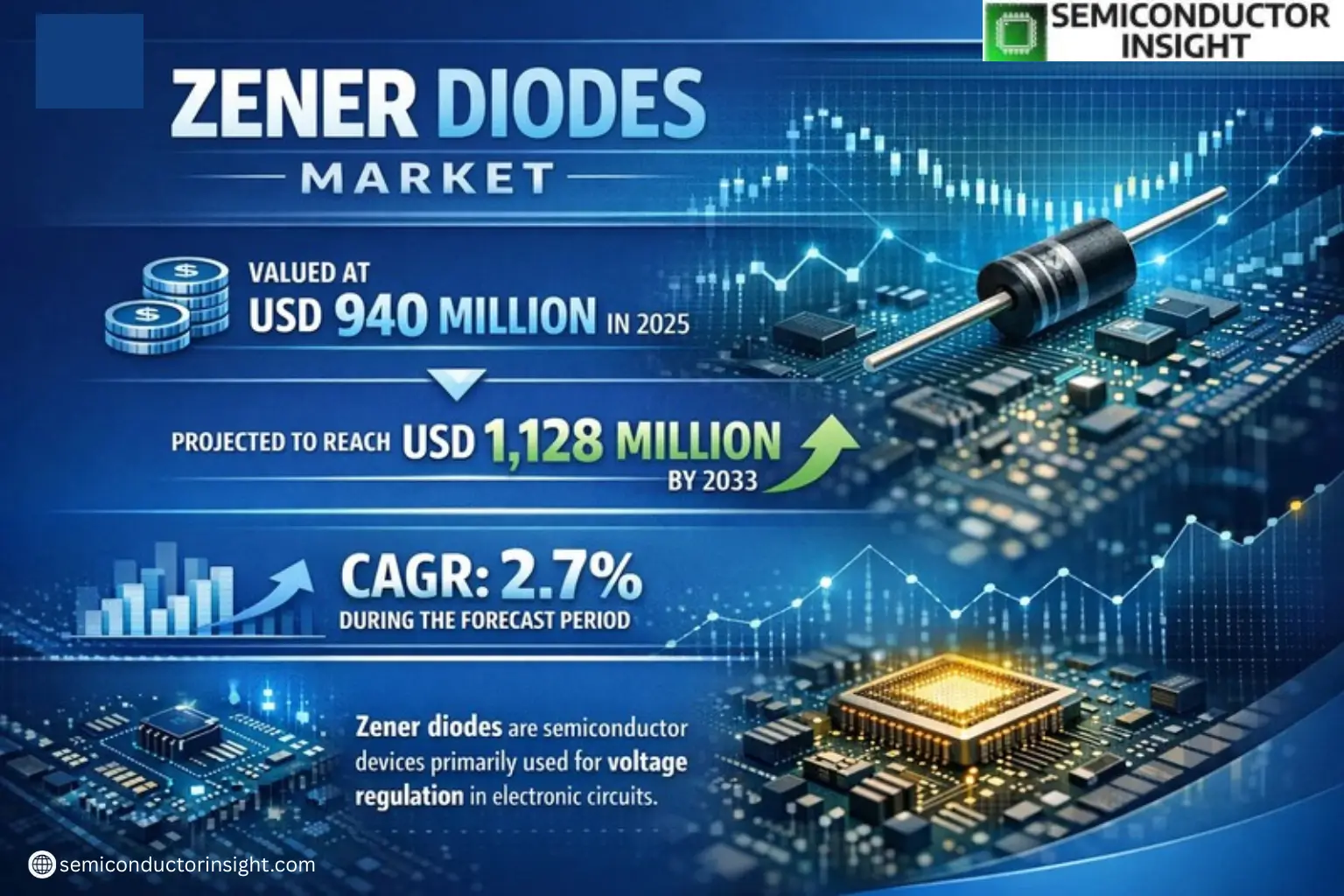
Global Zener Diodes Market was valued at USD 940 million in 2025 and is projected to reach USD 1,128 million by 2033, exhibiting a CAGR of 2.7% during the forecast period.
Zener diodes are semiconductor devices primarily used for voltage regulation in electronic circuits. These components allow current to flow in one direction but can also conduct in reverse when exposed to sufficient voltage, known as the breakdown or Zener voltage. Their ability to maintain a stable output voltage makes them indispensable in power supply circuits, surge protectors, and signal clamping applications. The market offers various types of Zener diodes, including surface-mount and through-hole variants, with surface-mount technology dominating nearly 90% of the market due to its compact design and compatibility with modern PCB assembly processes.
The growth of the Zener Diodes Market is driven by increasing demand from consumer electronics, automotive systems, and telecommunications infrastructure. North America currently leads the market with a 30% share, followed by Europe and Japan collectively accounting for 40%. Key players such as Vishay, ON Semiconductor, NXP (Nexperia), ROHM, and Diodes Incorporated hold approximately 40% of the global market share. Recent advancements in miniaturization and energy efficiency are further expanding application possibilities across IoT devices and renewable energy systems.
MARKET DRIVERS
Growing Demand for Voltage Regulation in Electronics
Zener Diodes Market is witnessing significant growth due to the increasing need for precise voltage regulation in consumer electronics, industrial equipment, and automotive systems. With the rise in adoption of smart devices and IoT applications, the demand for reliable voltage protection components has surged by approximately 12% annually.
Expansion of Automotive Electronics
Modern vehicles incorporate over 100 electronic control units (ECUs), many requiring Zener diodes for voltage stabilization. The transition toward electric vehicles (EVs) and advanced driver-assistance systems (ADAS) has further accelerated market growth, with the automotive segment accounting for nearly 25% of total Zener diode sales.
Manufacturers are focusing on developing high-power Zener diodes capable of handling voltages up to 200V to meet the requirements of industrial power management systems.
MARKET CHALLENGES
Intense Competition from Alternative Technologies
Zener Diodes Market faces competition from TVS diodes and MOVs (metal oxide varistors) in certain applications, particularly where higher surge protection is required. Price pressure from Asian manufacturers has also compressed profit margins for established players.
Other Challenges
Thermal Management Issues
High-power Zener diodes generate significant heat during operation, requiring additional thermal dissipation solutions that increase overall system cost and complexity.
MARKET RESTRAINTS
Supply Chain Disruptions in Semiconductor Industry
Global semiconductor shortage has impacted Zener diode availability, with lead times extending from 8-12 weeks to over 20 weeks for certain specifications. This has forced some manufacturers to redesign circuits using alternative components where possible.
MARKET OPPORTUNITIES
Emerging 5G Infrastructure Requirements
The rollout of 5G networks presents significant opportunities for Zener diode manufacturers, as base stations and network equipment require robust voltage protection components. The telecommunications sector is expected to grow at a CAGR of 9.8% in Zener diode consumption through 2027.
Zener Diodes Market Trends
Steady Growth Projected in Zener Diodes Market
Global Zener Diodes Market was valued at USD 940 million in 2025 and is projected to reach USD 1128 million by 2033, growing at a CAGR of 2.7%. This steady growth is driven by increasing demand from consumer electronics and automotive sectors where Zener diodes are essential for voltage regulation and circuit protection.
Other Trends
Dominance of Surface Mount Technology
Surface Mount Technology (SMT) accounts for approximately 90% of the Zener Diodes Market share due to its compact size and suitability for automated PCB assembly. The through-hole segment continues to decline as electronic devices emphasize miniaturization and manufacturing efficiency.
Regional Market Leadership
North America leads the Zener Diodes Market with 30% share, followed by Europe and Japan which collectively hold 40% of global sales. The Asia-Pacific region is witnessing growth due to expanding electronics manufacturing capabilities and increasing local demand for consumer devices.
Application Segment Analysis
Consumer electronics remains the largest application segment for Zener Diodes, followed by computing and industrial applications. The automotive sector is expected to show significant growth as electric vehicles require more sophisticated voltage regulation components.
Competitive Landscape
Five major players including Vishay, ON Semiconductor, and NXP collectively control 40% of the global Zener Diodes Market. These companies are focusing on product innovation and strategic partnerships to maintain their market positions.
The industry faces challenges from alternative voltage regulation technologies, though Zener diodes maintain strong positions due to their reliability and cost-effectiveness in many applications.
COMPETITIVE LANDSCAPE
Key Industry Players
Vishay and ON Semiconductor Dominate the Zener Diodes Market with 40% Combined Share
Global Zener Diodes Market is highly concentrated, with the top five players accounting for approximately 40% of total market share. Vishay Intertechnology leads the industry with its comprehensive portfolio of surface mount and through-hole Zener diodes, maintaining a strong presence across consumer electronics and automotive applications. ON Semiconductor follows closely as the second-largest player, leveraging its advanced semiconductor manufacturing capabilities to serve the telecommunications and industrial sectors.
Niche players like ROHM Semiconductor and Nexperia (a NXP spin-off) hold significant positions in the Asia-Pacific region, specializing in compact, high-performance Zener diodes for space-constrained applications. Diodes Incorporated and Bourns have strengthened their market positions through strategic acquisitions and expansions into emerging markets. Japanese manufacturers such as Toshiba and Renesas maintain technological leadership in low-power Zener diode solutions for precision applications.
List of Key Zener Diodes Companies Profiled
- Vishay Intertechnology
- ON Semiconductor
- Nexperia (NXP)
- ROHM Semiconductor
- Diodes Incorporated
- Bourns
- Renesas Electronics
- Good-Ark Electronics
- Toshiba Electronic Devices
- Microchip Technology
- TORWEX
- Comchiptech
- MicroCommercial Components
- ANOVA
- Kexin
Segment Analysis:
| Segment Category | Sub-Segments | Key Insights |
| By Type |
|
Surface Mount Technology dominates the market due to:
|
| By Application |
|
Consumer Electronics leads application demand because of:
|
| By End User |
|
OEMs represent the largest end-user segment as:
|
| By Voltage Range |
|
Low Voltage segment shows strongest adoption because:
|
| By Manufacturing Technology |
|
Zener Breakdown technology maintains leadership due to:
|
Regional Analysis: Zener Diodes Market
China’s dominance stems from complete supply chain integration, with Zener Diode production closely tied to smartphone and IoT device manufacturing hubs in Guangdong and Jiangsu provinces. Local component standardization drives cost efficiencies.
Japanese manufacturers focus on high-reliability Zener Diodes for automotive and industrial applications, with superior thermal stability specifications. Keiretsu business networks ensure stable demand from domestic electronics conglomerates.
Samsung and LG’s semiconductor divisions drive advanced Zener Diode development for 5G infrastructure and display technologies. Close collaboration between chaebols and research institutes accelerates product innovation cycles.
TSMC’s specialty process nodes enable precision Zener Diodes for analog ICs. The semiconductor cluster in Hsinchu Science Park creates synergies between diode manufacturers and fabless chip designers.
North America
North America maintains technological leadership in specialized Zener Diode applications for aerospace, defense, and medical equipment. The region benefits from strong R&D capabilities in precision voltage regulation and radiation-hardened components. U.S. manufacturers focus on high-margin, low-volume production for mission-critical systems, with stringent quality certifications driving premium pricing. Supply chain restructuring efforts are bringing some Zener Diode packaging operations back from Asia, particularly for defense applications requiring trusted sources.
Europe
European demand centers on industrial automation and automotive applications, with German and Italian manufacturers driving specifications for Zener Diodes in harsh environments. The region emphasizes energy-efficient designs compliant with RoHS directives. Collaborative R&D programs between universities and automotive suppliers are advancing silicon carbide Zener Diodes for next-generation electric vehicles. Distribution networks are consolidating to serve cross-border electronics manufacturing clusters.
Middle East & Africa
Growth in the region stems from telecommunications infrastructure expansion and renewable energy projects requiring robust voltage regulation. Dubai and South Africa are emerging as distribution hubs for Zener Diodes serving African markets. Local assembly of consumer electronics in Egypt and Morocco is creating incremental demand, though most components are still imported from Asian manufacturers.
South America
Brazil dominates regional Zener Diode consumption through its automotive and industrial equipment sectors. Protectionist trade policies have fostered some local assembly operations, though technical capabilities remain limited. Economic volatility continues to constrain electronics manufacturing investment, making the region dependent on imports for advanced components.
Report Scope
This market research report provides a comprehensive analysis of the Zener Diodes Market, covering the forecast period 2025–2033. It offers detailed insights into market dynamics, technological advancements, competitive landscape, and key trends shaping the industry.
Key focus areas of the report include:
- Market Overview: The report begins with an overview outlining its current market scenario, key growth indicators, and industry transformation drivers. It discusses macroeconomic factors, demand–supply balance, regulatory landscape, and the strategic role of semiconductors in powering advancements across industries such as automotive, telecommunications, consumer electronics, and industrial automation.
- Market Size & Forecast: Historical data and future projections for revenue, unit shipments, and market value across major regions and segments.
- Segmentation Analysis: Detailed breakdown by product type, technology, application, and end-user industry to identify high-growth segments and investment opportunities.
- Regional Insights: Insights into market performance across North America, Europe, Asia-Pacific, Latin America, and the Middle East & Africa, including country-level analysis where relevant.
- Competitive Landscape: Profiles of leading market participants, including their product offerings, R&D focus, manufacturing capacity, pricing strategies, and recent developments such as mergers, acquisitions, and partnerships.
- Technology Trends & Innovation: Assessment of emerging technologies, integration of AI/IoT, semiconductor design trends, fabrication techniques, and evolving industry standards.
- Market Drivers & Restraints: Evaluation of factors driving market growth along with challenges, supply chain constraints, regulatory issues, and market-entry barriers.
- Stakeholder Insights: Insights for component suppliers, OEMs, system integrators, investors, and policymakers regarding the evolving ecosystem and strategic opportunities.
Primary and secondary research methods are employed, including interviews with industry experts, data from verified sources, and real-time market intelligence to ensure the accuracy and reliability of the insights presented.
FREQUENTLY ASKED QUESTIONS:
What is the current market size of Zener Diodes Market?
-> Zener Diodes Market was valued at USD 940 million in 2025 and is projected to reach USD 1,128 million by 2033, exhibiting a CAGR of 2.7% during the forecast period.
Which key companies operate in Zener Diodes Market?
-> Key players include Vishay, ON Semiconductor, NXP (Nexperia), ROHM, Diodes, among others. Global top five players hold a share about 40%.
What are the key growth drivers?
-> Key growth drivers include increasing demand in consumer electronics, automotive applications, and industrial automation.
Which region dominates the market?
-> North America is the largest market with a share of 30%, followed by Europe and Japan with a combined share of 40%.
What are the emerging trends?
-> Emerging trends include adoption of surface mount technology (accounts for 90% market share), miniaturization of components, and integration in smart devices.

Get Sample Report PDF for Exclusive Insights
Report Sample Includes
- Table of Contents
- List of Tables & Figures
- Charts, Research Methodology, and more...
 Download Sample Report PDF