MARKET INSIGHTS
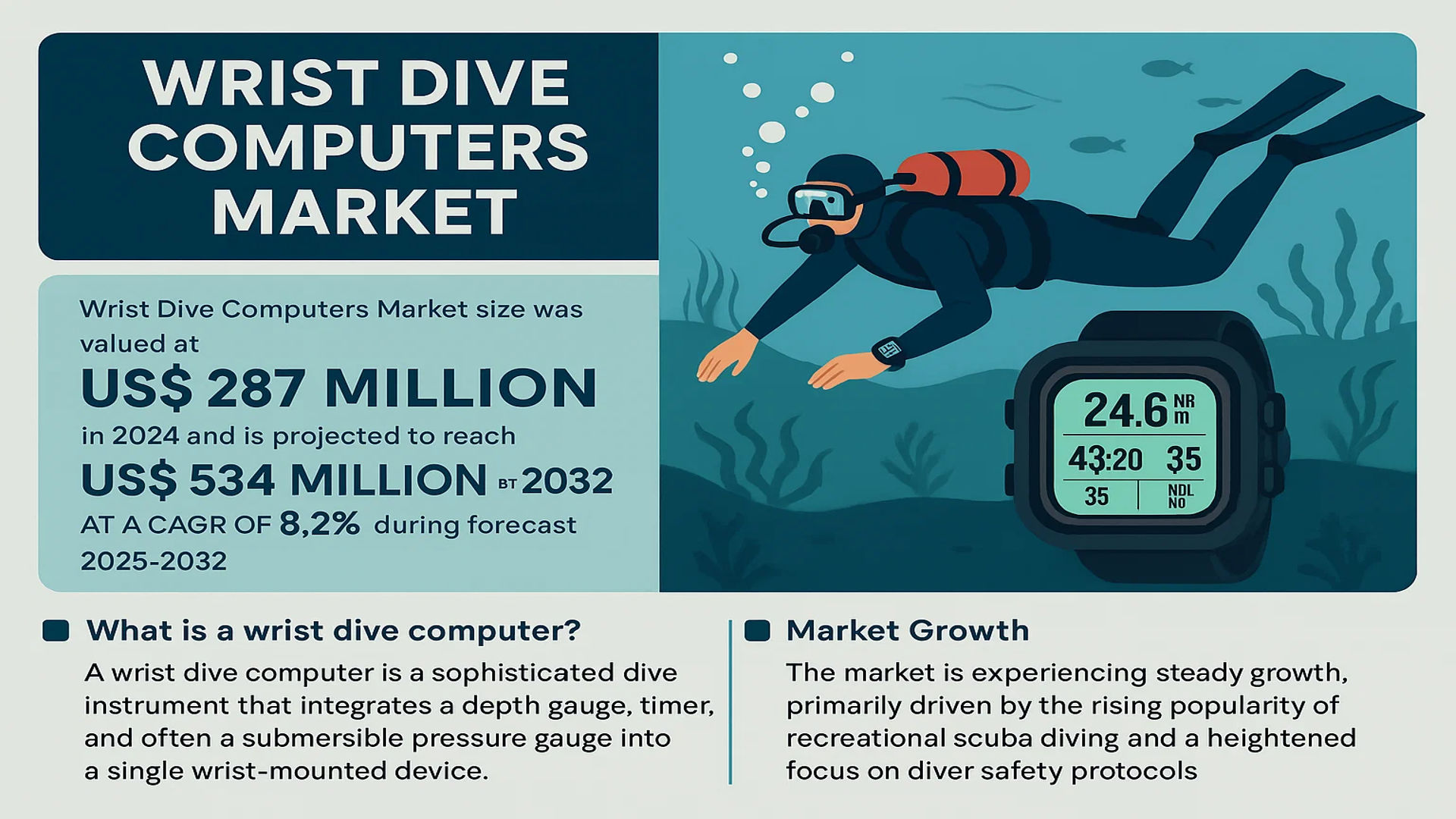
The global Wrist Dive Computers Market size was valued at US$ 287 million in 2024 and is projected to reach US$ 534 million by 2032, at a CAGR of 8.2% during the forecast period 2025-2032.
A wrist dive computer is a sophisticated dive instrument that integrates a depth gauge, timer, and often a submersible pressure gauge (SPG) into a single wrist-mounted device. It continuously monitors depth and time data, applying it to a decompression algorithm to track dissolved nitrogen in a diver’s tissues. This provides real-time information on remaining no-decompression limits and ascent rates, which is immensely useful for avoiding decompression sickness and enhancing overall dive safety.
The market is experiencing steady growth, primarily driven by the rising popularity of recreational scuba diving and a heightened focus on diver safety protocols. Furthermore, technological advancements, such as the integration of OLED color displays for improved readability and the development of air integration features, are making these devices more appealing to both civilian and professional divers. Key players like Suunto, Shearwater Research, and Garmin (which acquired Oceanic) are continuously innovating, with recent product launches in 2024 focusing on enhanced connectivity and longer battery life, further fueling market expansion.
MARKET DYNAMICS
MARKET DRIVERS
Rising Popularity of Recreational Diving Activities to Propel Market Expansion
The global wrist dive computers market is experiencing robust growth driven primarily by the increasing participation in recreational diving worldwide. The Professional Association of Diving Instructors (PADI) reported issuing over 1.3 million certifications annually, with recreational diving participation growing at approximately 5-7% per year across key markets. This surge in diving enthusiasts directly correlates with increased demand for reliable safety equipment, particularly wrist-mounted dive computers that provide real-time decompression data and dive planning capabilities. The convenience of having critical dive information readily accessible on the wrist, combined with advanced features such as wireless air integration and digital compass functionality, has made these devices essential for both novice and experienced divers seeking enhanced underwater safety and convenience.
Technological Advancements and Smart Feature Integration to Accelerate Adoption
Continuous technological innovation represents a significant driver for market growth, with manufacturers integrating advanced features that enhance diver safety and user experience. Modern wrist dive computers now incorporate sophisticated algorithms based on extensive decompression research, Bluetooth connectivity for data transfer to mobile applications, and high-resolution color displays that remain visible in various lighting conditions. The integration of artificial intelligence for predictive dive planning and the development of more accurate sensors for depth and temperature measurement have substantially improved device reliability. These technological enhancements address critical safety concerns while providing divers with comprehensive data analysis capabilities, making advanced dive computers increasingly accessible to the broader diving community.
Growing Military and Professional Diving Applications to Fuel Market Demand
The expansion of military and commercial diving operations worldwide contributes significantly to market growth, with these sectors requiring robust and reliable dive computers for mission-critical applications. Military organizations increasingly utilize advanced wrist dive computers for special operations, underwater construction, and salvage operations, where precise decompression management is essential for operational safety and effectiveness. The commercial diving sector, particularly offshore oil and gas operations and underwater infrastructure maintenance, represents a substantial market segment with specific requirements for durable, high-performance equipment. These professional applications often drive innovation in product development, with features such as extended battery life, enhanced durability, and specialized gas mixture support being developed initially for professional markets before trickling down to recreational products.
MARKET CHALLENGES
High Product Costs and Economic Sensitivity to Limit Market Penetration
The wrist dive computers market faces significant challenges related to product pricing and economic sensitivity, particularly in emerging markets and among entry-level divers. Advanced wrist dive computers with full feature sets typically range from $800 to $1,500, representing a substantial investment for recreational divers. This pricing structure creates barriers to adoption, especially in price-sensitive regions and among new divers who may prioritize basic equipment before investing in sophisticated computers. The manufacturing costs associated with pressure-resistant housings, specialized sensors, and rigorous testing procedures contribute to these high retail prices, making market expansion challenging in developing economies where disposable income levels may not support such purchases.
Other Challenges
Technical Complexity and User Interface Limitations
The sophisticated nature of dive computer technology presents challenges in user interface design and accessibility. Many potential users, particularly those new to diving, find the multitude of functions and data displays overwhelming, potentially leading to underutilization of safety features or incorrect interpretation of critical information. Manufacturers must balance advanced functionality with intuitive operation, a design challenge that requires significant research and development investment. Additionally, the small display size inherent to wrist-mounted devices limits the amount of information that can be presented simultaneously, creating design constraints that affect both usability and safety.
Battery Life and Maintenance Requirements
Battery performance and maintenance present ongoing challenges for both manufacturers and users. While most modern devices offer respectable battery life, typically ranging from 100-300 dive hours depending on usage patterns, battery replacement often requires professional service to maintain water resistance integrity. This creates additional costs and inconvenience for users, particularly those in remote locations without access to authorized service centers. The trend toward rechargeable batteries addresses some concerns but introduces new challenges related to charging convenience during extended dive trips and long-term battery degradation.
MARKET RESTRAINTS
Seasonal Nature of Diving Activities and Geographic Limitations to Constrain Market Growth
The seasonal variability of diving activities significantly restrains market growth, particularly in temperate regions where diving is primarily a seasonal pursuit. In many Northern Hemisphere markets, diving activity decreases by approximately 60-70% during winter months, creating substantial fluctuations in product demand throughout the year. This seasonality affects manufacturing planning, inventory management, and retail performance, making consistent market growth challenging to maintain. Additionally, the geographic concentration of prime diving locations—primarily coastal regions and tropical destinations—limits the addressable market compared to more universally accessible sports and activities. This geographic constraint means that market growth is inherently tied to tourism patterns and the development of diving infrastructure in new regions, both of which evolve relatively slowly.
Intense Market Competition and Price Pressure to Impact Profitability
The wrist dive computers market experiences significant competitive pressure that restrains profitability and innovation investment. With numerous established brands and increasing entry from technology companies expanding into outdoor recreation markets, price competition has intensified substantially. Market leaders face pressure to reduce prices while maintaining advanced feature sets, squeezing profit margins and potentially limiting research and development budgets. This competitive environment particularly affects mid-tier manufacturers who must balance feature development with cost constraints, potentially slowing the pace of technological advancement as companies focus on cost reduction rather than innovation.
Regulatory Compliance and Certification Requirements to Increase Development Costs
Stringent regulatory requirements and certification standards present significant restraints on market development and product innovation. Dive computers must undergo rigorous testing and certification processes to ensure reliability and safety under extreme conditions, with compliance costs representing a substantial portion of development budgets. These requirements vary by region, with different standards applying in North America, Europe, and Asia-Pacific markets, creating additional complexity for global product launches. The time-consuming nature of certification processes can delay product introductions by several months, affecting competitive positioning and potentially causing manufacturers to miss key selling seasons.
MARKET OPPORTUNITIES
Integration with Digital Ecosystems and Smart Technology to Create New Growth Avenues
The integration of wrist dive computers with broader digital ecosystems presents substantial growth opportunities for market participants. The development of comprehensive dive logging applications, social sharing platforms, and cloud-based data analysis services creates additional value propositions beyond the core dive computer functionality. Manufacturers increasingly focus on developing ecosystems where dive computers seamlessly connect with smartphones, tablets, and computers, enabling detailed dive analysis, trend tracking, and community engagement. This connectivity allows for regular software updates that enhance functionality over time, creating ongoing customer engagement opportunities and potential revenue streams through premium features or subscription services.
Expansion into Emerging Markets and Developing Diving Infrastructure to Offer Significant Potential
Emerging markets represent substantial untapped opportunities for wrist dive computer manufacturers, particularly in Southeast Asia, the Middle East, and Latin America where diving tourism is growing rapidly. Countries such as Indonesia, Thailand, and Mexico have experienced double-digit growth in diving tourism over recent years, creating new markets for dive equipment. The development of new dive centers and training facilities in these regions provides natural distribution channels and customer education opportunities. Additionally, rising disposable incomes in developing economies enable more consumers to participate in recreational diving, creating a expanding customer base for entry-level and mid-range dive computers.
Development of Specialized Products for Niche Applications to Drive Premium Segment Growth
The development of specialized wrist dive computers for niche applications offers significant opportunity for market differentiation and premium pricing. Technical diving applications, including mixed gas diving, rebreather compatibility, and cave diving, require advanced features and specialized algorithms that command higher price points. Similarly, the growing interest in freediving and spearfishing has created demand for computers optimized for these activities with features such as depth alarms, surface interval timing, and specific data displays. The military and professional diving sectors continue to require ruggedized, mission-specific computers with features not available in consumer models, representing another high-value market segment. These specialized applications allow manufacturers to develop products with higher margins while addressing specific user needs that are not met by mainstream offerings.
WRIST DIVE COMPUTERS MARKET TRENDS
Integration of Advanced Connectivity and AI-Driven Algorithms to Emerge as a Dominant Trend
The global wrist dive computer market is undergoing a significant transformation, driven by the integration of sophisticated connectivity features and artificial intelligence. Modern devices now routinely incorporate Bluetooth and ANT+ connectivity, enabling seamless data transfer to smartphones and computers for detailed post-dive analysis. This trend is crucial for the growing community of technical and recreational divers who rely on data to track their progress and ensure safety. Furthermore, AI-driven algorithms are enhancing decompression modeling, moving beyond traditional Bühlmann-based models to offer more personalized and adaptive dive profiles. These algorithms can factor in individual physiological data, previous dive history, and real-time environmental conditions, substantially reducing the risk of decompression sickness. The shift towards cloud-based logbook integration is also notable, with an estimated 65% of new mid-to-high-end models released in the past two years offering this feature, creating a more holistic dive management ecosystem.
Other Trends
Rise in Technical and Recreational Diving Tourism
Global tourism recovery post-pandemic has directly fueled demand for dive computers, with popular diving destinations experiencing a notable surge in enthusiast visits. Regions like Southeast Asia, the Caribbean, and the Red Sea have reported a 20-30% annual increase in certified diver registrations, directly correlating to higher equipment sales. This growth is not limited to rental fleets; there is a marked increase in personal ownership, as divers seek the reliability and familiarity of their own gear. The market is responding with more rugged, travel-friendly designs that cater to the mobile diver, featuring enhanced battery life and durability to withstand frequent travel and use in varied aquatic environments. This trend underscores the market’s shift from being purely safety-oriented to also encompassing lifestyle and convenience.
Product Diversification and Market Segmentation
Manufacturers are aggressively pursuing product diversification to capture value across different consumer segments. The market has clearly bifurcated into two main categories: feature-rich, color-display computers for the serious enthusiast and technical diver, and more affordable, monochrome models for the casual recreational user. This segmentation strategy is evident in pricing, with high-end models often exceeding $1,200 and entry-level devices stabilizing around the $300-$500 range. A key development is the expansion into freediving-specific computers, a niche that has seen over 40% growth in dedicated models offered since 2022. Additionally, the integration of heart rate monitoring via optical sensors is an emerging premium feature, providing data for more advanced physiological workload and air consumption calculations, appealing to the health-conscious and data-driven diver.
COMPETITIVE LANDSCAPE
Key Industry Players
Innovation and Strategic Expansion Drive Market Leadership
The global wrist dive computers market exhibits a semi-consolidated competitive structure, characterized by a mix of established multinational corporations and specialized niche players. This dynamic is fueled by continuous technological advancements and the critical need for reliable safety equipment in both recreational and professional diving. Market leadership is primarily determined by a company’s ability to innovate, its brand reputation for accuracy and durability, and its global distribution network.
Suunto (Finland) and Garmin Ltd. (U.S.) are consistently identified as dominant forces, collectively holding a significant portion of the market share. Suunto’s long-standing heritage in dive computers and outdoor sports instrumentation, exemplified by models like the Suunto D5, grants it considerable brand loyalty. Conversely, Garmin has rapidly gained traction by leveraging its expertise in GPS and wearable technology, integrating advanced features like satellite communications and smartwatch functionalities into its Descent series, which appeals to the tech-savvy diver.
Meanwhile, Shearwater Research (Canada) has carved out a formidable position, particularly within the technical and professional diving segments. The company is renowned for its high-performance, user-friendly interfaces, and robust decompression algorithms. Its focus on the high-end market, with products like the Teric and Perdix models, has allowed it to command premium pricing and foster a dedicated user base. Similarly, Oceanic (U.S.), a brand under Huish Outdoors, maintains a strong presence through its comprehensive range of computers that cater to everyone from beginners to advanced divers, supported by extensive retail partnerships.
Other key players, including Mares (Italy) and Cressi (Italy), leverage their deep-rooted history in the broader diving equipment sector to cross-sell their wrist computers. Their growth strategies often involve geographical expansion into emerging diving markets in Asia-Pacific and strategic refreshes of their product lines to incorporate color displays and Bluetooth connectivity. The competitive intensity is further heightened by consistent investments in research and development, focusing on enhancing battery life, improving screen readability in low-light conditions, and refining algorithmic safety models to minimize decompression risks.
List of Key Wrist Dive Computer Companies Profiled
- Suunto (Finland)
- Garmin Ltd. (U.S.)
- Shearwater Research Inc. (Canada)
- Oceanic (A Huish Outdoors Company) (U.S.)
- Mares S.p.A. (Italy)
- Cressi S.p.A. (Italy)
- Scubapro (U.S.)
- Aqualung International (France)
- Sherwood Scuba (U.S.)
Segment Analysis:
By Type
OLED Color Display Segment Dominates the Market Due to Enhanced User Experience and Superior Readability
The market is segmented based on type into:
- OLED Color Display
- Colorless Display
By Application
Civilian Segment Leads Due to Growing Popularity of Recreational Diving and Increased Spending on Adventure Sports
The market is segmented based on application into:
- Military
- Civilian
By End User
Recreational Divers Segment Holds the Largest Share Fueled by Rising Global Tourism and Dive Certification Rates
The market is segmented based on end user into:
- Recreational Divers
- Professional Divers
- Dive Centers and Training Schools
By Connectivity
Wireless-Enabled Computers are Gaining Traction for Their Seamless Data Transfer and Logbook Integration Capabilities
The market is segmented based on connectivity into:
- Wired (PC Interface)
- Wireless (Bluetooth, ANT+)
Regional Analysis: Wrist Dive Computers Market
North America
North America represents a mature and technologically advanced market for wrist dive computers, characterized by high consumer spending power and a strong culture of recreational diving. The United States, in particular, is a significant hub for innovation, hosting key manufacturers like Shearwater Research, Oceanic, and Aeris. Demand is primarily driven by a well-established scuba diving industry in regions such as Florida, California, and Hawaii, supported by a large base of certified divers—estimated at over 3 million by PADI (Professional Association of Diving Instructors). The market is highly competitive, with consumers showing a strong preference for feature-rich models incorporating OLED color displays, air integration, and advanced algorithm support like Bühlmann ZHL-16C. While military and professional applications exist, the civilian recreational segment dominates sales. However, market growth faces seasonal limitations and is sensitive to economic fluctuations that impact discretionary spending on high-end dive gear.
Europe
Europe is another cornerstone of the global wrist dive computer market, distinguished by stringent product certification standards (CE marking) and a diverse diving landscape ranging from the Mediterranean to the colder waters of the North Sea. Countries like Italy, France, Germany, and the United Kingdom have strong domestic markets, bolstered by prominent local brands such as Suunto and Mares. European divers are known for being particularly discerning, valuing reliability, safety features, and environmental durability. There is a noticeable trend towards multi-gas computers and nitrox capability becoming standard even on mid-range models. The market is also supported by a robust network of dive shops and training agencies. While growth is steady, it is somewhat tempered by market saturation in key regions and the high cost of entry for new, innovative products, keeping premium brands dominant.
Asia-Pacific
The Asia-Pacific region is identified as the fastest-growing market for wrist dive computers, propelled by rising disposable incomes, growing tourism, and the expansion of dive travel hotspots in Southeast Asia. Countries like Thailand, Indonesia, the Philippines, and Malaysia are not only premier diving destinations but also emerging as significant consumer markets. China and Japan are major production and consumption hubs, with Japanese brands like Citizen (under its Scubapro line) holding considerable market share. The region exhibits a dual-market characteristic: a demand for low-to-mid-range, cost-effective models from new and occasional divers, alongside a growing appetite for high-performance computers from experienced enthusiasts. This growth is further fueled by government initiatives in some countries to promote marine tourism, though price sensitivity remains a key factor influencing purchasing decisions across many markets.
South America
The South American market for wrist dive computers is developing, with growth centered around countries with extensive coastlines and rich marine biodiversity, such as Brazil. The region’s diving industry is closely tied to ecotourism, attracting international divers to locations like Fernando de Noronha and the Galapagos Islands (though the latter is governed by Ecuador). This drives demand primarily through rental operations and sales to local dive centers. However, the broader consumer market is constrained by economic volatility and lower average incomes, which limit widespread personal ownership of advanced dive computers. Brands tend to focus on distributing durable, entry-level to mid-range models. The market potential is significant but remains largely untapped, awaiting greater economic stability and further development of the regional diving infrastructure.
Middle East & Africa
The market in the Middle East & Africa is nascent and unevenly developed. Growth is concentrated in specific areas, notably the Red Sea region—encompassing Egypt, Israel, and Jordan—which is a world-renowned diving destination attracting a high volume of tourists. This creates steady demand, though it is often met through the rental market operated by resorts and dive centers. South Africa also has a established community of technical and recreational divers. In contrast, the broader African continent and parts of the Middle East face significant challenges, including limited access to diving sites, lower participation rates, and economic barriers that restrict the market to a very niche segment. Overall, the region presents long-term growth opportunities linked to tourism development, but the current market size is relatively small compared to other global regions.
Report Scope
This market research report provides a comprehensive analysis of the global and regional Wrist Dive Computers markets, covering the forecast period 2025–2032. It offers detailed insights into market dynamics, technological advancements, competitive landscape, and key trends shaping the industry.
Key focus areas of the report include:
- Market Size & Forecast: Historical data and future projections for revenue, unit shipments, and market value across major regions and segments.
- Segmentation Analysis: Detailed breakdown by product type, display technology, application, and end-user industry to identify high-growth segments and investment opportunities.
- Regional Outlook: Insights into market performance across North America, Europe, Asia-Pacific, Latin America, and the Middle East & Africa, including country-level analysis where relevant.
- Competitive Landscape: Profiles of leading market participants, including their product offerings, R&D focus, manufacturing capacity, pricing strategies, and recent developments such as mergers, acquisitions, and partnerships.
- Technology Trends & Innovation: Assessment of emerging technologies, integration of AI/bluetooth connectivity, dive algorithm advancements, display innovations, and evolving industry standards.
- Market Drivers & Restraints: Evaluation of factors driving market growth along with challenges, supply chain constraints, regulatory issues, and market-entry barriers.
- Stakeholder Analysis: Insights for component suppliers, OEMs, distributors, investors, and policymakers regarding the evolving ecosystem and strategic opportunities.
Primary and secondary research methods are employed, including interviews with industry experts, data from verified sources, and real-time market intelligence to ensure the accuracy and reliability of the insights presented.
FREQUENTLY ASKED QUESTIONS:
What is the current market size of Global Wrist Dive Computers Market?
-> Wrist Dive Computers Market size was valued at US$ 287 million in 2024 and is projected to reach US$ 534 million by 2032, at a CAGR of 8.2% during the forecast period 2025-2032.
Which key companies operate in Global Wrist Dive Computers Market?
-> Key players include Suunto, Garmin, Shearwater Research, Cressi, Oceanic, Mares, Scubapro, Aqua Lung, Hollis, and Liquivision, among others.
What are the key growth drivers?
-> Key growth drivers include rising participation in recreational diving, technological advancements in dive computers, increasing disposable income in emerging markets, and growing emphasis on diver safety.
Which region dominates the market?
-> North America holds the largest market share, while Asia-Pacific is expected to be the fastest-growing region during the forecast period.
What are the emerging trends?
-> Emerging trends include integration of AI-powered dive algorithms, wireless connectivity features, multi-gas capability, and the development of compact, user-friendly designs.

Get Sample Report PDF for Exclusive Insights
Report Sample Includes
- Table of Contents
- List of Tables & Figures
- Charts, Research Methodology, and more...
 Download Sample Report PDF