WLCSP Probe Card Market Insights
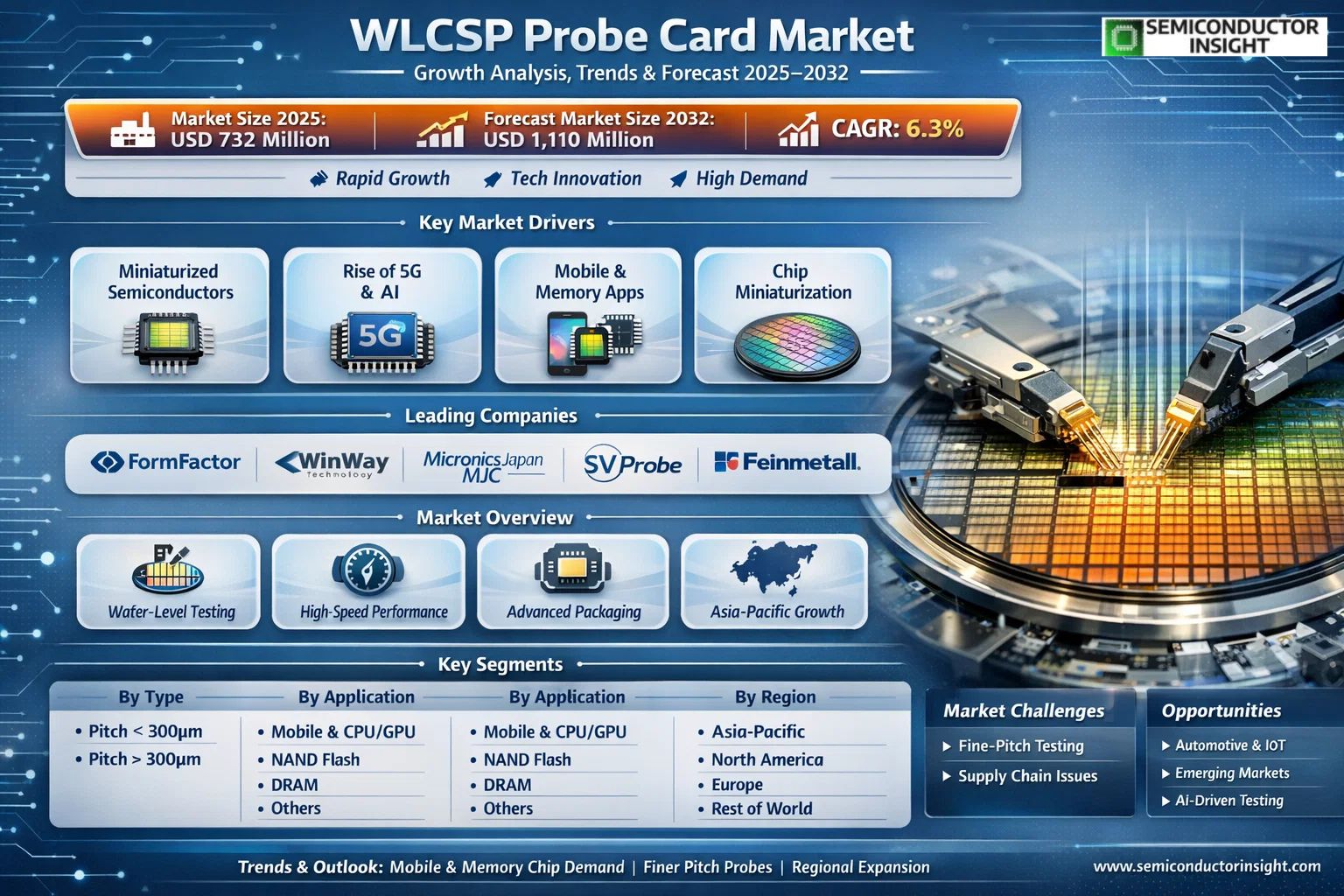
Global WLCSP Probe Card market size was valued at USD 732 million in 2025. The market is projected to reach USD 1,110 million by 2032, exhibiting a CAGR of 6.3% during the forecast period.
A WLCSP (Wafer-Level Chip Scale Package) probe card is a specialized testing tool used in semiconductor manufacturing to test WLCSPs directly at the wafer level before they are singulated into individual chips. WLCSPs are ultra-miniaturized chip packages that are roughly the same size as the die itself, making probe cards essential for evaluating functionality, reliability, and performance on these compact devices.
The market is experiencing rapid growth due to surging demand for advanced semiconductor testing amid the expansion of chip miniaturization and high-performance computing. Rising adoption of WLCSP in applications like mobile AP/CPU/GPU, NAND Flash, DRAM, and others further accelerates this trend. While finer pitches below 300μm pose technical challenges, innovations in probe technology address them effectively. Key players such as FormFactor, WinWay Technology, Micronics Japan (MJC), SV Probe, Feinmetall, Seiken Co., Ltd., SER, and TwinSolution dominate with robust portfolios and ongoing R&D investments.
MARKET DRIVERS
Rising Demand for Miniaturized Semiconductors
WLCSP Probe Card Market is propelled by the increasing adoption of wafer-level chip scale packaging in high-performance electronics, driven by the need for compact devices in smartphones and wearables. With global semiconductor production reaching over 1 trillion chips annually, probe cards designed for WLCSP testing ensure reliable wafer-level validation, reducing defects and enhancing yield rates by up to 15%.
Advancements in 5G and AI Technologies
Technological shifts toward 5G infrastructure and AI processors are accelerating WLCSP Probe Card Market growth, as these applications demand precise testing at finer pitches below 40 microns. Probe card innovations, including cantilever and vertical probe designs, support high-speed testing, meeting the surge in data center chip deployments projected to grow 12% yearly.
➤ Innovative materials like advanced ceramics improve probe card durability, extending lifespan by 20-30% in high-volume WLCSP testing environments.
Overall, these drivers position WLCSP Probe Card Market for sustained expansion, with investments in R&D by key manufacturers enhancing compatibility with next-gen fabs.
MARKET CHALLENGES
Technical Complexity in Fine-Pitch Testing
WLCSP Probe Card Market faces hurdles from the intricate requirements of testing ultra-fine pitch wafers, where alignment precision must be maintained within 2 microns to avoid yield losses exceeding 10%. Developing probe cards for pitches under 30 microns demands sophisticated MEMS integration, complicating production scalability.
Other Challenges
Cost Pressures and Supply Chain Volatility
Rising material costs for gold-plated probes and ceramic substrates have increased WLCSP probe card prices by 8-10% in recent years, straining budgets for mid-tier semiconductor firms amid fluctuating raw material supplies. Additionally, adapting to diverse WLCSP configurations across foundries poses interoperability issues, requiring customized solutions that extend lead times and elevate operational expenses in the market.
MARKET RESTRAINTS
High Capital Intensity and R&D Barriers
Capital-intensive manufacturing processes in WLCSP Probe Card Market deter new entrants, with setup costs for cleanroom facilities and precision equipment surpassing $50 million per fab line. This concentration among established players like FormFactor and Advantest limits market diversity.
Regulatory compliance for probe card materials, including RoHS standards and export controls on semiconductor tech, further restrains innovation pace, delaying product launches by 6-12 months in key regions.
Geopolitical tensions disrupting rare earth supplies also impact probe tip alloys, constraining production volumes and contributing to supply shortages in WLCSP Probe Card Market.
MARKET OPPORTUNITIES
Expansion in Automotive and IoT Sectors
WLCSP Probe Card Market holds significant potential from the automotive industry’s shift to ADAS and EVs, where WLCSP-packaged sensors require robust probe testing for reliability at 150°C operating conditions. IoT device proliferation, expected to exceed 75 billion units by 2025, further boosts demand for cost-effective probe solutions.
Emerging markets in Asia-Pacific, with fab investments rising 20% annually, offer avenues for localized WLCSP probe card production, reducing logistics costs and improving turnaround times for regional chipmakers.
Hybrid probe card designs integrating AI-driven test analytics present opportunities to cut testing times by 25%, appealing to high-volume WLCSP applications in consumer electronics and data processing.
WLCSP Probe Card Market Trends
Increasing Demand from Mobile and Memory Chip Testing
WLCSP Probe Card Market is experiencing robust growth fueled by the expansion of wafer-level chip scale packaging in high-volume semiconductor production. WLCSP probe cards enable precise electrical testing at the wafer level for ultra-compact packages matching die dimensions, critical for functionality and yield in consumer electronics and data storage. Applications in mobile AP/CPU/GPU segments lead adoption, as manufacturers prioritize reliability in densely integrated devices. NAND Flash and DRAM testing further drives demand, with probe cards supporting high-throughput wafer probing to meet escalating production needs in smartphones and servers.
Other Trends
Advancements in Fine Pitch Probe Technologies
Probe card designs for pitches of 300μm or less are gaining prominence in WLCSP Probe Card Market, accommodating the shift toward higher density interconnects in advanced nodes. This trend reflects semiconductor industry’s push for miniaturization, where finer pitches ensure accurate contact with shrinking bump sizes, enhancing test coverage for complex logic and memory devices. Manufacturers are refining cantilever and vertical probe architectures to handle these challenges, improving signal integrity and reducing contact resistance during high-speed testing cycles.
Regional Shifts and Competitive Landscape Evolution
Asia-Pacific regions, including China, Japan, and South Korea, dominate WLCSP Probe Card Market dynamics, driven by concentrated semiconductor fabrication hubs and rising domestic chip packaging capacities. North America and Europe contribute through innovation in probe card solutions, while emerging markets in Southeast Asia and India present expansion opportunities. Leading players such as FormFactor, WinWay Technology, Micronics Japan (MJC), SV Probe, Feinmetall, Seiken Co., Ltd., SER, and TwinSolution intensify competition, with top firms capturing substantial revenue shares through product enhancements and strategic partnerships. Industry surveys highlight ongoing developments in materials and automation, addressing challenges like pitch scaling and thermal management to sustain market momentum.
COMPETITIVE LANDSCAPE
Key Industry Players
WLCSP Probe Card Market Leaders and Strategic Challengers
WLCSP Probe Card Market exhibits a moderately concentrated structure, with the global top five players commanding a substantial revenue share in 2025. FormFactor stands out as the leading manufacturer, leveraging its advanced cantilever and vertical probe technologies tailored for wafer-level chip scale packaging testing. This dominance stems from FormFactor’s extensive R&D investments and strong partnerships with major semiconductor foundries, enabling high-precision probing for pitches ≤300μm and >300μm. The market’s growth, projected from US$732 million in 2025 to US$1110 million by 2032 at a 6.3% CAGR, underscores the critical role of these leaders in addressing demands from mobile AP/CPU/GPU, NAND Flash, and DRAM applications.
Beyond the frontrunners, several niche players contribute significantly through specialized offerings and regional strengths. Companies like Micronics Japan (MJC) and WinWay Technology excel in high-density probe solutions for advanced nodes, while Feinmetall and SV Probe focus on customizable designs for reliability testing. Emerging competitors such as Seiken Co., Ltd., SER, and TwinSolution are gaining traction in Asia-Pacific markets, particularly in China and Japan, by providing cost-effective alternatives and rapid customization. This tiered competitive dynamic fosters innovation in probe card durability and pitch accuracy, challenging incumbents while expanding market accessibility amid rising semiconductor complexity.
List of Key WLCSP Probe Card Companies Profiled
- FormFactor
- Micronics Japan (MJC)
- WinWay Technology
- Feinmetall
- SV Probe
- Seiken Co., Ltd.
- SER
- TwinSolution
- MPI Corporation
- ERS electronic GmbH
- Ingun RF
- Kabushiki Kaisha Tokyo Kenkyujo
- Probe Card Innovators
- TSK Corporation
Segment Analysis:
| Segment Category | Sub-Segments | Key Insights |
| By Type |
|
Pitch ≤ 300μm
|
| By Application |
|
Mobile AP/CPU/GPU
|
| By End User |
|
Semiconductor Foundries
|
| By Wafer Size |
|
300 mm
|
| By Technology |
|
Cantilever
|
Regional Analysis: WLCSP Probe Card Market
Asia-Pacific
Asia-Pacific’s dense cluster of foundries and OSATs creates unmatched scale for WLCSP Probe Card deployment. High-output fabs prioritize probe cards for efficient at-speed testing, reducing downtime and enhancing throughput in WLCSP Probe Card Market operations.
Regional R&D hubs pioneer probe technologies like advanced spring designs and multi-DUT probing, tailored for next-gen WLCSP complexities. This fosters a competitive edge in WLCSP Probe Card Market through rapid iteration and customization.
Localized sourcing minimizes disruptions, enabling agile responses to demand surges in electronics and automotive sectors, bolstering stability in WLCSP Probe Card Market supply dynamics.
Government-backed initiatives and private ventures fuel expansion of testing infrastructure, positioning Asia-Pacific for leadership in emerging WLCSP applications through 2034.
North America
North America plays a crucial role in WLCSP Probe Card Market through its innovation-driven ecosystem, centered in the United States. Home to design houses and equipment leaders like FormFactor and Advantest affiliates, the region excels in developing cutting-edge probe card architectures for R&D-intensive applications. Demand arises from fabless firms focusing on high-performance computing, AI chips, and defense electronics, where precision testing is paramount. Collaborative university-industry partnerships accelerate advancements in probe materials and contact technologies, addressing fine-pitch challenges. While production volumes lag behind Asia-Pacific, North America’s strength lies in IP generation and early adoption of disruptive WLCSP trends. Business strategies emphasize premium, customizable solutions, with growth projected through integration with advanced packaging like 2.5D/3D stacks by 2034.
Europe
Europe contributes steadily to WLCSP Probe Card Market, leveraging its automotive and industrial semiconductor strengths in Germany, the Netherlands, and France. Companies like Infineon and NXP drive need for robust probe cards in power and sensor WLCSP testing, prioritizing reliability for safety-critical systems. The region’s focus on sustainability influences probe designs toward eco-friendly materials and longer lifespans. EU-funded projects promote digital sovereignty, spurring domestic testing capabilities. Challenges include fragmented supply chains, but strategic alliances with Asian suppliers mitigate risks. Future trajectories highlight growth in EV and IoT sectors, with business strategies centered on modular probe systems for diverse WLCSP formats through the 2026-2034 horizon.
South America
South America represents an emerging frontier in WLCSP Probe Card Market, with Brazil and Mexico leading adoption amid expanding electronics assembly. Local demand stems from consumer devices and automotive manufacturing, supported by nearshoring trends from North America. Limited indigenous production fosters reliance on imports, but investments in training and facilities build testing expertise. Key dynamics include cost-sensitive probe selections and adaptations for regional device mixes. Growth potential lies in agribusiness electronics and renewable energy chips, where WLCSP efficiency gains traction. Business strategies focus on partnerships for technology transfer, aiming for self-reliance by 2034 amid infrastructural developments.
Middle East & Africa
The Middle East & Africa region shows nascent potential in WLCSP Probe Card Market, driven by diversification efforts in the UAE, Israel, and South Africa. Israel’s fabless innovation and UAE’s sovereign wealth-funded fabs spark initial demand for advanced probe cards in AI and telecom WLCSP testing. Africa’s electronics growth in mobile and payment systems adds momentum. Constraints like skill gaps and import dependencies persist, yet visionary projects accelerate infrastructure. Strategic focus on high-value niches like data centers positions the region for expansion, with collaborations enhancing local capabilities toward 2034 market integration.
Report Scope
This market research report provides a comprehensive analysis of the WLCSP Probe Card Market , covering the forecast period 2026–2034. It offers detailed insights into market dynamics, technological advancements, competitive landscape, and key trends shaping the industry.
Key focus areas of the report include:
- Market Overview: The report begins with an overview outlining its current market scenario, key growth indicators, and industry transformation drivers. It discusses macroeconomic factors, demand–supply balance, regulatory landscape, and the strategic role of semiconductors in powering advancements across industries such as automotive, telecommunications, consumer electronics, and industrial automation.
- Market Size & Forecast: Historical data and future projections for revenue, unit shipments, and market value across major regions and segments.
- Segmentation Analysis: Detailed breakdown by product type, technology, application, and end-user industry to identify high-growth segments and investment opportunities.
- Regional Insights: Insights into market performance across North America, Europe, Asia-Pacific, Latin America, and the Middle East & Africa, including country-level analysis where relevant.
- Competitive Landscape: Profiles of leading market participants, including their product offerings, R&D focus, manufacturing capacity, pricing strategies, and recent developments such as mergers, acquisitions, and partnerships.
- Technology Trends & Innovation: Assessment of emerging technologies, integration of AI/IoT, semiconductor design trends, fabrication techniques, and evolving industry standards.
- Market Drivers & Restraints: Evaluation of factors driving market growth along with challenges, supply chain constraints, regulatory issues, and market-entry barriers.
- Stakeholder Insights: Insights for component suppliers, OEMs, system integrators, investors, and policymakers regarding the evolving ecosystem and strategic opportunities.
Primary and secondary research methods are employed, including interviews with industry experts, data from verified sources, and real-time market intelligence to ensure the accuracy and reliability of the insights presented.
FREQUENTLY ASKED QUESTIONS:
What is the current market size of WLCSP Probe Card Market?
-> WLCSP Probe Card Market was valued at USD 732 million in 2025 and is expected to reach USD 1110 million by 2032, at a CAGR of 6.3% during the forecast period.
Which key companies operate in WLCSP Probe Card Market?
-> Key players include FormFactor, WinWay Technology, Micronics Japan (MJC), SV Probe, Feinmetall, Seiken Co., Ltd., SER, and TwinSolution, among others.
What are the key growth drivers?
-> Key growth drivers include demand for wafer-level testing in semiconductor manufacturing, adoption of ultra-miniaturized WLCSPs, and expansion in mobile AP/CPU/GPU, NAND Flash, and DRAM applications.
Which region dominates the market?
-> Asia dominates the market, with key contributions from China, Japan, and South Korea.
What are the emerging trends?
-> Emerging trends include finer pitch probe cards (≤ 300μm), advanced testing for high-density memory devices, and growth in semiconductor packaging technologies.

Get Sample Report PDF for Exclusive Insights
Report Sample Includes
- Table of Contents
- List of Tables & Figures
- Charts, Research Methodology, and more...
 Download Sample Report PDF