
Market Insights
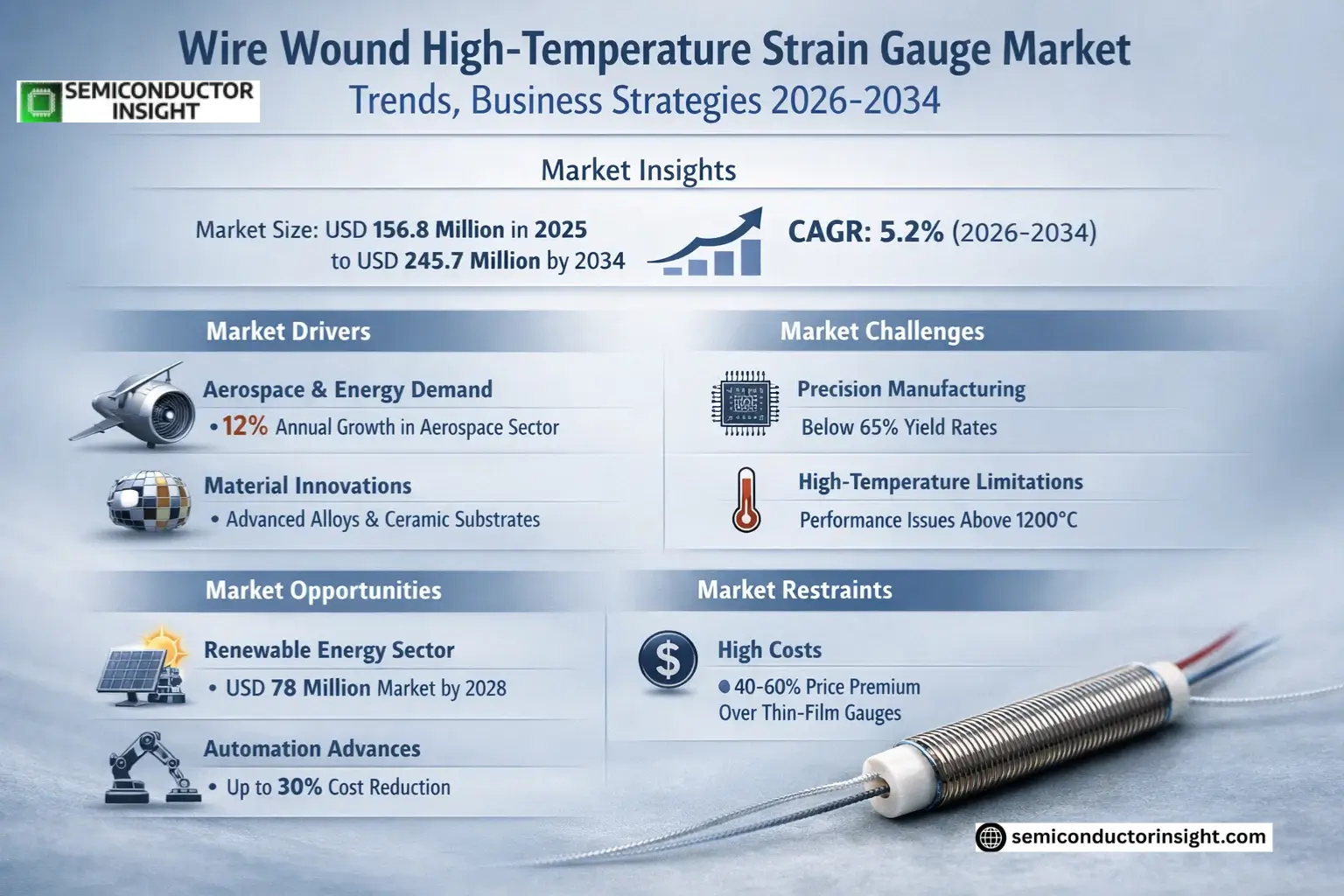
Global Wire Wound High-Temperature Strain Gauge Market size was valued at USD 156.8 million in 2025. The market is projected to grow from USD 168.3 million in 2026 to USD 245.7 million by 2034, exhibiting a CAGR of 5.2% during the forecast period.
Wire wound high-temperature strain gauges are precision sensors designed to measure mechanical strain in extreme thermal environments, typically above 200°C. These devices consist of fine resistance wires wound around an insulating substrate, enabling accurate stress analysis in applications such as aerospace propulsion systems, industrial gas turbines, and nuclear reactors.
The market growth is driven by increasing demand for condition monitoring in energy infrastructure and stricter safety regulations in process industries. However, the emergence of fiber optic alternatives presents competitive challenges. Key manufacturers like HBM and Vishay are investing in advanced alloys and ceramic substrates to enhance temperature resilience beyond 1000°C while maintaining measurement accuracy under thermal cycling conditions.
MARKET DRIVERS
Increasing Demand in Aerospace & Energy Sectors
Wire Wound High-Temperature Strain Gauge Market is experiencing growth due to heightened demand in aerospace and energy applications. These gauges provide accurate strain measurements in extreme conditions, making them vital for turbine monitoring and structural integrity testing. The aerospace sector alone has contributed to a projected 12% annual growth for high-temperature strain gauges.
Technological Advancements in Materials
Innovations in alloy compositions and ceramic substrates have enhanced the durability of wire wound strain gauges above 1000°C. Manufacturers are investing heavily in research, with over 35% of industry R&D budgets allocated to high-temperature stability improvements.
Growing regulatory requirements for safety testing in industrial processes are further propelling adoption across manufacturing sectors.
MARKET CHALLENGES
Precision Manufacturing Complexities
Wire wound high-temperature strain gauges require micron-level precision during production, resulting in yield rates below 65% for some manufacturers. The specialized winding techniques demand highly skilled labor, creating production bottlenecks.
Other Challenges
Performance Degradation at Extreme Temperatures
Even advanced wire wound designs show signal drift above 1200°C, limiting applications in certain nuclear and hypersonic test environments.
MARKET RESTRAINTS
High Cost Compared to Alternative Technologies
Wire wound high-temperature strain gauges carry a 40-60% price premium over thin-film alternatives, restricting adoption in cost-sensitive industries. The complex manufacturing process and rare material requirements contribute to this pricing differential.
MARKET OPPORTUNITIES
Emerging Applications in Renewable Energy Infrastructure
The expansion of concentrated solar power plants and next-gen nuclear reactors creates new demand for wire wound strain gauges capable of withstanding prolonged thermal cycling. Projected installations suggest a potential USD 78 million addressable market by 2028 for these applications alone.
Automation in Production Processes
Advances in robotic winding systems could reduce manufacturing costs by up to 30%, potentially making wire wound solutions more competitive against alternative strain measurement technologies.
Wire Wound High-Temperature Strain Gauge Market Trends
Growing Adoption in Aerospace and Energy Sectors
Wire Wound High-Temperature Strain Gauge Market is witnessing increased demand from aerospace and energy applications, where accurate strain measurement under extreme conditions is critical. These gauges provide reliable performance in environments exceeding 500°C, making them essential for turbine monitoring and structural testing in aircraft engines and power plants.
Other Trends
Material Advancements Driving Market Expansion
Manufacturers are developing advanced alloys and ceramic substrates to enhance the durability and temperature resistance of wire wound strain gauges. This innovation addresses the need for longer operational lifespans in harsh industrial environments while maintaining measurement precision.
Regional Market Developments
Asia-Pacific shows particularly strong growth potential for Wire Wound High-Temperature Strain Gauges, with expanding aerospace and energy infrastructure projects in China and India. Meanwhile, North America maintains technological leadership through R&D investments from key manufacturers like Vishay and HBM.
Competitive Landscape Shifts
The market remains consolidated among established players, with the top five companies holding majority revenue share. Recent strategic acquisitions have strengthened product portfolios, particularly in specialized multi-axis strain gauge configurations for complex measurement applications.
Industry Standards and Compliance Impact
Increasing regulatory requirements for safety and precision in high-temperature industrial applications are prompting upgrades to advanced Wire Wound Strain Gauge technologies. This trend is particularly evident in nuclear power and chemical processing sectors where measurement reliability directly impacts operational safety.
COMPETITIVE LANDSCAPE
Key Industry Players
Global Leaders and Emerging Challengers in High-Temperature Strain Measurement
Global Wire Wound High-Temperature Strain Gauge Market is dominated by established players like HBM and Vishay, which collectively hold a significant market share. These companies lead through advanced R&D capabilities and extensive product portfolios tailored for aerospace, energy, and industrial applications. The market exhibits moderate consolidation with the top five players accounting for approximately XX% revenue share in 2025, showcasing competition through technological innovation and strategic partnerships.
Emerging Asian manufacturers like AVIC Electrical Measurement and Juhang Technology are gaining traction through cost-competitive solutions, particularly in the Chinese market. Niche players such as Flintec and Keli Sensor specialize in customized strain gauges for extreme environments, while Japanese firms like KYOWA maintain strong positions in precision measurement segments. Regional players compete through application-specific solutions and localized supply chains.
List of Key Wire Wound High-Temperature Strain Gauge Companies Profiled
- HBM
- Vishay Precision Group
- AVIC Electrical Measurement
- Mettler Toledo
- Flintec
- NMB Technologies
- Keli Sensor Manufacturing
- Juhang Technology
- KYOWA Electronic Instruments
- TML (Tokyo Measuring Instruments Lab)
- Hitec Sensors
- Piezocryst Advanced Sensorics
- Strain Measurement Devices
- Hypersen Technologies
- Zemic Europe
Segment Analysis:
| Segment Category | Sub-Segments | Key Insights |
| By Type |
|
Uniaxial Strain Gauges dominate due to their simplicity and cost-effectiveness for single-direction measurements.
|
| By Application |
|
Aerospace Sector shows highest adoption due to critical requirements for precision measurements under extreme conditions.
|
| By End User |
|
Original Equipment Manufacturers lead consumption due to integrated measurement requirements.
|
| By Material Type |
|
Nickel-Chromium Alloys remain the preferred material choice for most applications.
|
| By Temperature Range |
|
301-600°C segment shows strongest growth potential across industrial applications.
|
Regional Analysis: Wire Wound High-Temperature Strain Gauge Market
The United States accounts for over 60% of North American demand, with key applications in aerospace testing and power generation. Defense contracts and NASA projects utilize specialized wire wound gauges for extreme conditions.
Canada focuses on mining and oil sands applications, developing corrosion-resistant strain gauge solutions. Research at universities like Waterloo advances high-temperature measurement for industrial automation.
Mexico’s growing automotive sector creates opportunities for high-temperature strain gauges in engine testing. Strategic location supports both domestic demand and exports to other North American markets.
Strict ASME and ASTM standards in North America ensure premium quality requirements, creating barriers for low-cost competitors and maintaining high-value market dynamics.
Europe
Europe shows strong adoption of wire wound high-temperature strain gauges in automotive testing and renewable energy applications. Germany leads with precision engineering requirements in turbine monitoring. The EU’s focus on energy efficiency drives innovation in high-temperature sensing technologies. Stringent aerospace certification processes create specialized demand. Collaborative projects between manufacturers and research institutes enhance product capabilities for extreme environments.
Asia-Pacific
Rapid industrialization fuels Asia-Pacific’s growth, with China and Japan as primary markets. Expanding power generation infrastructure creates demand for reliable high-temperature strain measurement. Local manufacturers increasingly compete on customized solutions. Government investments in space programs and advanced manufacturing stimulate technological advancements. Emerging applications in semiconductor manufacturing present new growth avenues.
South America
South America’s market is developing, focusing on mining and oil exploration applications. Brazil shows potential with aircraft manufacturing requirements. Infrastructure challenges affect adoption rates, but regional partnerships are improving technical capabilities. Local customization for tropical climate conditions represents a niche opportunity for manufacturers.
Middle East & Africa
The Middle East drives demand through oil and gas applications, requiring durable high-temperature strain gauges for refinery monitoring. Limited local manufacturing creates import opportunities. Africa shows potential in mining sector applications, though infrastructure limitations currently constrain market growth.
Report Scope
This market research report provides a comprehensive analysis of the Wire Wound High-Temperature Strain Gauge Market , covering the forecast period 2025–2034. It offers detailed insights into market dynamics, technological advancements, competitive landscape, and key trends shaping the industry.
Key focus areas of the report include:
- Market Overview: The report begins with an overview outlining its current market scenario, key growth indicators, and industry transformation drivers. It discusses macroeconomic factors, demand–supply balance, regulatory landscape, and the strategic role of strain gauges in high-temperature applications across industries such as aerospace, energy, metallurgy, and chemical processing.
- Market Size & Forecast: Historical data and future projections for revenue, unit shipments, and market value across major regions and segments.
- Segmentation Analysis: Detailed breakdown by product type (Uniaxial, Multi Axis, Special Purpose), application, and end-user industry to identify high-growth segments and investment opportunities.
- Regional Insights: Insights into market performance across North America, Europe, Asia, South America, and Middle East & Africa, including country-level analysis.
- Competitive Landscape: Profiles of leading market participants, including their product offerings, market share, R&D focus, and recent developments such as mergers and acquisitions.
- Technology Trends: Assessment of emerging technologies and material advancements in high-temperature strain measurement.
- Market Drivers & Restraints: Evaluation of factors driving market growth along with challenges and industry-specific barriers.
- Stakeholder Insights: Strategic insights for manufacturers, suppliers, system integrators, and investors.
The report employs primary and secondary research methods, including interviews with industry experts and data from verified sources, to ensure accuracy and reliability.
FREQUENTLY ASKED QUESTIONS:
What is the current market size of Wire Wound High-Temperature Strain Gauge Market?
-> Wire Wound High-Temperature Strain Gauge Market size was valued at USD 156.8 million in 2025. The market is projected to grow from USD 168.3 million in 2026 to USD 245.7 million by 2034, exhibiting a CAGR of 5.2% during the forecast period.
Which key companies operate in Wire Wound High-Temperature Strain Gauge Market?
-> Key players include HBM, Vishay, AVIC Electrical Measurement, Mettler Toledo, Flintec, NMB, Keli Sensor, Juhang Technology, and KYOWA, among others.
What are the key growth drivers?
-> Key growth drivers include increasing aerospace applications, energy sector demand, and advancements in high-temperature material testing.
Which region dominates the market?
-> North America (with U.S. market size estimated at USD million in 2025) and Asia (with China emerging as high-growth market) are key regions.
What are the emerging trends?
-> Emerging trends include development of specialized strain gauges for extreme environments and integration with IoT-based monitoring systems.
Get Sample Report PDF for Exclusive Insights
Report Sample Includes
- Table of Contents
- List of Tables & Figures
- Charts, Research Methodology, and more...
 Download Sample Report PDF


