MARKET INSIGHTS
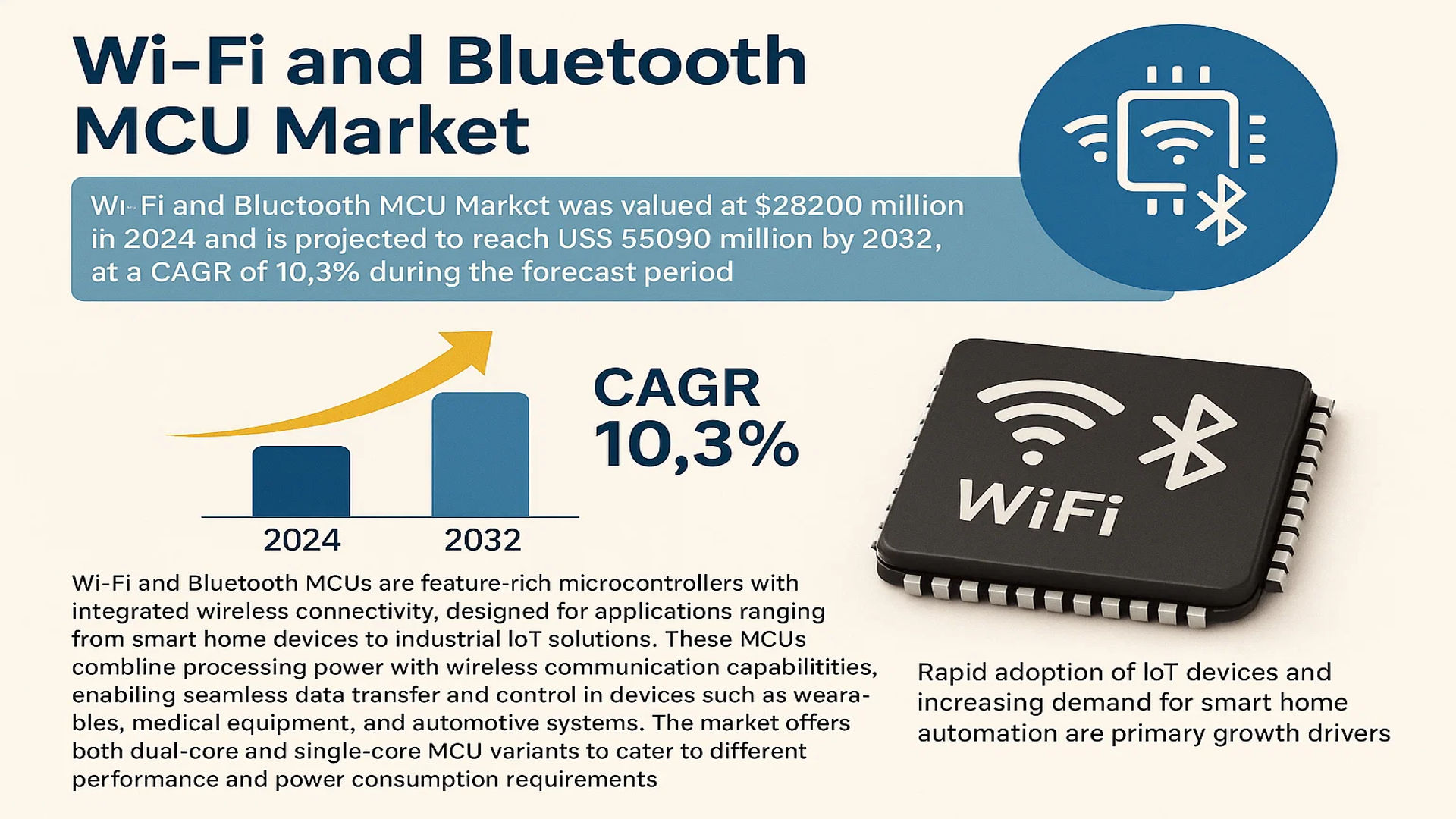
The global Wi-Fi and Bluetooth MCU Market was valued at 28200 million in 2024 and is projected to reach US$ 55090 million by 2032, at a CAGR of 10.3% during the forecast period.
Wi-Fi and Bluetooth MCUs are feature-rich microcontrollers with integrated wireless connectivity, designed for applications ranging from smart home devices to industrial IoT solutions. These MCUs combine processing power with wireless communication capabilities, enabling seamless data transfer and control in devices such as wearables, medical equipment, and automotive systems. The market offers both dual-core and single-core MCU variants to cater to different performance and power consumption requirements.
Rapid adoption of IoT devices and increasing demand for smart home automation are primary growth drivers. However, challenges like spectrum congestion and security concerns persist. Key players like Texas Instruments and NXP are investing heavily in low-power designs, while emerging applications in edge AI create new opportunities. The Asia-Pacific region dominates production, accounting for over 40% of global MCU manufacturing capacity.
MARKET DYNAMICS
MARKET DRIVERS
Proliferation of IoT Devices and Smart Home Ecosystems Fuels Demand
The exponential growth of IoT-connected devices globally has become a primary driver for the Wi-Fi and Bluetooth MCU market. With over 30 billion IoT devices projected to be in use worldwide by 2025, the need for efficient wireless connectivity solutions continues to surge. Wi-Fi and Bluetooth MCUs enable seamless communication between smart appliances, wearables, and industrial sensors, creating an interconnected ecosystem. Recent advancements in low-power wireless technologies have extended battery life while maintaining robust connectivity – a critical requirement for IoT deployments. Major tech companies are integrating these MCUs into their product lines at an accelerating pace to meet consumer demand for smart home automation and industrial IoT applications.
Advancements in Wireless Standards and Dual Connectivity Solutions
Technological evolution in wireless communication standards is significantly boosting market adoption. The transition to Wi-Fi 6/6E and Bluetooth 5.x standards has created demand for MCUs capable of supporting higher data rates (up to 9.6 Gbps for Wi-Fi 6E), reduced latency, and improved power efficiency. These enhancements enable more sophisticated applications in AR/VR, real-time industrial monitoring, and high-fidelity audio streaming. Many manufacturers now offer dual-core MCU solutions combining both Wi-Fi and Bluetooth connectivity in a single chip, reducing system complexity and cost while improving performance. Such integrated solutions are becoming increasingly preferred for space-constrained applications like hearables and medical wearables.
Strong Growth in Consumer Electronics Market
The consumer electronics sector remains the largest end-user of Wi-Fi and Bluetooth MCUs, accounting for approximately 60% of global market share. The ongoing miniaturization of consumer devices combined with consumers’ expectations for wireless functionality in every product drives continuous innovation in MCU design. Smartphones, tablets, and wireless audio devices require increasingly sophisticated wireless MCUs to support features like hands-free operation, multi-device pairing, and locational awareness. Emerging product categories such as smart glasses and next-generation gaming peripherals present additional growth avenues. Furthermore, rapid adoption of voice assistant-enabled devices is creating demand for MCUs with advanced voice processing capabilities.
MARKET RESTRAINTS
Semiconductor Supply Chain Constraints Hamper Market Expansion
While demand for Wi-Fi and Bluetooth MCUs continues to grow, the market faces significant supply chain challenges that impact product availability and pricing. The semiconductor industry’s capacity constraints, particularly for advanced process nodes below 40nm where many wireless MCUs are manufactured, have created shortages across the electronics sector. Lead times for certain MCU variants extended to over 50 weeks during recent supply chain disruptions, forcing manufacturers to redesign products or seek alternative solutions. These constraints are exacerbated by the concentrated nature of semiconductor manufacturing, with a few major foundries accounting for the majority of global production capacity.
Security Vulnerabilities in Wireless Protocols Raise Concerns
Security remains a persistent challenge for wireless MCU adoption, particularly in sensitive applications like healthcare and industrial automation. Researchers have identified vulnerabilities in both Wi-Fi and Bluetooth protocols that could potentially allow unauthorized access or data interception. Implementing robust security features like hardware-based encryption increases MCU complexity and cost, creating a trade-off between security and affordability. As cyber threats become more sophisticated, regulatory bodies are implementing stricter security requirements, increasing development timelines and compliance costs for MCU manufacturers.
Fragmentation in Wireless Ecosystem Creates Compatibility Issues
The coexistence of multiple wireless standards and proprietary implementations presents interoperability challenges across different devices and ecosystems. While industry groups work towards standardization, variations in protocol implementations between manufacturers can lead to connectivity issues and user frustration. This fragmentation is particularly problematic for smart home environments where devices from multiple vendors need to work together seamlessly. MCU developers must balance the demand for feature-rich solutions with the need for broad compatibility, often requiring extensive testing across different platform combinations.
MARKET OPPORTUNITIES
Emerging Applications in Healthcare and Industrial IoT Offer Significant Growth Potential
The healthcare sector represents a high-growth opportunity for advanced wireless MCUs as telemedicine and remote patient monitoring gain traction. Medical-grade MCUs with specialized features like ultra-low power operation (extending battery life to months or years), medical-grade encryption, and minimal RF interference are in increasing demand. Similarly, industrial applications including predictive maintenance, asset tracking, and smart manufacturing require ruggedized MCUs capable of operating in harsh environments while maintaining reliable wireless connectivity. These specialized applications command premium pricing and are driving innovation in the MCU market.
Development of AI-Enabled Edge Computing Applications
The integration of machine learning capabilities directly into wireless MCUs creates exciting new opportunities for edge computing applications. Advanced MCUs now incorporate neural network accelerators and dedicated AI processing cores, enabling intelligent decision-making at the device level without relying on cloud connectivity. This development is particularly valuable for applications requiring real-time responsiveness like voice recognition in smart speakers or predictive maintenance in industrial equipment. The combination of wireless connectivity and edge AI opens new possibilities for decentralized computing architectures across multiple industries.
Expansion of Smart City Infrastructure Worldwide
Global smart city initiatives are driving demand for robust, low-power wireless MCUs in urban infrastructure applications. Connected street lighting, environmental monitoring systems, and intelligent traffic management all require reliable wireless connectivity with minimal maintenance requirements. Governments worldwide are investing heavily in smart city technologies, creating a long-term growth opportunity for MCU manufacturers. These applications often require specialized features like extended temperature range operation, long-range connectivity options, and enhanced security – features that command higher margins in the competitive MCU market.
MARKET CHALLENGES
Increasing Design Complexity and Development Costs
As wireless MCUs incorporate more features and functionality, their design and development processes become increasingly complex and costly. Integrating multiple wireless protocols, security features, and application-specific processing cores requires specialized engineering expertise and more sophisticated development tools. The rising costs associated with advanced semiconductor manufacturing processes further compounds this challenge. Smaller MCU vendors in particular struggle with the R&D investment required to remain competitive against larger players with more substantial resources. This trend favors industry consolidation as smaller players seek partnerships or acquisitions to share development costs.
Power Consumption Challenges in Battery-Powered Applications
Balancing performance with power efficiency remains an ongoing challenge for MCU developers, particularly for always-on applications like wearables and IoT sensors. While wireless standards continue to improve power efficiency, the increasing complexity of applications and demand for real-time responsiveness pushes power requirements higher. Achieving multi-year battery life while maintaining reliable wireless connectivity requires careful optimization at both hardware and software levels. Thermal management becomes another critical consideration as processing demands increase in compact form factors, potentially limiting performance to prevent overheating.
Global Competition and Pricing Pressure
The Wi-Fi and Bluetooth MCU market has become intensely competitive with numerous players vying for market share across different application segments. While leading semiconductor companies dominate the high-performance segment, cost-sensitive markets face intense price competition from regional manufacturers. This competitive pressure compresses margins and forces vendors to differentiate through specialized features or ecosystem integrations. The rapid pace of technological advancement creates additional challenges as products can quickly become obsolete, requiring continuous investment in next-generation designs to maintain competitive positioning.
WI-FI AND BLUETOOTH MCU MARKET TRENDS
IoT Adoption and Smart Device Proliferation Driving Growth
The global Wi-Fi and Bluetooth MCU market is experiencing robust growth, driven by the rapid expansion of IoT applications and smart devices. Wi-Fi and Bluetooth-enabled microcontrollers (MCUs) have become indispensable in modern electronics due to their ability to deliver seamless wireless connectivity with low power consumption. The market was valued at $28,200 million in 2024 and is projected to reach $55,090 million by 2032, growing at a CAGR of 10.3%. The integration of these MCUs in smart home devices, wearables, and industrial automation systems has accelerated demand, particularly as the IoT ecosystem expands with more connected devices requiring efficient communication protocols.
Other Trends
Advancements in Low-Power Connectivity Solutions
Power efficiency remains a critical focus for Wi-Fi and Bluetooth MCU manufacturers, as battery-powered devices dominate consumer electronics and IoT applications. Recent advancements in ultra-low-power Bluetooth Low Energy (BLE) and Wi-Fi 6/6E standards have enhanced energy efficiency, enabling longer operational lifespans for wearables and remote sensors. Companies are investing in dual-core MCU architectures to optimize processing performance while minimizing power consumption, further fueling adoption in smart home and healthcare devices.
Rising Demand for Dual-Band and Multi-Protocol MCUs
As wireless communication standards evolve, dual-band Wi-Fi (2.4 GHz and 5 GHz) and multi-protocol MCUs supporting Bluetooth, Zigbee, and Thread are gaining traction. The ability to seamlessly switch between connectivity protocols enhances interoperability in smart ecosystems, making these MCUs ideal for smart lighting, security systems, and voice-controlled assistants. Leading manufacturers are integrating AI-driven RF optimization to enhance signal stability and reduce latency, addressing key challenges in high-density IoT environments.
COMPETITIVE LANDSCAPE
Key Industry Players
Leading Companies Accelerate IoT Innovation with Advanced Wireless Solutions
The global Wi-Fi and Bluetooth MCU market features a dynamic mix of semiconductor manufacturers, connectivity specialists, and IoT solution providers. Espressif Systems has emerged as a dominant force, capturing significant market share through its cost-effective ESP32 series of dual-core MCUs. The company’s success stems from its early mover advantage in IoT-focused wireless chips and strong developer community engagement across North America, Europe, and Asia-Pacific regions.
NXP Semiconductors and Texas Instruments maintain robust positions in the market, leveraging their comprehensive portfolios of industrial-grade wireless MCUs. These established players benefit from decades of microcontroller expertise and strategic partnerships with automotive and smart infrastructure customers. In 2024, NXP’s revenue from wireless connectivity solutions grew by 14% year-over-year, demonstrating strong adoption in industrial IoT applications.
Meanwhile, Qualcomm and Silicon Laboratories are focusing on premium segments through advanced Bluetooth Low Energy (BLE) and Wi-Fi 6 solutions. These companies invest heavily in R&D to integrate AI acceleration and enhanced security features into their wireless MCUs, addressing growing enterprise demands. The market has also seen increasing competition from Asian manufacturers like Murata Manufacturing, which combines module expertise with SoC design capabilities.
The competitive landscape continues evolving as companies adopt diverse strategies. While some focus on vertical integration (like Infineon acquiring Cypress Semiconductor), others specialize in niche applications. For instance, Laird Connectivity targets medical devices with ultra-low power wireless solutions, whereas Tuya Smart dominates the smart home ecosystem with its cloud-integrated MCU platforms.
List of Key Wi-Fi and Bluetooth MCU Companies Profiled
- Espressif Systems (China)
- NXP Semiconductors (Netherlands)
- Texas Instruments Incorporated (U.S.)
- Infineon Technologies AG (Germany)
- Murata Manufacturing Co., Ltd. (Japan)
- Qualcomm Technologies (U.S.)
- Silicon Laboratories (U.S.)
- Laird Connectivity (U.K.)
- Tuya Inc. (China)
- U-blox (Switzerland)
Segment Analysis:
By Type
Dual-core MCU Segment Leads the Market Due to Performance and Efficiency Advantages
The market is segmented based on type into:
- Dual-core MCU
- Subtypes: ARM Cortex-M based, RISC-V based, and others
- Single Core MCU
By Application
Wi-Fi Segment Dominates Owing to High Demand for IoT and Smart Home Connectivity
The market is segmented based on application into:
- Wi-Fi
- Subtypes: Wi-Fi 4, Wi-Fi 5, Wi-Fi 6, and others
- Bluetooth
- Subtypes: Bluetooth Classic, Bluetooth Low Energy (BLE), and others
By End User
Consumer Electronics Segment Holds Major Share Due to Proliferation of Smart Devices
The market is segmented based on end user into:
- Consumer Electronics
- Subtypes: Smartphones, Smart TVs, Wearables, and others
- Automotive
- Industrial
- Healthcare
- Others
Regional Analysis: Wi-Fi and Bluetooth MCU Market
Asia-Pacific
The Asia-Pacific region dominates the global Wi-Fi and Bluetooth MCU market, accounting for over 40% of the total revenue share. Countries like China, Japan, and South Korea lead the charge due to their robust electronics manufacturing ecosystems and high adoption of IoT devices. China’s aggressive investments in smart infrastructure and its ‘Made in China 2025’ initiative have propelled demand for advanced MCUs. Additionally, India’s rapid urbanization and expanding middle-class population are driving smart home and wearable device adoption, further boosting market growth. However, intense price competition among local manufacturers remains a challenge for global players.
North America
North America is a key innovator in the Wi-Fi and Bluetooth MCU market, driven by strong R&D investments from industry leaders like Texas Instruments and Qualcomm. The U.S. holds the largest share, fueled by high demand for smart home devices, wearables, and industrial IoT solutions. Strict regulatory standards for wireless communications ensure product reliability and interoperability, while venture capital funding for IoT startups continues to expand the ecosystem. The ongoing rollout of 5G networks is also accelerating demand for advanced MCUs capable of handling higher data throughput and lower latency connections.
Europe
Europe’s Wi-Fi and Bluetooth MCU market is characterized by stringent regulatory compliance (e.g., CE marking and RoHS directives) and a strong focus on energy-efficient solutions. Germany and the UK are the largest markets, with increasing adoption in automotive and industrial automation applications. The EU’s push for smart cities and sustainable technologies, such as energy management systems, is creating new opportunities. However, higher production costs compared to Asian manufacturers and slower consumer adoption rates in some regions pose challenges to growth.
South America
South America is a niche but growing market, with Brazil and Argentina as the primary adopters of Wi-Fi and Bluetooth MCUs. Increased smartphone penetration and smart home device adoption are driving demand, though economic instability and currency fluctuations hinder large-scale investments. Local manufacturing remains limited, making the region heavily reliant on imports. Nevertheless, government initiatives promoting digital transformation and IoT in agriculture and logistics show long-term potential.
Middle East & Africa
The MEA region is gradually embracing Wi-Fi and Bluetooth MCUs, with the UAE, Saudi Arabia, and South Africa leading adoption. Smart city projects and commercial IoT deployments in sectors like retail and healthcare are the primary drivers. However, infrastructure limitations, low consumer awareness, and high import dependency restrict market expansion. Despite these challenges, increasing foreign investments in technology hubs and growing urbanization signal future growth opportunities.
Report Scope
This market research report provides a comprehensive analysis of the Global Wi-Fi and Bluetooth MCU market, covering the forecast period 2024–2032. It offers detailed insights into market dynamics, technological advancements, competitive landscape, and key trends shaping the industry.
Key focus areas of the report include:
- Market Size & Forecast: Historical data and future projections for revenue, unit shipments, and market value across major regions and segments. The Global Wi-Fi and Bluetooth MCU market was valued at USD 28,200 million in 2024 and is projected to reach USD 55,090 million by 2032, growing at a CAGR of 10.3%.
- Segmentation Analysis: Detailed breakdown by product type (Dual-core MCU, Single Core MCU), application (Wi-Fi, Bluetooth), and end-user industry to identify high-growth segments and investment opportunities.
- Regional Outlook: Insights into market performance across North America, Europe, Asia-Pacific, Latin America, and the Middle East & Africa, including country-level analysis where relevant. Asia-Pacific leads the market with 42% share in 2024.
- Competitive Landscape: Profiles of leading market participants including Espressif, NXP, Texas Instruments, Infineon Technologies, and Qualcomm, including their product offerings, R&D focus, and recent developments.
- Technology Trends & Innovation: Assessment of emerging technologies, integration of AI/IoT in MCUs, and evolving wireless communication standards like Wi-Fi 6 and Bluetooth 5.3.
- Market Drivers & Restraints: Evaluation of factors driving market growth such as IoT proliferation and smart device adoption, along with challenges like semiconductor shortages and design complexity.
- Stakeholder Analysis: Insights for component suppliers, OEMs, system integrators, and investors regarding the evolving ecosystem and strategic opportunities.
Primary and secondary research methods are employed, including interviews with industry experts, data from verified sources, and real-time market intelligence to ensure the accuracy and reliability of the insights presented.
FREQUENTLY ASKED QUESTIONS:
What is the current market size of Global Wi-Fi and Bluetooth MCU Market?
-> Wi-Fi and Bluetooth MCU Market was valued at 28200 million in 2024 and is projected to reach US$ 55090 million by 2032, at a CAGR of 10.3% during the forecast period.
Which key companies operate in Global Wi-Fi and Bluetooth MCU Market?
-> Key players include Espressif, NXP, Texas Instruments, Infineon Technologies, Qualcomm, Silicon Laboratories, and Murata Manufacturing, among others.
What are the key growth drivers?
-> Key growth drivers include rising IoT adoption, increasing smart home devices, and demand for wireless connectivity in consumer electronics.
Which region dominates the market?
-> Asia-Pacific dominates with 42% market share in 2024, driven by electronics manufacturing in China, Japan, and South Korea.
What are the emerging trends?
-> Emerging trends include low-power MCUs for IoT, AI-integrated wireless chips, and advanced security features for connected devices.

Get Sample Report PDF for Exclusive Insights
Report Sample Includes
- Table of Contents
- List of Tables & Figures
- Charts, Research Methodology, and more...