MARKET INSIGHTS
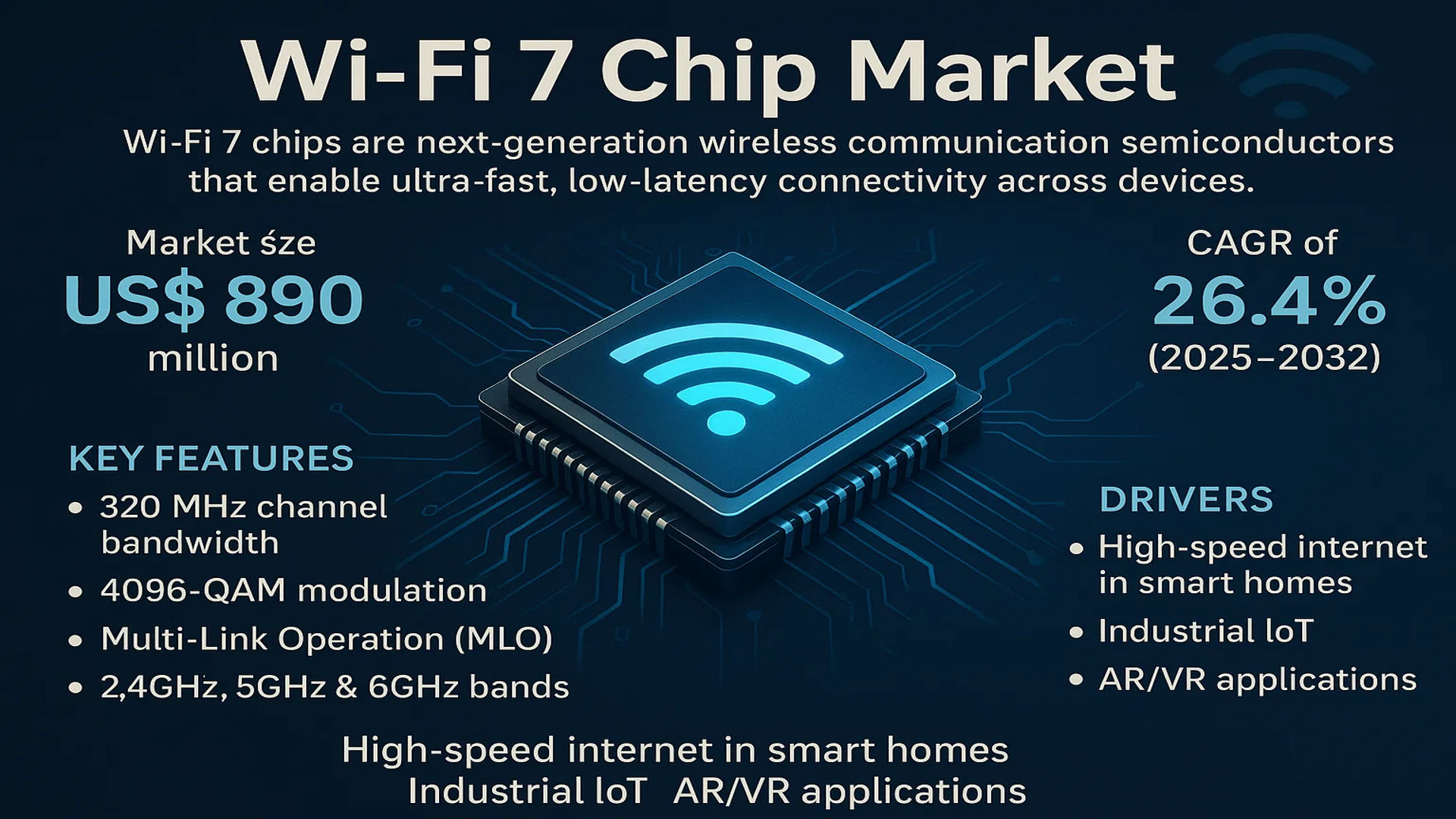
The global Wi-Fi 7 Chip Market size was valued at US$ 890 million in 2024 and is projected to reach US$ 5,240 million by 2032, at a CAGR of 26.4% during the forecast period 2025-2032.
Wi-Fi 7 chips are next-generation wireless communication semiconductors that enable ultra-fast, low-latency connectivity across devices. These chips support advanced features like 320 MHz channel bandwidth, 4096-QAM modulation, and Multi-Link Operation (MLO), delivering theoretical speeds up to 46 Gbps. The technology operates across three frequency bands: 2.4GHz, 5GHz, and the newly opened 6GHz spectrum.
The market growth is driven by increasing demand for high-speed internet in smart homes, industrial IoT, and AR/VR applications. While the semiconductor sector faced a 2.0% decline in Asia Pacific during 2022, Wi-Fi 7 adoption is accelerating globally with key players like Qualcomm and Broadcom launching commercial chips. Recent developments include MediaTek’s Filogic 880 platform supporting Wi-Fi 7 and Intel’s integration of the technology into its latest processors for enterprise solutions.
MARKET DYNAMICS
MARKET DRIVERS
Explosive Growth in Connected Devices and IoT to Accelerate Wi-Fi 7 Adoption
The proliferation of smart devices and IoT applications is creating unprecedented demand for high-bandwidth wireless connectivity. With over 29 billion connected devices projected globally by 2030, Wi-Fi 7’s superior capabilities in handling dense network environments position it as a critical enabler of next-generation connectivity. The standard’s multi-link operation (MLO) and 320MHz channel bandwidth deliver up to 5.8 Gbps peak speeds, addressing the performance limitations of previous generations in smart homes, industrial IoT, and enterprise networks.
Emerging AR/VR Applications Driving Need for Ultra-Low Latency Solutions
The rapid advancement of augmented and virtual reality technologies is creating new requirements for wireless networks that Wi-Fi 7 is uniquely positioned to fulfill. With latency as low as 2 milliseconds, the standard enables seamless experiences in applications ranging from gaming to industrial training simulations. Major technology companies are already developing Wi-Fi 7 enabled headsets, with the AR/VR device market expected to exceed 50 million annual shipments by 2026, creating significant demand for compatible chipsets.
Enterprise Digital Transformation Fueling Infrastructure Upgrades
Businesses worldwide are prioritizing network modernization to support bandwidth-intensive applications like 4K/8K video conferencing and cloud computing. Wi-Fi 7’s improved quality of service (QoS) and deterministic latency features make it particularly attractive for enterprise deployments. The technology’s ability to support over 500 concurrent connections per access point without performance degradation addresses critical pain points in office environments, fueling adoption across corporate networks.
MARKET RESTRAINTS
Complex Certification Process and Regulatory Hurdles Slowing Market Penetration
While Wi-Fi 7 offers significant technological advancements, the certification timeline and regional regulatory approvals present substantial barriers to rapid adoption. The standard’s operation in the 6GHz band requires coordination with multiple regulatory bodies, with some regions yet to fully allocate the spectrum. This fragmented regulatory landscape creates uncertainty for chipset manufacturers and delays product launches in key markets.
Other Restraints
Spectrum Congestion Concerns
The shared nature of unlicensed spectrum introduces potential interference issues that could limit Wi-Fi 7’s performance in dense urban environments. With various wireless technologies competing for bandwidth in the same frequency bands, ensuring consistent quality of service remains a significant challenge for network operators.
Backward Compatibility Requirements
The need to maintain compatibility with older Wi-Fi standards while implementing new features adds complexity to chipset design. This constraint requires manufacturers to allocate valuable silicon real estate to legacy protocols, potentially limiting the performance gains achievable with pure Wi-Fi 7 implementations.
MARKET OPPORTUNITIES
Growth of Smart Manufacturing Creating New Industrial Applications
The Industry 4.0 revolution is driving massive demand for reliable wireless connectivity in factory environments. Wi-Fi 7’s time-sensitive networking (TSN) capabilities and deterministic latency make it ideal for mission-critical industrial automation applications. The industrial IoT market is projected to grow at a compound annual rate of over 20%, representing a significant opportunity for specialized chipset solutions that can withstand harsh operating conditions while delivering enterprise-grade performance.
Automotive Connectivity Emerging as Key Growth Sector
The automotive industry’s increasing focus on in-vehicle connectivity and vehicle-to-everything (V2X) communication creates a substantial opportunity for Wi-Fi 7 chip manufacturers. Modern vehicles now incorporate multiple high-bandwidth applications including infotainment systems, telematics, and advanced driver assistance features that require robust wireless connectivity. With over 90 million connected cars expected to ship annually by 2030, automotive-grade Wi-Fi 7 solutions represent a critical growth vertical for semiconductor companies.
MARKET CHALLENGES
Supply Chain Complexities Impacting Semiconductor Availability
The ongoing volatility in global semiconductor supply chains presents significant challenges for Wi-Fi 7 chip manufacturers. While demand continues to grow, production capacity constraints and geopolitical factors are creating uncertainties in component availability. Companies must navigate complex sourcing strategies to secure supply of advanced nodes required for high-performance RF designs, with lead times for certain fab processes extending beyond 30 weeks in some cases.
Other Challenges
Thermal Management Issues
High-performance Wi-Fi 7 implementations generate substantial heat due to increased power requirements for advanced modulation schemes and multiple antenna systems. Developing cost-effective thermal solutions that maintain reliability while meeting form factor constraints remains a technical challenge for mobile and compact devices.
Skill Gap in RF Engineering
The specialized knowledge required for millimeter wave and multi-antenna system design has created a shortage of qualified engineers. With Wi-Fi 7 pushing the boundaries of wireless technology, companies face increasing competition for top talent in signal processing and RF system architecture.
WI-FI 7 CHIP MARKET TRENDS
Rapid Adoption of Wi-Fi 7 Technology to Drive Market Expansion
The global Wi-Fi 7 chip market is experiencing rapid growth due to increasing demand for high-speed, low-latency wireless connectivity. Wi-Fi 7 (IEEE 802.11be) represents a significant technological leap over Wi-Fi 6, offering theoretical speeds of up to 46 Gbps, reduced latency, and enhanced multi-device handling capabilities. Major semiconductor companies such as Qualcomm, Intel, and Broadcom have already introduced Wi-Fi 7 chipsets, with commercial adoption expected to ramp up in 2024-2025. The transition is driven by bandwidth-intensive applications such as 8K video streaming, cloud gaming, and augmented reality (AR), all of which necessitate the advanced features of Wi-Fi 7. Furthermore, enterprises upgrading their networks to support hybrid work models are contributing to early adoption.
Other Trends
Integration with Next-Generation Devices
The integration of Wi-Fi 7 chips in flagship smartphones, gaming consoles, and smart home devices is a key trend shaping the market. Companies like Samsung and Apple are anticipated to incorporate Wi-Fi 7 capabilities in their upcoming devices, accelerating mainstream adoption. Additionally, the automotive sector is increasingly incorporating Wi-Fi 7 for in-vehicle infotainment and V2X (Vehicle-to-Everything) communications, particularly in electric and autonomous vehicles. This widespread adoption across industries is projected to fuel a compound annual growth rate (CAGR) of over 30% from 2024 to 2032.
Expansion of IoT and Smart Cities
The proliferation of IoT applications and smart city initiatives is significantly impacting the Wi-Fi 7 chip market. Municipalities and industrial sectors require robust, high-capacity networks to support thousands of connected devices seamlessly. Wi-Fi 7’s improved efficiency in dense environments makes it ideal for these applications, with deployment expected in smart grids, traffic management systems, and industrial automation. This trend is compounded by the rise of the Industrial Internet of Things (IIoT), where manufacturers demand ultra-reliable, low-latency connectivity to enhance production efficiency. The global IoT market’s expansion is thus expected to be a major growth driver for Wi-Fi 7 chip adoption.
COMPETITIVE LANDSCAPE
Key Industry Players
Semiconductor Leaders Accelerate Wi-Fi 7 Chip Innovation to Meet Rising Demand
The global Wi-Fi 7 chip market is characterized by strong competition among established semiconductor giants, with the top five players collectively holding over 65% market share in 2024. Qualcomm Technologies and Broadcom currently lead the space, leveraging their longstanding expertise in wireless connectivity solutions and strategic partnerships with major OEMs across consumer electronics and enterprise segments.
Intel has been aggressively expanding its Wi-Fi 7 offerings, particularly targeting the laptop and PC market where it holds significant platform advantages. Meanwhile, MediaTek continues to strengthen its position in mobile devices, capitalizing on its strong relationships with smartphone manufacturers across Asia.
The competition is intensifying as companies race to commercialize Wi-Fi 7 solutions that support the standard’s key advancements – including 320 MHz bandwidth channels, multi-link operation, and 4K QAM modulation. Market leaders are investing heavily in R&D, with several having already sampled second-generation Wi-Fi 7 chips that promise improved power efficiency and lower latency.
While established players dominate, emerging challengers are making inroads in specific applications. Samsung Electronics has been developing integrated Exynos solutions combining Wi-Fi 7 with other connectivity standards, particularly for its mobile and IoT products. This vertical integration strategy poses a growing competitive threat to standalone chip vendors.
List of Key Wi-Fi 7 Chip Companies Profiled
- Intel Corporation (U.S.)
- Broadcom Inc. (U.S.)
- MediaTek Inc. (Taiwan)
- Qualcomm Technologies, Inc. (U.S.)
- Samsung Electronics (South Korea)
- NXP Semiconductors (Netherlands)
- Texas Instruments (U.S.)
- Marvell Technology (U.S.)
- Celeno Communications (Israel)
Segment Analysis:
By Type
The 6GHz Segment Leads Due to Its High-Speed and Low Latency Capabilities
The market is segmented based on Wi-Fi 7 Chip frequency types into:
- 2.4GHz
- 5GHz
- 6GHz
By Application
Consumer Electronics Segment Dominates Market with High Demand for Smart Devices
The market is segmented based on application into:
- Industrial Internet of Things Applications
- Automotive
- Consumer Electronics
- Household Appliances
- Others
By Technology
Multi-Link Operation (MLO) Gains Traction for Enhanced Connectivity Performance
The market is segmented based on key technologies into:
- Multi-Link Operation (MLO)
- 4K QAM Modulation
- 320MHz Channel Support
- Preamble Puncturing
By End-Use Industry
Telecommunications Sector Drives Adoption for Next-Gen Networking Solutions
The market is segmented based on end-use industries into:
- Telecommunications
- Manufacturing
- Retail
- Healthcare
- Others
Regional Analysis: Wi-Fi 7 Chip Market
Asia-Pacific
The Asia-Pacific region dominates the global Wi-Fi 7 chip market, driven by rapid technological adoption and massive semiconductor manufacturing capabilities. China, South Korea, and Japan collectively account for over 60% of global production, with manufacturers like Samsung and MediaTek leading innovation. The region benefits from strong government support for 5G/6G infrastructure and IoT initiatives, creating robust demand for next-gen connectivity solutions. Urbanization and digital transformation across India and Southeast Asian nations further accelerate adoption. However, geopolitical tensions and export controls on advanced chip technologies pose potential supply chain challenges. The commercially available Wi-Fi 7 routers from TP-Link and Xiaomi already demonstrate the region’s first-mover advantage in consumer applications.
North America
As the innovation hub for wireless technologies, North America maintains strong Wi-Fi 7 chip demand due to enterprise upgrades and premium consumer electronics adoption. Major players like Intel and Qualcomm are developing chipsets supporting 320MHz channels and 16×16 MIMO configurations, targeting data-intensive applications. The U.S. leads in industrial IoT implementations while Canada focuses on smart city projects. FCC spectrum allocation for 6GHz band usage accelerates commercial deployment. However, higher device costs compared to Wi-Fi 6 solutions currently limit mass-market penetration, creating a phased adoption curve concentrated in tech hubs and enterprise networks.
Europe
European adoption emphasizes industrial and automotive applications, with strict compliance to ETSI standards governing spectrum usage. Germany and the UK are pioneering smart factory implementations using Wi-Fi 7’s deterministic latency features. The region shows particular interest in multi-link operation (MLO) technology for mission-critical systems. While R&D investments are strong, market growth faces headwinds from economic uncertainties and preference for wired industrial networks. Regulatory focus on sustainability also drives demand for energy-efficient chip designs, with Nordic semiconductor companies emerging as key innovators in low-power implementations.
South America
Market development follows a slower trajectory due to infrastructure limitations and economic volatility. Brazil leads regional adoption, with service providers gradually upgrading backhaul networks to support Wi-Fi 7 capabilities. Cost sensitivity favors dual-band (2.4/5GHz) implementations over cutting-edge 6GHz solutions. Manufacturing localization remains limited, creating import dependency. However, growing smart home adoption and smartphone penetration offer long-term growth opportunities if macroeconomic conditions stabilize and spectrum regulations become more favorable for advanced wireless technologies.
Middle East & Africa
The market remains nascent but shows pockets of high-value adoption in GCC countries’ smart city projects. UAE and Saudi Arabia lead in deploying Wi-Fi 7 for hospitality and enterprise applications, leveraging the technology’s high-density performance capabilities. Infrastructure constraints and limited local manufacturing hinder broader adoption across Africa, though undersea cable investments may improve backbone connectivity. The region presents long-term potential as 5G networks mature and create complementary demand for advanced Wi-Fi solutions, particularly in oil/gas and transportation sectors requiring reliable wireless connectivity.
Report Scope
This market research report provides a comprehensive analysis of the Global Wi-Fi 7 Chip market, covering the forecast period 2025–2032. It offers detailed insights into market dynamics, technological advancements, competitive landscape, and key trends shaping the industry.
Key focus areas of the report include:
- Market Size & Forecast: Historical data and future projections for revenue, unit shipments, and market value across major regions and segments. The Wi-Fi 7 Chip market is projected to grow significantly, driven by increasing demand for high-speed connectivity and IoT applications.
- Segmentation Analysis: Detailed breakdown by product type (2.4GHz, 5GHz, 6GHz), application (Industrial IoT, Automotive, Consumer Electronics, Household Appliances, Others), and end-user industry to identify high-growth segments and investment opportunities.
- Regional Outlook: Insights into market performance across North America, Europe, Asia-Pacific, Latin America, and the Middle East & Africa, including country-level analysis. Asia-Pacific is expected to dominate due to rapid technological adoption and manufacturing capabilities.
- Competitive Landscape: Profiles of leading market participants, including Intel, Broadcom, MediaTek, Qualcomm Technologies, and Samsung Electronics, detailing their product offerings, R&D focus, manufacturing capacity, pricing strategies, and recent developments.
- Technology Trends & Innovation: Assessment of emerging technologies, integration of AI/IoT, semiconductor design trends, fabrication techniques, and evolving industry standards like IEEE 802.11be for Wi-Fi 7.
- Market Drivers & Restraints: Evaluation of factors driving market growth, such as increasing demand for high-speed internet and smart devices, along with challenges like supply chain constraints and regulatory issues.
- Stakeholder Analysis: Insights for component suppliers, OEMs, system integrators, investors, and policymakers regarding the evolving ecosystem and strategic opportunities in the Wi-Fi 7 Chip market.
Primary and secondary research methods are employed, including interviews with industry experts, data from verified sources, and real-time market intelligence to ensure the accuracy and reliability of the insights presented.
FREQUENTLY ASKED QUESTIONS:
What is the current market size of Global Wi-Fi 7 Chip Market?
-> Wi-Fi 7 Chip Market size was valued at US$ 890 million in 2024 and is projected to reach US$ 5,240 million by 2032, at a CAGR of 26.4% during the forecast period 2025-2032.
Which key companies operate in Global Wi-Fi 7 Chip Market?
-> Key players include Intel, Broadcom, MediaTek, Qualcomm Technologies, and Samsung Electronics, among others.
What are the key growth drivers?
-> Key growth drivers include rising demand for high-speed internet, proliferation of IoT devices, and advancements in wireless communication technologies.
Which region dominates the market?
-> Asia-Pacific is the fastest-growing region, driven by strong manufacturing capabilities and rapid adoption of advanced technologies, while North America leads in innovation and early adoption.
What are the emerging trends?
-> Emerging trends include integration of AI in wireless chips, development of energy-efficient solutions, and increased adoption in automotive and industrial applications.

Get Sample Report PDF for Exclusive Insights
Report Sample Includes
- Table of Contents
- List of Tables & Figures
- Charts, Research Methodology, and more...