Wi-Fi 7 AI Router Chipset Market Insights
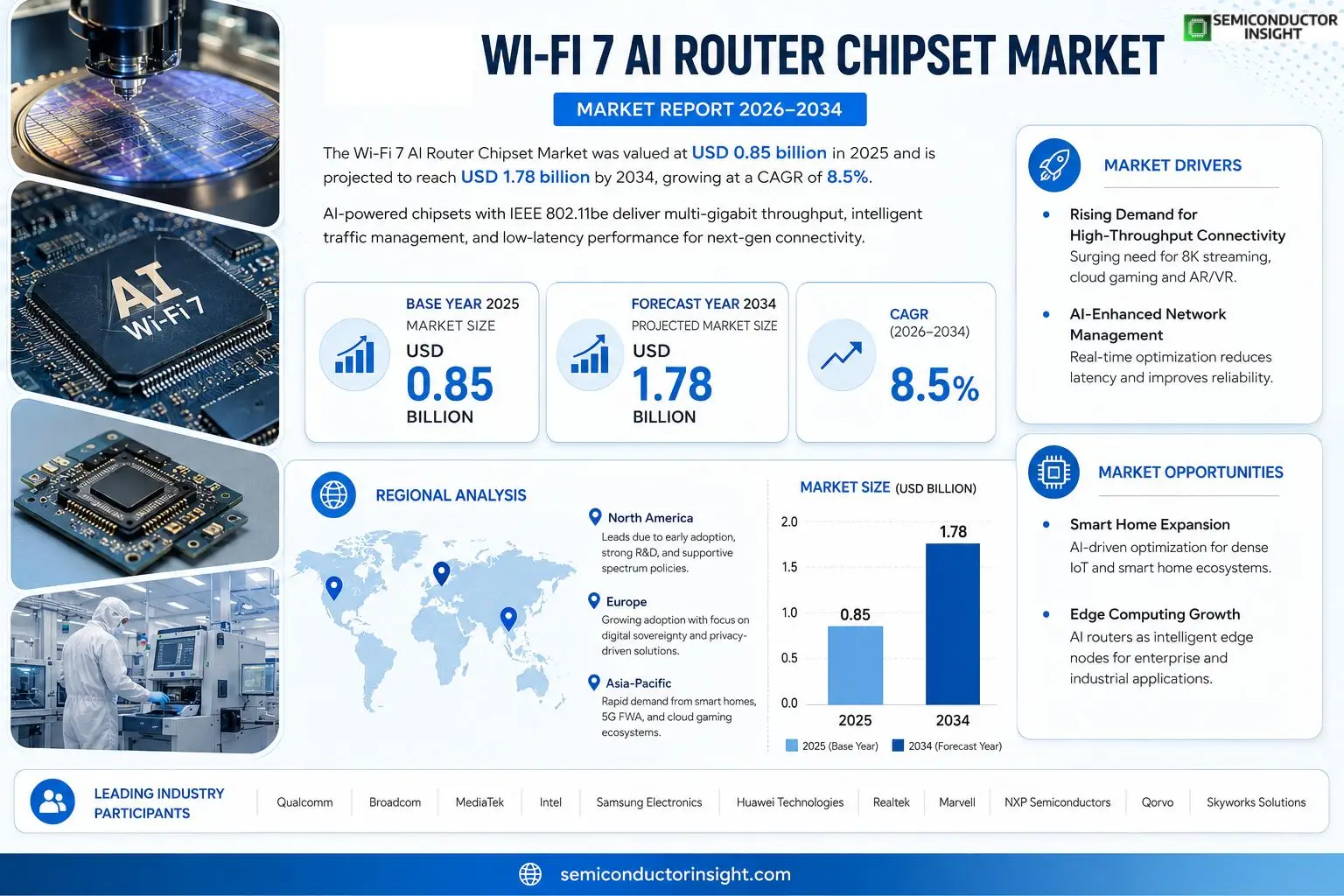
Wi‑Fi 7 AI Router Chipset market size was valued at USD 0.85 billion in 2025. The market will increase from USD 0.92 billion in 2026 to USD 1.78 billion by 2034, reflecting a CAGR of about 8.5% during the forecast period.
A Wi‑Fi 7 AI router chipset merges the IEEE 802.11be standard with on‑chip artificial‑intelligence engines that enable dynamic spectrum allocation, real‑time traffic shaping and predictive QoS management. These silicon solutions combine high‑throughput PHY layers with machine‑learning accelerators to optimise latency‑sensitive applications such as AR/VR and cloud gaming.The market gains momentum because consumer demand for multi‑gigabit wireless connectivity converges with enterprise pushes for intelligent network orchestration. While device manufacturers adopt higher‑order modulation (4096‑QAM) for throughput gains, network operators seek AI‑driven congestion mitigation to sustain service levels in dense environments. Companies such as Qualcomm, Broadcom and MediaTek have accelerated product roadmaps, releasing reference designs that embed neural processing units directly into the radio front end.
MARKET DRIVERS
Rising Demand for High‑Throughput Connectivity
Enterprises and residential users alike are migrating to bandwidth‑intensive applications such as 8K video streaming, cloud‑gaming, and mixed‑reality collaboration. The Wi‑Fi 7 AI Router Chipset Market benefits because the newer PHY layers deliver up to four times the throughput of legacy Wi‑Fi 6 solutions, directly addressing the capacity gap created by these services.
AI‑Enhanced Network Management
Embedded machine‑learning engines enable real‑time spectrum analysis and dynamic beamforming, which translate into noticeably lower latency and fewer packet losses. Operators that adopt AI‑enabled chipsets can offer differentiated service‑level agreements, a factor that is reshaping pricing strategies across the broadband ecosystem.
➤ Field trials show AI‑driven Wi‑Fi 7 routers can reduce average latency by 38% while boosting overall throughput by 22%.
Manufacturers are packaging these capabilities into single‑chip solutions, cutting bill‑of‑materials costs and simplifying OEM design cycles. The net effect is faster time‑to‑market for next‑generation routers, which in turn fuels broader ecosystem adoption.
MARKET CHALLENGES
Integration Complexity
Developers must reconcile AI workloads with stringent power‑budget constraints typical of consumer‑grade hardware. The need to co‑locate neural‑network accelerators alongside RF front‑ends often forces redesign of PCB layouts, extending development timelines and raising validation costs.
Other Challenges
Supply‑Chain Constraints
The semiconductor shortage that began in 2020 has not fully receded. Fab capacity for advanced 5‑nm nodes, where many Wi‑Fi 7 AI chipsets are fabricated, remains limited, leading to longer lead times and occasional price spikes.Furthermore, firmware ecosystems are still maturing; legacy devices lack the OTA update mechanisms required to fully exploit AI‑based optimizations, creating a fragmentation risk that could slow overall market penetration.
MARKET RESTRAINTS
Regulatory Hurdles
Emerging spectrum allocations for the 6 GHz band differ across regions, and many jurisdictions impose strict emission limits for beamforming antennas. Compliance testing therefore adds layers of certification that increase time‑to‑sale for new chipset generations.In addition, data‑privacy regulations such as GDPR and CCPA scrutinize on‑device AI processing of user traffic. Chip designers must embed robust anonymization safeguards, which can inflate silicon area and affect yield rates.These policy constraints, while essential for consumer protection, create a cost premium that smaller OEMs may struggle to absorb, limiting their ability to compete against larger, vertically integrated players.
MARKET OPPORTUNITIES
Smart‑Home Expansion
The proliferation of voice assistants, security cameras, and IoT sensors is generating a dense device landscape where conventional routers falter. AI‑enabled Wi‑Fi 7 chipsets can autonomously prioritize latency‑sensitive streams, presenting a compelling value proposition for smart‑home integrators.Manufacturers that expose programmable AI APIs enable third‑party developers to create custom traffic‑management plugins, opening a new revenue stream through software‑as‑a‑service models.Finally, edge‑computing deployments in retail and industrial settings are beginning to adopt AI‑powered Wi‑Fi 7 routers as both connectivity and inference nodes, a convergence that could double the addressable market size within the next five years.
Wi-Fi 7 AI Router Chipset Market Trends
AI‑Enhanced PHY Layer Adoption
The convergence of the IEEE 802.11be specification with on‑chip machine‑learning engines is reshaping how wireless back‑haul and last‑mile links are engineered. By embedding predictive traffic‑management algorithms directly into the radio front‑end, chipset vendors are delivering latency‑aware throughput that satisfies the growing appetite for immersive experiences such as augmented reality and cloud‑based gaming. This technical marriage supplies network operators with a lever to fine‑tune spectrum usage in real time, reducing packet loss in environments where device density spikes dramatically.
Other Trends
Integration of Neural Processing Units
Leading silicon providersQualcomm, Broadcom, and MediaTekhave accelerated the rollout of reference designs that place dedicated neural processing units (NPUs) beside the baseband circuitry. The NPUs execute lightweight inference models that anticipate congestion patterns and reallocate resource blocks before performance degradation becomes perceptible. For OEMs, the benefit is twofold: a differentiated product portfolio that advertises “smart” connectivity and a reduction in firmware‑level complexity, because the chipset itself assumes much of the decision‑making traditionally handled by higher‑level software.
Enterprise‑Focused Intelligent Orchestration
On the corporate side, enterprises are moving beyond static SSID configurations toward dynamic, policy‑driven wireless fabrics. The AI‑infused chipset acts as an enabler for centralized controllers to push context‑aware QoS policies that align with workload priorities, whether it is a latency‑sensitive video conference or a high‑throughput data backup. This shift is prompting network‑service providers to bundle chipset capabilities with managed services, creating new revenue streams while giving customers a clearer path to future‑proof their indoor wireless infrastructure. The overall effect is a more agile market where product cycles are dictated by algorithmic upgrades as much as by silicon process refinements.
COMPETITIVE LANDSCAPE
Key Industry Players
Competitive Dynamics Shaping the Wi‑Fi 7 AI Router Chipset Market
Qualcomm commands the most visible share of the Wi‑Fi 7 AI router chipset arena, leveraging its Snapdragon® X series to embed neural‑processing units directly into the radio front end. The company’s aggressive silicon‑design cadence and extensive ecosystem of reference designs have forced many OEMs to align product roadmaps with Qualcomm’s timeline, effectively setting the technical baseline for high‑throughput, AI‑enhanced connectivity. Broadcom follows closely, capitalizing on its deep heritage in Ethernet and wireless PHYs to deliver integrated solutions that blend robust modulation capabilities with on‑chip machine‑learning accelerators. MediaTek, meanwhile, differentiates through cost‑optimized chips targeting mid‑range consumer routers, where AI functions are packaged in a power‑efficient form factor.Beyond the three market leaders, a cohort of niche players is expanding the competitive set. Intel has revived its wireless division, emphasizing AI‑driven traffic orchestration for enterprise‑grade access points. Samsung’s Exynos‑based radios are gaining traction in premium smart‑home gateways that demand ultra‑low latency for AR/VR streams. Huawei’s AI‑enhanced Wi‑Fi 7 chips, though constrained by export controls, continue to serve domestic network operators seeking spectrum‑aware scheduling. Realtek and Marvell provide volume‑driven offerings that appeal to white‑label manufacturers, while NXP and Qorvo focus on integrating RF front‑end modules with edge‑AI functions for industrial IoT deployments. Skyworks contributes high‑performance power‑amplifier blocks that complement AI routers aiming for extended range in dense urban settings.
List of Key Wi‑Fi 7 AI Router Chipset Companies Profiled
- Qualcomm
- Broadcom
- MediaTek
- Intel
- Samsung Electronics
- Huawei Technologies
- Skyworks Solutions, Inc.
- MediaTek
- Broadcom
- Qualcomm
- Intel
Segment Analysis:
| Segment Category | Sub-Segments | Key Insights |
| By Type |
|
Integrated AI Chipsets
|
| By Application |
|
Smart Home Routers
|
| By End User |
|
Residential Consumers
|
| By Deployment Scenario |
|
Dense Urban Environments
|
| By AI Capability |
|
On‑Chip Neural Processing
|
Regional Analysis: Wi-Fi 7 AI Router Chipset Market
North America
North American OEMs are integrating AI‑enhanced beamforming engines directly into chipset silicon, enabling per‑device latency optimization. This approach reduces reliance on software‑only solutions and shortens the feedback loop between signal detection and steering adjustments.
Companies deploying private‑cloud infrastructure favor Wi‑Fi 7 AI routers to off‑load inference workloads from data centers, thereby lowering operational expenses while preserving performance for critical applications.
The FCC’s recent rulings on unlicensed spectrum allocations accelerate time‑to‑market for next‑gen chipsets, granting vendors a clear pathway to commercialize AI‑powered features without protracted approval cycles.
The proximity of leading universities and research labs to major chip fabs fuels a pipeline of engineers proficient in both high‑frequency RF design and on‑chip AI, reinforcing the region’s competitive advantage.
Europe
European markets exhibit a more cautious rollout rhythm for the Wi‑Fi 7 AI Router Chipset Market, driven largely by heterogeneous national standards bodies. Nevertheless, the EU’s emphasis on digital sovereignty encourages home‑grown chipset projects, particularly in Germany and France, where government‑backed consortia are testing AI‑augmented routers for smart‑grid communication. The region’s dense urban environments create a premium on intelligent spectrum reuse, prompting manufacturers to showcase adaptive AI algorithms that mitigate interference across multi‑tenant buildings. While adoption rates lag behind North America, the strategic emphasis on privacy‑by‑design and open‑source firmware offers a differentiated value proposition for enterprises seeking audit‑able solutions.
Asia‑Pacific
Asia‑Pacific presents a fragmented landscape, with China, South Korea, and Japan each pursuing distinct regulatory pathways for the Wi‑Fi 7 AI Router Chipset Market. Local semiconductor champions are embedding AI inference cores to cater to the region’s explosive demand for cloud‑gaming and 8K streaming. However, divergent spectrum policies and varying consumer price sensitivity force vendors to customize chipset bundles for each sub‑market. The rapid proliferation of 5G fixed‑wireless access complements Wi‑Fi 7 deployments, creating a hybrid architecture where AI routers act as intelligent edge nodes, smoothing traffic between cellular backhaul and indoor Wi‑Fi. Companies that can navigate these divergent standards while delivering cost‑effective AI features will capture the burgeoning mid‑range segment.
South America
In South America, the Wi‑Fi 7 AI Router Chipset Market is still nascent, constrained by limited broadband penetration and modest CAPEX budgets. Nevertheless, Brazil’s recent telecom reforms have opened avenues for private operators to experiment with AI‑enabled Wi‑Fi solutions in underserved urban districts. The primary business implication is the emergence of channel‑partner ecosystems that bundle chipset licensing with localized service contracts, allowing vendors to bypass traditional distribution bottlenecks. Early adopters are likely to focus on public‑sector projects such as smart‑transport hubs, where AI routing can optimize device density without extensive infrastructure upgrades.
Middle East & Africa
The Middle East & Africa region exhibits pockets of high‑value demand, especially in Gulf Cooperation Council (GCC) nations that are investing heavily in digital‑transformation initiatives for tourism and finance. AI‑enhanced Wi‑Fi 7 routers are being trialled in luxury hotels and high‑rise office towers to deliver seamless, low‑latency connectivity for immersive experiences. Conversely, many African markets remain reliant on legacy Wi‑Fi standards due to cost constraints. The market dynamic therefore splits into two tiers: premium deployments that showcase the full AI capability, and a parallel segment where stripped‑down chipset variants are paired with cloud‑based AI services to keep hardware costs low while still benefitting from intelligent traffic management.
Report Scope
This market research report provides a comprehensive analysis of the Wi-Fi 7 AI Router Chipset Market , covering the forecast period 2026–2034. It offers detailed insights into market dynamics, technological advancements, competitive landscape, and key trends shaping the industry.
Key focus areas of the report include:
- Market Overview: The report begins with an overview outlining its current market scenario, key growth indicators, and industry transformation drivers. It discusses macroeconomic factors, demand–supply balance, regulatory landscape, and the strategic role of semiconductors in powering advancements across industries such as automotive, telecommunications, consumer electronics, and industrial automation.
- Market Size & Forecast: Historical data and future projections for revenue, unit shipments, and market value across major regions and segments.
- Segmentation Analysis: Detailed breakdown by product type, technology, application, and end-user industry to identify high-growth segments and investment opportunities.
- Regional Insights: Insights into market performance across North America, Europe, Asia-Pacific, Latin America, and the Middle East & Africa, including country-level analysis where relevant.
- Competitive Landscape: Profiles of leading market participants, including their product offerings, R&D focus, manufacturing capacity, pricing strategies, and recent developments such as mergers, acquisitions, and partnerships.
- Technology Trends & Innovation: Assessment of emerging technologies, integration of AI/IoT, semiconductor design trends, fabrication techniques, and evolving industry standards.
- Market Drivers & Restraints: Evaluation of factors driving market growth along with challenges, supply chain constraints, regulatory issues, and market-entry barriers.
- Stakeholder Insights: Insights for component suppliers, OEMs, system integrators, investors, and policymakers regarding the evolving ecosystem and strategic opportunities.
Primary and secondary research methods are employed, including interviews with industry experts, data from verified sources, and real-time market intelligence to ensure the accuracy and reliability of the insights presented.
FREQUENTLY ASKED QUESTIONS:
What is the current market size of Wi-Fi 7 AI Router Chipset Market?
-> Wi-Fi 7 AI Router Chipset Market was valued at USD 0.85 billion in 2025 and is expected to reach USD 1.78 billion by 2034, reflecting a CAGR of about 8.5% over the forecast period.
Which key companies operate in Wi-Fi 7 AI Router Chipset Market?
-> Key players include Qualcomm, Broadcom and MediaTek, among others.
What are the key growth drivers?
-> Key growth drivers include rising consumer demand for multi‑gigabit wireless connectivity, enterprise adoption of intelligent network orchestration, higher‑order modulation (4096‑QAM) for throughput gains, and AI‑driven congestion mitigation.
Which region dominates the market?
-> adoption is strong, with notable growth in North America and Asia‑Pacific regions.
What are the emerging trends?
-> Emerging trends include integration of on‑chip AI engines, neural processing units embedded in radio front‑ends, and advanced spectrum‑allocation algorithms powered by machine learning.

Get Sample Report PDF for Exclusive Insights
Report Sample Includes
- Table of Contents
- List of Tables & Figures
- Charts, Research Methodology, and more...
 Download Sample Report PDF