Wearable AI Processor Market Insights
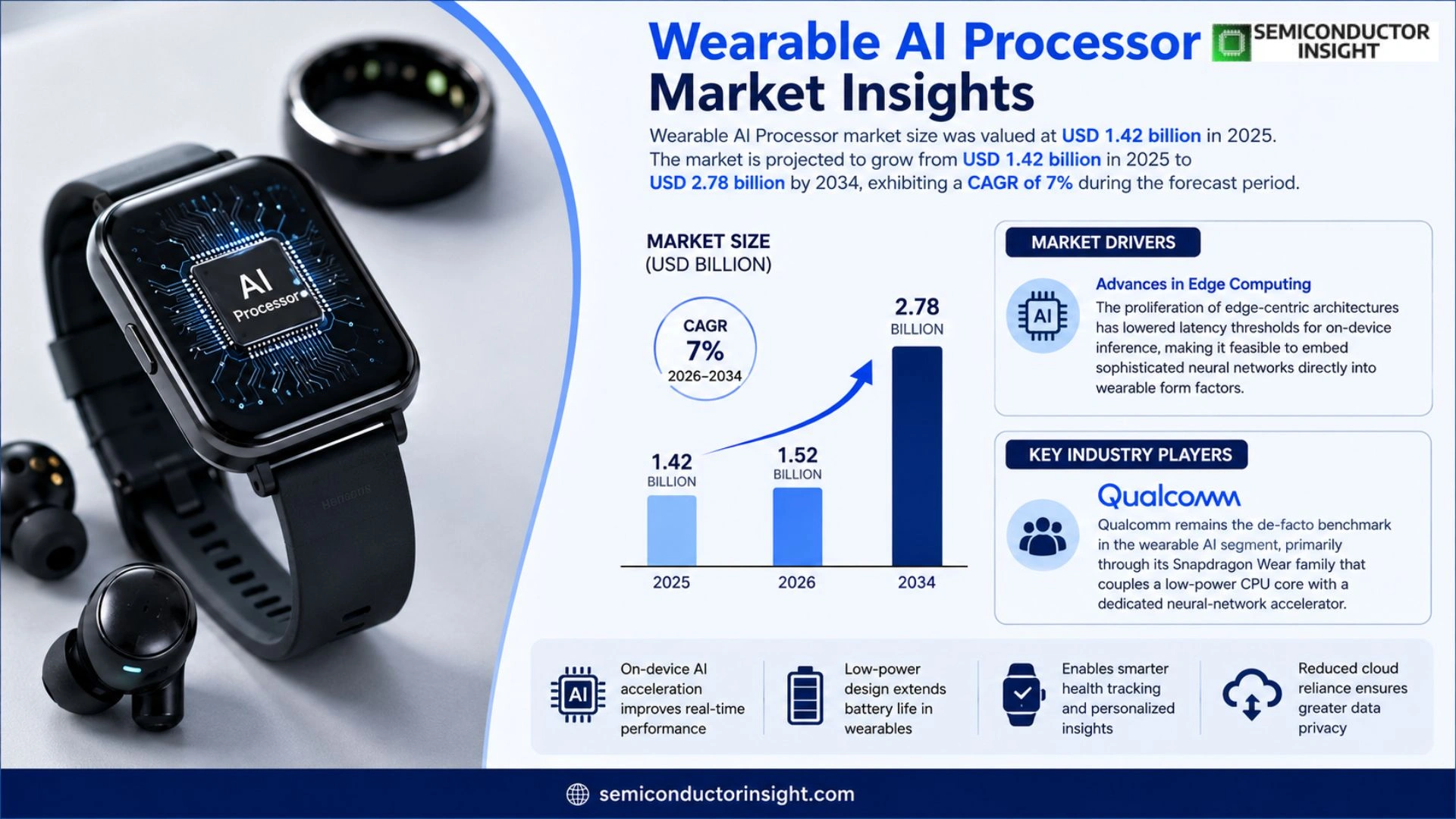
Wearable AI Processor market size was valued at USD 1.42 billion in 2025. The market is projected to grow from USD 1.42 billion in 2025 to USD 2.78 billion by 2034, exhibiting a CAGR of 7% during the forecast period.
Wearable AI processors are low‑power micro‑architectures designed specifically for on‑device intelligence in smart watches, fitness bands, AR glasses and health monitors.
They integrate neural‑network accelerators, sensor fusion engines and energy‑efficient cores that enable real‑time analytics without relying on cloud connectivity.
The sector is gaining momentum as consumer demand for always‑on health insights rises and manufacturers seek longer battery life.
Advances in edge‑AI algorithms reduce latency, while semiconductor innovations lower silicon cost, encouraging broader adoption across mid‑range devices.
Key players such as Qualcomm, Apple and MediaTek are expanding their portfolios through strategic IP licensing and collaborations with wearable OEMs.
MARKET DRIVERS
Advances in Edge Computing
The proliferation of edge‑centric architectures has lowered latency thresholds for on‑device inference, making it feasible to embed sophisticated neural networks directly into wearable form factors. Manufacturers are capitalising on this shift by designing processors that can execute models locally, thereby circumventing the bandwidth bottlenecks of cloud‑centric pipelines. Consequently, product cycles are accelerating as firms iterate between silicon and firmware to meet consumer expectations for instantaneous insights.
Rising Demand for Real‑time Health Monitoring
Consumer adoption of fitness trackers and smart watches has matured into a willingness to pay for clinical‑grade analytics. Continuous glucose monitoring, atrial‑fibrillation detection, and posture correction rely on on‑board AI that can process biosignals in milliseconds. This trend is prompting OEMs to allocate larger portions of R&D budgets toward specialised AI cores, because the revenue premium on devices that deliver actionable health data is becoming tangible.
➤ Strategic partnerships between semiconductor firms and wearable brands are accelerating time‑to‑market for differentiated AI‑enabled products.
Investors are interpreting these dynamics as a signal that Wearable AI Processor Market will experience a shift from commodity silicon to differentiated, high‑performance IP. Companies that secure early wins in power‑efficient architectures are positioning themselves to capture long‑term design‑win contracts with leading consumer electronics brands.
MARKET CHALLENGES
Technical Barriers to Ultra‑low Power Operation
Designers must reconcile the competing demands of computational intensity and battery longevity. While process node scaling offers marginal gains, the thermal envelope of wrist‑worn devices imposes strict limits on sustained workloads. As a result, many development cycles stall at the prototype stage when power budgets cannot accommodate the desired inference accuracy.
Other Challenges
Regulatory Hurdles
Medical‑grade wearables that incorporate AI-driven diagnostics are subject to stringent approval pathways in major jurisdictions. The need for clinical validation extends product timelines and inflates development costs, deterring some entrants from pursuing aggressive market launches.
MARKET RESTRAINTS
High Development Costs
Bringing a custom AI processor from concept to silicon requires multi‑disciplinary expertise, from algorithmic optimisation to advanced packaging. The capital outlay for silicon‑only design houses, verification suites, and test equipment frequently exceeds $50 million for a single product family. Smaller players, which often drive innovation, find these barriers prohibitive, leading to a market that is increasingly consolidated around a few large suppliers.
MARKET OPPORTUNITIES
Integration with 5G Ecosystems
The rollout of 5G networks is reshaping data pipelines for wearables, enabling near‑real‑time offloading of heavyweight models when latency tolerances permit. This creates a hybrid execution model where on‑device AI handles immediate inference, while the network assists with periodic model updates and contextual enrichment. Companies that architect processors with seamless 5G handoff capabilities stand to unlock new revenue streams from subscription‑based analytics services.
Wearable AI Processor Market therefore presents a fertile landscape for firms that can blend ultra‑low power design with adaptive connectivity. By aligning silicon roadmaps with emerging standards for edge compute, industry players can transform current constraints into differentiated value propositions for both consumer and enterprise segments.
Wearable AI Processor Market Trends
Edge AI Integration Drives Wearable Processor Adoption
Manufacturers are embedding AI capabilities directly onto the silicon of smart watches, fitness bands, AR glasses and health monitors. The architecture combines ultra‑low‑power cores with dedicated neural‑network accelerators and sensor‑fusion engines, allowing devices to evaluate biometric streams in real time without contacting cloud services. This shift reduces latency, preserves battery reserves and satisfies a growing appetite for instant health feedback. By eliminating the need for constant data transmission, OEMs can differentiate their products on the basis of reliability and privacy, which in turn strengthens brand loyalty among health‑conscious consumers.
Other Trends
Cost Efficiency Through Semiconductor Advances
Recent process‑node refinements have lowered silicon production expense, making edge‑AI capable chips viable for mid‑tier wearables. Companies such as Qualcomm, Apple and MediaTek are extending their IP portfolios and entering licensing arrangements that spread development risk across the ecosystem. Collaborative engineering with device makers shortens time‑to‑market, while the reduced bill‑of‑materials encourages broader price‑point strategies, expanding the reach of sophisticated on‑device analytics beyond premium segments.
Ecosystem Expansion via Strategic Partnerships
The competitive landscape is being reshaped by alliances that link chip designers with software platforms, health‑data aggregators and cloud‑edge orchestration services. Such partnerships enable a seamless flow of model updates and cross‑device learning while preserving the on‑device inference advantage. For integrators, the ability to offer a turnkey solution,hardware, firmware and AI services,accelerates adoption among OEMs lacking in‑house expertise. The cumulative effect is a richer selection of wearable products that can address niche applications, from athletic performance tracking to clinical‑grade monitoring, thereby widening the overall addressable market.
COMPETITIVE LANDSCAPE
Key Industry Players
Competitive positioning of leading wearable AI processor providers
Qualcomm remains the de‑facto benchmark in the wearable AI segment, primarily through its Snapdragon Wear family that couples a low‑power CPU core with a dedicated neural‑network accelerator. The company’s extensive IP portfolio and aggressive licensing model have enabled rapid integration across flagship smart‑watch lines, securing a sizable share of design wins. Apple, while not disclosing silicon details, has internalised its processor strategy with the Apple S series, leveraging tight hardware‑software co‑design to deliver on‑device inference that rivals any third‑party offering. MediaTek has capitalised on its cost‑efficient 5G‑ready cores, positioning itself as the preferred partner for volume‑oriented fitness bands and emerging AR glasses. Collectively, these three firms shape a market where scale, integration depth, and ecosystem support dictate winning contracts, leaving smaller innovators to chase niche segments or co‑development opportunities.
Beyond the top tier, a constellation of specialized firms adds depth to the competitive picture. Samsung Semiconductor supplies Exynos‑based AI blocks that emphasize power‑saving sensor fusion, while STMicroelectronics promotes its Ultra‑Low‑Power MCU line for health‑monitor wearables. NXP focuses on secure edge compute for medical‑grade devices, and Texas Instruments leverages its long‑standing analog expertise to embed AI capability in energy‑harvesting sensors. Ambarella’s low‑latency video‑centric AI cores are gaining traction in AR eyewear, whereas Huawei’s HiSilicon units, despite export constraints, continue to service domestic OEMs. Google’s Tensor‑Lite‑enabled SoCs provide a software‑first route for Android‑based wearables, and Renesas, Analog Devices, and Marvell each contribute niche accelerators that address specific form‑factor or regulatory demands. The breadth of these players illustrates a market where differentiation hinges on power envelope, integration flexibility, and the ability to embed proprietary AI models without compromising battery life.
List of Key Wearable AI Processor Companies Profiled
- Qualcomm
- Apple
- MediaTek
- Samsung Semiconductor
- STMicroelectronics
- NXP Semiconductors
- Texas Instruments
- Ambarella
- Huawei HiSilicon
- Renesas Electronics
- Analog Devices
- Marvell Technology Group
Segment Analysis:
| Segment Category | Sub-Segments | Key Insights |
| By Type |
|
Neural‑Network Accelerators
|
| By Application |
|
Smart Watches
|
| By End User |
|
Consumers
|
| By Architecture |
|
Custom ASICs
|
| By Value Proposition |
|
Battery Efficiency
|
Regional Analysis: Wearable AI Processor Market
North America
The concentration of research labs in Boston and Austin fuels a rapid turnover of prototype silicon, allowing OEMs to test novel neural‑engine blocks within months rather than years, a cadence that directly influences product differentiation.
Near‑shoring initiatives have shortened the distance between fab facilities and design studios, reducing lead times for specialty process nodes required by ultra‑low‑power wearable chips.
The FDA’s clear pathway for Class II medical wearables encourages manufacturers to certify AI processors early, aligning engineering milestones with compliance reviews.
Enterprise safety programmes and consumer wellness trends both demand on‑device inference, prompting hardware teams to prioritize power budgets that extend battery life without sacrificing responsiveness.
Europe
European nations, particularly Germany and the Nordic countries, are leveraging strong collaborations between automotive suppliers and health‑tech firms to embed AI processors into multi‑modal wearables. Public‑private research consortia receive substantial EU funding, which accelerates the translation of algorithmic research into silicon prototypes. Meanwhile, stringent privacy legislation forces developers to adopt edge‑first strategies, reinforcing the market’s focus on on‑device analytics rather than cloud reliance. These dynamics generate a distinctive competitive edge for European players who can promise both data sovereignty and high‑efficiency processing.
Asia‑Pacific
Asia‑Pacific benefits from a massive consumer base eager for stylish, feature‑rich wearables, prompting manufacturers in Japan, South Korea, and Taiwan to prioritize integration density. The region’s semiconductor fabs excel at volume production of sub‑10 nm nodes, enabling cost‑effective scaling of AI cores. In addition, governmental incentives aimed at “smart health” initiatives stimulate partnerships between device makers and local start‑ups, fostering a pipeline of niche applications such as language‑specific voice assistants and culturally tailored fitness metrics.
South America
In South America, adoption is driven by a growing awareness of preventive health monitoring among urban populations. Local device assemblers are forming joint ventures with North American design houses to co‑develop processors that balance ruggedness with low‑power consumption, a necessary trade‑off for markets with limited charging infrastructure. While the region still lags in proprietary silicon design, its emphasis on assembly and system integration positions it as a valuable downstream partner for global suppliers.
Middle East & Africa
The Middle East & Africa region sees emerging demand from professional sports and remote‑work safety programs that rely on biometric tracking. Partnerships between Gulf‑based venture funds and European AI chip designers are creating a pipeline of customized processor solutions aimed at extreme‑temperature operation. In Africa, mobile‑first strategies encourage the embedding of lightweight AI inference engines within wearables that can function independently of continuous network access, aligning product design with connectivity realities on the continent.
Report Scope
This market research report provides a comprehensive analysis of the Wearable AI Processor Market , covering the forecast period 2026–2034. It offers detailed insights into market dynamics, technological advancements, competitive landscape, and key trends shaping the industry.
Key focus areas of the report include:
- Market Overview: The report begins with an overview outlining its current market scenario, key growth indicators, and industry transformation drivers. It discusses macroeconomic factors, demand–supply balance, regulatory landscape, and the strategic role of semiconductors in powering advancements across industries such as automotive, telecommunications, consumer electronics, and industrial automation.
- Market Size & Forecast: Historical data and future projections for revenue, unit shipments, and market value across major regions and segments.
- Segmentation Analysis: Detailed breakdown by product type, technology, application, and end-user industry to identify high-growth segments and investment opportunities.
- Regional Insights: Insights into market performance across North America, Europe, Asia-Pacific, Latin America, and the Middle East & Africa, including country-level analysis where relevant.
- Competitive Landscape: Profiles of leading market participants, including their product offerings, R&D focus, manufacturing capacity, pricing strategies, and recent developments such as mergers, acquisitions, and partnerships.
- Technology Trends & Innovation: Assessment of emerging technologies, integration of AI/IoT, semiconductor design trends, fabrication techniques, and evolving industry standards.
- Market Drivers & Restraints: Evaluation of factors driving market growth along with challenges, supply chain constraints, regulatory issues, and market-entry barriers.
- Stakeholder Insights: Insights for component suppliers, OEMs, system integrators, investors, and policymakers regarding the evolving ecosystem and strategic opportunities.
Primary and secondary research methods are employed, including interviews with industry experts, data from verified sources, and real-time market intelligence to ensure the accuracy and reliability of the insights presented.
FREQUENTLY ASKED QUESTIONS:
What is the current market size of Wearable AI Processor Market?
-> Wearable AI Processor Market was valued at USD 1.42 billion in 2025 and is expected to reach USD 2.78 billion by 2034, reflecting a CAGR of 7%
Which key companies operate in Wearable AI Processor Market?
-> Key players include Qualcomm, Apple, and MediaTek, among others.
What are the key growth drivers?
-> Key growth drivers include rising consumer demand for always‑on health insights, the need for longer battery life in wearables, advances in edge‑AI algorithms that reduce latency, and semiconductor innovations that lower silicon costs.
Which region dominates the market?
-> The market is global with strong activity in major technology hubs across North America, Europe, and Asia‑Pacific.
What are the emerging trends?
-> Emerging trends include integration of advanced neural‑network accelerators, sensor‑fusion engines, and energy‑efficient cores to enable real‑time analytics on‑device, as well as broader adoption of edge‑AI in mid‑range wearable devices.
Get Sample Report PDF for Exclusive Insights
Report Sample Includes
- Table of Contents
- List of Tables & Figures
- Charts, Research Methodology, and more...
 Download Sample Report PDF