MARKET INSIGHTS
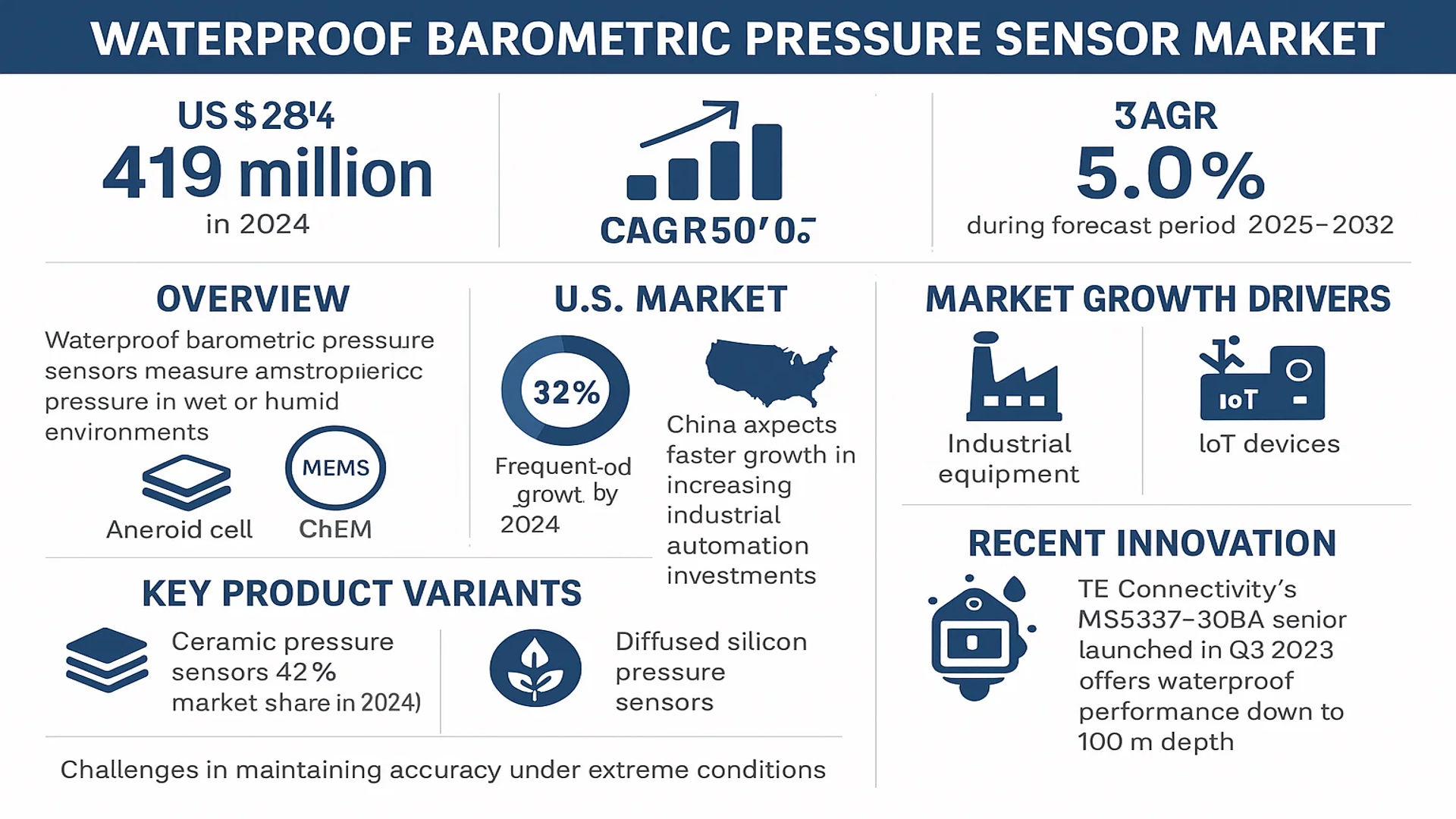
The global Waterproof Barometric Pressure Sensor Market size was valued at US$ 284 million in 2024 and is projected to reach US$ 419 million by 2032, at a CAGR of 5.0% during the forecast period 2025-2032. The U.S. market accounted for 32% of global revenue in 2024, while China is expected to grow at a faster pace due to increasing industrial automation investments.
Waterproof barometric pressure sensors are specialized devices that measure atmospheric pressure while maintaining operational integrity in wet or humid environments. These sensors utilize aneroid cells or MEMS (Micro-Electro-Mechanical Systems) technology to detect pressure changes, with waterproof enclosures protecting sensitive components. Key product variants include ceramic pressure sensors (holding 42% market share in 2024) and diffused silicon pressure sensors, both offering high accuracy within ±0.1% of full scale.
Market growth is primarily driven by expanding applications in industrial equipment (projected 28% revenue share by 2032) and IoT devices, particularly in weather stations and smart agriculture systems. However, challenges persist in maintaining sensor accuracy under extreme conditions, prompting manufacturers to develop advanced sealing technologies. Recent innovations include TE Connectivity’s MS5837-30BA sensor, launched in Q3 2023, which offers waterproof performance down to 100m depth with 0.5mbar resolution.
MARKET DYNAMICS
MARKET DRIVERS
Rising Demand for Rugged Sensors in Harsh Environments Accelerates Market Growth
The waterproof barometric pressure sensor market is experiencing significant growth due to increasing industrial automation and the need for durable measurement solutions in extreme conditions. These sensors play a critical role in applications ranging from industrial equipment monitoring to underwater exploration, where reliability under pressure (literally and figuratively) is non-negotiable. The market is projected to grow at a compound annual growth rate exceeding 6% through 2030, with ceramic pressure sensors showing particular promise due to their corrosion resistance and thermal stability. Major industrial sectors adopting these solutions include oil & gas, where pressure monitoring in subsea operations can prevent catastrophic failures, and automotive applications where sensor durability ensures accurate altitude measurements in all weather conditions.
IoT Expansion Creates New Application Horizons for Pressure Sensing
The proliferation of Internet of Things (IoT) devices represents a transformative driver for waterproof pressure sensors. As smart cities and industrial IoT networks expand globally, the demand for environmental monitoring solutions has surged, with over 30 billion IoT devices expected to be deployed by 2025. Waterproof barometric sensors enable critical functions in smart agriculture (monitoring greenhouse conditions), urban flood warning systems (detecting water level changes), and wearable health tech (tracking altitude changes during athletic activities). This broad applicability across verticals creates unprecedented market opportunities. Recent product innovations include ultra-compact MEMS-based sensors that maintain accuracy while withstanding immersion at depths exceeding 10 meters – a capability previously unavailable at consumer price points.
Automotive Sector Electrification Fuels Specialized Sensor Needs
The automotive industry’s shift toward electric and autonomous vehicles has established waterproof barometric pressure sensors as critical components in next-generation transportation systems. These sensors enable multiple safety and performance functions, including battery pressure monitoring in EVs (where even minor leaks can indicate thermal runaway risks), adaptive suspension adjustment based on altitude changes, and weatherproof cabin atmosphere control. With global EV sales surpassing 10 million units annually and projected to triple by 2030, automakers increasingly specify waterproof variants to meet stringent reliability standards. Leading suppliers have responded with automotive-grade sensors featuring extended temperature ranges (-40°C to 125°C) and enhanced resistance to vibration, chemicals, and prolonged moisture exposure.
MARKET RESTRAINTS
High-Performance Sensor Costs Challenge Widespread Adoption
While demand grows across applications, premium pricing for high-accuracy waterproof pressure sensors remains a barrier for cost-sensitive markets. Industrial-grade waterproof sensors typically command 30-50% price premiums over standard models due to specialized materials (like titanium housings), hermetic sealing processes, and rigorous testing protocols. This creates adoption challenges in price-driven sectors such as consumer electronics and mass-market IoT deployments. Furthermore, the long development cycles for custom waterproof solutions – often requiring 12-18 months from design to production – discourage some OEMs from specifying these components despite their technical advantages. Manufacturers are addressing this through hybrid approaches, using cost-effective polymer seals for moderate waterproofing while reserving premium metal encapsulation for extreme environments.
Technical Complexities in Miniaturization Limit Design Flexibility
The physics of maintaining waterproof integrity while shrinking sensor dimensions presents formidable engineering challenges. As device manufacturers push for smaller form factors (particularly in wearables and mobile applications), sensor designers must balance the competing demands of water resistance, pressure sensitivity, and spatial constraints. Traditional O-ring seals become unreliable below certain sizes, prompting development of innovative solutions like laser-welded micro-housings and nano-coating technologies. However, these advanced techniques often require capital-intensive manufacturing equipment and specialized expertise, creating bottlenecks in high-volume production. The industry is responding with modular designs that separate sensing elements from waterproof enclosures, allowing reuse of core technologies across multiple product configurations while containing development costs.
MARKET OPPORTUNITIES
Emerging Applications in Blue Economy Create New Growth Frontiers
The expanding maritime and underwater technology sector presents untapped potential for waterproof pressure sensors. Ocean exploration equipment, aquaculture monitoring systems, and offshore renewable energy installations all require robust pressure measurement solutions capable of withstanding prolonged seawater exposure. With the blue economy projected to grow at nearly twice the rate of the broader ocean economy through 2030, sensor manufacturers are developing specialized products featuring titanium or ceramic housings with depth ratings exceeding 1000 meters. Recent innovations include self-cleaning sensor surfaces that prevent marine growth interference and pressure-compensated designs that maintain accuracy despite extreme hydrostatic forces. These advancements open doors in sectors ranging from deep-sea mining to coral reef preservation initiatives.
Advancements in MEMS Technology Enable Next-Generation Solutions
Breakthroughs in micro-electromechanical systems (MEMS) fabrication are overcoming traditional limitations in waterproof sensor design. New wafer-level packaging techniques allow complete sensor die encapsulation during semiconductor manufacturing rather than as a secondary process, dramatically improving moisture resistance while reducing unit costs. These manufacturing innovations coincide with improved piezoresistive materials that maintain sensitivity despite miniaturization, enabling waterproof sensors in hearing aids, endoscopic medical devices, and other space-constrained applications. The MEMS pressure sensor market segment is forecast to surpass $3 billion by 2026, with waterproof variants capturing an increasing share as their performance gaps with conventional sensors narrow. Early adopters benefit from reduced power consumption (critical for battery-powered applications) and simplified integration with complementary sensing modalities like temperature and humidity.
MARKET CHALLENGES
Standardization Gaps Complicate Cross-Industry Adoption
The absence of universal waterproofing standards for pressure sensors creates confusion in specification and procurement processes. While ingress protection (IP) ratings provide general guidance, they don’t fully capture performance under sustained pressure or in chemically aggressive environments. This forces OEMs to develop application-specific test protocols, slowing time-to-market and increasing validation costs. Variations in testing methodologies – some focusing on short-term immersion resistance while others prioritize long-term seal integrity under thermal cycling – make direct product comparisons difficult. Industry associations are working toward standardized accelerated life testing procedures that simulate real-world conditions, but interim solutions require manufacturers to maintain extensive application engineering teams to guide customers through selection processes.
Supply Chain Complexity Impacts Custom Solution Development
The specialized materials and processes required for high-performance waterproof sensors create dependencies on limited supplier networks. Critical components like fluoropolymer seals and alumina ceramic substrates often have lead times exceeding standard semiconductor components, complicating production planning. This challenge intensifies for custom solutions requiring non-standard form factors or extreme environmental ratings, where alternate sourcing options may not exist. Recent global supply chain disruptions have prompted reevaluation of lean inventory strategies, with leading manufacturers establishing strategic reserves of long-lead items. Simultaneously, vertical integration efforts are gaining traction, with some sensor producers bringing coating applications and precision machining capabilities in-house to reduce external dependencies and better control quality.
WATERPROOF BAROMETRIC PRESSURE SENSOR MARKET TRENDS
Rising Demand for Rugged and High-Performance Sensors in Harsh Environments
The global waterproof barometric pressure sensor market is witnessing notable growth due to increased adoption across industries requiring reliable pressure measurement in challenging conditions. These sensors, capable of withstanding moisture, dust, and extreme temperatures, are becoming indispensable in applications such as industrial automation, marine systems, and outdoor IoT deployments. The market for ceramic pressure sensors, known for their durability, is projected to grow at a steady CAGR of approximately 8% over the next five years, driven by their resistance to corrosion and long operational life. Additionally, advancements in MEMS (Micro-Electro-Mechanical Systems) technology have enhanced the precision and compactness of these sensors, making them suitable for wearable devices and smart home applications.
Other Trends
Integration in IoT and Smart Devices
The proliferation of IoT devices is significantly accelerating the demand for waterproof barometric pressure sensors, particularly in applications like weather stations, HVAC systems, and smart agriculture. With over 30 billion IoT devices expected to be deployed globally by 2025, manufacturers are prioritizing miniaturization and energy efficiency in sensor designs. Wireless data transmission capabilities are also being integrated, allowing real-time environmental monitoring in remote locations without physical data retrieval. This trend is particularly prominent in agricultural IoT solutions, where farmers rely on pressure sensors for altitude and climate adjustments in precision farming.
Growth in Automotive and Industrial Applications
Automotive manufacturers are increasingly incorporating waterproof barometric pressure sensors into vehicles for altitude compensation in engine control units (ECUs) and advanced driver assistance systems (ADAS). The automotive segment alone accounted for nearly 25% of the market revenue in 2024, with further growth anticipated due to rising electric vehicle production. Industrial equipment is another key contributor, where sensors play a vital role in hydraulic systems, leak detection, and underwater robotics. The Asia-Pacific region, led by China and Japan, dominates production due to extensive manufacturing infrastructure and government investments in Industry 4.0 technologies.
COMPETITIVE LANDSCAPE
Key Industry Players
Strategic Product Innovation Dominates Market Competition
The global waterproof barometric pressure sensor market features a moderately fragmented competitive environment, with established electronics manufacturers and specialized sensor developers vying for market share. Murata Manufacturing and Infineon Technologies currently lead the sector, collectively accounting for approximately 30% of the 2024 market revenue. Their dominance stems from extensive R&D investments in MEMS (Micro-Electro-Mechanical Systems) technology and strategic partnerships with IoT device manufacturers.
Japanese conglomerate TDK Corporation has emerged as a formidable competitor through its recent acquisition of sensor startups, while TE Connectivity strengthens its position with military-grade waterproof sensors capable of operating at depths exceeding 50 meters. The latter’s ruggedized designs have become industry benchmarks for extreme environment applications.
Mid-tier players like ROHM Semiconductor and OMEGA Engineering are gaining traction by offering cost-optimized solutions for consumer electronics. Their IP67 and IP68 rated sensors now feature in smart home devices and wearables, benefiting from the 18% annual growth in IoT applications. Meanwhile, Adafruit Industries dominates the maker community with open-source sensor modules, capturing nearly 40% of the educational and prototyping segment.
The competitive intensity is further amplified by technological convergence – traditional pressure sensor manufacturers now face competition from semiconductor giants repurposing smartphone sensor technologies. This has led to a wave of specialist acquisitions, with five major deals completed in Q1 2024 alone.
List of Key Waterproof Barometric Pressure Sensor Manufacturers
- Murata Manufacturing Co., Ltd. (Japan)
- Infineon Technologies AG (Germany)
- Adafruit Industries (U.S.)
- OMEGA Engineering (U.S.)
- ROHM Semiconductor (Japan)
- TDK Corporation (Japan)
- Servoflo Corporation (U.S.)
- TE Connectivity Ltd. (Switzerland)
- Hoperf Electronic (China)
Segment Analysis:
By Type
Ceramic Pressure Sensor Segment Leads Due to High Durability and Resistance to Harsh Environments
The market is segmented based on type into:
- Ceramic Pressure Sensor
- Subtypes: Piezoresistive ceramic, Capacitive ceramic, and others
- Diffused Silicon Pressure Sensor
- Others
By Application
Industrial Equipment Segment Holds Largest Share Owing to Widespread Use in Process Control and Monitoring
The market is segmented based on application into:
- Household Appliances
- Industrial Equipment
- IoT Devices
- Automotive
- Others
By Technology
MEMS-based Sensors Dominate Market Due to Compact Size and Cost-Effectiveness
The market is segmented based on technology into:
- MEMS-based Sensors
- Piezoresistive Sensors
- Capacitive Sensors
- Others
By End User
Manufacturing Sector Accounts for Significant Adoption in Quality Control Applications
The market is segmented based on end user into:
- Manufacturing
- Healthcare
- Consumer Electronics
- Automotive
- Others
Regional Analysis: Waterproof Barometric Pressure Sensor Market
Asia-Pacific
The Asia-Pacific region dominates the global waterproof barometric pressure sensor market, driven by rapid industrialization, expanding IoT applications, and robust electronics manufacturing sectors. China, Japan, and South Korea collectively account for over 45% of global sensor production capacity. The region benefits from strong government support for smart city initiatives and industrial automation, with China’s “Made in China 2025” policy accelerating adoption in manufacturing and consumer electronics. While cost-competitive ceramic sensors remain popular, demand for high-precision diffused silicon variants is growing in premium applications. Local manufacturers are increasingly competing with global players through technological collaborations and vertical integration strategies.
North America
North America represents a high-value market focused on technological innovation and specialized applications. The U.S. leads in aerospace, defense, and advanced weather monitoring systems utilizing waterproof barometric sensors, with companies like TE Connectivity and OMEGA Engineering driving R&D. Strict quality standards and the need for extreme-environment performance in oil & gas and marine applications create demand for ruggedized sensor solutions. The region also shows strong uptake in connected automotive systems and smart home devices, with California’s tech ecosystem influencing IoT integration trends. While production volumes are lower than Asia-Pacific, average selling prices remain premium due to advanced feature requirements.
Europe
Europe’s market is characterized by stringent environmental regulations and emphasis on energy-efficient sensor technologies. Germany and the UK lead adoption in industrial equipment and renewable energy systems, where waterproof sensors monitor turbine performance and subsea applications. The EU’s focus on climate monitoring and smart agriculture has spurred demand for weather-resistant pressure sensing solutions. Automotive OEMs increasingly incorporate these sensors in tire pressure and emissions monitoring systems to meet Euro 7 standards. While facing cost pressures from Asian manufacturers, European firms like Infineon Technologies maintain competitiveness through MEMS innovation and specialized industrial solutions.
South America
The South American market shows moderate but steady growth, primarily driven by Brazil’s budding automotive and oil industries. Local manufacturers focus on cost-effective ceramic sensor solutions for household appliances and basic industrial applications. Challenges include limited local production capabilities and reliance on imports, though regional trade agreements are gradually improving component availability. Emerging applications in mining equipment and hydrological monitoring present new opportunities, but market expansion remains constrained by economic volatility and underdeveloped IoT infrastructure outside major urban centers.
Middle East & Africa
This region exhibits niche demand concentrated in oilfield services, marine applications, and selective smart city projects in Gulf Cooperation Council countries. The harsh desert and coastal environments create specific requirements for durable, waterproof sensing solutions. While adoption is growing in HVAC systems and basic industrial automation, the market remains hindered by limited local technical expertise and preference for low-cost alternatives. However, increasing investments in infrastructure and diversification away from oil dependencies are expected to drive long-term sensor demand, particularly in water management and renewable energy applications.
Report Scope
This market research report provides a comprehensive analysis of the global and regional Waterproof Barometric Pressure Sensor markets, covering the forecast period 2025–2032. It offers detailed insights into market dynamics, technological advancements, competitive landscape, and key trends shaping the industry.
Key focus areas of the report include:
- Market Size & Forecast: Historical data and future projections for revenue, unit shipments, and market value across major regions and segments. The global market was valued at US$ 284 million in 2024 and is projected to reach US$ 419 million by 2032, growing at a CAGR of 5.0%.
- Segmentation Analysis: Detailed breakdown by product type (Ceramic Pressure Sensor, Diffused Silicon Pressure Sensor, Others), application (Household Appliances, Industrial Equipment, IoT Devices), and end-user industries to identify high-growth segments.
- Regional Outlook: Insights into market performance across North America (USD 142.6 million in 2024), Europe, Asia-Pacific (fastest growing at 6.1% CAGR), Latin America, and Middle East & Africa, including country-level analysis.
- Competitive Landscape: Profiles of leading market participants including Murata, Infineon Technologies, TE Connectivity, TDK, and ROHM Semiconductor, covering their market share (top 5 held 48% in 2024), product portfolios, and strategic developments.
- Technology Trends & Innovation: Assessment of MEMS technology adoption, IoT integration, miniaturization trends, and smart sensor advancements in waterproof pressure sensing.
- Market Drivers & Restraints: Evaluation of growth drivers (rising demand in weather stations, industrial automation) along with challenges (high manufacturing costs, technical complexities in waterproofing).
- Stakeholder Analysis: Strategic insights for sensor manufacturers, OEMs, system integrators, and investors regarding emerging opportunities in automotive, aerospace, and smart city applications.
Research methodology combines primary interviews with industry leaders and analysis of verified market data from regulatory bodies, trade associations, and corporate financial reports to ensure accuracy.
FREQUENTLY ASKED QUESTIONS:
What is the current market size of Global Waterproof Barometric Pressure Sensor Market?
-> Waterproof Barometric Pressure Sensor Market size was valued at US$ 284 million in 2024 and is projected to reach US$ 419 million by 2032, at a CAGR of 5.0% during the forecast period 2025-2032.
Which key companies operate in this market?
-> Key players include Murata, Infineon Technologies, TE Connectivity, TDK, ROHM Semiconductor, Adafruit, and OMEGA Engineering, with the top 5 holding 48% market share.
What are the key growth drivers?
-> Growth is driven by rising IoT adoption, industrial automation trends, and increasing demand in weather monitoring systems, with ceramic sensors growing at 5.8% CAGR.
Which region dominates the market?
-> Asia-Pacific leads in growth (6.1% CAGR), while North America accounted for 33.6% of 2024 revenues (USD 142.6 million).
What are the emerging trends?
-> Emerging trends include MEMS-based sensors, integration with AI for predictive maintenance, and ultra-compact waterproof designs for wearable devices.

Get Sample Report PDF for Exclusive Insights
Report Sample Includes
- Table of Contents
- List of Tables & Figures
- Charts, Research Methodology, and more...