MARKET INSIGHTS
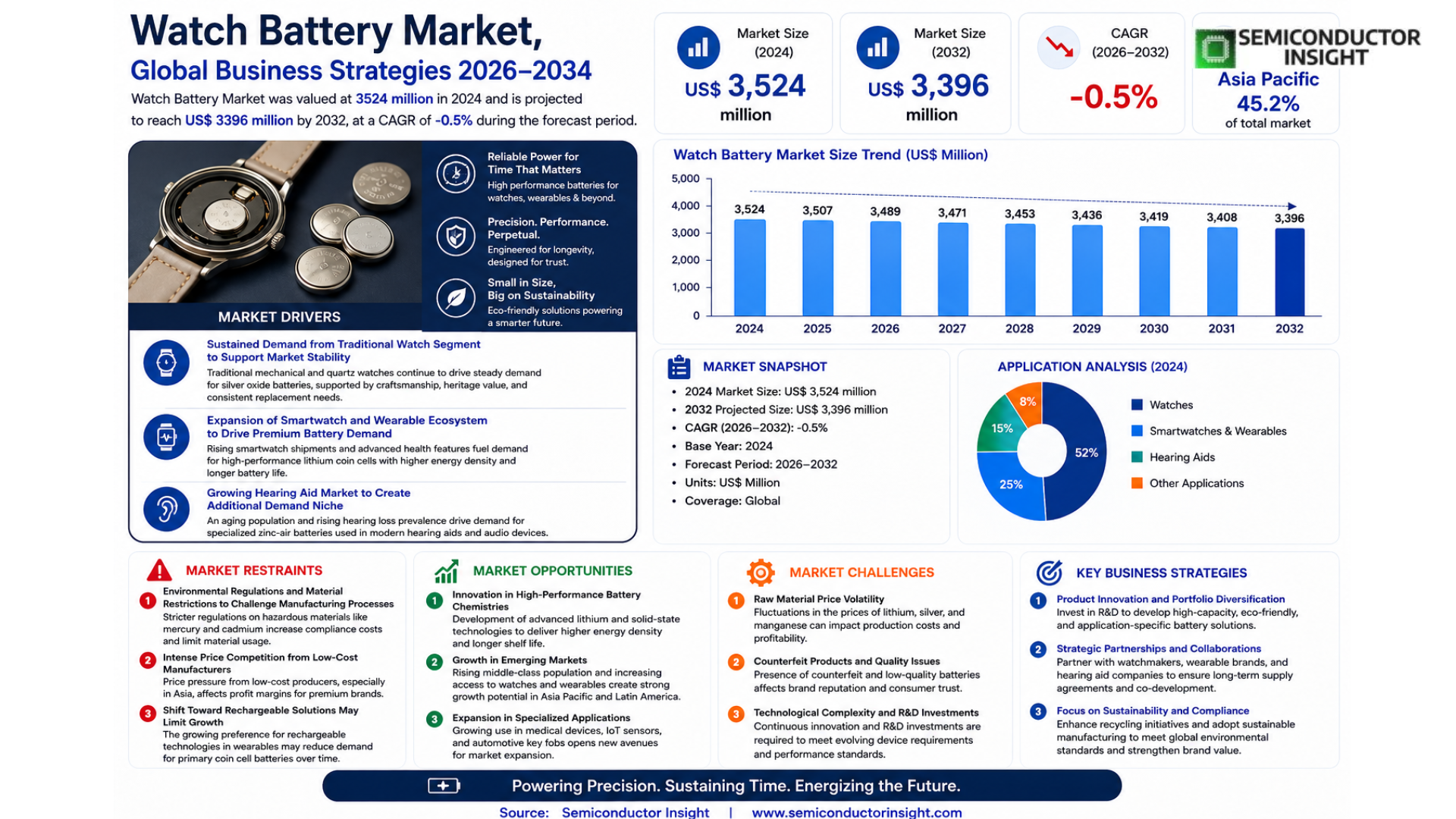
The global Watch Battery Market was valued at 3524 million in 2024 and is projected to reach US$ 3396 million by 2032, at a CAGR of -0.5% during the forecast period.
A watch battery, also known as a button cell, is a small, single-cell battery shaped as a squat cylinder, typically 5 to 25 mm in diameter and 1 to 6 mm high. These batteries are fundamental components used to power a wide array of small portable electronics devices, including wristwatches, pocket calculators, and hearing aids. The primary chemistries include LR (Alkaline), SR (Silver Oxide), and CR (Lithium), each offering different performance characteristics for various applications.
While the traditional watch segment remains a stable consumer of these power sources, the market is facing a slight overall contraction. This is largely because the rapid growth of the smartwatch segment, which often utilizes larger, rechargeable lithium-ion batteries, is cannibalizing a portion of the traditional button cell demand. However, the market remains highly competitive and consolidated, with key players like Sony holding a significant market share of approximately 18%. Other major participants include Panasonic, Renata Batteries (Swatch Group), and Energizer, who continue to innovate within the established LR, SR, and CR battery segments to maintain their positions.
MARKET DYNAMICS
MARKET DRIVERS
Sustained Demand from Traditional Watch Segment to Support Market Stability
Despite the projected slight decline in overall market value, the traditional watch segment continues to demonstrate remarkable resilience, contributing significantly to watch battery demand. Mechanical and quartz analog watches maintain substantial consumer appeal due to their craftsmanship, heritage value, and longevity. The global luxury watch market, valued at approximately $50 billion annually, relies heavily on precision battery-powered movements for quartz models. High-end brands continue to release new collections with advanced features like perpetual calendars and moon phase indicators that require reliable power sources. This sustained production and consumer preference for traditional timepieces ensures consistent replacement battery demand, particularly for silver oxide variants which dominate this segment due to their stable voltage output and long shelf life.
Expansion of Smartwatch and Wearable Ecosystem to Drive Premium Battery Demand
The rapid proliferation of smartwatches and wearable devices represents a significant growth driver for advanced battery technologies. Global smartwatch shipments exceeded 200 million units in 2024, with compound annual growth rates projected at 15-20% through 2030. These devices require high-performance lithium coin cells that can support increasingly sophisticated features including always-on displays, health monitoring sensors, GPS functionality, and wireless connectivity. The shift toward medical-grade health tracking capabilities, particularly in heart rate monitoring, blood oxygen measurement, and ECG functionality, demands batteries with exceptional energy density and reliability. Major technology companies continue to enhance their wearable ecosystems, driving innovation in battery technology to support longer battery life between charges while maintaining compact form factors.
Growing Hearing Aid Market to Create Additional Demand Niche
The hearing aid industry represents a substantial and growing market for specialized watch batteries, particularly zinc-air cells designed for high-drain applications. With an aging global population and increasing awareness of hearing health, the hearing aid market has experienced consistent growth of 5-7% annually. Approximately 20% of the world’s population experiences some degree of hearing loss, driving demand for advanced hearing assistance devices. Modern hearing aids require batteries that can provide consistent power for digital signal processing, wireless connectivity, and advanced noise cancellation features. The trend toward smaller, more discreet devices has accelerated the development of high-capacity batteries in compact form factors, creating specialized opportunities within the broader watch battery market.
MARKET RESTRAINTS
Environmental Regulations and Material Restrictions to Challenge Manufacturing Processes
The watch battery industry faces increasing pressure from environmental regulations governing hazardous materials, particularly mercury and cadmium content in battery production. Stricter global standards, including the European Union’s Battery Directive and similar regulations in North America and Asia, mandate reduced heavy metal content and higher recycling rates. Compliance requires significant investment in alternative materials and manufacturing processes, increasing production costs by an estimated 15-20%. The phase-out of mercury in alkaline batteries and restrictions on other traditional materials force manufacturers to develop new chemical formulations while maintaining performance characteristics. These regulatory requirements particularly impact smaller manufacturers who lack the research and development resources of larger corporations, potentially leading to market consolidation.
Competition from Rechargeable Technologies to Limit Disposable Battery Growth
Advancements in rechargeable battery technology present a significant restraint to traditional disposable watch battery sales. The development of lithium-polymer and solid-state batteries with increasingly compact form factors enables manufacturers to integrate rechargeable solutions into smartwatches and other wearable devices. Wireless charging capabilities and improved energy efficiency reduce the need for disposable battery replacements in premium devices. While traditional watches continue to use disposable cells, the higher-growth smartwatch segment increasingly adopts built-in rechargeable solutions. This technological shift impacts battery manufacturers who must adapt their product portfolios toward either specialized disposable cells for traditional applications or develop competitive rechargeable alternatives for the evolving wearable market.
Supply Chain Vulnerabilities and Raw Material Price Volatility to Impact Profitability
The watch battery manufacturing sector faces ongoing challenges related to raw material availability and pricing volatility. Key materials including lithium, silver, and zinc experience significant price fluctuations due to geopolitical factors, mining production changes, and competing demand from larger battery markets. Lithium prices increased by over 400% between 2021 and 2023 before moderating, directly impacting production costs for lithium coin cells. Silver oxide batteries face similar challenges with silver prices showing considerable volatility. These material cost fluctuations, combined with global supply chain disruptions affecting component availability, create manufacturing uncertainties and compressed profit margins. Manufacturers must implement sophisticated hedging strategies and develop alternative material sources to maintain competitive pricing.
MARKET CHALLENGES
Consumer Shift Toward Smart Devices with Integrated Power Systems to Challenge Traditional Battery Demand
The market faces a fundamental challenge from the ongoing consumer transition toward devices with integrated, non-replaceable power systems. Modern smartwatches and wearable devices increasingly feature sealed designs with built-in rechargeable batteries, eliminating the need for consumer-replaceable cells. This design trend reduces aftermarket battery sales despite growing device volumes. While traditional watches maintain user-replaceable battery systems, the higher-growth segments increasingly adopt integrated power solutions. Manufacturers must navigate this transition by either focusing on specialized applications where replaceable batteries remain essential or developing new business models around rechargeable solutions. The industry’s traditional revenue streams from replacement batteries face gradual erosion as device design philosophies evolve toward sealed units with longer-lasting power systems.
Other Challenges
Counterfeit Products and Quality Control Issues
The watch battery market contends with significant counterfeit and substandard products that undermine brand reputation and consumer safety. Counterfeit batteries often fail to meet performance specifications, potentially damaging sensitive electronic devices and creating safety hazards. The proliferation of these products through online marketplaces and unauthorized distribution channels complicates quality control and brand protection efforts. Manufacturers invest substantial resources in anti-counterfeiting technologies, including holographic packaging, unique coding systems, and supply chain verification processes. However, the economic incentive for counterfeit production remains high due to the relatively high value of genuine branded batteries compared to manufacturing costs.
Technical Standardization and Compatibility Challenges
The industry faces ongoing challenges related to technical standardization and device compatibility. While international standards exist for common battery sizes, device manufacturers increasingly create proprietary battery specifications to optimize performance or design aesthetics. This trend toward custom battery solutions fragments the replacement market and complicates inventory management for retailers and distributors. Consumers often struggle to identify the correct battery type for their devices, particularly as manufacturers use internal model numbers rather than standard size designations. The lack of universal compatibility information and the proliferation of device-specific batteries create consumer confusion and potential purchasing errors.
MARKET OPPORTUNITIES
Development of Advanced Battery Technologies to Enable New Device Capabilities
Significant opportunities exist in developing advanced battery technologies that enable new device capabilities and applications. Research into higher energy density materials, improved temperature performance, and enhanced safety characteristics supports the evolution of next-generation wearable devices. The medical wearable segment particularly benefits from batteries with longer operational life and more stable discharge characteristics, enabling continuous health monitoring applications. Innovations in solid-state battery technology promise improved safety and energy density compared to traditional liquid electrolyte cells. These technological advancements allow battery manufacturers to capture premium market segments and develop proprietary technologies that differentiate their products in a competitive marketplace.
Expansion in Emerging Markets to Offset Mature Market Decline
Emerging markets present substantial growth opportunities as disposable incomes rise and consumer electronics adoption increases. Regions including Southeast Asia, Latin America, and Africa show growing demand for watches and wearable devices, driving corresponding battery needs. The traditional watch market remains particularly strong in these regions, where analog watches maintain cultural significance and represent accessible luxury items. As distribution networks improve and retail infrastructure develops, battery availability and replacement services expand into previously underserved areas. Manufacturers can capitalize on these growth markets by developing region-specific distribution partnerships and product formulations suited to local climate conditions and usage patterns.
Specialization in N Applications and Custom Solutions to Create Value-Added Opportunities
The trend toward device specialization creates opportunities for battery manufacturers to develop custom solutions for specific applications. Medical devices, military equipment, industrial instrumentation, and specialty electronics often require batteries with unique performance characteristics, including extended temperature ranges, higher capacity, or specific discharge profiles. These niche applications typically command premium pricing and provide stable demand patterns less susceptible to consumer market fluctuations. Manufacturers that invest in application-specific research and development can establish strong positions in these specialized segments, often with longer product lifecycles and more stable customer relationships than the consumer market provides.
WATCH BATTERY MARKET TRENDS
Rise of Smartwatches and Wearables to Emerge as a Dominant Trend
The proliferation of smartwatches and advanced wearables is fundamentally reshaping the watch battery landscape. While traditional quartz watches require infrequent battery changes, often lasting two to five years, modern smartwatches with features like always-on displays, GPS tracking, and heart rate monitoring demand more frequent power cycles, driving a consistent replacement market. This shift is significant; the global smartwatch market is projected to exceed 230 million unit shipments annually, creating a substantial and recurring demand for high-performance batteries. This trend favors lithium coin cells (CR series) due to their higher energy density and stable voltage output, which are critical for powering sophisticated sensors and connectivity modules. The increasing integration of health monitoring features, such as ECG and blood oxygen saturation tracking, further necessitates reliable and long-lasting power sources, positioning advanced battery technology as a key enabler of wearable device innovation.
Other Trends
Miniaturization and Enhanced Energy Density
A relentless drive towards smaller, more powerful electronic devices is pushing battery manufacturers to innovate in miniaturization and energy density. Consumers expect devices to become slimmer and lighter without compromising on battery life, compelling suppliers to develop cells that pack more energy into the same or smaller form factors. This is particularly evident in the high-growth hearing aid segment, where zinc-air batteries dominate due to their superior energy capacity for their size. Technological advancements are focused on improving the internal chemistry and construction of these batteries to extend operational life, a critical factor for medical and continuous-use devices. This trend ensures that even as devices shrink, their functional runtime meets or exceeds consumer expectations, securing the battery’s role as a vital component.
Shift Towards Rechargeable and Eco-Conscious Solutions
Growing environmental awareness and stringent regulations on disposable batteries are accelerating the development and adoption of rechargeable watch battery solutions. While the market is still predominantly led by primary (non-rechargeable) cells, there is a noticeable pivot, particularly within the smartwatch segment, where lithium-polymer rechargeable batteries are becoming the standard. This shift is driven by consumer demand for sustainability and the economic advantage of reusable power sources over the long term. Furthermore, manufacturers are investing in research to improve the cycle life and charging efficiency of these rechargeable cells to make them viable for a wider range of applications. The industry is also responding to regulatory pressures by improving the recyclability of traditional cells and reducing the use of hazardous materials, aligning product development with broader global sustainability goals.
COMPETITIVE LANDSCAPE
Key Industry Players
Market Leaders Leverage Innovation and Strategic Alliances to Maintain Dominance
The global watch battery market exhibits a fragmented yet competitive structure, characterized by the presence of multinational electronics giants, specialized battery manufacturers, and emerging regional players. Sony Corporation stands as the undisputed market leader, commanding an estimated 18% revenue share in 2024. This dominance is largely attributed to its extensive product portfolio spanning silver oxide (SR) and lithium (CR) chemistries, coupled with its formidable global distribution network and longstanding relationships with major watchmakers.
Panasonic Corporation and Renata Batteries SA, a subsidiary of the Swatch Group, also hold significant market positions. Panasonic’s strength lies in its massive scale and vertical integration, allowing for cost-effective manufacturing. Renata, conversely, leverages its unique position within the Swatch Group to secure a steady demand stream from the luxury and precision watch segment, making it a highly specialized and influential player.
Furthermore, companies are actively engaging in research and development to cater to the evolving needs of the market, particularly the growing smartwatch segment which demands higher energy density and longer life cycles. This has led to increased investment in advanced lithium-based chemistries. Strategic expansions into high-growth regions, especially within Asia-Pacific, and targeted mergers and acquisitions are key tactics being employed to capture market share and diversify product offerings.
Meanwhile, established consumer battery brands like Energizer Holdings, Inc. and Duracell Inc. are strengthening their positions through brand recognition and robust retail channels. Their strategy focuses on the aftermarket replacement segment, ensuring widespread availability for consumers. Similarly, Varta AG (under Rayovac) continues to be a formidable competitor in Europe, focusing on technological advancements in hearing aid batteries, a closely related and synergistic market.
List of Key Watch Battery Companies Profiled
- Sony Corporation (Japan)
- Panasonic Corporation (Japan)
- Renata Batteries SA (Switzerland) – Swatch Group Ltd.
- Maxell Holdings, Ltd. (Japan) – Hitachi Ltd.
- Varta AG (Germany) – Spectrum Brands Holdings, Inc. (Rayovac)
- Seiko Holdings Corporation (Japan)
- Toshiba Corporation (Japan)
- Energizer Holdings, Inc. (U.S.)
- Duracell Inc. (U.S.) – Berkshire Hathaway Inc.
- GP Batteries International Limited (Hong Kong)
- Vinnic (France)
- NANFU Battery Co., Ltd. (China)
- TMMQ (China)
- EVE Energy Co., Ltd. (China)
- Camelion Battery (GmbH) (Germany)
Segment Analysis:
By Type
Silver Oxide (SR) Batteries Dominate the Market Due to Superior Performance and Reliability in Precision Timekeeping
The market is segmented based on type into:
- LR (Alkaline)
- SR (Silver Oxide)
- CR (Lithium)
- Others
By Application
Traditional Watch Segment Leads Due to Consistent Global Demand and High Replacement Cycle
The market is segmented based on application into:
- Traditional Watch
- Smartwatch
- Hearing Aids
- Calculators and Small Electronics
- Others
Regional Analysis: Watch Battery Market
Asia-Pacific
The Asia-Pacific region dominates the global watch battery market, accounting for over 45% of total consumption by volume. This leadership position is driven by massive manufacturing hubs in China, Japan, and South Korea, which collectively produce millions of timepieces annually. China, in particular, serves as both a major producer and consumer, with its domestic battery manufacturers like NANFU and EVE Energy capturing significant market share. The region’s strength lies in its cost-effective production capabilities and extensive supply chain networks. However, the market faces a dual dynamic: while demand for traditional silver oxide (SR) batteries remains strong in affordable analog watches, there’s rapidly growing consumption of lithium (CR) batteries for smartwatches and hybrid timepieces. Japan’s Seiko and Maxell (Hitachi) maintain technological leadership in high-performance cells, particularly for luxury watches, while Chinese manufacturers compete aggressively in the economy segment. The proliferation of wearable technology across urban centers in India, Southeast Asia, and China continues to drive replacement battery sales, though overall market growth is tempered by the longer lifespan of modern batteries and increased competition from rechargeable alternatives.
Europe
Europe represents a mature but technologically advanced watch battery market, characterized by stringent environmental regulations and high consumer awareness. The EU’s Battery Directive and REACH regulations significantly influence market dynamics, pushing manufacturers toward mercury-free and more environmentally sustainable solutions. Switzerland, as the global hub of luxury watchmaking, creates substantial demand for high-quality silver oxide batteries, with Renata Batteries (Swatch Group) maintaining a dominant position in this premium segment. Germany’s Varta AG leverages its engineering expertise to supply both the traditional watch industry and emerging wearable technology sectors. European consumers show increasing preference for brands with strong environmental credentials, driving adoption of more expensive but eco-friendly battery options. The market faces gradual decline in traditional watch battery sales due to the popularity of smartwatches with rechargeable batteries, though this is partially offset by the continued prestige of mechanical and luxury quartz timepieces requiring high-performance cells. The region’s well-established recycling infrastructure for portable batteries also creates a more circular economy compared to other markets.
North America
North America’s watch battery market is characterized by strong brand recognition and retail distribution networks, with Energizer and Duracell maintaining significant market share through extensive retail partnerships. The United States represents the largest single-country market in the region, driven by consumer replacement demand rather than original equipment manufacturing. The market demonstrates a clear bifurcation: premium silver oxide batteries for luxury watches and basic alkaline cells for inexpensive timepieces. Smartwatch adoption has significantly impacted the replacement market, as many consumers transition to devices with rechargeable batteries. However, this has created opportunities for lithium-based cells in hybrid watches that combine traditional aesthetics with smart features. Regulatory pressure regarding battery disposal and mercury content continues to shape product offerings, with major brands increasingly promoting their environmentally responsible alternatives. The region’s organized retail sector and strong consumer awareness about battery safety and performance parameters maintain steady demand, though overall market volume shows slight decline due to changing timepiece preferences.
South America
The South American watch battery market remains primarily a replacement market with limited local manufacturing. Brazil and Argentina represent the largest markets, though economic volatility often affects consumer purchasing patterns. The region shows preference for cost-effective alkaline (LR) batteries over more expensive silver oxide options, particularly in the value segment. Market growth is constrained by several factors, including informal retail channels, counterfeit products, and limited environmental regulations regarding battery composition and disposal. However, the region’s growing middle class and increasing watch ownership present opportunities for market development. Major international brands like Sony and Panasonic maintain presence through distribution partnerships, while local manufacturers face challenges competing on quality and consistency. The luxury watch segment remains relatively small but stable, creating consistent demand for high-performance batteries among affluent consumers. Infrastructure limitations for proper battery recycling and collection present environmental challenges that may drive future regulatory changes.
Middle East & Africa
The watch battery market in Middle East & Africa is emerging but fragmented, with significant variation between developed Gulf states and developing African nations. The UAE and Saudi Arabia represent more mature markets with higher consumption of premium battery types for luxury watches, reflecting the region’s affinity for high-end timepieces. In contrast, African markets predominantly demand economical alkaline batteries for basic quartz watches. The region faces challenges including counterfeit products, informal distribution channels, and limited environmental awareness regarding battery disposal. However, growing urbanization and increasing disposable income in key markets are driving gradual market development. International brands must navigate complex import regulations and diverse consumer preferences across the region. The lack of comprehensive recycling infrastructure presents both environmental concerns and potential future opportunities for companies offering more sustainable solutions. While not currently a major growth market globally, the region’s developing retail sectors and growing consumer electronics adoption suggest long-term potential for watch battery sales.
Report Scope
This market research report provides a comprehensive analysis of the global and regional Watch Battery markets, covering the forecast period 2025–2032. It offers detailed insights into market dynamics, technological advancements, competitive landscape, and key trends shaping the industry.
Key focus areas of the report include:
- Market Size & Forecast: Historical data and future projections for revenue, unit shipments, and market value across major regions and segments.
- Segmentation Analysis: Detailed breakdown by product type, technology, application, and end-user industry to identify high-growth segments and investment opportunities.
- Regional Outlook: Insights into market performance across North America, Europe, Asia-Pacific, Latin America, and the Middle East & Africa, including country-level analysis where relevant.
- Competitive Landscape: Profiles of leading market participants, including their product offerings, R&D focus, manufacturing capacity, pricing strategies, and recent developments such as mergers, acquisitions, and partnerships.
- Technology Trends & Innovation: Assessment of emerging technologies, integration of AI/IoT, semiconductor design trends, fabrication techniques, and evolving industry standards.
- Market Drivers & Restraints: Evaluation of factors driving market growth along with challenges, supply chain constraints, regulatory issues, and market-entry barriers.
- Stakeholder Analysis: Insights for component suppliers, OEMs, system integrators, investors, and policymakers regarding the evolving ecosystem and strategic opportunities.
Primary and secondary research methods are employed, including interviews with industry experts, data from verified sources, and real-time market intelligence to ensure the accuracy and reliability of the insights presented.
FREQUENTLY ASKED QUESTIONS:
What is the current market size of Global Watch Battery Market?
-> Watch Battery Market was valued at 3524 million in 2024 and is projected to reach US$ 3396 million by 2032, at a CAGR of -0.5% during the forecast period.
Which key companies operate in Global Watch Battery Market?
-> Key players include Sony, Maxell (Hitachi), Panasonic, Renata Batteries (Swatch Group), Varta (Rayovac), Seiko, Toshiba, Energizer, Duracell, and GP Batteries, among others.
What are the key growth drivers?
-> Key growth drivers include demand from smartwatches, expansion of wearable electronics, and replacement cycles in traditional timepieces.
Which region dominates the market?
-> Asia-Pacific is the dominant market, driven by manufacturing hubs in China and Japan, while Europe maintains significant market share through Switzerland’s watch industry.
What are the emerging trends?
-> Emerging trends include development of higher capacity lithium batteries, mercury-free alternatives, and miniaturization for advanced wearable devices.

Get Sample Report PDF for Exclusive Insights
Report Sample Includes
- Table of Contents
- List of Tables & Figures
- Charts, Research Methodology, and more...
 Download Sample Report PDF