
Walking Aid Robot Market Insights
Global Walking Aid Robot market size was valued at USD 0.75 billion in 2025. The market is projected to grow from USD 0.94 billion in 2026 to USD 4.62 billion by 2034, exhibiting a CAGR of 22.2% during the forecast period.
A walking aid robot is a robotic device designed to assist individuals with mobility impairments in walking and maintaining balance. These robots provide physical support and stability, helping users with conditions such as age-related mobility decline, injuries, or disabilities to walk independently or with minimal assistance. Walking aid robots often come equipped with sensors, AI, and motion control systems that detect the user’s movement intentions, adjust support accordingly, and provide a smoother and safer walking experience.
The market is experiencing rapid growth due to several factors, including a surging global aging population, rising incidences of neurological disorders and injuries, and continuous advancements in AI-driven robotics and lightweight materials. Furthermore, increasing demand for at-home rehabilitation solutions and favorable reimbursement policies in developed regions are propelling expansion. Initiatives by key players continue to drive innovation. For instance, in 2023, Cyberdyne expanded availability of its HAL exoskeleton through new partnerships in Europe. Cyberdyne, Ekso Bionics, Lifeward, Hocoma, and Panasonic are some of the key players operating in the market with a wide range of portfolios.
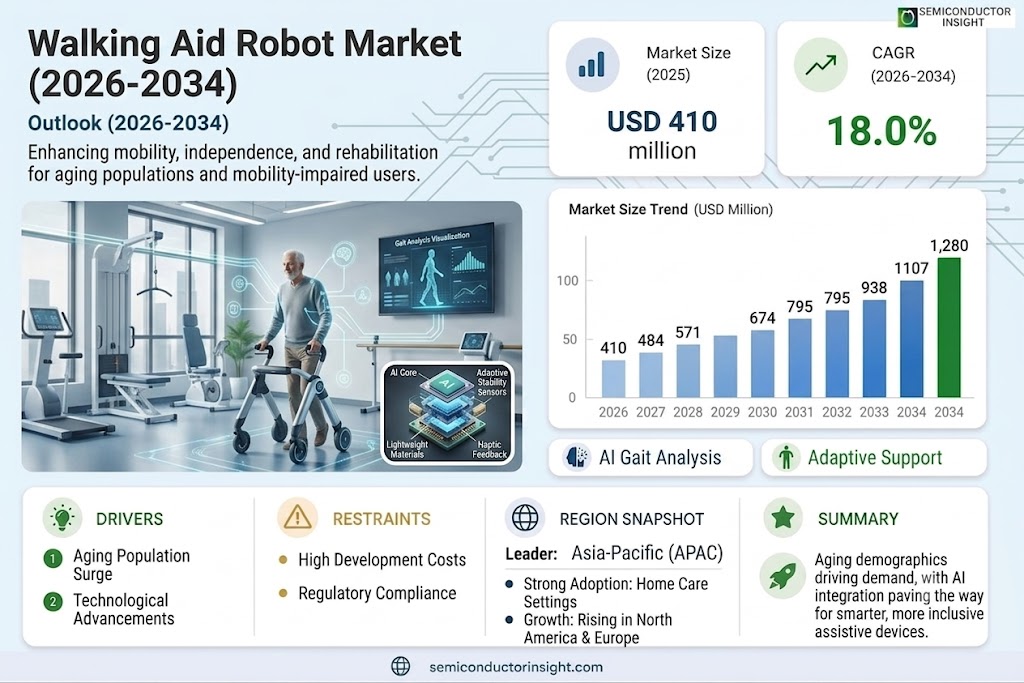
MARKET DRIVERS
Aging Population Surge
Walking Aid Robot Market is propelled by the global aging population, with over 1.4 billion people expected to be aged 60 and above by 2030. This demographic shift increases demand for assistive technologies that enhance mobility and independence for elderly users facing conditions like arthritis and Parkinson’s disease.
Technological Advancements
Integration of AI, sensors, and lightweight materials has improved the functionality of walking aid robots, making them more intuitive and reliable. These innovations allow for real-time gait analysis and adaptive support, addressing key needs in rehabilitation and daily living.
➤ Government initiatives worldwide are allocating funds for smart assistive devices, boosting market penetration in home care settings.
Rising healthcare expenditures and a shift toward aging-in-place solutions further accelerate adoption, with the market witnessing a projected CAGR of 18% through the next decade.
MARKET CHALLENGES
High Development Costs
Developing sophisticated walking aid robots involves substantial R&D investments, limiting entry for smaller players in Walking Aid Robot Market. Complex engineering for stability and user safety escalates production expenses.
Other Challenges
Regulatory Compliance
Stringent medical device regulations from bodies like the FDA delay approvals and increase certification costs, hindering faster market entry for innovative robotic walkers.User training requirements and limited awareness in rural areas pose additional hurdles, slowing widespread adoption despite evident benefits for mobility-impaired individuals.
MARKET RESTRAINTS
Technical Limitations
Battery life and navigation challenges in uneven terrains restrict the practicality of walking aid robots, particularly for outdoor use in Walking Aid Robot Market. Current models often require frequent recharging, impacting user convenience.Interoperability issues with existing healthcare systems and high maintenance needs further constrain scalability. Safety concerns, including fall risks during malfunctions, demand ongoing improvements.Limited reimbursement policies in many regions deter consumer uptake, as out-of-pocket costs remain prohibitive for advanced mobility aids.
MARKET OPPORTUNITIES
Emerging Market Expansion
Walking Aid Robot Market holds significant potential in Asia-Pacific and Latin America, where aging populations are growing rapidly alongside rising disposable incomes. Tailored, affordable models could capture these underserved segments.Advancements in telehealth integration enable remote monitoring, opening avenues for subscription-based services in home rehabilitation. Partnerships between robotics firms and healthcare providers can enhance distribution.Customization through 3D printing and AI personalization promises differentiated products, fostering growth in post-stroke recovery and chronic mobility management applications.
Walking Aid Robot Market Trends
Advancements in AI and Sensor Technologies
In Walking Aid Robot Market, a prominent trend is the integration of advanced AI algorithms and sensors, enabling devices to detect user movement intentions and provide adaptive physical support for balance and stability. These technologies facilitate smoother walking experiences for individuals with mobility impairments, including age-related decline or post-injury recovery. Manufacturers are focusing on enhancing motion control systems, which adjust support dynamically to promote independent mobility. This evolution reduces reliance on traditional aids and aligns with demands for intuitive, user-centric solutions in rehabilitation and daily living.
Other Trends
Growth in Wearable Segments
The wearable segment within Walking Aid Robot Market is experiencing accelerated adoption due to its portability and lightweight design, outperforming fixed models in versatility for both clinical and home use. Key players such as Cyberdyne, Ekso Bionics, and Honda are leading innovations with exoskeleton-style devices that offer targeted assistance, capturing significant revenue shares. This shift reflects broader industry movement toward non-invasive, user-friendly robotics that integrate seamlessly into everyday routines.
Expansion Across Applications and Regions
Demand in Walking Aid Robot Market is diversifying across applications like hospitals, nursing homes, and households, driven by aging populations and rising chronic conditions. Household penetration is particularly notable, empowering users with disabilities to maintain autonomy. Regionally, North America holds a leading position with robust healthcare infrastructure, while Asia, including China and Japan, shows rapid growth due to expansive manufacturing bases and demographic shifts. Industry surveys highlight ongoing developments in product types and competitive strategies among top firms like Lifeward and Panasonic, fostering a dynamic landscape focused on accessibility and technological refinement.
COMPETITIVE LANDSCAPE
Key Industry Players
Leading Innovators in Walking Aid Robot Market
Walking Aid Robot Market features a competitive landscape dominated by established robotics pioneers and specialized medical device firms, with the global top five players collectively holding a significant revenue share in 2025. Honda leads with its advanced exoskeleton technologies derived from humanoid robotics expertise, offering stable support for mobility-impaired users through AI-driven motion assistance. Cyberdyne’s HAL suit, Ekso Bionics’ EksoNR device, and Lifeward’s ReWalk systems exemplify the market’s focus on wearable robotics that integrate sensors and neural interfaces for natural gait restoration. This oligopolistic structure is bolstered by high R&D barriers and regulatory approvals, fostering innovation in balance support and fall prevention for aging populations and rehabilitation needs.
Beyond the frontrunners, niche players contribute through targeted innovations in fixed and household applications, particularly from Asia-Pacific and European firms. Companies like Hocoma with its Lokomat systems, Rex Bionics’ REX exoskeleton, and Panasonic’s assistive robots address hospital and nursing home segments with customizable therapy solutions. Emerging challengers such as German Bionic, Shanghai Fourier Intelligence, and Shenzhen-based firms like ZuoWei Technology and MileBot Robotics are gaining traction via cost-effective, AI-enhanced wearables tailored for household use, intensifying competition and driving market expansion amid rising demand for independent mobility aids.
List of Key Walking Aid Robot Companies Profiled
- Honda
- Lifeward
- Hocoma
- Woodway
- Cyberdyne
- Ekso Bionics
- Rex Bionics
- Panasonic
- Samsung
- German Bionic
- Shenzhen ZuoWei Technology
- SIASUN ROBOT & AUTOMATION
- Shenzhen MileBot Robotics
- Hangzhou RoboCT Technology Development
- Shanghai Fourier Intelligence
Segment Analysis:
| Segment Category | Sub-Segments | Key Insights |
| By Type |
|
Wearable
|
| By Application |
|
Household
|
| By End User |
|
Elderly Individuals
|
| By Medical Condition |
|
Age-Related Decline
|
| By Technology |
|
AI-Integrated
|
Regional Analysis: Walking Aid Robot Market
North America
Cutting-edge research in AI and sensors propels Walking Aid Robot development. Collaborations between tech firms and healthcare providers yield intuitive devices that predict user intent, reducing accidents and boosting confidence in daily navigation.
Dominant manufacturers focus on modular designs customizable for varied user profiles. Strategic partnerships enhance supply chains, ensuring premium components for durable, lightweight Walking Aid Robots suited to active lifestyles.
Favorable policies streamline approvals for assistive robotics. Incentives for domestic production encourage innovation, while stringent testing protocols build trust, facilitating widespread integration into rehabilitation programs.
Affluent demographics prioritize quality assistive tech. Home healthcare shifts amplify demand for autonomous Walking Aid Robots, with clinics adopting them for therapy to improve patient outcomes and independence.
Europe
Europe exhibits robust growth in Walking Aid Robot Market, underpinned by aging demographics and comprehensive social welfare systems. Countries like Germany and the UK lead with precision-engineered robots emphasizing user safety and data privacy under GDPR. Collaborative EU-funded projects drive cross-border standardization, enhancing interoperability. Market dynamics favor compact, energy-efficient models for urban living, addressing mobility challenges in historic cities. Healthcare providers integrate these devices into elderly care frameworks, promoting active aging. Innovations in haptic feedback and voice controls cater to diverse linguistic needs, while sustainability initiatives push eco-friendly materials. Challenges like fragmented regulations are offset by harmonization efforts, positioning Europe as a quality-focused hub that influences global Walking Aid Robot benchmarks through ethical AI development.
Asia-Pacific
Asia-Pacific emerges as a dynamic force in Walking Aid Robot Market, fueled by rapid urbanization and expanding geriatric populations in Japan and China. Manufacturing prowess enables cost-effective production, democratizing access to advanced mobility aids. Government-backed initiatives in smart cities incorporate robotic walkers into public infrastructure. Cultural emphasis on family caregiving evolves toward tech-assisted independence, with customizable designs accommodating varied body types. R&D hubs innovate obstacle-avoidance tech for dense environments, while telemedicine linkages extend reach to rural areas. Supply chain efficiencies and tech talent pools accelerate market penetration, though affordability remains key to sustaining momentum in this high-potential Walking Aid Robot landscape.
South America
South America presents untapped opportunities in Walking Aid Robot Market amid rising chronic disease burdens and improving healthcare access. Brazil and Argentina spearhead pilots in urban rehabilitation centers, adapting robots for tropical climates and rough terrains. Local startups collaborate with international firms to localize designs, focusing on affordability and remote monitoring. Economic recovery boosts investments, yet infrastructure gaps challenge scalability. Growing middle-class awareness drives demand for portable aids supporting post-injury recovery, with potential in sports rehab. Navigating import duties and training needs will unlock broader adoption in this evolving regional market.
Middle East & Africa
The Middle East & Africa region shows nascent promise in Walking Aid Robot Market, propelled by oil-funded healthcare modernizations in Gulf states. High-income nations invest in premium robotic exoskeletons for luxury elderly care, while Africa’s mobile health trends favor rugged, solar-powered walkers. Challenges like uneven infrastructure and skill shortages hinder pace, but telemedicine integrations bridge gaps. Cultural shifts toward tech in rehabilitation open doors, with customized solutions for nomadic lifestyles. Strategic alliances could catalyze growth, transforming assistive robotics into vital tools for inclusive mobility across diverse terrains.
Report Scope
This market research report provides a comprehensive analysis of Walking Aid Robot Market, covering the forecast period 2025–2032. It offers detailed insights into market dynamics, technological advancements, competitive landscape, and key trends shaping the industry.
Key focus areas of the report include:
- Market Overview: The report begins with an overview outlining its current market scenario, key growth indicators, and industry transformation drivers. It discusses macroeconomic factors, demand–supply balance, regulatory landscape, and the strategic role of walking aid robots in powering advancements across industries such as healthcare, rehabilitation, elderly care, and household assistance.
- Market Size & Forecast: Historical data and future projections for revenue, unit shipments, and market value across major regions and segments.
- Segmentation Analysis: Detailed breakdown by product type, technology, application, and end-user industry to identify high-growth segments and investment opportunities.
- Regional Insights: Insights into market performance across North America, Europe, Asia, South America, and the Middle East & Africa, including country-level analysis where relevant.
- Competitive Landscape: Profiles of leading market participants, including their product offerings, R&D focus, manufacturing capacity, pricing strategies, and recent developments such as mergers, acquisitions, and partnerships.
- Technology Trends & Innovation: Assessment of emerging technologies, integration of AI/IoT, semiconductor design trends, fabrication techniques, and evolving industry standards.
- Market Drivers & Restraints: Evaluation of factors driving market growth along with challenges, supply chain constraints, regulatory issues, and market-entry barriers.
- Stakeholder Insights: Insights for component suppliers, OEMs, system integrators, investors, and policymakers regarding the evolving ecosystem and strategic opportunities.
Primary and secondary research methods are employed, including interviews with industry experts, data from verified sources, and real-time market intelligence to ensure the accuracy and reliability of the insights presented.
FREQUENTLY ASKED QUESTIONS:
What is the current market size of Walking Aid Robot Market?
-> Global Walking Aid Robot market was valued at USD million in 2025 and is projected to reach USD million by 2032, at a CAGR of % during the forecast period.
Which key companies operate in Walking Aid Robot Market?
-> Key players include Honda, Lifeward, Hocoma, Woodway, Angelexo Scientific, Cyberdyne, among others.
What are the key growth drivers?
-> Key growth drivers include aging population, mobility impairments from age-related decline and injuries, and advancements in AI and sensor technologies.
Which region dominates the market?
-> North America, particularly the U.S., holds a significant market size in 2025, while Asia, led by China, shows strong growth potential.
What are the emerging trends?
-> Emerging trends include wearable exoskeletons, AI-driven motion detection, and expansion into household and nursing home applications.

Get Sample Report PDF for Exclusive Insights
Report Sample Includes
- Table of Contents
- List of Tables & Figures
- Charts, Research Methodology, and more...
 Download Sample Report PDF



