Wafer Saw Dicing Blades Market Insights
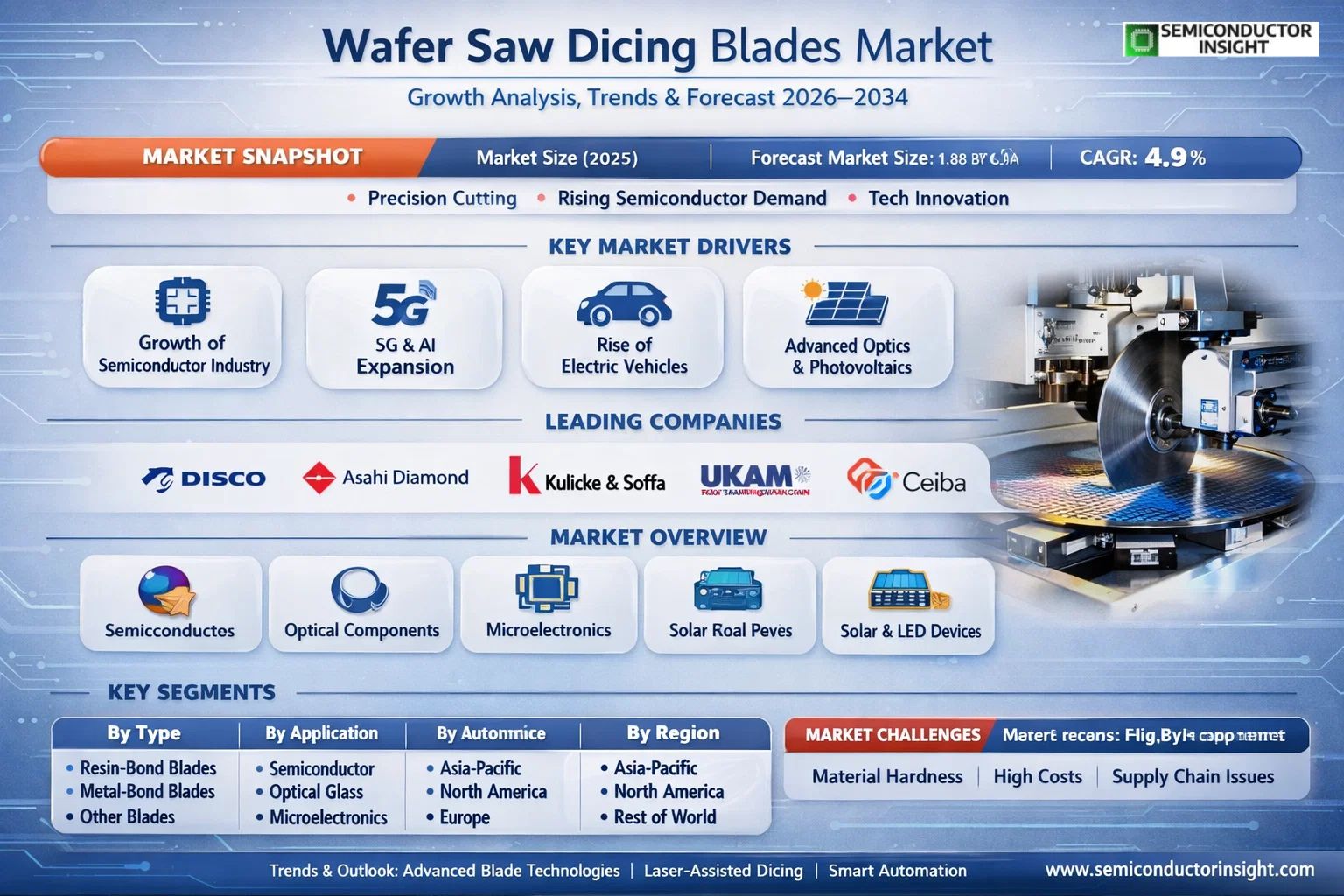
Global wafer saw dicing blades market size was valued at USD 1.28 billion in 2025. The market is projected to grow from USD 1.34 billion in 2026 to USD 1.82 billion by 2034, exhibiting a CAGR of 4.9% during the forecast period.
Wafer saw dicing blades are high-precision cutting tools used primarily in the semiconductor, electronics, optics, and other precision processing industries. Their main function is to slice a single wafer, typically made from silicon or other materials like gallium arsenide or sapphire, into multiple small pieces known as die or chips. These components form the base material for microelectronic devices such as integrated circuits (ICs), sensors, solar cells, and optical devices. The blades are manufactured from ultra-hard materials like diamond abrasives embedded in a metal or resin bond matrix to ensure exceptional hardness and wear resistance during high-speed cutting operations.
The market’s growth is fundamentally driven by the relentless expansion of Global semiconductor industry and the proliferation of advanced electronics. Key demand drivers include the rapid adoption of 5G technology, artificial intelligence (AI), high-performance computing (HPC), and the Internet of Things (IoT), all of which require increasingly smaller and more powerful chips. This trend towards miniaturization demands higher precision and performance from dicing blades. Furthermore, growth in adjacent sectors such as electric vehicles, advanced optics for consumer electronics, and photovoltaics provides additional momentum for market expansion.
MARKET DRIVERS
Proliferation of Advanced Semiconductor Packaging
The relentless demand for smaller, more powerful electronic devices is a primary catalyst for the Wafer Saw Dicing Blades Market. Advanced packaging technologies like fan-out wafer-level packaging (FO-WLP) and 3D IC integration require ultra-precise and thin dicing to separate densely packed chips. This drives demand for specialized, high-performance dicing blades capable of cutting thinner wafers and handling fragile materials with minimal chipping and high yield, directly supporting market expansion.
Expansion of Compound Semiconductor Applications
Beyond traditional silicon, the rise of compound semiconductors such as silicon carbide (SiC) and gallium nitride (GaN) for power electronics, RF devices, and optoelectronics presents a significant driver. These harder, more brittle materials necessitate specialized dicing solutions. The Wafer Saw Dicing Blades Market is responding with blades featuring advanced diamond abrasives and bond systems specifically engineered for these challenging substrates, creating a high-value segment.
➤ The transition to larger wafer diameters, like 300mm and beyond, for improved manufacturing economies of scale, further sustains demand for high-durability, consistent-performance dicing blades to maximize yield across the entire wafer surface.
Continuous automation and the integration of Industry 4.0 principles in semiconductor fabs also propel the market. Automated dicing saws require blades that offer predictable wear characteristics and consistent performance to minimize machine downtime and maintenance, aligning with the industry’s focus on operational efficiency and yield optimization.
MARKET CHALLENGES
Technical Demands of Next-Generation Materials
A central challenge in the Wafer Saw Dicing Blades Market is keeping pace with the material science revolution in semiconductors. Cutting ultra-low-k dielectric films, glass substrates for interposers, and novel 2D materials introduces severe risks of delamination, cracking, and contamination. Developing blade matrices and diamond formulations that can successfully dice these heterogeneous and delicate structures without compromising device integrity requires substantial and continuous R&D investment.
Other Challenges
Precision Yield Management
As chip features shrink and wafer real estate costs increase, every micron of material loss during dicing (kerf loss) impacts final die count and profitability. Achieving near-zero kerf while maintaining blade life and cut quality presents an ongoing engineering challenge for blade manufacturers, balancing abrasive technology with mechanical design.
Cost and Supply Chain Pressures
The market faces pressure from the high cost of premium synthetic diamonds and specialized bonding materials. Furthermore, maintaining a stable supply of these critical raw materials amidst global geopolitical and trade uncertainties adds complexity to production planning and cost control for dicing blade suppliers.
MARKET RESTRAINTS
Adoption of Alternative Dicing Technologies
A key restraint for the traditional Wafer Saw Dicing Blades Market is the growing adoption of blade-less dicing technologies for specific applications. Laser dicing and stealth dicing are gaining traction for ultra-thin wafers and certain compound semiconductors, as they can reduce mechanical stress and eliminate kerf loss entirely. This technological shift limits the addressable market for mechanical saw blades in some high-growth, cutting-edge segments, pushing manufacturers to innovate to justify their value proposition.
Cyclical Nature of Semiconductor Capital Expenditure
The market’s growth is inherently tied to the capital investment cycles of semiconductor manufacturers. During periods of overcapacity or economic downturn, chipmakers delay or reduce equipment and consumable purchases, directly impacting the demand for wafer saw dicing blades. This cyclicality introduces volatility and makes long-term capacity planning challenging for blade manufacturers.
MARKET OPPORTUNITIES
Growth in Automotive and Industrial Electronics
The rapid electrification of vehicles and automation in industry is a major opportunity. These sectors require robust semiconductors for power control, sensors, and microcontrollers, often built on SiC and GaN. The Wafer Saw Dicing Blades Market is poised to benefit by providing reliable, high-volume dicing solutions tailored for the stringent quality and durability standards of automotive-grade electronics, representing a stable, high-growth avenue.
Development of Hybrid and Application-Specific Solutions
There is significant opportunity in developing hybrid dicing approaches and highly customized blades. Combining mechanical dicing with laser scoring or creating blade geometries optimized for specific material stacks (e.g., memory chips vs. logic chips) can offer superior performance. Manufacturers that excel in co-engineering solutions directly with semiconductor fabricators can capture higher margins and build long-term, strategic partnerships in this specialized segment of the market.
Aftermarket and Services Expansion
Beyond selling consumable blades, there is a growing opportunity in value-added services. Offering advanced blade conditioning, performance monitoring software integrated with dicing saws, and predictive maintenance programs can create recurring revenue streams. This service-oriented model helps secure customer loyalty in the competitive Wafer Saw Dicing Blades Market by optimizing overall dicing process efficiency and total cost of ownership for the end-user.
Primary Trends Influencing The Wafer Saw Dicing Blades Market
Advancement in Blade and Cutting Technology
Continuous technological innovation is a dominant trend defining the Wafer Saw Dicing Blades Market. As semiconductor device geometries shrink and new substrate materials like silicon carbide and gallium nitride gain prominence, blades are evolving accordingly. Key advancements include the refinement of diamond-based bond materials, both resin and metal, to optimize for specific materials and minimize chipping. Laser-assisted dicing technology is emerging as a complementary technique, promoting the development of hybrid systems and specialized blades designed for these integrated processes. The push for greater throughput and yield is also driving automation and intelligent process control, where blade performance data informs predictive maintenance schedules.
Other Trends
Material Expertise and Customization
The market is seeing increased demand for highly customized wafer saw dicing blades tailored to specific applications. Manufacturers are expanding their portfolios to address diverse materials beyond traditional silicon, including ceramics, optical glass, and advanced compound semiconductors used in power electronics and RF devices. This requires deep material science expertise to develop bond matrices and abrasive formulations that deliver clean cuts, extended blade life, and minimal kerf loss. The ability to provide application-specific solutions for the LED, microelectronics, and solar energy sectors is a key competitive differentiator.
Downstream Demand Driven by Broader Electronics Growth
Demand for wafer saw dicing blades remains intrinsically linked to growth in downstream electronics manufacturing. The proliferation of 5G infrastructure, automotive electrification, and high-performance computing continues to drive semiconductor production volumes, creating steady demand for precision dicing tools. Furthermore, the diversification of consumer electronics, such as wearables and IoT sensors, expands the application base into various microelectronic form factors. While the market is concentrated among established global leaders, the sustained expansion across these end-user industries encourages ongoing R&D investment and presents opportunities for specialized suppliers in the Wafer Saw Dicing Blades Market.
COMPETITIVE LANDSCAPE
Key Industry Players
A High-Concentration Market Driving Precision Innovation
Global wafer saw dicing blades market is characterized by a consolidated competitive structure, dominated by a few technologically advanced international leaders. DISCO Corporation stands as the unequivocal market leader, renowned for its extensive product portfolio, technological prowess, and dominant market share in precision cutting equipment and consumables. Companies like Mitsubishi Heavy Industries and Tokyo Seimitsu further reinforce a competitive environment defined by high technical barriers, significant R&D investments, and deep integration with leading semiconductor fabrication facilities. This concentration is driven by the critical nature of dicing blade performance, where micron-level precision, blade longevity, and minimal chipping directly impact semiconductor yield and device performance. Market share is primarily contested through continuous innovation in diamond coatings, bond matrix materials, and the development of blades compatible with next-generation ultra-thin wafers and advanced node packaging.
Beyond the established giants, a tier of significant niche players and specialized suppliers contributes to the market’s dynamism. Companies such as Asahi Diamond Industrial, Saint-Gobain, and Kinik leverage core competencies in advanced abrasive materials to serve specific material segments, including optical glass, ceramics, and compound semiconductors. Moreover, the Asia-Pacific region, particularly Japan, China, and South Korea, hosts a cluster of competitive manufacturers like Kulicke & Soffa Industries and ITI, which focus on cost-competitive solutions and responsive supply chains for high-volume microelectronics and LED production. Emerging technological trends, including laser-assisted dicing and demand for specialized blades for fan-out wafer-level packaging, present opportunities for agile and innovative mid-sized companies to carve out specialized market positions.
List of Key Wafer Saw Dicing Blades Companies Profiled
- DISCO Corporation
- Asahi Diamond Industrial Co., Ltd.
- Kulicke & Soffa Industries, Inc.
- Mitsubishi Heavy Industries Machine Tool Co., Ltd.
- Tokyo Seimitsu Co., Ltd. (Accretech)
- Saint-Gobain S.A.
- Kinik Company
- 3M Company
- UKAM Industrial Superhard Tools
- Lam Research Corporation
- Ceiba Technologies
- Shanghai Sinyang Semiconductor Materials Co., Ltd.
- ITI (International Technidyne Inc.)
- Bosch Power Tools (Abrasives Division)
- Xiamen Tungsten Co., Ltd.
- Sungold Abrasives
- Lande Precision Tools
Segment Analysis:
| Segment Category | Sub-Segments | Key Insights |
| By Type |
|
Resin-Bond Blades are the established leader, favored for providing a superior balance of cutting performance and minimal chipping on fragile wafers like silicon. Their elasticity allows for cleaner cuts and reduced damage to delicate semiconductor structures. Manufacturers are innovating with composite formulations to extend blade life and handle newer, harder substrate materials, which sustains their dominance across core applications. |
| By Application |
|
Semiconductor applications drive the most critical and high-value demand, acting as the primary growth engine for advanced blade technologies. The relentless push for smaller integrated circuit geometries and the expansion of 5G, AI, and HPC applications demand unprecedented cutting precision and blade durability. This segment continuously pushes the technological envelope, leading to innovations in ultra-thin and high-stability blades to minimize kerf loss and material waste. |
| By End User |
|
Integrated Device Manufacturers (IDMs) represent the leading and most technically demanding end-user segment. Their in-house control over the entire manufacturing process creates a deep, integrated need for blades that meet exacting proprietary specifications for yield and performance. This segment fosters close collaborative relationships with blade suppliers for custom development, particularly for next-generation nodes, and sets the benchmarks for quality and innovation that ripple through the supply chain. |
| By Material Technology |
|
Diamond-Based Blades are the unequivocal leader in material technology due to their unparalleled hardness and wear resistance, which are non-negotiable for cutting ultra-hard semiconductor wafers. The evolution towards engineered diamond grains, optimized bonding matrices, and innovative laser-assisted coating techniques defines the high-end market. This focus aims to solve key challenges such as thermal management during cutting and extending operational lifespan, which directly impacts total cost of ownership for manufacturers. |
| By Precision Requirement |
|
Ultra-High Precision (Sub-Micron) requirements are the leading and fastest-evolving segment, fueled by the semiconductor industry’s roadmap for miniaturization. This segment demands blades capable of achieving extreme dimensional accuracy and pristine edge quality on increasingly thin and complex wafers. It drives significant R&D investment into blade stability, vibration damping, and compatibility with fully automated, intelligent dicing saws, making it the primary arena for technological differentiation among top-tier suppliers. |
Regional Analysis: Wafer Saw Dicing Blades Market
Asia-Pacific
The region hosts the world’s leading semiconductor foundries and OSATs, creating a captive, high-volume market for wafer saw dicing blades. This concentration fosters specialized supply chains for just-in-time delivery and collaborative R&D on blade specifications for new process nodes.
Asia-Pacific is the primary early adopter of advanced packaging (e.g., Fan-Out, 3D IC) and wide-bandgap semiconductor manufacturing. This drives the need for specialized dicing blades with superior edge quality and longevity to minimize chipping and stress on delicate structures.
Local blade producers are deeply integrated into the tool ecosystems of major dicing saw manufacturers. This facilitates co-development of blade-and-spindle solutions optimized for high-throughput, multi-wafer processing common in the region’s mega-fabs.
High domestic production of both abrasives and precision tooling creates significant cost efficiencies. The scale of operations allows for economies in manufacturing wafer saw dicing blades, providing competitive pricing and rapid scalability to meet global demand surges.
North America
North America is a critical hub for innovation and high-value semiconductor design, which shapes a significant portion of the wafer saw dicing blades market demand. The region’s strength lies in its leadership in R&D-intensive segments like AI processors, advanced microprocessors, and defense-related semiconductors. This creates a premium demand for ultra-precision wafer dicing blades capable of executing complex, low-Kerf street patterns and handling novel materials developed in U.S. and Canadian labs. The market is characterized by close collaboration between blade suppliers and fabless design houses or IDMs to prototype and qualify blades for next-generation devices before volume manufacturing, often in Asia. The focus is on performance, reliability, and yield maximization over pure cost, supporting a stable market for advanced blade solutions.
Europe
The European wafer saw dicing blades market is distinguished by its focus on automotive, industrial, and power semiconductor applications. The region’s leading position in automotive electronics, particularly for electric and autonomous vehicles, drives specialized demand for blades optimized for silicon carbide and other power substrate dicing. European semiconductor manufacturers, often operating specialized analog/mixed-signal or MEMS fabs, require high-precision, application-specific blade solutions. The market dynamics are influenced by stringent quality standards and a strong emphasis on process stability and traceability. Collaboration between blade manufacturers, research institutes, and equipment OEMs supports the development of blades for niche, high-reliability applications, creating a stable and technologically advanced regional segment within Global wafer dicing blades landscape.
South America
South America represents an emerging and growing segment within the wafer saw dicing blades market, primarily driven by increasing investments in electronics assembly and the gradual expansion of localized component manufacturing, particularly in Brazil and Mexico. The region’s demand is fueled by consumer electronics production and the automotive industry’s supply chain localization efforts. While not a major hub for leading-edge semiconductor fabrication, the need for reliable dicing blades for packaging and testing operations is rising. The market is characterized by import dependency for high-end blades, but with growing technical service support from global suppliers. Growth is tied to regional economic stability and further integration into global electronics manufacturing networks.
Middle East & Africa
The wafer saw dicing blades market in the Middle East & Africa is currently in a nascent stage but shows potential for strategic growth. The primary demand drivers are related to telecommunications infrastructure build-outs, which require semiconductor components, and incremental growth in electronics consumption. The region lacks significant semiconductor fabrication, so the wafer dicing blades market is almost entirely tied to maintenance, repair, and operations (MRO) activities for assembly and test facilities, as well as for R&D centers at academic institutions. Investments in technology diversification, particularly in nations like Saudi Arabia and the UAE, could foster future demand for dicing equipment and consumables for specialized research and pilot production lines, marking a gradual evolution from a pure import market.
Report Scope
This market research report provides a comprehensive analysis of the Wafer Saw Dicing Blades Market , covering the forecast period 2026–2034. It offers detailed insights into market dynamics, technological advancements, competitive landscape, and key trends shaping the industry.
Key focus areas of the report include:
- Market Overview: The report begins with an overview outlining its current market scenario, key growth indicators, and industry transformation drivers. It discusses macroeconomic factors, demand–supply balance, regulatory landscape, and the strategic role of semiconductors in powering advancements across industries such as automotive, telecommunications, consumer electronics, and industrial automation.
- Market Size & Forecast: Historical data and future projections for revenue, unit shipments, and market value across major regions and segments.
- Segmentation Analysis: Detailed breakdown by product type, technology, application, and end-user industry to identify high-growth segments and investment opportunities.
- Regional Insights: Insights into market performance across North America, Europe, Asia-Pacific, Latin America, and the Middle East & Africa, including country-level analysis where relevant.
- Competitive Landscape: Profiles of leading market participants, including their product offerings, R&D focus, manufacturing capacity, pricing strategies, and recent developments such as mergers, acquisitions, and partnerships.
- Technology Trends & Innovation: Assessment of emerging technologies, integration of AI/IoT, semiconductor design trends, fabrication techniques, and evolving industry standards.
- Market Drivers & Restraints: Evaluation of factors driving market growth along with challenges, supply chain constraints, regulatory issues, and market-entry barriers.
- Stakeholder Insights: Insights for component suppliers, OEMs, system integrators, investors, and policymakers regarding the evolving ecosystem and strategic opportunities.
Primary and secondary research methods are employed, including interviews with industry experts, data from verified sources, and real-time market intelligence to ensure the accuracy and reliability of the insights presented.
FREQUENTLY ASKED QUESTIONS:
What is the current market size of Wafer Saw Dicing Blades Market?
-> Global Wafer Saw Dicing Blades market was valued at USD 1278 million in 2025 and is projected to reach USD 1822 million by 2034, at a CAGR of 4.9% during the forecast period.
Which key companies operate in Wafer Saw Dicing Blades Market?
-> Key players include DISCO Corporation, Asahi Diamond Industrial, Kulicke & Soffa Industries, UKAM, Ceiba, Shanghai Sinyang, ITI, Kinik, Saint-Gobain, Tokyo Seimitsu, 3M, Lam Research Corporation, Xiamen Tungsten, Sungold Abrasives, Lande Precision Tools, Hongye Cutting Tools, Bosch Abrasives, and Suzhou Sail Science & Technology Co., Ltd., among others.
What are the key growth drivers?
-> Key growth drivers include the continued growth of global semiconductor, consumer electronics, and optics industries, rapid development of 5G, artificial intelligence (AI), and the Internet of Things (IoT), and the proliferation of electric vehicles, solar energy, and smart devices which increase demand for high-precision, high-performance cutting tools.
Which region dominates the market?
-> Asia is a key region, with major contributions from markets such as China, Japan, and South Korea, driven by strong semiconductor and electronics manufacturing sectors.
What are the emerging trends?
-> Emerging trends include innovations in blade materials, laser-assisted cutting techniques, diamond coating technologies, and the development of intelligent and automated cutting equipment to meet demands for greater precision and cutting speed.

Get Sample Report PDF for Exclusive Insights
Report Sample Includes
- Table of Contents
- List of Tables & Figures
- Charts, Research Methodology, and more...
 Download Sample Report PDF