Wafer Level Bump Packaging and Testing Service Market Insights
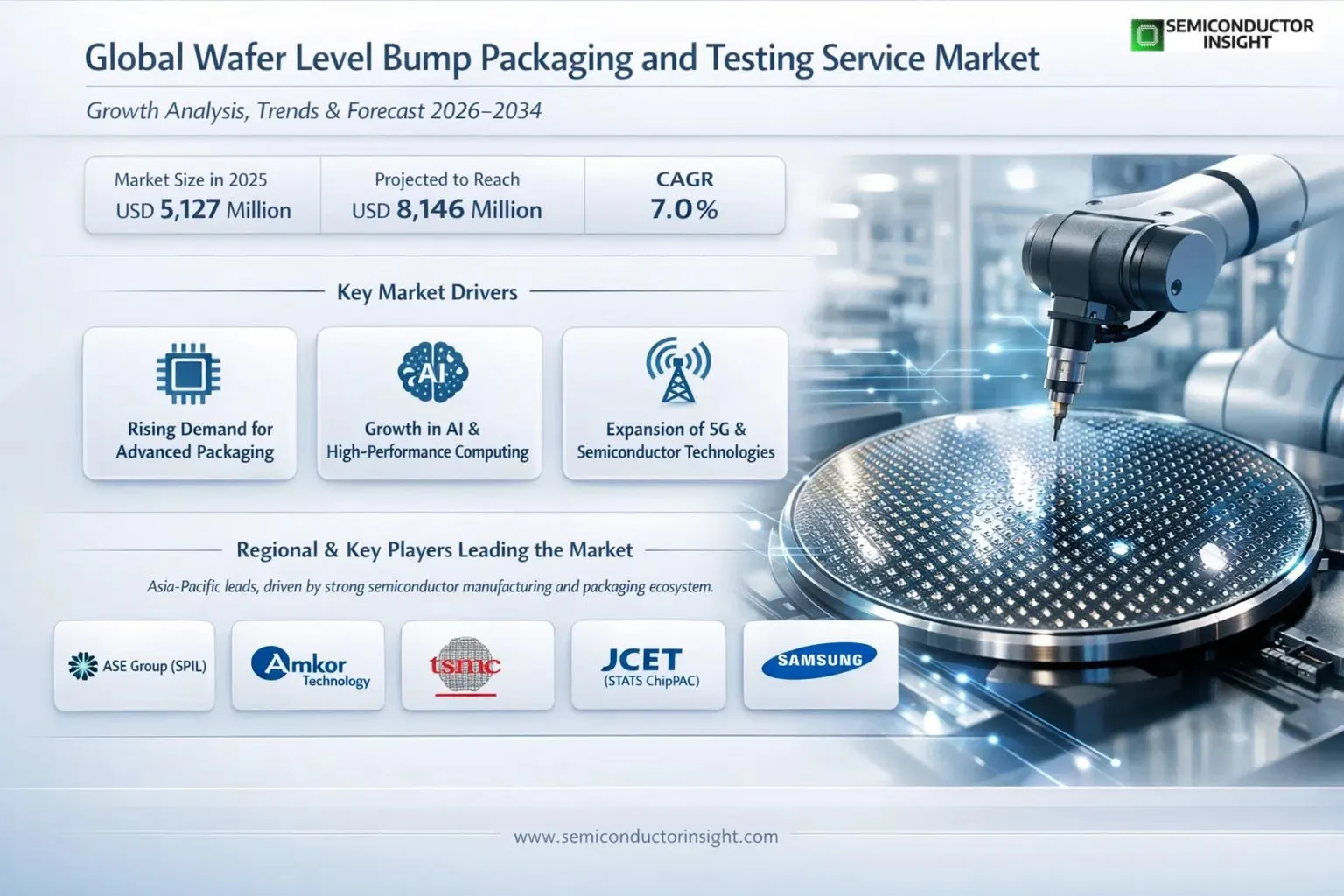
Global Wafer Level Bump Packaging and Testing Service market size was valued at USD 5,127 million in 2025. The market is projected to grow from USD 5,486 million in 2026 to USD 8,146 million by 2034, exhibiting a CAGR of 7.0% during the forecast period.
Wafer-level bumping packaging and testing service refers to an advanced technical service that packages and tests chips directly on wafers during the semiconductor manufacturing process. Metal bumps are directly formed on the wafers that have completed circuit manufacturing as the interconnection structure between the chip and the external circuit board. This service avoids the traditional steps of cutting individual chips before packaging, and can implement bump production, packaging, electrical performance testing, and visual inspection at the wafer level to reduce costs and improve production efficiency.
Wafer Level Bump Packaging and Testing Service, commonly referred to as wafer bumping, is a key process within advanced packaging ,a broad category of semiconductor packaging technologies that go beyond traditional wire bonding and plastic molding to enable higher performance, increased functionality, and better power efficiency. It integrates multiple chips, dies, or components into a single package using technologies such as Flip-Chip, Fan-Out Wafer-Level Packaging (FOWLP), 2.5D/3D Integration, System-in-Package (SiP), and Chiplet-based architectures. Global advanced packaging market is expected to surpass USD 79.1 billion by 2031, fueled by the adoption of heterogeneous integration and chiplet-based systems, underscoring the strategic importance of wafer bumping services. Major foundries such as TSMC, Intel, and Samsung, alongside leading OSATs including ASE, Amkor Technology, and JCET, are actively investing in high-density advanced packaging capabilities to meet the surging demand from AI accelerators, mobile processors, data center SoCs, and automotive electronics.
MARKET DRIVERS
Rising Demand for Advanced Semiconductor Packaging in Consumer Electronics and High-Performance Computing
Wafer Level Bump Packaging and Testing Service Market is experiencing robust growth momentum, primarily driven by the accelerating adoption of advanced semiconductor packaging technologies across consumer electronics, data centers, and high-performance computing platforms. As device miniaturization continues to push the boundaries of traditional packaging formats, wafer level bump packaging has emerged as a preferred interconnect solution, offering superior electrical performance, reduced form factor, and enhanced thermal management. The proliferation of smartphones, wearables, and IoT-enabled devices has created sustained upstream demand for wafer-level packaging services that can support high I/O density and fine-pitch bump structures.
Expansion of 5G Infrastructure and AI-Driven Chip Architectures Fueling Market Momentum
Global rollout of 5G networks and the rapid scaling of artificial intelligence workloads have significantly elevated the complexity and performance requirements of semiconductor chips, positioning wafer level bump packaging and testing services as critical enablers of next-generation connectivity. Advanced packaging formats such as flip-chip ball grid arrays (FC-BGA) and copper pillar bumping are increasingly integrated into RF front-end modules, application processors, and AI accelerators, all of which demand precision bump formation and rigorous electrical testing protocols. The shift toward heterogeneous integration and chiplet-based architectures further amplifies the need for reliable wafer-level interconnect and co-testing ecosystems.
➤ As semiconductor nodes continue to shrink below 3nm and 2nm process geometries, wafer level bump packaging and testing service providers are investing heavily in ultra-fine pitch copper pillar and micro-bump technologies to meet the evolving performance benchmarks of leading fabless chip designers and integrated device manufacturers.
Collaborative developments between OSATs (Outsourced Semiconductor Assembly and Test companies) and foundries are reshaping the competitive landscape of Wafer Level Bump Packaging and Testing Service Market, with a clear trend toward integrated front-end and back-end process flows. This convergence is enabling faster time-to-market cycles and improved yield optimization, reinforcing the market’s long-term growth trajectory across automotive, aerospace, and medical electronics verticals.
MARKET CHALLENGES
Technical Complexity of Ultra-Fine Pitch Bump Formation and Yield Management
One of the most pressing challenges confronting participants in Wafer Level Bump Packaging and Testing Service Market is the increasing technical complexity associated with ultra-fine pitch bump deposition processes. As interconnect pitches shrink to sub-100 micron dimensions, maintaining dimensional uniformity, bump coplanarity, and solder joint integrity becomes exponentially more difficult. Process-induced defects such as bridging, voiding, and non-wetting failures directly impact yield rates, creating significant cost pressures for service providers operating on thin margins in a highly competitive environment. Advanced inspection and metrology solutions are required at every stage of the bump formation process, adding to capital expenditure burdens.f
Other Challenges
High Capital Investment Requirements
The establishment and continuous upgrading of wafer level bump packaging and testing infrastructure demands substantial capital outlay, encompassing electroplating equipment, advanced lithography tools, wafer probing systems, and automated optical inspection platforms. For mid-tier service providers in Wafer Level Bump Packaging and Testing Service Market, financing these investments while maintaining competitive pricing remains a structural challenge, particularly amid cyclical downturns in the broader semiconductor industry.
Supply Chain Disruptions and Materials Sourcing Constraints
Global semiconductor supply chain remains vulnerable to geopolitical tensions, trade restrictions, and raw material shortages, all of which directly affect the availability and pricing of specialty chemicals, photoresists, and electroplating materials essential to bump packaging processes. Service providers in Wafer Level Bump Packaging and Testing Service Market must develop resilient multi-source procurement strategies and maintain strategic material buffers to mitigate supply-side volatility without compromising delivery timelines or quality standards.
MARKET RESTRAINTS
Stringent Reliability Standards and Qualification Cycles Limiting Market Scalability
A significant restraint on Wafer Level Bump Packaging and Testing Service Market is the rigorous qualification and reliability certification process mandated by end-use industries such as automotive, aerospace, and medical electronics. Automotive-grade semiconductor components, governed by AEC-Q100 and IATF 16949 standards, require extensive thermal cycling, mechanical shock, and humidity endurance testing before commercial deployment, substantially extending product development timelines. These prolonged qualification cycles constrain the ability of wafer level packaging service providers to rapidly scale capacity in response to emerging demand signals, effectively creating a structural bottleneck in market responsiveness.
Concentration of Advanced Packaging Capabilities Among a Limited Number of Tier-1 Providers
Wafer Level Bump Packaging and Testing Service Market is characterized by a significant concentration of advanced technical capabilities and intellectual property among a small number of tier-1 OSATs and integrated device manufacturers. This concentration creates barriers to entry for emerging service providers and limits the negotiating leverage of fabless chip designers seeking diversified packaging supply chains. Regional disparities in advanced packaging infrastructure, particularly between East Asian markets and Western economies, further compound this restraint, as reshoring initiatives in North America and Europe face multi-year timelines before meaningful capacity becomes commercially available.
MARKET OPPORTUNITIES
Accelerating Adoption of Advanced Heterogeneous Integration Creating New Revenue Streams
Wafer Level Bump Packaging and Testing Service Market stands to benefit substantially from the industry-wide transition toward heterogeneous integration architectures, wherein multiple chiplets with diverse functional profiles are co-packaged within a single device footprint. This paradigm shift demands sophisticated wafer-level interconnect solutions, including hybrid bonding, through-silicon via (TSV) integration, and multi-tier bump structures, all of which fall within the core competency domain of advanced packaging service providers. As leading semiconductor companies across the United States, Taiwan, South Korea, and Europe accelerate chiplet roadmap execution, demand for specialized wafer level bump packaging and co-testing services is expected to expand across both volume production and engineering service engagements.
Government-Led Semiconductor Localization Initiatives Opening New Geographic Markets
Policy-driven semiconductor investment programs, including the U.S. CHIPS and Science Act, the European Chips Act, and analogous initiatives across India and Japan, are creating substantial greenfield opportunities for Wafer Level Bump Packaging and Testing Service Market. These programs provide direct funding, tax incentives, and research co-investment mechanisms that lower the capital risk threshold for establishing advanced packaging facilities in geographies that have historically lacked domestic wafer-level processing capabilities. Service providers positioned to align their capacity expansion strategies with these national semiconductor sovereignty agendas are likely to secure long-term anchor customer commitments, creating durable competitive advantages in newly emerging packaging ecosystems.
Growing Automotive Electrification and ADAS Adoption Driving Specialized Packaging Demand
The accelerating electrification of Global automotive fleet and the rapid advancement of advanced driver-assistance systems (ADAS) and autonomous driving technologies represent a high-value opportunity segment for Wafer Level Bump Packaging and Testing Service Market. Power management ICs, LiDAR sensing modules, radar processing chips, and in-vehicle networking semiconductors all require packaging solutions that combine high thermal conductivity, robust mechanical reliability, and fine-pitch electrical interconnects , precisely the performance envelope addressed by wafer level bump packaging technologies. As automotive semiconductor content per vehicle continues to rise, specialized bump packaging and functional testing services tailored to automotive-grade requirements are poised for sustained demand growth through the decade ahead.
MAIN TITLE HERE () Trends
Rising Demand from AI, HPC, and Advanced Packaging Adoption Drives Wafer Level Bump Packaging and Testing Service Market
Wafer Level Bump Packaging and Testing Service Market is experiencing significant momentum, largely driven by the accelerating adoption of advanced semiconductor packaging technologies across high-performance computing (HPC), artificial intelligence (AI), and data center applications. Wafer-level bumping, which involves forming metal interconnects directly on completed wafers before dicing, has emerged as a foundational process enabling higher I/O density, improved signal integrity, and reduced overall packaging costs. As chipmakers and OSATs scale investments in Flip-Chip, Fan-Out Wafer-Level Packaging (FOWLP), and 2.5D/3D integration architectures, demand for precision bumping and wafer-level testing services continues to grow steadily across global semiconductor supply chains.
The shift toward heterogeneous integration and chiplet-based system designs is reshaping packaging requirements. Technologies such as Copper Pillar Bumping (CPB), micro-bumps (uBump) for 2.5D/3D stacking, and Through-Silicon Via (TSV)-enabled interconnects are increasingly preferred over traditional solder bumps due to their superior electrical performance and finer pitch capabilities. Leading foundries including TSMC, Intel, and Samsung, alongside major OSAT players such as ASE, Amkor Technology, and JCET, are actively expanding their wafer bumping capacities to address next-generation computing and networking chip requirements. The transition to 12-inch wafer bumping from 8-inch formats is also gaining traction as manufacturers pursue economies of scale and higher throughput.
Other Trends
Expansion of Automotive and Industrial Applications
Wafer Level Bump Packaging and Testing Service Market is witnessing growing traction in automotive electronics and industrial applications. The proliferation of advanced driver-assistance systems (ADAS), electric vehicle (EV) power management chips, and ruggedized industrial sensors is pushing demand for reliable, high-precision wafer-level packaging and testing services. Automotive-grade semiconductor components require stringent electrical testing and thermal performance validation at the wafer level, making bumping and testing services an indispensable part of the supply chain for this segment.
Growth of Mobile and Consumer Device Segments
Mobile devices, PCs, laptops, and consumer IoT products continue to represent a substantial application base for wafer level bump packaging. The persistent miniaturization trend in mobile processors and display driver ICs (DDICs) is driving adoption of WLCSP and Bump for DDIC technologies. Chipmakers serving smartphone OEMs are increasingly relying on wafer-level packaging formats to achieve compact form factors while maintaining competitive power efficiency and processing performance.
Regional Capacity Expansion and Supply Chain Localization Shape Market Dynamics
Asia remains the dominant region for Wafer Level Bump Packaging and Testing Service activity, with China, South Korea, Japan, and Southeast Asia hosting a concentration of both OSAT facilities and integrated device manufacturers (IDMs). However, geopolitical considerations and supply chain resilience strategies are encouraging capacity investments in North America and Europe. Government-backed semiconductor initiatives are incentivizing domestic advanced packaging infrastructure, which is expected to gradually diversify Global footprint of wafer bumping and testing services over the coming years. Sustainability and design co-optimization between packaging and chip design teams are also emerging as key strategic priorities influencing service provider roadmaps.
COMPETITIVE LANDSCAPE
Key Industry Players
Wafer Level Bump Packaging and Testing Service Market , Competitive Dynamics, Strategic Positioning, and Leading OSAT & IDM Players
Global Wafer Level Bump Packaging and Testing Service market is characterized by a moderately consolidated competitive structure, dominated by a handful of large Outsourced Semiconductor Assembly and Test (OSAT) providers and Integrated Device Manufacturers (IDMs) with deep technological capabilities. ASE Group (inclusive of SPIL) commands a leading position in this space, leveraging its extensive flip-chip bumping lines, copper pillar bump (CPB) expertise, and high-volume 12-inch wafer bumping infrastructure. Amkor Technology and JCET (formerly STATS ChipPAC) follow closely, each offering a broad portfolio spanning FC Bumping, WLCSP, and advanced uBump technologies catering to AI accelerators, high-performance computing, and mobile applications. Major foundries such as TSMC, Samsung, and Intel have also deepened their involvement in wafer-level bumping as part of their advanced packaging strategies , integrating 2.5D/3D interposer-based packaging, Through-Silicon Via (TSV) stacking, and hybrid bonding into their process roadmaps. The market’s competitive intensity is further shaped by heavy capital investments in RDL Interposer, Fan-Out Wafer-Level Packaging (FOWLP), and co-packaged optics (CPO), particularly to support demand from data centers, 5G network infrastructure, and automotive electronics segments.
Beyond the tier-one players, a growing cohort of specialized and regionally significant companies is reshaping the competitive terrain of Wafer Level Bump Packaging and Testing Service Market. Powertech Technology Inc. (PTI), Tongfu Microelectronics (TFME), ChipMOS TECHNOLOGIES, and Chipbond Technology Corporation have established strong niches in DDIC bumping, WLCSP, and cost-competitive 8-inch wafer bumping services, serving consumer electronics, display driver IC, and IoT application segments. South Korean players such as Nepes, LB Semicon Inc., SFA Semicon, and Hana Micron are actively expanding their wafer bumping capabilities to capture demand from mobile and automotive customers, while Chinese OSATs including Hefei Chipmore Technology, Union Semiconductor (Hefei), Tongfu Microelectronics, Jiangsu CAS Microelectronics Integration, and Jiangsu Yidu Technology are scaling rapidly under government-supported semiconductor self-sufficiency initiatives. Emerging companies such as Ningbo ChipEx Semiconductor, Shenzhen TXD Technology, Raytek Semiconductor, Winstek Semiconductor, and International Micro Industries, Inc. (IMI) are carving out positions in niche bump types including CuNiAu and Gold Bump processes, further intensifying competitive pressure across mid-tier market segments.
List of Key Wafer Level Bump Packaging and Testing Service Companies Profiled
- ASE Group (SPIL)
- Amkor Technology
- TSMC
- JCET (STATS ChipPAC)
- Intel Corporation
- Samsung Electronics
- SJSemi
- ChipMOS TECHNOLOGIES
- Chipbond Technology Corporation
- Hefei Chipmore Technology
- Union Semiconductor (Hefei) Co., Ltd.
- HT-tech
- Powertech Technology Inc. (PTI)
- Tongfu Microelectronics (TFME)
- Nepes
- LB Semicon Inc.
- SFA Semicon
- International Micro Industries, Inc. (IMI)
- Raytek Semiconductor
- Winstek Semiconductor
- Hana Micron
- Ningbo ChipEx Semiconductor Co., Ltd.
- UTAC Group
- Shenzhen TXD Technology
- Jiangsu CAS Microelectronics Integration
- Jiangsu Yidu Technology
Segment Analysis:
| Segment Category | Sub-Segments | Key Insights |
| By Type |
|
FC Bumping (Flip-Chip Bumping) holds the leading position in Wafer Level Bump Packaging and Testing Service Market by package technology, driven by its critical role in enabling high-density interconnects for advanced semiconductor devices.
|
| By Application |
|
Servers, Data Centers & AI represents the fastest-growing and increasingly dominant application segment within Wafer Level Bump Packaging and Testing Service Market, reflecting the explosive global appetite for artificial intelligence infrastructure and cloud computing capacity.
|
| By End User |
|
OSAT (Outsourced Semiconductor Assembly and Test) providers represent the leading end-user category in Wafer Level Bump Packaging and Testing Service Market, as fabless semiconductor companies and system designers increasingly outsource their advanced packaging requirements to specialized service providers.
|
| By Bump Type |
|
Copper Pillar Bump (CPB) is the dominant bump type in Wafer Level Bump Packaging and Testing Service Market, having largely superseded traditional solder bumps in high-performance semiconductor packaging applications due to its superior electrical and mechanical properties.
|
| By Wafer Size |
|
12-inch Wafer Bumping is the leading segment by wafer size, reflecting the broader industry transition toward larger wafer formats that deliver greater economies of scale and improved throughput for high-volume semiconductor manufacturing.
|
Regional Analysis: Wafer Level Bump Packaging and Testing Service Market
Asia-Pacific
Asia-Pacific hosts the world’s most integrated semiconductor supply chains. Taiwan’s TSMC and South Korea’s Samsung and SK Hynix form the backbone of advanced wafer processing, while regional OSAT firms provide specialized bump packaging and testing services that support high-volume production with exceptional precision and yield optimization across diverse end-use verticals.
Sustained research and development investment across the Asia-Pacific region has fostered breakthrough advancements in flip-chip, copper pillar, and micro-bump technologies. Government-backed initiatives in China, South Korea, and Japan are accelerating the development of next-generation wafer level packaging solutions that meet evolving demands for greater I/O density and reduced form factor in advanced semiconductor devices.
The Asia-Pacific region is the world’s largest consumer electronics production and consumption hub. The proliferation of smartphones, tablets, wearables, and smart home devices generates sustained demand for wafer level bump packaging and testing services, as manufacturers prioritize compact, power-efficient chip architectures that rely heavily on advanced wafer level interconnect and packaging technologies.
Policy frameworks across Asia-Pacific actively support semiconductor industry growth. China’s national semiconductor strategy, South Korea’s K-Semiconductor Belt initiative, and India’s emerging chip incentive programs are channeling significant resources into wafer level packaging infrastructure, creating a favorable environment for market participants to expand their wafer level bump packaging and testing service capabilities regionally.
North America
North America represents a strategically significant region in Wafer Level Bump Packaging and Testing Service Market, anchored by the United States’ robust semiconductor design and fabless ecosystem. Leading chip design houses concentrated in Silicon Valley and across the Sunbelt region drive consistent demand for advanced packaging and testing services, often outsourced to specialized providers with wafer level bump expertise. The CHIPS and Science Act has reinvigorated domestic semiconductor ambitions, encouraging reshoring of advanced packaging capabilities and spurring investments in testing infrastructure. North America’s leadership in high-performance computing, artificial intelligence accelerators, and advanced communications chips necessitates sophisticated wafer level bump packaging and testing solutions that support complex multi-die and heterogeneous integration architectures. Defense and aerospace sectors further contribute to regional demand, requiring ruggedized and highly reliable packaging and testing standards. As domestic foundry capacity expands through upcoming fabrication facilities, the North American wafer level bump packaging and testing service market is expected to witness meaningful capacity additions and competitive ecosystem development through the forecast period.
Europe
Europe occupies a focused and technologically advanced position within Global wafer level bump packaging and testing service market. The region’s semiconductor industry is characterized by specialization in automotive-grade chips, industrial electronics, and power semiconductors, all of which increasingly require sophisticated bump packaging and testing service capabilities to meet stringent reliability and performance standards. Germany, the Netherlands, and France serve as key centers of semiconductor activity, with strong linkages to equipment manufacturers and materials suppliers that support advanced wafer level packaging processes. The European Chips Act has catalyzed regional ambitions to expand semiconductor manufacturing and packaging footprints, attracting investments from global players seeking to diversify their supply chains. Europe’s automotive sector, transitioning rapidly toward electrification and advanced driver assistance systems, is creating incremental demand for high-reliability wafer level bump packaging solutions. Academic and research institutions across the region actively collaborate with industry to advance packaging innovations, positioning Europe as a center for niche, high-value wafer level bump packaging and testing service applications.
South America
South America remains an emerging participant in Global wafer level bump packaging and testing service market, with Brazil representing the most developed semiconductor and electronics manufacturing base across the continent. While the region does not yet host significant wafer level bump packaging and testing service infrastructure comparable to leading markets, growing electronics assembly activity and increasing foreign direct investment in technology manufacturing are gradually building foundational capabilities. Brazil’s government has implemented policies to stimulate domestic electronics production, which over time is expected to generate demand for localized advanced packaging and testing services. The region’s expanding telecommunications sector, driven by mobile broadband adoption and digital infrastructure development, creates downstream demand for semiconductors that rely on wafer level bump packaging technologies. As global semiconductor supply chain diversification accelerates, South America presents a longer-term opportunity for wafer level bump packaging and testing service providers seeking new growth avenues beyond saturated markets.
Middle East & Africa
The Middle East and Africa region is at an early but progressively evolving stage within Wafer Level Bump Packaging and Testing Service Market landscape. While indigenous semiconductor manufacturing remains limited, several Gulf Cooperation Council nations are actively investing in technology infrastructure and digital transformation initiatives that create downstream demand for advanced packaged semiconductors. The United Arab Emirates and Saudi Arabia are pursuing ambitious technology diversification strategies, with growing interest in establishing electronics and semiconductor-adjacent industries as part of broader economic diversification agendas. Africa’s expanding mobile connectivity and fintech ecosystems are driving increased semiconductor consumption, indirectly supporting global demand for wafer level bump packaging and testing services. As multinational technology companies deepen their presence across the Middle East and Africa, the region is expected to gradually develop greater strategic relevance within the broader wafer level bump packaging and testing service market value chain over the coming decade.
Report Scope
This market research report provides a comprehensive analysis of Wafer Level Bump Packaging and Testing Service Market, covering the forecast period 2026–2034. It offers detailed insights into market dynamics, technological advancements, competitive landscape, and key trends shaping the industry.
Key focus areas of the report include:
- Market Overview: The report begins with an overview outlining its current market scenario, key growth indicators, and industry transformation drivers. It discusses macroeconomic factors, demand–supply balance, regulatory landscape, and the strategic role of semiconductors in powering advancements across industries such as automotive, telecommunications, consumer electronics, and industrial automation.
- Market Size & Forecast: Historical data and future projections for revenue, unit shipments, and market value across major regions and segments.
- Segmentation Analysis: Detailed breakdown by product type, technology, application, and end-user industry to identify high-growth segments and investment opportunities.
- Regional Insights: Insights into market performance across North America, Europe, Asia-Pacific, Latin America, and the Middle East & Africa, including country-level analysis where relevant.
- Competitive Landscape: Profiles of leading market participants, including their product offerings, R&D focus, manufacturing capacity, pricing strategies, and recent developments such as mergers, acquisitions, and partnerships.
- Technology Trends & Innovation: Assessment of emerging technologies, integration of AI/IoT, semiconductor design trends, fabrication techniques, and evolving industry standards.
- Market Drivers & Restraints: Evaluation of factors driving market growth along with challenges, supply chain constraints, regulatory issues, and market-entry barriers.
- Stakeholder Insights: Insights for component suppliers, OEMs, system integrators, investors, and policymakers regarding the evolving ecosystem and strategic opportunities.
Primary and secondary research methods are employed, including interviews with industry experts, data from verified sources, and real-time market intelligence to ensure the accuracy and reliability of the insights presented.
FREQUENTLY ASKED QUESTIONS:
What is the current market size of Wafer Level Bump Packaging and Testing Service Market?
-> Global Wafer Level Bump Packaging and Testing Service Market was valued at USD 5,127 million in 2025 and is expected to reach USD 8,146 million by 2034, growing at a CAGR of 7.0% during the forecast period.
Which key companies operate in Wafer Level Bump Packaging and Testing Service Market?
-> Key players include ASE (SPIL), Amkor Technology, TSMC, JCET (STATS ChipPAC), Intel, Samsung, SJSemi, ChipMOS TECHNOLOGIES, Chipbond Technology Corporation, Hefei Chipmore Technology, Powertech Technology Inc. (PTI), Tongfu Microelectronics (TFME), Nepes, UTAC, and Hana Micron, among others.
What are the key growth drivers?
-> Key growth drivers include surging demand for AI accelerators, 5G infrastructure, high-performance computing (HPC), and high-bandwidth memory (HBM), along with rapid adoption of advanced packaging technologies such as Flip-Chip, Fan-Out Wafer-Level Packaging (FOWLP), 2.5D/3D Integration, and Chiplet-based architectures. Growing investments by major foundries and OSATs in high-density packaging capabilities further accelerate market expansion.
Which region dominates the market?
-> Asia is the dominant region in Wafer Level Bump Packaging and Testing Service Market, driven by the strong presence of leading semiconductor manufacturers and OSATs in China, Japan, South Korea, and Southeast Asia, while North America remains a significant contributor owing to demand from data centers, AI, and advanced computing applications.
What are the emerging trends?
-> Emerging trends include expansion of 2.5D/3D packaging architectures, co-packaged optics (CPO), hybrid bonding, RDL Interposer-based Fan-Out techniques, heterogeneous integration, and chiplet-based system designs. Sustainability initiatives, design co-optimization, and the integration of logic-memory-analog components are also shaping the future roadmap of the Wafer Level Bump Packaging and Testing Service industry.

Get Sample Report PDF for Exclusive Insights
Report Sample Includes
- Table of Contents
- List of Tables & Figures
- Charts, Research Methodology, and more...
 Download Sample Report PDF