Market Insights
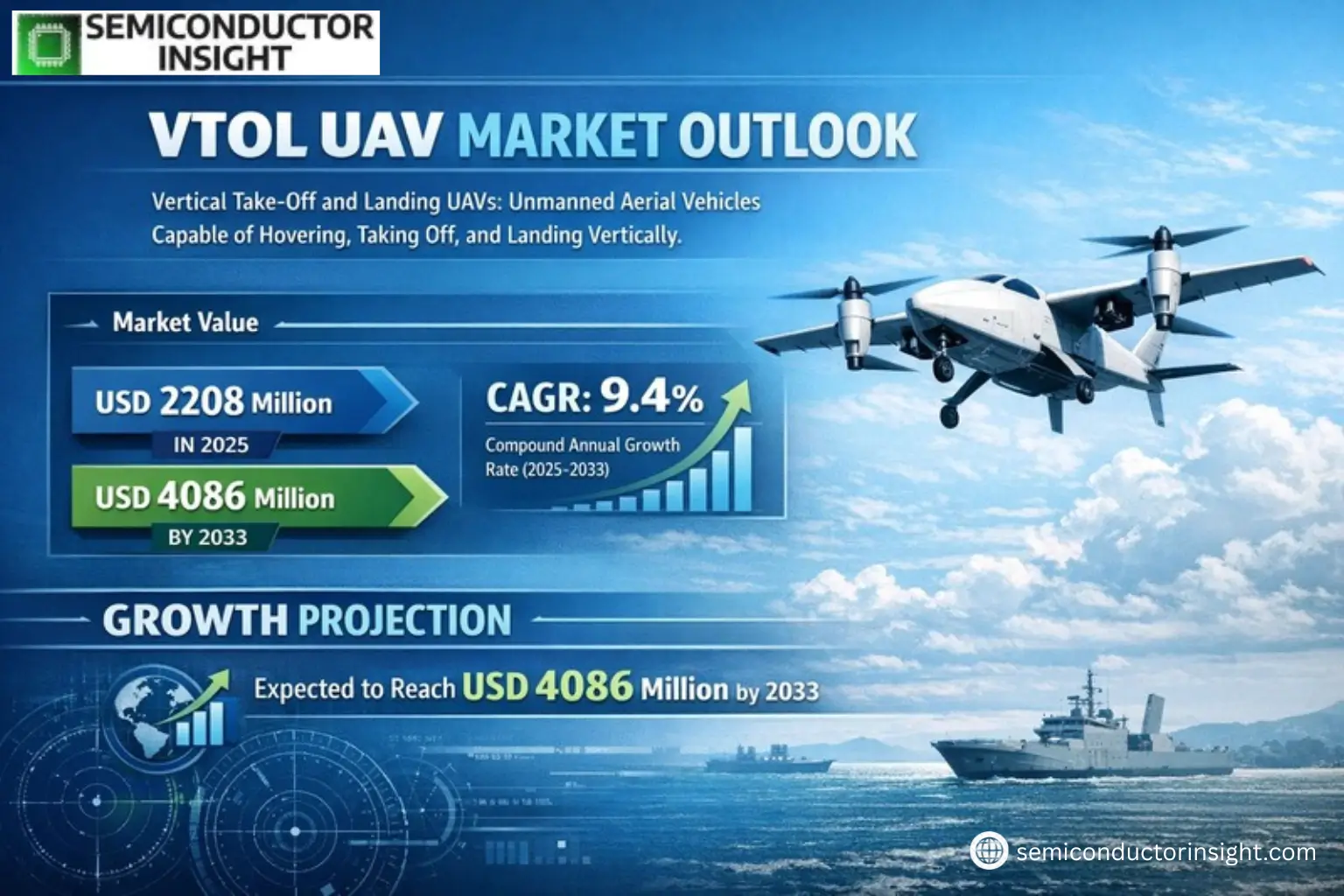
Global VTOL UAV Market was valued at USD 2208 million in 2025 and is projected to reach USD 4086 million by 2033, exhibiting a CAGR of 9.4% during the forecast period.
VTOL (Vertical Take-Off and Landing) UAVs are unmanned aerial vehicles capable of hovering, taking off, and landing vertically without requiring runways. These advanced drones combine the flexibility of helicopters with the efficiency of fixed-wing aircraft, making them ideal for applications where space constraints or operational complexity limit traditional aircraft. The market includes multicopter, helicopter, and hybrid configurations, with small-sized VTOL UAVs dominating over 95% of the segment share due to their cost-effectiveness and versatility.
The market growth is driven by increasing defense budgets, expanding commercial applications like logistics and surveillance, and technological advancements in battery efficiency and autonomous navigation. North America leads adoption with a 65% market share, followed by China and Europe collectively holding over 25%. Key players such as DJI and Parrot command nearly 85% of the global market through continuous innovation in payload capacity and flight endurance.
MARKET DRIVERS
Increasing Military Demand for VTOL UAVs
VTOL UAV Market is witnessing significant growth due to rising military adoption. Defense sectors globally are investing over USD 2 billion annually in vertical takeoff and landing drones for surveillance, reconnaissance, and tactical operations. The ability to operate without runways makes VTOL UAVs indispensable in combat zones.
Commercial Applications Driving Adoption
Commercial sectors such as logistics, agriculture, and infrastructure inspection are increasingly leveraging VTOL UAV technology. Global last-mile delivery market for VTOL drones is projected to grow at 22% CAGR, with major e-commerce players testing drone delivery systems. Their precision landing capabilities enable operations in urban environments.
Advancements in battery technology and autonomous flight systems are further accelerating market expansion, enabling longer flight durations and more complex missions.
MARKET CHALLENGES
Regulatory Hurdles in Airspace Integration
Strict aviation regulations in urban areas remain a significant barrier for VTOL UAV operations. Many countries are still developing frameworks for Beyond Visual Line of Sight (BVLOS) operations, which is critical for commercial scaling.
Other Challenges
Payload Limitations
Most current VTOL UAV models have payload capacities under 5kg, restricting their use for heavier cargo applications and specialized equipment transport.
MARKET RESTRAINTS
High Development and Operational Costs
The average production cost for military-grade VTOL UAVs exceeds USD 500,000 per unit, while commercial models range between USD 20,000-USD 100,000. These costs, combined with specialist maintenance requirements, create significant barriers to entry for smaller operators.
MARKET OPPORTUNITIES
Emergence of Urban Air Mobility
Global urban air mobility market presents a USD 15 billion opportunity for VTOL UAV manufacturers. Cities worldwide are piloting air taxi services and emergency medical delivery systems using VTOL technology, with trials showing 40% reduction in emergency response times.
Advancements in Hybrid Propulsion Systems
New hybrid-electric VTOL UAV designs combining combustion engines with electric motors are extending flight endurance beyond 8 hours, opening new applications in maritime patrol and border security operations.
VTOL UAV Market Trends
Rapid Market Expansion Driven by Technological Advancements
Global VTOL UAV Market, valued at USD 2208 million in 2025, is projected to grow at a 9.4% CAGR to reach USD 4086 million by 2033. This growth is primarily fueled by advancements in autonomous flight technology and increased adoption across military and commercial sectors. The integration of AI and improved battery systems has enhanced operational capabilities, making VTOL UAVs indispensable for surveillance, delivery, and agricultural applications.
Other Trends
Dominance of Small-Sized VTOL UAVs
Small-sized VTOL UAVs currently dominate the market with over 95% share, primarily due to their cost-effectiveness and versatility. These units are extensively used in photography, inspection, and short-range surveillance operations. Their compact size allows for easy deployment in urban environments where space constraints exist.
Regional Market Leadership and Competitive Landscape
North America leads the VTOL UAV Market with a 65% share, driven by strong defense spending and commercial adoption. DJI and Parrot maintain an 85% combined market share, leveraging their technological expertise in multicopter systems. The Asia-Pacific region shows the fastest growth potential, with China accounting for a significant portion of global production and consumption.
Other Trends
Shift Toward Hybrid VTOL Systems
The industry is witnessing increased development of hybrid VTOL systems that combine fixed-wing endurance with vertical takeoff capabilities. These systems are particularly valuable for long-range surveillance and emergency response operations where both flight duration and landing flexibility are critical requirements.
Application-Specific Market Growth
The civil and commercial sector represents the largest application segment for VTOL UAVs, followed by military and homeland security uses. Key growth areas include precision agriculture, infrastructure inspection, and last-mile delivery services, with regulatory frameworks gradually adapting to accommodate expanded commercial drone operations.
COMPETITIVE LANDSCAPE
Key Industry Players
Consolidated Market Dominated by Aerospace & Defense Giants
Global VTOL UAV Market is highly consolidated, with DJI and Parrot collectively holding approximately 85% market share as of 2025. DJI maintains undisputed leadership in commercial VTOL drones, leveraging its vertically integrated manufacturing and strong R&D capabilities in multirotor systems. The military segment features more diversified competition with established aerospace contractors like Israel Aerospace Industries (IAI) and CybAero offering specialized VTOL solutions for defense applications.
Niche players are carving out specialized segments through technological differentiation. Companies like EHang focus on urban air mobility solutions, while Yamaha leads in agricultural VTOL applications. Emerging Chinese manufacturers such as Zero Tech and XAIRCRAFT are gaining traction through competitive pricing, though they face regulatory hurdles in Western markets. The hybrid VTOL segment shows particularly intense competition with numerous startups vying for position.
List of Key VTOL UAV Companies Profiled
- DJI
- Parrot
- 3D Robotics
- Yamaha Motor
- XAIRCRAFT
- ZERO TECH
- EHang
- Israel Aerospace Industries (IAI)
- CybAero
- Alpha Unmanned Systems
- Microdrones
- Ewatt
- Hanhe
- Airbus (AscTec)
- LONCIN MOTOR
Segment Analysis:
| Segment Category | Sub-Segments | Key Insights |
| By Type |
|
Multicopter dominates due to:
|
| By Application |
|
Civil and Commercial shows strongest growth potential:
|
| By End User |
|
Enterprise segment leads due to:
|
| By Propulsion System |
|
Electric propulsion leads the market:
|
| By Size |
|
Small Size VTOL UAVs dominate because:
|
Regional Analysis: Global VTOL UAV Market
The U.S. Department of Defense leads VTOL UAV adoption for ISR missions and tactical support. Advanced VTOL platforms are being integrated with next-generation warfare systems, creating sustained demand. Canada’s focus on Arctic surveillance further boosts regional market prospects.
Urban air mobility initiatives and last-mile delivery solutions drive commercial VTOL UAV adoption. Companies like Amazon and UPS are testing VTOL delivery networks, while regulatory bodies work on beyond-visual-line-of-sight (BVLOS) operation frameworks.
Silicon Valley and aerospace clusters in Seattle and Montreal foster VTOL UAV innovation. Breakthroughs in battery efficiency, autonomous navigation, and swarm technology originate predominantly from North American research institutions and startups.
The FAA’s evolving Part 107 rules and Canada’s advanced drone regulations create a stable environment for VTOL UAV operations. These frameworks serve as global benchmarks, attracting international investment and partnership opportunities.
Europe
Europe’s VTOL UAV Market thrives on collaborative defense programs and smart city initiatives. The EU’s drone strategy promotes cross-border UAV operations, with emphasis on urban air mobility and emergency response applications. Regulatory alignment through EASA standards accelerates commercial adoption, while defense agencies invest in long-endurance VTOL platforms for border surveillance. European manufacturers focus on sustainable designs, incorporating hybrid-electric propulsion systems to meet environmental regulations. The region’s strong aerospace heritage and R&D infrastructure support continuous VTOL UAV advancements.
Asia-Pacific
The Asia-Pacific VTOL UAV Market experiences rapid growth fueled by territorial security needs and infrastructure development. China leads in manufacturing capabilities, while Japan focuses on disaster response applications. India’s expanding defense budget drives military VTOL UAV procurement. Southeast Asian nations increasingly adopt coastal surveillance systems. The region benefits from lower production costs and growing domestic demand for commercial drone services, though regulatory fragmentation presents challenges. Local manufacturers are gaining prominence through government-backed initiatives and strategic technology transfers.
Middle East & Africa
Oil-rich Gulf states drive VTOL UAV adoption for pipeline monitoring and security applications. Israel’s advanced defense sector contributes sophisticated VTOL technologies. Africa utilizes VTOL UAVs for wildlife conservation and medical supply delivery across remote areas. Market growth faces infrastructure limitations but benefits from increasing counter-terrorism investments. Regional alliances facilitate technology transfers, while local startups emerge to address specific operational needs in harsh environments.
Latin America
Latin America’s VTOL UAV Market grows through agricultural monitoring and border security applications. Brazil leads in both military and commercial adoption, leveraging its expansive geography. Regulatory frameworks are evolving, with Chile and Colombia emerging as early adopters of urban air mobility concepts. The region benefits from U.S. technology partnerships but faces budget constraints. Niche applications in mining and forestry demonstrate the versatility of VTOL UAV solutions in addressing regional challenges.
Report Scope
This market research report provides a comprehensive analysis of the VTOL UAV Market, covering the forecast period 2025–2033. It offers detailed insights into market dynamics, technological advancements, competitive landscape, and key trends shaping the industry.
Key focus areas of the report include:
- Market Overview: The report begins with an overview outlining its current market scenario, key growth indicators, and industry transformation drivers. It discusses macroeconomic factors, demand–supply balance, regulatory landscape, and the strategic role of VTOL UAVs in powering advancements across industries such as military, homeland security, civil and commercial applications.
- Market Size & Forecast: Historical data and future projections for revenue, unit shipments, and market value across major regions and segments.
- Segmentation Analysis: Detailed breakdown by product type, technology, application, and end-user industry to identify high-growth segments and investment opportunities.
- Regional Insights: Insights into market performance across North America, Europe, Asia-Pacific, Latin America, and the Middle East & Africa, including country-level analysis where relevant.
- Competitive Landscape: Profiles of leading market participants, including their product offerings, R&D focus, manufacturing capacity, pricing strategies, and recent developments such as mergers, acquisitions, and partnerships.
- Technology Trends & Innovation: Assessment of emerging technologies, integration of AI/IoT, UAV design trends, and evolving industry standards.
- Market Drivers & Restraints: Evaluation of factors driving market growth along with challenges, supply chain constraints, regulatory issues, and market-entry barriers.
- Stakeholder Insights: Insights for component suppliers, OEMs, system integrators, investors, and policymakers regarding the evolving ecosystem and strategic opportunities.
Primary and secondary research methods are employed, including interviews with industry experts, data from verified sources, and real-time market intelligence to ensure the accuracy and reliability of the insights presented.
FREQUENTLY ASKED QUESTIONS:
What is the current market size of VTOL UAV Market?
-> VTOL UAV Market was valued at USD 2208 million in 2025 and is projected to reach USD 4086 million by 2033, exhibiting a CAGR of 9.4% during the forecast period.
Which key companies operate in VTOL UAV Market?
-> Key players include DJI, PARROT, 3D Robotics, AscTec, Yamaha, XAIRCRAFT, ZERO TECH, Ehang, IAI, CybAero, Alpha Unmanned Systems, and Microdrones, among others.
What are the key growth drivers?
-> Key growth drivers include increasing military applications, expanding civil and commercial uses, technological advancements in UAV autonomy, and rising demand for surveillance and security solutions.
Which region dominates the market?
-> North America is the largest market with a share of about 65%, followed by China and Europe.
What are the emerging trends?
-> Emerging trends include hybrid VTOL designs, AI-powered autonomous operations, increased payload capacities, and expanded agricultural applications.

Get Sample Report PDF for Exclusive Insights
Report Sample Includes
- Table of Contents
- List of Tables & Figures
- Charts, Research Methodology, and more...
 Download Sample Report PDF