MARKET INSIGHTS
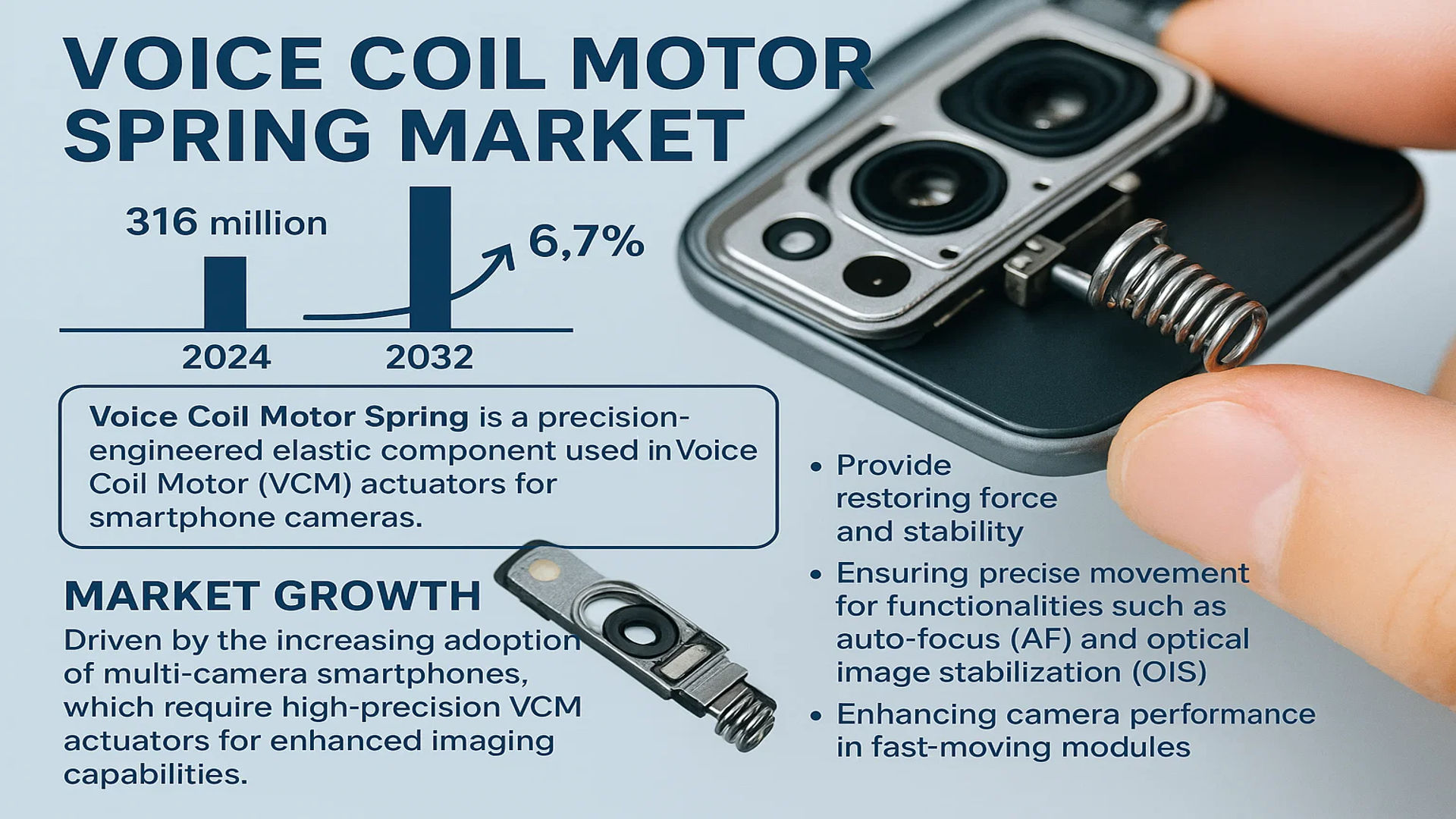
The global Voice Coil Motor Spring Market was valued at 316 million in 2024 and is projected to reach US$ 473 million by 2032, at a CAGR of 6.7% during the forecast period.
Voice Coil Motor Spring is a precision-engineered elastic component used in Voice Coil Motor (VCM) actuators for smartphone cameras. These springs provide restoring force and stability, ensuring precise movement for critical functionalities such as auto-focus (AF) and optical image stabilization (OIS). The component plays a pivotal role in enhancing camera performance by maintaining accuracy in fast-moving modules.
The market growth is primarily driven by the increasing adoption of multi-camera smartphones, which require high-precision VCM actuators for enhanced imaging capabilities. Additionally, advancements in mobile photography, such as periscope lenses and computational photography, further fuel demand. Key manufacturers, including United Precision Technologies Co., Ltd., Shibata Co., Ltd., and TOTOKU Inc., dominate the market with extensive product portfolios. While stainless steel remains the dominant material segment, innovations in nickel-titanium alloys are gaining traction due to their superior durability and flexibility under high-frequency actuation cycles.
MARKET DYNAMICS
MARKET DRIVERS
Growing Adoption of High-Resolution Smartphone Cameras to Accelerate Market Expansion
The relentless demand for advanced smartphone camera systems with auto-focus (AF) and optical image stabilization (OIS) capabilities is significantly propelling the voice coil motor spring market. With consumers increasingly prioritizing high-quality photography, smartphone manufacturers are integrating sophisticated multi-lens camera setups that rely heavily on VCM actuators. Industry reports indicate that over 1.5 billion smartphones with advanced camera modules are shipped annually, creating sustained demand for precision spring components. The transition to 64MP and 108MP camera sensors in mid-range devices further intensifies this need, as these high-resolution systems require more precise positioning capabilities provided by voice coil motor springs.
Expansion of IoT and Smart Device Ecosystem Creates New Application Avenues
The rapid proliferation of IoT devices and smart home technologies is opening new opportunities for VCM spring applications beyond smartphones. Security cameras, smart doorbells, and automotive vision systems increasingly incorporate VCM-based focus mechanisms, driving component demand. The global IoT market, projected to exceed $1.5 trillion by 2030, represents a significant growth frontier. Emerging applications in medical devices such as endoscopes and industrial automation equipment are further diversifying the market landscape, as these sectors demand the precise, rapid movement capabilities enabled by voice coil motor spring mechanisms.
Related Industry Development
➤ Recent advancements in material science have enabled manufacturers to develop ultra-thin voice coil motor springs with thicknesses below 0.1mm, meeting the stringent space constraints of modern compact camera modules while maintaining required mechanical properties.
The automotive sector’s shift towards advanced driver assistance systems (ADAS) and autonomous vehicles is another significant driver, as these systems utilize multiple high-precision cameras requiring reliable focus mechanisms. With major automakers committing to fully autonomous vehicle production timelines within this decade, the demand for automotive-grade VCM components is anticipated to grow substantially.
MARKET RESTRAINTS
Intense Price Pressure from Consumer Electronics Industry to Challenge Profit Margins
The voice coil motor spring market faces significant margin compression due to extreme cost sensitivity in the consumer electronics sector. Smartphone manufacturers, which account for over 80% of global VCM spring demand, continuously pressure suppliers to reduce component costs while improving performance specifications. This dynamic forces spring manufacturers to absorb rising raw material costs, particularly for specialized alloys, while maintaining stringent quality standards. The highly competitive nature of the smartphone market exacerbates this challenge, as OEMs frequently switch suppliers based on minor price differences.
Precision Manufacturing Requirements Create High Barriers to Entry
The sophisticated nature of voice coil motor spring production presents substantial technical and financial obstacles for new market entrants. Manufacturing these components requires sub-micron level precision in forming and heat treatment processes, necessitating multi-million-dollar investments in specialized equipment and cleanroom facilities. Additionally, the industry’s stringent qualification processes, where components must demonstrate reliability across millions of actuation cycles under varying environmental conditions, create lengthy product development cycles. These factors collectively limit market participation to established players with substantial technical expertise and capital resources.
MARKET CHALLENGES
Miniaturization Demands Test Material Science Boundaries
As smartphone designs trend toward thinner profiles and larger camera sensors, voice coil motor spring manufacturers face mounting challenges in maintaining performance while reducing component dimensions. Current industry requirements demand springs that maintain 0.01mm dimensional tolerances while fitting within increasingly constrained Z-height allocations, often less than 2.5mm. This push for miniaturization stresses material capabilities, as thinner wire gauges must maintain sufficient elastic modulus and fatigue resistance over hundreds of thousands of operational cycles. These technical hurdles frequently result in extended development timelines and higher research costs for spring manufacturers.
Other Challenges
Supply Chain Complexity
The global nature of the electronics supply chain introduces vulnerabilities, as VCM spring production depends on specialized alloys often sourced from limited suppliers. Recent geopolitical tensions and trade restrictions have highlighted the risks of concentrated material supply chains.
Environmental Regulations
Increasing environmental regulations regarding hazardous substances used in spring manufacturing and surface treatments require ongoing process adjustments and material substitutions while maintaining performance standards.
MARKET OPPORTUNITIES
Emerging Foldable Device Segment Presents New Design Opportunities
The burgeoning foldable smartphone market, projected to grow at over 35% CAGR through 2030, creates exciting possibilities for innovative voice coil motor spring designs. These devices require camera modules that maintain focus stability despite frequent mechanical flexing, necessitating springs with enhanced durability characteristics. Early adopters in the VCM spring industry are developing specialized alloys and novel heat treatment processes to address these unique requirements, potentially commanding premium pricing for such high-performance solutions.
Advancements in Computational Photography Drive Premium Component Demand
The shift toward computational photography techniques in flagship smartphones is creating demand for VCM springs capable of ultra-precise multi-axis movements. As manufacturers implement sensor-shift stabilization and multi-frame image processing, the required positioning accuracy for camera components has increased to sub-micron levels. This technological evolution enables spring suppliers to develop and market higher-value solutions with tighter specifications, potentially improving overall market profitability despite volume pressures in mainstream segments.
The medical technology sector represents another promising frontier, where sterilization-compatible VCM springs could enable new generations of compact endoscopic and diagnostic imaging devices. With medical device regulations favoring proven component suppliers, established VCM spring manufacturers can leverage their electronics industry experience to penetrate this stable, high-margin market segment.
VOICE COIL MOTOR SPRING MARKET TRENDS
Advancements in Smartphone Camera Technology Driving Market Growth
The global voice coil motor (VCM) spring market is experiencing significant growth due to rising demand for high-performance camera modules in smartphones. The market, valued at US$ 316 million in 2024, is projected to reach US$ 473 million by 2032, growing at a CAGR of 6.7%. This expansion is primarily fueled by advancements in autofocus (AF) and optical image stabilization (OIS) technologies, which require increasingly precise VCM springs for optimal performance. As smartphone OEMs push for slimmer designs with multi-camera setups, the need for compact yet durable springs has intensified, leading manufacturers to innovate in material science and production techniques.
Other Trends
Material Innovation for Enhanced Performance
The shift toward high-performance alloys is reshaping the VCM spring landscape. Stainless steel remains dominant, accounting for over 60% of market share due to its durability and elasticity. However, emerging materials like nickel-titanium shape memory alloys are gaining traction, offering superior fatigue resistance—a critical factor given that smartphone camera modules endure 10,000+ actuation cycles during their lifespan. Copper alloys are also seeing increased adoption in premium devices, as they enable faster response times for rapid autofocus, crucial for capturing high-quality images in motion.
Regional Manufacturing Shifts and Supply Chain Optimization
While China currently produces 75% of global VCM springs, geopolitical tensions and pandemic-related disruptions have prompted manufacturers to diversify production bases. Southeast Asia is emerging as a key alternative, with countries like Vietnam and Thailand attracting investments from major players. Meanwhile, North American and European manufacturers are focusing on high-precision springs for specialized applications beyond consumer electronics, including medical devices and aerospace. This geographic diversification is creating new opportunities for suppliers who can meet the stringent quality standards required across different industries.
COMPETITIVE LANDSCAPE
Key Industry Players
Precision Component Manufacturers Compete for Dominance in Evolving Camera Module Market
The global voice coil motor (VCM) spring market features a fragmented but intensifying competitive environment, with Asian manufacturers leading production while Western firms focus on specialty alloys. United Precision Technologies Co., Ltd. emerges as a dominant force, leveraging China’s manufacturing ecosystem to supply springs for approximately 25% of global smartphone camera modules. Its vertically integrated production process allows for tight quality control and competitive pricing.
Shibata Co., Ltd. and TOTOKU Inc. are establishing strong positions through patented metallurgical advancements, particularly in nickel-titanium alloy formulations that offer superior fatigue resistance. These Japanese manufacturers benefit from their proximity to major camera module producers in South Korea and China, catering to premium smartphone brands demanding high-cycle durability.
Recent industry shifts show companies like Dongguan Heju Precision Electronic Co., Ltd. making strategic moves into laptop and tablet camera modules as secondary growth channels. Meanwhile, TBT (SDI Corporation) differentiates itself through proprietary surface treatment technologies that enhance spring longevity in high-humidity environments – a critical requirement for Southeast Asian markets.
Three strategic trends are reshaping competition: (1) Vertical integration with VCM actuator manufacturers, (2) Development of alloy alternatives to mitigate rare material dependencies, and (3) Micro-precision manufacturing capabilities for emerging periscope camera systems requiring ultra-compact spring designs. Investments in automated optical inspection systems have become a key differentiator for quality assurance at production volumes exceeding 100 million units annually.
List of Key Voice Coil Motor Spring Manufacturers
- United Precision Technologies Co., Ltd. (China)
- Shibata Co., Ltd. (Japan)
- Kyosei Co., Ltd. (Japan)
- TOTOKU Inc. (Japan)
- TBT (SDI Corporation) (South Korea)
- Ningbo Boway Alloy Material Co., Ltd. (China)
- Dongguan Heju Precision Electronic Co., Ltd. (China)
- Shaoxing HUALI Electronics Co., Ltd. (China)
- Shenzhen Yaodafa Precision Technology Co., Ltd. (China)
The market’s technological roadmap suggests growing emphasis on material science innovations to address two critical industry pain points: the trade-off between spring constant precision and miniaturization, and the need for environmentally stable performance across diverse climates. Manufacturers investing in computational modeling for spring design optimization are gaining an edge in product development cycles, while those maintaining traditional trial-and-error approaches face margin pressures.
Segment Analysis:
By Type
Stainless Steel Segment Leads Due to Superior Durability and Corrosion Resistance
The market is segmented based on type into:
- Stainless Steel
- Subtypes: 304, 316, and others
- Copper Alloy
- Nickel-Titanium Alloy
- Tungsten Alloy
- Others
By Application
Smartphone Camera Module Segment Dominates Owing to Expanding Mobile Photography Demand
The market is segmented based on application into:
- Smartphone Camera Module
- Laptop Camera Module
- Tablet Camera Module
- Others
By End-User
Consumer Electronics Sector Holds Largest Share Due to High VCM Adoption
The market is segmented based on end-user into:
- Consumer Electronics
- Automotive
- Medical Devices
- Industrial Equipment
Regional Analysis: Voice Coil Motor Spring Market
Asia-Pacific
The Asia-Pacific region dominates the global Voice Coil Motor Spring market, driven by its strong electronics manufacturing ecosystem and high demand for smartphone camera components. China leads in production and consumption, accounting for over 60% of regional market share due to massive smartphone production (over 1 billion units annually) from brands like Huawei, Xiaomi, and OPPO. Japan and South Korea also contribute significantly through precision component suppliers and technological innovation in camera stabilization systems. While cost-effective stainless steel springs remain prevalent, there’s growing R&D investment in advanced alloys to meet the demand for thinner, more durable springs in next-generation mobile devices.
North America
North America maintains a strong position in the high-value segment of the Voice Coil Motor Spring market, primarily serving premium smartphone brands and specialized imaging applications. The U.S. market benefits from advanced R&D capabilities and strong intellectual property protections, with key players developing proprietary spring designs for enhanced autofocus performance. The region shows increasing demand for nickel-titanium alloy springs that offer superior fatigue resistance in high-performance camera modules. North American manufacturers face challenges from Asian competitors on price but maintain an edge through technological differentiation and strict quality standards for premium OEM applications.
Europe
Europe’s Voice Coil Motor Spring market is characterized by steady demand from automotive and industrial imaging applications alongside traditional smartphone uses. German and French manufacturers focus on high-precision springs for specialty cameras in medical and automotive sectors, where reliability is prioritized over cost. The region benefits from strong materials science research institutions developing new alloy compositions, though production volumes remain smaller than Asia. EU environmental regulations are gradually influencing material choices, with some manufacturers exploring lead-free and more recyclable alloy options for future products.
South America
The South American market for Voice Coil Motor Springs is emerging but constrained by limited local smartphone production capabilities. Brazil shows the most potential as a growing consumer market, while regional manufacturers primarily supply replacement parts for aftermarket repairs rather than OEM applications. The lack of advanced materials processing infrastructure limits local production to basic stainless steel variants, with most high-end springs imported from Asia. However, the region benefits from proximity to North American markets for certain specialty applications in security and automotive imaging systems.
Middle East & Africa
This region represents a developing market for Voice Coil Motor Springs, with growth primarily driven by smartphone consumption rather than local manufacturing. The UAE and South Africa serve as regional distribution hubs for components sourced from Asian suppliers. While there are initiatives to establish local electronics manufacturing, current capabilities remain focused on final assembly rather than precision component production. Market growth is expected to follow smartphone adoption rates, particularly in North African and Gulf Cooperation Council countries where mobile device penetration continues to rise steadily.
Report Scope
This market research report provides a comprehensive analysis of the global and regional Voice Coil Motor Spring markets, covering the forecast period 2024–2032. It offers detailed insights into market dynamics, technological advancements, competitive landscape, and key trends shaping the industry.
Key focus areas of the report include:
- Market Size & Forecast: Historical data and future projections for revenue, unit shipments, and market value across major regions and segments. The Global Voice Coil Motor Spring market was valued at USD 316 million in 2024 and is projected to reach USD 473 million by 2032, growing at a CAGR of 6.7%.
- Segmentation Analysis: Detailed breakdown by material type (Stainless Steel, Copper Alloy, Nickel-Titanium Alloy, Tungsten Alloy, Others) and application (Smartphone Camera Module, Laptop Camera Module, Tablet Camera Module, Others) to identify high-growth segments.
- Regional Outlook: Insights into market performance across North America, Europe, Asia-Pacific, Latin America, and the Middle East & Africa. Asia-Pacific dominates with China as a key manufacturing hub.
- Competitive Landscape: Profiles of leading manufacturers including United Precision Technologies Co., Ltd., Shibata Co., Ltd., Kyosei, TOTOKU Inc., and TBT(SDI Corporation), covering their market share, product portfolios, and strategic initiatives.
- Technology Trends & Innovation: Assessment of precision manufacturing techniques, material science advancements, and integration with camera module technologies.
- Market Drivers & Restraints: Evaluation of smartphone market growth, demand for high-quality camera modules, and challenges in material sourcing and miniaturization.
- Stakeholder Analysis: Insights for component manufacturers, camera module assemblers, smartphone OEMs, and investors regarding supply chain dynamics and growth opportunities.
Primary and secondary research methods are employed, including interviews with industry experts, analysis of company financials, and validation through multiple data sources to ensure accuracy.
FREQUENTLY ASKED QUESTIONS:
What is the current market size of Global Voice Coil Motor Spring Market?
-> Voice Coil Motor Spring Market was valued at 316 million in 2024 and is projected to reach US$ 473 million by 2032, at a CAGR of 6.7% during the forecast period.
Which key companies operate in Global Voice Coil Motor Spring Market?
-> Key players include United Precision Technologies Co., Ltd., Shibata Co., Ltd., Kyosei, TOTOKU Inc., TBT(SDI Corporation), Ningbo Boway Alloy Material Co., Ltd., and Dongguan Heju Precision Electronic Co., Ltd.
What are the key growth drivers?
-> Key growth drivers include increasing smartphone production, demand for advanced camera technologies, and the miniaturization trend in consumer electronics.
Which region dominates the market?
-> Asia-Pacific is the dominant region, accounting for over 65% of global production, with China as the manufacturing hub.
What are the emerging trends?
-> Emerging trends include development of ultra-thin springs, adoption of advanced alloys for better performance, and integration with AI-based camera systems.

Get Sample Report PDF for Exclusive Insights
Report Sample Includes
- Table of Contents
- List of Tables & Figures
- Charts, Research Methodology, and more...
 Download Sample Report PDF