MARKET INSIGHTS
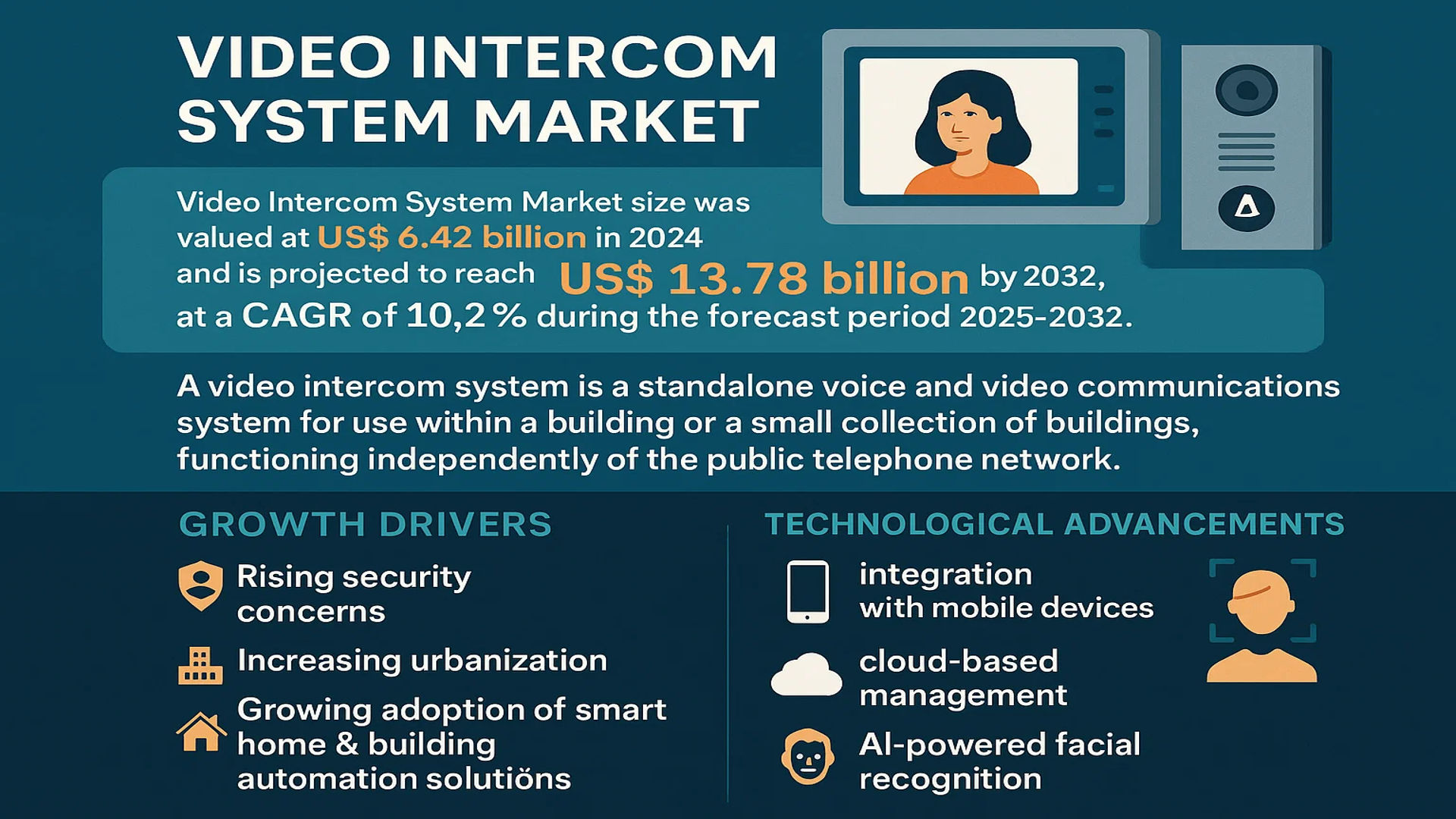
The global Video Intercom System Market size was valued at US$ 6.42 billion in 2024 and is projected to reach US$ 13.78 billion by 2032, at a CAGR of 10.2% during the forecast period 2025-2032.
A video intercom system is a standalone voice and video communications system for use within a building or a small collection of buildings, functioning independently of the public telephone network. These systems are generally mounted permanently in buildings and vehicles, facilitating secure two-way communication. They can incorporate connections to public address loudspeaker systems, telephones, and other intercom systems, and often include control of devices such as signal lights and electronic door latches.
The market is experiencing robust growth driven by rising security concerns, increasing urbanization, and the growing adoption of smart home and building automation solutions. Furthermore, technological advancements such as integration with mobile devices, cloud-based management, and AI-powered facial recognition are significantly contributing to market expansion. The residential sector is the dominant application segment, holding approximately 70% of the market share, because these systems are now considered a standard security feature in modern apartment complexes and gated communities. Key players operating in this competitive landscape include PANASONIC, Honeywell, Godrej, Samsung, and Aiphone, who are continuously innovating to enhance product features and connectivity.
MARKET DYNAMICS
MARKET DRIVERS
Rising Security Concerns and Urbanization to Accelerate Market Expansion
Increasing security concerns globally are significantly driving the adoption of video intercom systems. With crime rates rising in urban areas, property owners and businesses are investing in advanced security solutions to enhance safety. Video intercom systems provide real-time visual verification, remote access control, and two-way communication, which are critical for preventing unauthorized entry. The residential segment, which accounts for approximately 70% of the market, is particularly influenced by these security needs. Furthermore, rapid urbanization and the construction of smart cities are integrating video intercom systems as standard infrastructure in new residential and commercial buildings. The growth of high-rise apartments and gated communities, especially in emerging economies, has created a substantial demand for these systems, supporting market expansion.
Technological Advancements and IoT Integration to Propel Market Growth
Technological innovations are playing a pivotal role in the evolution of video intercom systems. The integration of Internet of Things (IoT) capabilities, artificial intelligence, and mobile connectivity has transformed traditional intercoms into smart, multifunctional devices. Modern systems offer features such as facial recognition, cloud storage, and smartphone integration, allowing users to manage access remotely. These advancements enhance user convenience and security, making video intercom systems more appealing to a broader audience. The commercial sector, which holds around 25% of the market share, is increasingly adopting these advanced systems for office buildings, hospitals, and educational institutions. The continuous development of wireless and IP-based intercom systems is reducing installation costs and improving scalability, further driving market adoption.
Growing Demand for Smart Home Ecosystems to Boost Market Penetration
The rising popularity of smart home ecosystems is significantly contributing to the growth of the video intercom system market. As consumers seek integrated home automation solutions, video intercoms are becoming a central component of connected living environments. These systems seamlessly interact with other smart devices such as smart locks, security cameras, and voice assistants, providing a cohesive and efficient security framework. The trend towards home automation is particularly strong in developed regions, where disposable incomes are higher and technological adoption is more prevalent. The ability to monitor and control access points via mobile applications has increased the appeal of video intercom systems, making them a standard feature in modern residential projects. This synergy between video intercoms and smart home technologies is expected to sustain market growth over the coming years.
MARKET CHALLENGES
High Initial Costs and Installation Complexities to Hinder Market Adoption
Despite the growing demand, high initial costs remain a significant challenge for the video intercom system market. Advanced systems with features like HD video, night vision, and IoT integration involve substantial upfront investment, which can be prohibitive for budget-conscious consumers and small businesses. Installation complexities, especially in existing buildings, add to the overall expense and may require professional assistance, further increasing costs. This financial barrier is particularly evident in price-sensitive markets and developing regions, where cost considerations often outweigh the benefits of enhanced security. Additionally, retrofitting older properties with modern video intercom systems can involve structural modifications, leading to higher labor and material expenses. These factors collectively slow down market penetration, especially among middle-income demographic segments.
Other Challenges
Cybersecurity Vulnerabilities
Cybersecurity risks pose a considerable challenge to the adoption of video intercom systems. As these devices become more connected and data-driven, they are increasingly susceptible to hacking, data breaches, and unauthorized access. Vulnerabilities in network configurations, software flaws, and weak encryption can compromise user privacy and system integrity. Instances of security breaches have raised concerns among potential users, particularly in commercial and high-security applications where data protection is paramount. Addressing these cybersecurity issues requires continuous investment in robust encryption protocols, regular software updates, and user education, which adds to the operational costs and complexity for manufacturers and end-users alike.
Interoperability and Standardization Issues
The lack of universal standards and interoperability among video intercom systems and other smart devices creates integration challenges. With multiple manufacturers offering proprietary technologies and communication protocols, users often face difficulties in achieving seamless connectivity between different systems and platforms. This fragmentation can limit the functionality and scalability of video intercom solutions, especially in environments where integration with existing security infrastructure is essential. The absence of industry-wide standards also complicates the upgrade process and may lead to compatibility issues, discouraging potential buyers from investing in advanced systems. Efforts to establish common protocols are ongoing but progress is slow, impacting market cohesion and growth.
MARKET RESTRAINTS
Economic Volatility and Supply Chain Disruptions to Limit Market Growth
Economic instability and fluctuations in disposable income can restrain the video intercom system market. During periods of economic downturn, consumers and businesses tend to prioritize essential expenditures over discretionary security upgrades, leading to reduced demand for non-essential advanced systems. Additionally, global supply chain disruptions, as witnessed in recent years, affect the availability of critical components such as semiconductors, sensors, and displays, causing production delays and increased costs. These challenges are compounded by rising raw material prices and logistical bottlenecks, which inflate the overall cost of manufacturing and distribution. Such economic and supply chain uncertainties create volatility in the market, making it difficult for manufacturers to maintain consistent pricing and meet consumer demand, thereby restraining growth.
MARKET OPPORTUNITIES
Expansion in Emerging Markets and Product Innovation to Unlock New Growth Avenues
Emerging markets present significant growth opportunities for the video intercom system industry. Rapid urbanization, increasing disposable incomes, and growing awareness of security solutions in regions such as Asia-Pacific, Latin America, and the Middle East are driving demand. Countries like India and China are witnessing a surge in residential and commercial construction projects, where video intercom systems are being incorporated as standard features. Moreover, product innovations focused on affordability and ease of use are making these systems more accessible to a broader consumer base. The development of low-cost, wireless, and DIY installation kits is particularly appealing in price-sensitive markets, enabling faster adoption. These factors, combined with strategic partnerships and localized marketing efforts, are expected to open new revenue streams and expand market reach.
Integration with Advanced Technologies to Create Future Growth Potential
The integration of video intercom systems with emerging technologies such as 5G, AI, and cloud computing offers substantial growth opportunities. 5G connectivity enables faster data transmission and lower latency, enhancing the performance of real-time video communication and remote access features. Artificial intelligence can improve functionality through advanced analytics, predictive maintenance, and automated threat detection, making systems more intelligent and efficient. Cloud-based solutions provide scalable storage and remote management capabilities, reducing the need for on-site hardware and lowering long-term costs. These technological advancements not only improve user experience but also create new application areas in sectors like healthcare, hospitality, and retail. As these technologies mature and become more affordable, their incorporation into video intercom systems will drive innovation and market expansion.
VIDEO INTERCOM SYSTEM MARKET TRENDS
Integration of AI and IoT Technologies to Emerge as a Dominant Trend
The global video intercom system market is undergoing a significant transformation driven by the integration of Artificial Intelligence (AI) and Internet of Things (IoT) capabilities. Modern systems now incorporate advanced features such as facial recognition, anomaly detection, and voice command integration, moving beyond basic audio-visual communication. This evolution enhances security protocols by enabling systems to distinguish between residents, visitors, and potential threats automatically. Furthermore, IoT connectivity allows these systems to integrate seamlessly with other smart home devices, creating a unified ecosystem for access control, lighting, and climate management. The demand for such intelligent, interconnected security solutions is a primary factor propelling market growth, with the residential segment accounting for approximately 70% of global installations. This trend is particularly pronounced in new construction projects, where smart home infrastructure is increasingly becoming a standard feature rather than a luxury add-on.
Other Trends
Rising Demand for Touchless and Mobile-Enabled Access Solutions
The post-pandemic era has accelerated the demand for touchless and mobile-enabled access control solutions within the video intercom market. Health and safety concerns have driven property developers and homeowners to seek systems that minimize physical contact with shared surfaces. This has led to the rapid adoption of mobile applications that allow users to screen visitors, grant access, and receive notifications directly on their smartphones, regardless of their physical location. This functionality is no longer confined to high-end properties; it is becoming a mainstream expectation in multi-tenant residential buildings and commercial offices. The convenience of remote management, coupled with enhanced security, is a powerful driver, making mobile-integrated video intercoms a critical component of modern property management and a key factor in the market’s projected growth to US$ 13.78 billion by 2032.
Expansion in Commercial and Multi-Tenant Residential Applications
While the residential sector remains the largest application area, the commercial segment is experiencing the fastest growth, driven by the need for sophisticated access management and visitor monitoring. Office buildings, gated communities, industrial facilities, and healthcare institutions are increasingly deploying advanced video intercom systems to enhance security protocols and streamline operations. In multi-tenant buildings, video intercom masters, which hold a 65% market share by type, are essential for centralized security management. These systems provide a robust first line of defense, logging entry attempts and providing visual verification. The commercial sector’s growth is further supported by stringent security regulations and the rising value of assets requiring protection. This expansion beyond traditional residential use is diversifying the market’s revenue streams and encouraging innovation tailored to specific commercial needs, such as integration with enterprise security software and higher durability for industrial environments.
COMPETITIVE LANDSCAPE
Key Industry Players
Companies Focus on Technological Innovation and Strategic Expansion to Secure Market Position
The global video intercom system market exhibits a fragmented yet dynamic competitive structure, characterized by the presence of multinational electronics giants, specialized security solution providers, and regional players. This diversity drives continuous innovation, particularly in integrating smart home ecosystems and cloud-based functionalities. While the market is crowded, a few key players have established significant brand recognition and distribution networks that grant them considerable influence.
Panasonic Corporation and Honeywell International Inc. are consistently identified as dominant forces, leveraging their extensive global reach and robust product portfolios that range from basic residential units to advanced commercial systems with access control integration. Their growth is heavily supported by strong brand loyalty and a widespread service network, which are critical for installation and maintenance. Furthermore, their continuous investment in R&D has led to the development of AI-powered features like facial recognition and anomaly detection, setting industry standards.
Meanwhile, companies like Aiphone Co., Ltd. and Samsung Electronics have carved out significant niches. Aiphone is renowned for its high-reliability systems tailored for the healthcare and industrial sectors, while Samsung has effectively leveraged its brand strength in consumer electronics to penetrate the residential smart home market. Their strategy often involves bundling video intercoms with other smart devices, creating a seamless user experience.
The competitive intensity is further heightened by agile players from the Asia-Pacific region, such as Dahua Technology and Guangdong Anjubao. These companies compete effectively on price and customization, offering cost-effective solutions that are particularly attractive in emerging economies. Their approach often involves forming strategic partnerships with local distributors and construction firms to secure contracts for new residential and commercial developments, ensuring a steady flow of volume-driven growth.
Looking forward, the competitive landscape is expected to evolve through increased merger and acquisition activity as larger firms seek to acquire innovative startups with unique software or AI capabilities. Additionally, a growing emphasis on cybersecurity and data privacy features is becoming a key differentiator, pushing all market participants to continually enhance their product offerings to meet evolving regulatory and consumer demands.
List of Key Video Intercom System Companies Profiled
- Panasonic Corporation (Japan)
- Honeywell International Inc. (U.S.)
- Godrej & Boyce Mfg. Co. Ltd. (India)
- Aiphone Co., Ltd. (Japan)
- Samsung Electronics Co., Ltd. (South Korea)
- Zicom Electronic Security Systems Ltd. (India)
- Dahua Technology Co., Ltd. (China)
- COMMAX Co., Ltd. (South Korea)
- Fermax Electrónica S.A.U. (Spain)
- Guangdong Anjubao Digital Technology Co., Ltd. (China)
- CP Plus GmbH & Co. KG (Germany)
- Leelen Technology Co., Ltd. (China)
Segment Analysis:
By Type
Video Intercom Master Segment Dominates the Market Due to its Central Role in System Integration and Control
The market is segmented based on type into:
- Door Station
- Video Intercom Master
- Indoor Units
By Application
Residential Segment Leads Due to Rising Demand for Smart Home Security and Access Control
The market is segmented based on application into:
- Residential
- Commercial
- Others
By Technology
IP-Based Systems Segment Gains Traction Due to Superior Scalability and Integration Capabilities
The market is segmented based on technology into:
- Analog Systems
- IP-Based Systems
By End User
Multi-Dwelling Units Segment Expands Rapidly Due to Urbanization and High-Rise Construction
The market is segmented based on end user into:
- Single-Family Homes
- Multi-Dwelling Units
- Office Buildings
- Industrial Facilities
Regional Analysis: Video Intercom System Market
Asia-Pacific
The Asia-Pacific region is the dominant force in the global video intercom system market, accounting for the largest market share by volume and revenue. This leadership is primarily driven by rapid urbanization, massive residential and commercial construction projects, and increasing security consciousness among the burgeoning middle class. China and India are the primary engines of growth, with China’s market alone valued at an estimated $2.1 billion in 2024. Government initiatives promoting smart city development, such as India’s Smart Cities Mission, are creating substantial demand for integrated security solutions. While cost sensitivity keeps demand high for basic systems, there is a clear and accelerating trend toward adopting advanced features like mobile app integration, facial recognition, and cloud-based management. Major local and international players, including PANASONIC, Honeywell, Dahua Technology, and Samsung, compete intensely in this high-volume market.
North America
The North American market is characterized by its focus on high-value, technologically advanced systems. High disposable income, stringent building safety codes, and a strong DIY home security culture drive demand for premium products. The United States is the largest national market within the region, with a significant portion of demand coming from the residential sector, particularly in single-family homes and high-end apartment complexes. Integration with broader smart home ecosystems (e.g., Amazon Alexa, Google Home) is a key purchasing driver. The market is also seeing robust growth in the commercial segment, where video intercoms are part of comprehensive access control systems for office buildings, industrial facilities, and healthcare campuses. While the adoption rate is high, market growth is steady rather than explosive, focused on upgrades and replacements with more feature-rich models.
Europe
Europe represents a mature and innovation-driven market for video intercom systems. Demand is heavily influenced by strict privacy regulations, such as the General Data Protection Regulation (GDPR), which dictates how video data is stored and processed. This has accelerated the adoption of systems with on-device processing and encrypted data transmission. The region has a strong presence of premium European brands like Fermax and COMMAX, which compete with global giants. The market is characterized by a high replacement rate, with consumers and businesses upgrading aging analog systems to modern IP-based solutions that offer superior video quality, scalability, and remote management capabilities. Growth is particularly strong in Western European countries like Germany, France, and the U.K., driven by renovation projects in existing building stock.
South America
The South American video intercom market is in a growth phase, though its development is uneven across the region. Economic volatility and currency fluctuations remain significant challenges, often prioritizing cost-effective solutions over advanced features. However, rising crime rates in major urban centers are a powerful driver for adoption, primarily in the residential sector within gated communities and high-rise apartments. Brazil and Argentina are the most promising markets. While basic audio and video systems are most prevalent, there is a growing niche demand for integrated solutions in new commercial constructions. The market is highly competitive, with a mix of international brands and local manufacturers catering to specific price points and preferences.
Middle East & Africa
The MEA region presents an emerging opportunity with long-term growth potential. Development is concentrated in wealthier Gulf Cooperation Council (GCC) nations like the UAE, Saudi Arabia, and Qatar, where lavish residential projects, smart city initiatives (e.g., NEOM in Saudi Arabia), and massive commercial developments create demand for high-end security and intercom solutions. In contrast, other parts of the region face challenges due to economic constraints and political instability, which limit widespread adoption. The market is a blend of luxury installations in new developments and more basic, cost-driven systems for essential security. As urban development continues, the demand for reliable video intercom systems is expected to rise steadily.
Report Scope
This market research report provides a comprehensive analysis of the global Video Intercom System market, covering the forecast period 2025–2032. It offers detailed insights into market dynamics, technological advancements, competitive landscape, and key trends shaping the industry.
Key focus areas of the report include:
- Market Size & Forecast: Historical data and future projections for revenue, unit shipments, and market value across major regions and segments.
- Segmentation Analysis: Detailed breakdown by product type, technology, application, and end-user industry to identify high-growth segments and investment opportunities.
- Regional Outlook: Insights into market performance across North America, Europe, Asia-Pacific, Latin America, and the Middle East & Africa, including country-level analysis where relevant.
- Competitive Landscape: Profiles of leading market participants, including their product offerings, R&D focus, manufacturing capacity, pricing strategies, and recent developments such as mergers, acquisitions, and partnerships.
- Technology Trends & Innovation: Assessment of emerging technologies, integration of AI/IoT, semiconductor design trends, fabrication techniques, and evolving industry standards.
- Market Drivers & Restraints: Evaluation of factors driving market growth along with challenges, supply chain constraints, regulatory issues, and market-entry barriers.
- Stakeholder Analysis: Insights for component suppliers, OEMs, system integrators, investors, and policymakers regarding the evolving ecosystem and strategic opportunities.
Primary and secondary research methods are employed, including interviews with industry experts, data from verified sources, and real-time market intelligence to ensure the accuracy and reliability of the insights presented.
FREQUENTLY ASKED QUESTIONS:
What is the current market size of Global Video Intercom System Market?
-> Video Intercom System Market size was valued at US$ 6.42 billion in 2024 and is projected to reach US$ 13.78 billion by 2032, at a CAGR of 10.2% during the forecast period 2025-2032.
Which key companies operate in Global Video Intercom System Market?
-> Key players include PANASONIC, Honeywell, Samsung, Aiphone, and Dahua Technology, among others.
What are the key growth drivers?
-> Key growth drivers include rising security concerns, urbanization, smart city initiatives, and integration with IoT and mobile applications.
Which region dominates the market?
-> Asia-Pacific is the largest and fastest-growing region, driven by significant adoption in China and India.
What are the emerging trends?
-> Emerging trends include AI-powered facial recognition, cloud-based systems, wireless technology adoption, and integration with smart home ecosystems.

Get Sample Report PDF for Exclusive Insights
Report Sample Includes
- Table of Contents
- List of Tables & Figures
- Charts, Research Methodology, and more...
 Download Sample Report PDF