MARKET INSIGHTS
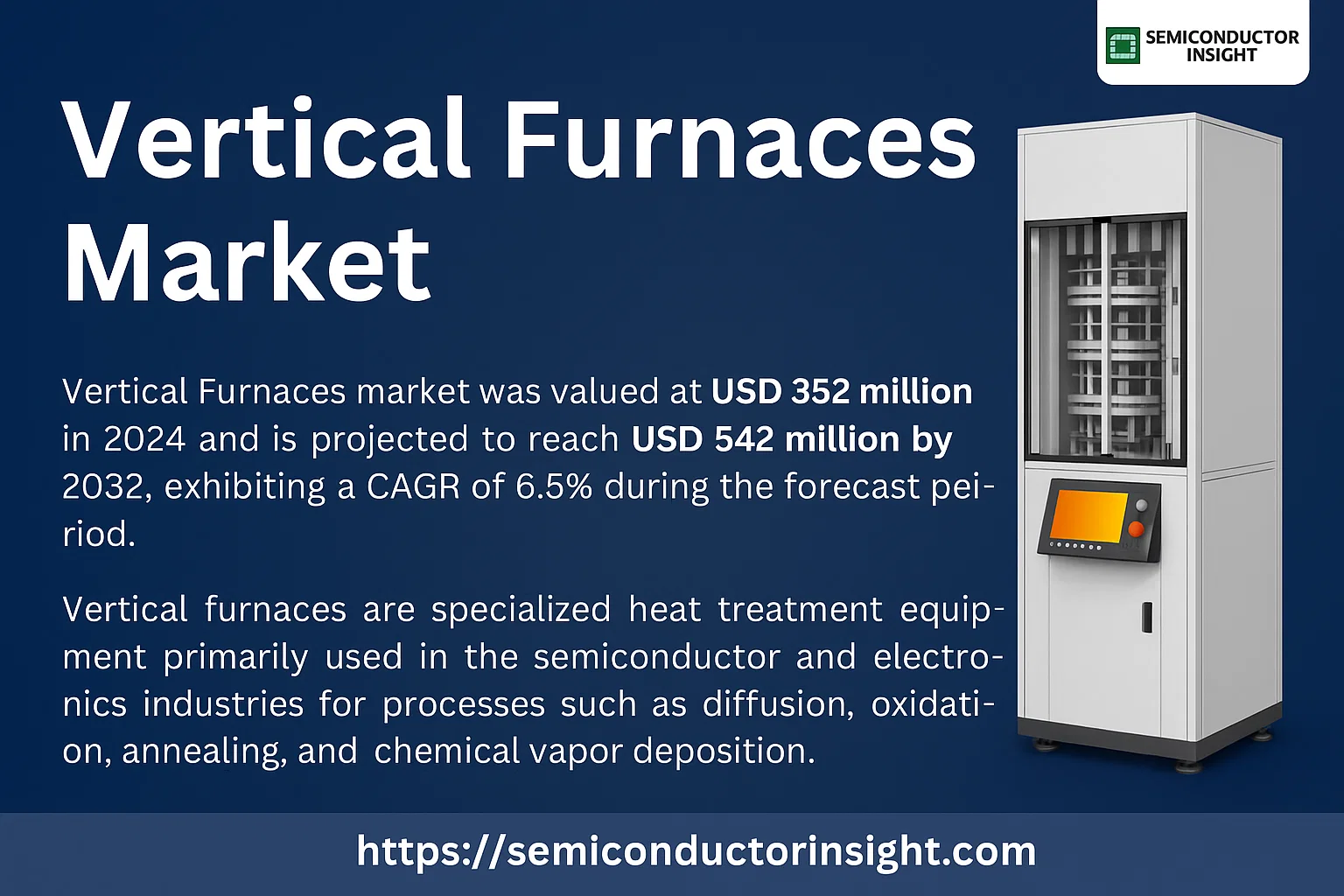
Global Vertical Furnaces Market was valued at USD 352 million in 2024 and is projected to reach USD 542 million by 2032, exhibiting a CAGR of 6.5% during the forecast period. Vertical furnaces are specialized heat treatment equipment primarily used in the semiconductor and electronics industries for processes such as diffusion, oxidation, annealing, and chemical vapor deposition. The market’s growth is driven by the expanding semiconductor industry, the proliferation of Internet of Things (IoT) devices, and the increasing adoption of advanced electronics across various sectors.
Key players in the market include Tokyo Electron Limited, Kokusai Electric Corporation, Koyo Thermo Systems, ASM International, NAURA, Centrotherm Photovoltaics, and Tempress. The global market is concentrated, with the top three companies holding a share of over 73%. China is the largest market, accounting for about 37% of the global total, followed by Japan and North America with shares of about 15% and 14%, respectively.
The market’s expansion is further supported by the increasing demand for high-performance computing, the rollout of 5G technology, and government initiatives supporting domestic semiconductor manufacturing. However, challenges such as the high cost of equipment and the cyclical nature of the semiconductor industry may pose restraints.
MARKET DRIVERS
Expansion and Modernization in Semiconductor Manufacturing
The global push for advanced electronics, including 5G infrastructure, IoT devices, and high-performance computing, is significantly driving the demand for vertical furnaces, which are essential for high-volume, uniform thermal processing of semiconductor wafers. The transition to smaller technology nodes, such as 5nm and 3nm, requires precise thermal processes like oxidation, diffusion, and annealing that vertical furnaces specialize in, bolstering market growth.
Advancements in Automation and Process Control
Integration of Industry 4.0 technologies, including IoT sensors, AI-based process control, and real-time data analytics, is enhancing the efficiency and yield of vertical furnace operations. These advancements reduce human error, improve throughput, and lower operational costs, making vertical furnaces more attractive for modern fabs. The demand for fully automated, high-throughput systems is a key factor propelling market adoption.
➤ The global market for vertical furnaces is projected to grow at a CAGR exceeding 6% over the next five years, driven by sustained capital expenditure in the semiconductor sector.
Furthermore, the growing investment in new semiconductor fabrication facilities, particularly in Asia-Pacific and North America, to address chip shortages and secure supply chains is creating a robust pipeline of demand for vertical furnace equipment.
MARKET CHALLENGES
High Capital and Operational Costs
The significant initial investment required for advanced vertical furnace systems, coupled with high maintenance and energy consumption costs, presents a major barrier for small and medium-sized enterprises. The need for specialized facilities, such as cleanrooms, and skilled personnel to operate these complex systems further increases the total cost of ownership.
Other Challenges
Technical Complexity and Integration Issues
Integrating vertical furnaces into existing semiconductor fabrication lines can be technically challenging, requiring precise compatibility with other process tools and metrology equipment. Any misalignment can lead to reduced yield and increased downtime.
Stringent Regulatory and Environmental Standards
Compliance with stringent environmental regulations concerning emissions, chemical usage, and energy efficiency adds operational complexities and costs for manufacturers.
MARKET RESTRAINTS
Cyclical Nature of the Semiconductor Industry
The vertical furnace market is highly susceptible to the boom-and-bust cycles of the global semiconductor industry. Periods of overcapacity and reduced capital expenditure by chipmakers can lead to postponed or canceled equipment orders, directly restraining market growth. This cyclicality creates significant uncertainty for vertical furnace manufacturers.
Competition from Alternative Technologies
The adoption of alternative thermal processing technologies, such as rapid thermal processing (RTP) systems for certain applications, poses a restraint. RTP systems offer faster cycle times for specific processes, which can be more economical for lower-volume or research-oriented production, diverting demand from traditional vertical batch furnaces.
MARKET OPPORTUNITIES
Emerging Applications in Power Electronics and MEMS
The growing markets for silicon carbide (SiC) and gallium nitride (GaN) power devices, as well as Micro-Electro-Mechanical Systems (MEMS), present significant growth opportunities. Vertical furnaces are critical for the high-temperature processes required to manufacture these advanced components, opening new revenue streams beyond traditional silicon-based semiconductors.
Growth in the Asia-Pacific Region
The concentration of semiconductor manufacturing in the Asia-Pacific region, particularly in China, Taiwan, and South Korea, offers substantial opportunities. Government initiatives and massive investments in domestic semiconductor production are fueling the demand for advanced manufacturing equipment like vertical furnaces.
Vertical Furnaces Market Trends
Sustained Growth Driven by Semiconductor Demand
The global Vertical Furnaces market, valued at $352 million in 2024, is on a strong growth trajectory, projected to reach $542 million by 2032. This represents a compound annual growth rate (CAGR) of 6.5% during the forecast period. The expansion is primarily fueled by the escalating demand for semiconductors across various end-use industries, particularly in consumer electronics, automotive, and data centers. Vertical furnaces are critical for thermal processing steps in semiconductor manufacturing, including oxidation, diffusion, and annealing, making their market health a direct indicator of the broader electronics supply chain’s vitality.
Other Trends
Geographical Market Dominance
China is the largest market for vertical furnaces, accounting for approximately 37% of the global share. This dominance is attributed to the country’s massive electronics manufacturing base and significant government investments in its domestic semiconductor industry. Japan and North America follow as the next largest markets, holding shares of about 15% and 14% respectively. The concentration of major semiconductor fabrication plants (fabs) and leading equipment suppliers in these regions solidifies their key positions in the global market landscape.
Market Consolidation and Competitive Landscape
The market exhibits a high level of consolidation, with the top three companies—Tokyo Electron Limited, Kokusai Electric Corporation, and Koyo Thermo Systems—collectively holding over 73% of the global market share. This concentration underscores the significant barriers to entry, including high R&D costs and the need for deep technological expertise. Other notable players include ASM International, NAURA, Centrotherm Photovoltaics, and Tempress, all competing on innovation, reliability, and service to secure contracts with major chip manufacturers.
Segmentation by Application and Wafer Size
The market is segmented by application, with Integrated Circuit (IC) manufacturing being the largest segment. The MEMS (Micro-Electro-Mechanical Systems) segment also represents a significant and growing application area. In terms of wafer size, the market is divided between 200mm and below, and the increasingly dominant 300mm segment. The transition to larger 300mm wafers is a key trend, driven by the pursuit of higher production efficiency and lower cost per chip, which influences the specifications and demand for new vertical furnace systems.
COMPETITIVE LANDSCAPE
Key Industry Players
A Market Characterized by High Concentration and Technological Specialization
The global vertical furnaces market is dominated by a handful of established players, with the top three companies—Tokyo Electron Limited, Kokusai Electric Corporation, and ASM International—collectively holding over 73% of the market share. This high concentration is indicative of significant barriers to entry, including immense R&D costs, complex manufacturing expertise, and entrenched customer relationships in the semiconductor industry. Tokyo Electron Limited (TEL) remains the undisputed leader, leveraging its extensive portfolio and global service network to serve major foundries and IDMs. The competitive dynamics are driven by the need for furnaces that offer superior process uniformity, high throughput, and reliability for advanced node semiconductor manufacturing, particularly for 300mm wafers used in leading-edge logic and memory applications.
Beyond the dominant leaders, several other companies have secured significant positions by focusing on niche applications or specific geographic markets. Players like NAURA are strongly positioned in China, the world’s largest market for vertical furnaces, capturing local demand driven by government initiatives and a booming domestic semiconductor industry. Specialized suppliers such as Koyo Thermo Systems, Centrotherm Photovoltaics, and Tempress (a part of Amtech Systems) cater to specific segments like power devices, MEMS (Micro-Electro-Mechanical Systems), and photovoltaic applications, often for 200mm and below wafer sizes. These companies compete on factors like process specialization, cost-effectiveness, and responsive customer support for specialized thermal processing needs.
List of Key Vertical Furnaces Companies Profiled
- Tokyo Electron Limited (TEL)
- Kokusai Electric Corporation
- ASM International
- Koyo Thermo Systems Co., Ltd.
- NAURA Technology Group Co., Ltd.
- Centrotherm Photovoltaics AG
- Tempress Systems, Inc. (Amtech Systems)
- Applied Materials, Inc.
- Hitachi Kokusai Electric Inc.
- SCREEN Holdings Co., Ltd.
- WONIK IPS
- Semco Technologies
- SVG Semiconductor Technologies (a subsidiary of MRL)
- ACM Research, Inc.
- Singulus Technologies AG
Segment Analysis:
| Segment Category | Sub-Segments | Key Insights |
| By Type |
|
Vertical Diffusion Furnaces represent the leading segment within the market due to their critical role in semiconductor manufacturing for introducing dopants into silicon wafers. Their design allows for superior process uniformity and high throughput in a compact footprint, which is essential for modern fabrication facilities seeking to maximize cleanroom space efficiency. The demand is driven by the continuous scaling of integrated circuits, which requires highly precise and controlled doping processes. These systems are instrumental in achieving the desired electrical characteristics in semiconductor devices, making them a foundational technology for leading-edge chip production. |
| By Application |
|
Integrated Circuit (IC) Fabrication is the dominant application, leveraging vertical furnaces for essential thermal processes like oxidation, diffusion, and thin-film deposition. The relentless drive for miniaturization and performance improvements in logic and memory chips necessitates extremely precise thermal budget control, which these furnaces provide. The vertical orientation minimizes particle contamination and ensures uniform temperature distribution across wafers, which is paramount for high device yields. This segment’s growth is intrinsically linked to global investments in new semiconductor fabrication plants and the upgrade of existing facilities to produce more advanced nodes. |
| By End User |
|
Foundries constitute the leading end-user segment, as they are the primary volume manufacturers of semiconductors for a wide array of fabless companies. Their business model relies on achieving the highest possible throughput and process consistency to serve multiple clients with diverse chip designs. Vertical furnaces are a cornerstone of their thermal processing bays due to their reliability, scalability, and ability to handle high-volume production. The competitive landscape among foundries drives continuous adoption of the latest furnace technologies to offer advanced process capabilities to their customers, ensuring this segment remains the most significant driver of market demand. |
| By Wafer Size |
|
300mm wafer processing is the leading segment, representing the industry standard for high-volume, cost-effective manufacturing of advanced semiconductors. The larger wafer size offers substantial economies of scale by producing more chips per wafer, which is critical for logic and memory applications. Vertical furnaces designed for 300mm wafers incorporate sophisticated automation and control systems to handle the increased weight and maintain process uniformity across the larger surface area. The ongoing transition and significant capital expenditure in 300mm fabrication facilities globally solidifies this segment’s dominance, as it is essential for producing the majority of the world’s cutting-edge electronics. |
| By Process Technology |
|
Doping/Diffusion is the leading process technology segment for vertical furnaces, as it is a fundamental step in defining the electrical properties of semiconductor devices. This process requires exceptionally high temperature stability and atmospheric control to ensure precise dopant distribution and junction formation. Vertical furnaces are particularly well-suited for this application due to their superior temperature uniformity and reduced risk of contamination compared to horizontal alternatives. The critical nature of doping for device performance, coupled with the increasing complexity of multi-layer chip architectures, ensures sustained and robust demand for vertical furnaces optimized for these precise thermal processes. |
Regional Analysis: Vertical Furnaces Market
The region’s strength lies in its dense cluster of world-leading semiconductor manufacturers and foundries. These facilities require vertical furnaces for critical processes like oxidation, diffusion, and annealing. The continuous push towards smaller process nodes and 3D NAND memory structures demands furnaces with exceptional temperature uniformity and process control, a specialty of suppliers serving this market.
Substantial national initiatives, such as China’s push for semiconductor self-sufficiency and similar programs in South Korea and Japan, are powerful market drivers. These policies provide financial incentives, tax benefits, and strategic direction, leading to a wave of new fab constructions that directly fuel demand for vertical furnace installations and upgrades.
A well-integrated local supply chain for quartzware, silicon carbide components, and control systems reduces lead times and costs for furnace manufacturers and end-users. This ecosystem encourages collaboration and co-development between furnace makers and semiconductor producers, leading to tailored solutions that address the specific thermal processing challenges of advanced node manufacturing.
Beyond front-end fabrication, the region is also a leader in advanced packaging technologies. The growth of 2.5D and 3D integrated circuit packaging creates new applications for vertical furnaces in processes like thermal compression bonding and dielectric curing, opening an additional, high-growth segment for the market within the region.
North America
North America maintains a significant presence in the vertical furnace market, anchored by a strong semiconductor industry in the United States. The market is characterized by a focus on research, development, and the production of highly specialized, leading-edge semiconductor devices. Major integrated device manufacturers and fabless companies driving innovation in areas like AI and high-performance computing create demand for the most advanced vertical furnace systems capable of handling complex thermal budgets. Government support through initiatives like the CHIPS Act aims to onshore semiconductor manufacturing, which is expected to stimulate new investments in fab equipment, including vertical furnaces. The regional market also benefits from a strong ecosystem of equipment suppliers and research institutions focused on next-generation thermal processing technologies.
Europe
The European vertical furnace market is driven by a diverse industrial base with strengths in automotive, industrial electronics, and specialized microelectromechanical systems (MEMS). While not as large as the Asia-Pacific market in volume, Europe excels in high-value, niche applications that require precision engineering. Countries like Germany, France, and Ireland host significant semiconductor fabrication and R&D facilities. The market demand is influenced by the region’s stringent quality standards and focus on power electronics, particularly for the automotive industry’s transition to electric vehicles. Collaborative research projects within the European Union also foster advancements in furnace technology for emerging applications, such as wide-bandgap semiconductors.
South America
The vertical furnace market in South America is still in a developing stage compared to other regions. Market activity is limited and primarily focused on servicing existing industrial and electronics manufacturing operations rather than large-scale new semiconductor fabs. Brazil represents the most significant market within the region, with demand stemming from its industrial base. The market is characterized by replacement demand and upgrades for older furnace systems used in non-leading-edge applications. Growth is gradual and tied to broader regional economic stability and potential future investments in local technology manufacturing capabilities, which currently remain limited.
Middle East & Africa
The Middle East & Africa region represents an emerging and potential growth area for the vertical furnace market, though it currently holds a very small share. The primary driver is strategic investment by certain Gulf nations, such as Saudi Arabia and the UAE, aiming to diversify their economies into advanced technology sectors. These initiatives include plans for building technology hubs and potentially attracting semiconductor-related manufacturing. However, the market is nascent, with demand currently limited to small-scale R&D facilities and universities. The long-term market potential is tied to the successful execution of these diversification strategies and the establishment of a supporting ecosystem for high-tech manufacturing.
Report Scope
This market research report provides a comprehensive analysis of the Vertical Furnaces Market , covering the forecast period 2025–2032. It offers detailed insights into market dynamics, technological advancements, competitive landscape, and key trends shaping the industry.
Key focus areas of the report include:
- Market Overview: The report begins with an overview outlining its current market scenario, key growth indicators, and industry transformation drivers. It discusses macroeconomic factors, demand–supply balance, regulatory landscape, and the strategic role of semiconductors in powering advancements across industries such as automotive, telecommunications, consumer electronics, and industrial automation.
- Market Size & Forecast: Historical data and future projections for revenue, unit shipments, and market value across major regions and segments.
- Segmentation Analysis: Detailed breakdown by product type, technology, application, and end-user industry to identify high-growth segments and investment opportunities.
- Regional Insights: Insights into market performance across North America, Europe, Asia-Pacific, Latin America, and the Middle East & Africa, including country-level analysis where relevant.
- Competitive Landscape: Profiles of leading market participants, including their product offerings, R&D focus, manufacturing capacity, pricing strategies, and recent developments such as mergers, acquisitions, and partnerships.
- Technology Trends & Innovation: Assessment of emerging technologies, integration of AI/IoT, semiconductor design trends, fabrication techniques, and evolving industry standards.
- Market Drivers & Restraints: Evaluation of factors driving market growth along with challenges, supply chain constraints, regulatory issues, and market-entry barriers.
- Stakeholder Insights: Insights for component suppliers, OEMs, system integrators, investors, and policymakers regarding the evolving ecosystem and strategic opportunities.
Primary and secondary research methods are employed, including interviews with industry experts, data from verified sources, and real-time market intelligence to ensure the accuracy and reliability of the insights presented.
FREQUENTLY ASKED QUESTIONS:
What is the current market size of Vertical Furnaces Market?
-> Global Vertical Furnaces Market was valued at USD 352 million in 2024 and is projected to reach USD 542 million by 2032, growing at a CAGR of 6.5% during the forecast period.
Which key companies operate in Vertical Furnaces Market?
-> Key players include Tokyo Electron Limited, Kokusai Electric Corporation, Koyo Thermo Systems, ASM International, NAURA, Centrotherm Photovoltaics, and Tempress. The global top 3 companies hold a combined market share of over 73%.
What are the key growth drivers?
-> Key growth drivers include strong demand from the semiconductor fabrication industry, technological advancements in wafer processing, and increasing adoption in integrated circuit and MEMS manufacturing.
Which region dominates the market?
-> China is the largest market, accounting for approximately 37% of the global share, followed by Japan (15%) and North America (14%).
What are the emerging trends?
-> Emerging trends include the transition to larger wafer sizes (300mm), increased demand for high-precision thermal processing, and integration of advanced control systems for improved process efficiency.

Get Sample Report PDF for Exclusive Insights
Report Sample Includes
- Table of Contents
- List of Tables & Figures
- Charts, Research Methodology, and more...
 Download Sample Report PDF