
MARKET INSIGHTS
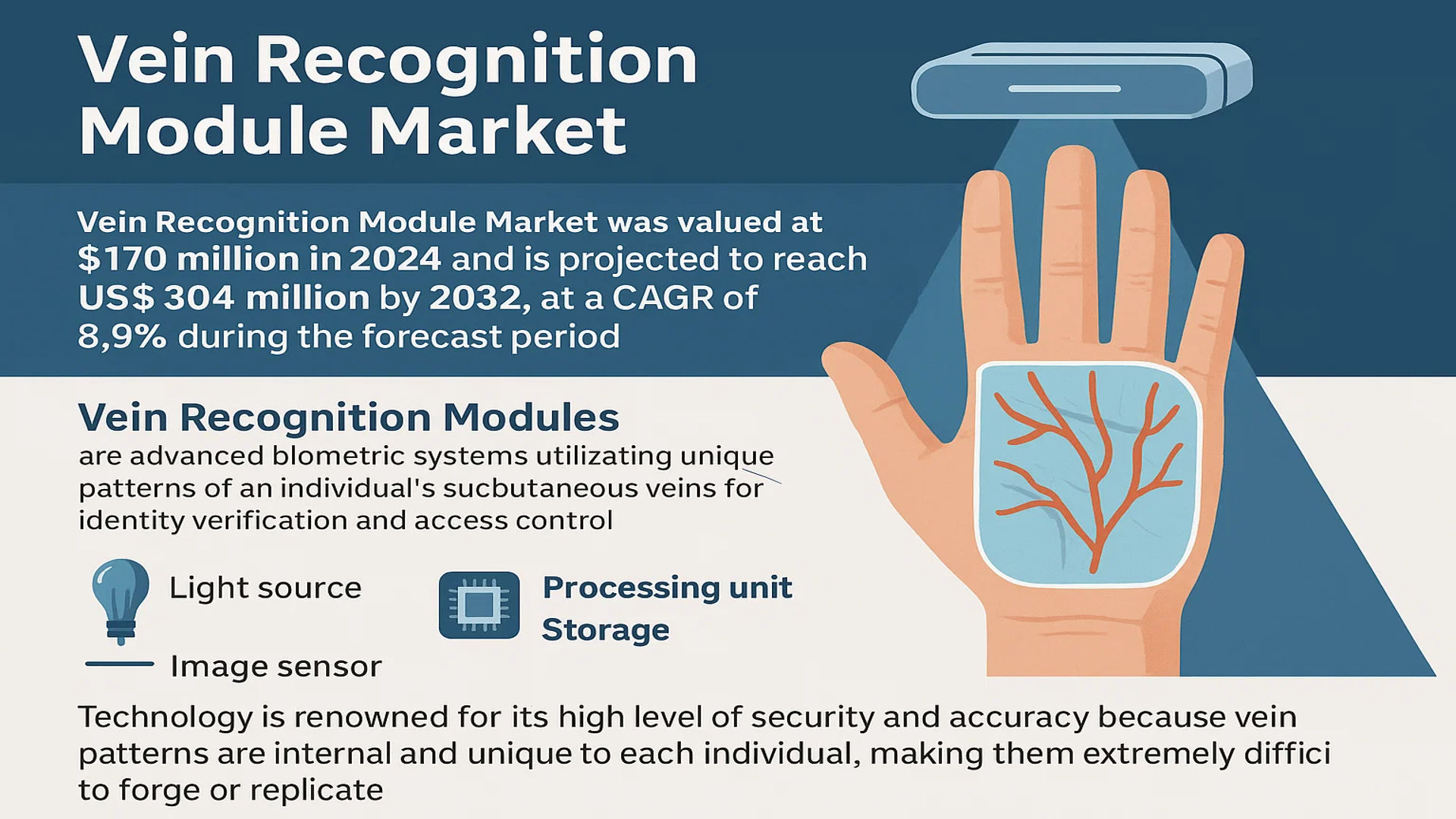
The global Vein Recognition Module Market was valued at 170 million in 2024 and is projected to reach US$ 304 million by 2032, at a CAGR of 8.9% during the forecast period.
Vein recognition modules are advanced biometric systems that utilize the unique patterns of an individual’s subcutaneous veins for identity verification and access control. These systems operate by capturing an image of the vein pattern using near-infrared light, as hemoglobin in the blood absorbs this light, making the veins visible as a dark network. The core components include a light source, an image sensor, a processing unit, and storage. This technology is renowned for its high level of security and accuracy because vein patterns are internal and unique to each individual, making them extremely difficult to forge or replicate.
The market is experiencing robust growth, primarily driven by the escalating demand for highly secure and contactless authentication solutions across the finance and government sectors. For instance, its adoption in ATMs for user authentication and in national ID programs enhances security protocols significantly. Furthermore, stringent data privacy regulations like the EU’s GDPR favor technologies such as vein recognition, as the biometric data is not exposed or easily captured like fingerprints or facial images. However, the market faces challenges from the cost-competitiveness of more established biometric technologies and the need for further public awareness and education regarding its benefits.
MARKET DYNAMICS
MARKET DRIVERS
Heightened Demand for Secure Authentication Solutions to Propel Market Expansion
The global vein recognition module market is experiencing robust growth driven by escalating demand for highly secure and contactless biometric authentication systems. Unlike traditional methods such as fingerprint or facial recognition, vein pattern recognition offers superior security because it relies on internal physiological characteristics that are nearly impossible to replicate or forge. This technology is gaining significant traction in sectors requiring stringent access control, including banking, healthcare, and government. Financial institutions, in particular, are increasingly adopting vein recognition for ATM transactions and secure login systems to combat rising fraud incidents, which cost the global economy over $4 trillion annually. The inherent liveness detection feature ensures that only living individuals can be authenticated, drastically reducing spoofing risks.
Stringent Data Privacy Regulations to Accelerate Adoption Rates
Governments worldwide are implementing rigorous data protection laws, such as the General Data Protection Regulation (GDPR) in Europe and similar frameworks in Asia and North America, which mandate secure handling of personal identifiable information. Vein recognition technology aligns perfectly with these regulations because it processes biometric data that is not easily exposed or stolen. Unlike fingerprints or facial images, vein patterns are internal and require specialized infrared imaging to capture, making them inherently private and compliant with privacy-by-design principles. This regulatory environment is pushing organizations across various industries to invest in vein recognition modules to avoid hefty non-compliance penalties, which can reach up to 4% of annual global turnover under GDPR.
Advancements in Healthcare Applications to Fuel Market Growth
The healthcare sector is emerging as a major adopter of vein recognition technology, utilizing it for patient identification, electronic health record access, and medication dispensing systems. Misidentification errors in healthcare settings lead to approximately 10% of all adverse events, costing the industry billions annually. Vein recognition offers a highly accurate solution that integrates seamlessly with hospital workflows while maintaining hygiene through contactless operation. Recent deployments in Japanese hospitals have demonstrated error rates below 0.0001%, significantly improving patient safety. The technology’s ability to function reliably even when patients are unconscious or unable to provide other forms of identification makes it particularly valuable in emergency and critical care settings.
MARKET CHALLENGES
High Implementation Costs to Constrain Widespread Adoption
Despite its technological advantages, the vein recognition module market faces significant challenges due to high implementation and maintenance costs. The sophisticated infrared imaging systems and advanced processing algorithms required for accurate vein pattern recognition result in per-unit costs that are approximately 40-60% higher than traditional fingerprint scanners. This cost differential makes it difficult for price-sensitive markets and small to medium enterprises to justify the investment. Additionally, integration with existing security infrastructure often requires specialized expertise and custom software development, further increasing the total cost of ownership. While large financial institutions and government agencies can absorb these expenses, many potential users in mid-market segments find the barrier to entry prohibitive.
Other Challenges
Environmental Sensitivity Issues
Vein recognition systems can experience performance degradation under certain environmental conditions. Strong ambient light, particularly infrared radiation from sunlight, can interfere with the imaging sensors’ ability to capture clear vein patterns. Similarly, extremely low temperatures can affect blood flow and vein visibility, reducing recognition accuracy. These limitations restrict deployment in outdoor or uncontrolled environments, narrowing the potential application scope. Manufacturers are investing in algorithmic improvements and sensor enhancements, but achieving consistent performance across all environmental conditions remains an ongoing technical challenge.
User Acceptance and Awareness Gaps
Limited public awareness and understanding of vein recognition technology creates adoption resistance. Many users are unfamiliar with how the technology works and express concerns about potential health effects of infrared exposure, despite its safety certification. Educational initiatives are required to demonstrate the technology’s benefits and safety, which involves additional marketing and training expenditures for implementers. Furthermore, some cultural perceptions regarding biometric data collection create hesitation, particularly in regions with heightened privacy sensitivities.
MARKET RESTRAINTS
Competition from Established Biometric Technologies to Limit Market Penetration
Well-established biometric technologies including fingerprint recognition, iris scanning, and facial recognition systems pose significant competitive restraints on vein recognition module adoption. These alternative technologies benefit from mature supply chains, mass production economies, and widespread integration into consumer devices such as smartphones and laptops. Fingerprint sensors, for instance, have achieved production costs below $3 per unit in high volumes, while vein recognition modules typically cost $50-$150 per unit. This substantial price difference makes it challenging for vein recognition to compete in price-sensitive applications despite its technical superiority. Furthermore, the existing infrastructure and user familiarity with traditional biometrics create switching costs and resistance to adopting newer technologies.
Technical Integration Complexities to Hinder Market Growth
Integrating vein recognition modules with existing security and IT systems presents considerable technical challenges that restrain market expansion. The technology requires specialized software development kits, application programming interfaces, and often custom integration work to ensure seamless operation with legacy systems. Many organizations lack the internal technical expertise to manage these integrations, necessitating expensive professional services from vendors or system integrators. Additionally, achieving interoperability across different vein recognition platforms remains difficult due to the absence of universal standards for data formats and communication protocols. These integration barriers extend implementation timelines and increase project risks, causing potential customers to delay or reconsider adoption decisions.
Limited Accuracy in Specific User Demographics to Restrict Application Scope
While vein recognition generally offers high accuracy rates, performance can vary across different user demographics, creating adoption restraints in certain applications. Elderly individuals often have less pronounced vein patterns due to thinning skin and reduced blood vessel elasticity, potentially lowering recognition accuracy. Similarly, individuals with certain medical conditions affecting circulation or skin pigmentation may experience inconsistent performance. These limitations make the technology less suitable for universal deployment in contexts requiring inclusive access, such as public services or healthcare applications serving diverse populations. Manufacturers are addressing these issues through algorithmic improvements and multi-modal approaches, but demographic performance variations continue to present implementation challenges.
MARKET OPPORTUNITIES
Expansion in Automotive and Smart Device Applications to Open New Revenue Streams
The integration of vein recognition technology into automotive systems and consumer smart devices presents substantial growth opportunities. Automotive manufacturers are increasingly incorporating biometric systems for vehicle access, personalized settings, and ignition control, with the global automotive biometric market projected to exceed $1 billion by 2026. Vein recognition offers advantages over other biometrics in automotive applications because it functions reliably despite environmental factors like temperature variations and user conditions such as wet hands. Similarly, smartphone and wearable device manufacturers are exploring vein recognition as a premium authentication feature that provides enhanced security without requiring additional external sensors. These expanding application areas could significantly increase market volume and drive production economies of scale.
Artificial Intelligence Integration to Enhance System Capabilities
Advancements in artificial intelligence and machine learning present transformative opportunities for vein recognition technology. AI algorithms can significantly improve recognition accuracy by adapting to individual vein pattern variations and environmental conditions. Deep learning approaches enable systems to maintain high performance even with partial or low-quality vein pattern captures, expanding usability across diverse scenarios. Furthermore, AI-powered systems can detect and prevent sophisticated spoofing attempts with greater efficacy than traditional rule-based approaches. The integration of these technologies is reducing false rejection rates to below 0.01% while maintaining false acceptance rates at negligible levels, making vein recognition suitable for even the most security-critical applications.
Emerging Markets Infrastructure Development to Create Expansion Opportunities
Rapid digitalization and infrastructure development in emerging economies, particularly across Asia-Pacific and Latin America, create substantial opportunities for vein recognition module deployment. Governments in these regions are investing heavily in smart city initiatives, digital identity programs, and financial inclusion projects that require robust authentication systems. The technology’s compatibility with privacy regulations and resistance to environmental factors makes it well-suited for diverse climatic conditions and implementation scales found in these markets. Additionally, the lower prevalence of legacy biometric systems in many emerging markets reduces switching costs and resistance to new technologies, enabling faster adoption cycles compared to mature markets.
VEIN RECOGNITION MODULE MARKET TRENDS
Integration with Artificial Intelligence and Multimodal Biometrics to Emerge as a Dominant Trend
The vein recognition module market is undergoing a significant transformation, primarily driven by the integration of Artificial Intelligence (AI) and machine learning algorithms. These technologies are enhancing the core capabilities of vein pattern analysis, moving beyond simple pattern matching to intelligent feature extraction and adaptive learning. AI algorithms can now compensate for environmental variables such as changes in skin temperature, ambient light, and minor physical alterations, which historically posed challenges to accuracy rates. This has resulted in a notable improvement in False Acceptance Rates (FAR) and False Rejection Rates (FRR), with some advanced systems now achieving accuracy rates exceeding 99.8%. Furthermore, the shift towards multimodal biometric systems, which fuse vein recognition with other modalities like facial recognition or fingerprints, is creating a powerful trend. This fusion addresses the inherent limitations of any single biometric method, delivering a more robust and spoof-resistant authentication solution that is crucial for high-security applications in finance and government sectors.
Other Trends
Expansion in Healthcare and Smart City Infrastructure
Beyond its traditional stronghold in financial security, vein recognition is experiencing accelerated adoption in the global healthcare sector. The technology’s contactless and hygienic nature became particularly valuable post-pandemic, leading to its deployment for patient identification, access to electronic health records, and securing medication dispensaries. In Japan, a pioneer in this technology, over 80% of major hospitals have integrated palm vein recognition for patient management, significantly reducing medical errors. Concurrently, national initiatives for developing smart city infrastructure are acting as a major catalyst. Governments, particularly in the Asia-Pacific region, are investing heavily in secure, automated public services. Vein recognition is being embedded into national ID programs, e-passports, and public access control systems for transportation hubs and government buildings, creating a sustained demand for these modules.
Technological Miniaturization and Cost Reduction Driving New Applications
A critical trend enabling broader market penetration is the ongoing miniaturization of sensor technology and the subsequent reduction in manufacturing costs. Early vein recognition systems were bulky and expensive, limiting their use to high-budget, stationary installations. Recent advancements have led to the development of compact, low-power consumption modules that can be seamlessly integrated into a wider array of devices, including smartphones, tablets, and portable point-of-sale (POS) terminals. This miniaturization is opening entirely new market segments, such as consumer electronics and smart home security. While fingerprint and facial recognition currently dominate these spaces due to lower costs, vein recognition is positioning itself as a premium, highly secure alternative. As production scales and component costs continue to decrease, the technology is poised to move beyond niche high-security applications into more mainstream markets, competing directly with established biometric modalities.
COMPETITIVE LANDSCAPE
Key Industry Players
Companies Strive to Strengthen their Product Portfolio to Sustain Competition
The global vein recognition module market exhibits a competitive landscape that is moderately fragmented, characterized by the presence of established multinational corporations, specialized technology firms, and emerging regional players. The market’s dynamism is fueled by the increasing adoption of high-security biometric solutions across finance, government, and security sectors. Fujitsu and Hitachi are universally recognized as the technology pioneers and market leaders, largely due to their early development of the technology and their deep penetration in the Asia-Pacific region, which consumes over 60% of global modules. Their sustained dominance is attributed to extensive R&D investments, robust patent portfolios, and successful large-scale deployments, particularly in Japan’s financial and healthcare infrastructure.
ZKTeco has emerged as a significant global contender, leveraging its strong position in the broader biometrics and access control market. The company’s growth strategy hinges on offering integrated security solutions that combine vein recognition with other biometric modalities, providing a compelling value proposition for multifactor authentication systems. Meanwhile, Chinese players like CAMABIO and Shenzhen Simbatec Technology are rapidly expanding their market share. Their growth is propelled by aggressive pricing strategies and strong support from domestic government initiatives aimed at smart city construction and national ID programs, making the Chinese market the fastest-growing globally.
These leading companies are actively engaged in strategic initiatives to fortify their positions. This includes pursuing technological advancements to improve accuracy under challenging environmental conditions, forming strategic partnerships with OEMs and software developers, and expanding their global sales networks. Furthermore, the competitive intensity is increasing as companies focus on developing AI-driven algorithms and multimodal biometric systems that fuse vein recognition with other technologies like facial recognition, creating more secure and user-friendly authentication experiences.
While the top players command a considerable share, the market also features several innovative smaller firms such as Mofiria (a subsidiary of Fujitsu Frontech Limited) and Ningbo Veinauthen, which specialize in specific applications or advanced sensor technologies. These companies often compete by focusing on niche segments or by offering more customizable solutions, thereby contributing to the overall innovation and diversification within the competitive landscape.
List of Key Vein Recognition Module Companies Profiled
- Fujitsu Limited (Japan)
- ZKTeco Co., Ltd. (China)
- Hitachi, Ltd. (Japan)
- CAMABIO (China)
- Mofiria Corporation (Japan)
- Inomec (South Korea)
- Sunny Optical Technology (Group) Company Limited (China)
- Shanghai Corespirit Information Technology Co., Ltd. (China)
- Wicrown Winpass Technology Co., Ltd. (China)
- Shenzhen Simbatec Technology Co., Ltd. (China)
- Saint Deem Technology Co., Ltd. (China)
- Guangzhou Maser Information Technology Co., Ltd. (China)
- Ningbo Veinauthen Intelligent Technology Co., Ltd. (China)
Segment Analysis:
By Type
Finger Veins Segment Dominates the Market Due to Superior Accuracy and Widespread Adoption in Consumer Electronics
The market is segmented based on type into:
- Finger Veins
- Palmar Veins
- Dorsal Hand Veins
- Wrist Veins
- Others
By Application
Finance Segment Leads Due to High-Security Requirements for Authentication and Payment Systems
The market is segmented based on application into:
- Finance
- Security
- Home
- Healthcare
- Others
By End User
Banking and Financial Institutions Segment Leads Owing to Massive Deployment in ATMs and Branch Security
The market is segmented based on end user into:
- Banking and Financial Institutions
- Government and Defense
- Healthcare Organizations
- Commercial Enterprises
- Others
By Technology
Near-Infrared Imaging Segment Dominates as the Primary Method for Capturing Subcutaneous Vein Patterns
The market is segmented based on technology into:
- Near-Infrared Imaging
- Thermal Imaging
- Multimodal Biometrics
- Others
Regional Analysis: Vein Recognition Module Market
Asia-Pacific
The Asia-Pacific region is the undisputed leader in the global vein recognition module market, accounting for over 50% of the global consumption. This dominance is driven by technological pioneering and massive government-led initiatives. Japan, the birthplace of the technology with companies like Fujitsu and Hitachi, exhibits a remarkably high penetration rate, particularly in the medical sector for patient identification and in the financial industry for ATM authentication. China represents the fastest-growing market, fueled by its national “smart city” initiatives which integrate vein recognition for access control, public security, and medical insurance payments. The sheer scale of its population and the government’s push for advanced, secure identification systems create a vast addressable market. While cost sensitivity remains a factor, the region’s focus on high-security applications and technological innovation solidifies its position as the market engine.
North America
The North American market is characterized by a strong demand for high-security and privacy-compliant biometric solutions. Strict data protection regulations, such as the California Consumer Privacy Act (CCPA), align well with the inherent advantages of vein recognition, which does not store easily replicable data like fingerprints or facial images. Adoption is prominent in the financial services sector for secure transaction authentication and in government applications requiring robust identity verification. The market is mature and values technological reliability, though growth is somewhat tempered by the established presence and lower cost of alternative biometric technologies. Investment in R&D for multimodal systems that combine vein recognition with other biometrics is a key trend among established security solution providers in the region.
Europe
Europe’s market is heavily influenced by the stringent data privacy framework of the General Data Protection Regulation (GDPR). Vein recognition technology, with its non-exposed and difficult-to-forge characteristics, is increasingly viewed as a superior and more compliant alternative to other biometrics. This is driving adoption in sectors like banking, healthcare, and border control where data sovereignty and security are paramount. The European Union’s focus on standardizing digital identity frameworks also presents significant long-term opportunities. However, market expansion faces challenges from a cautious approach to new technologies and a well-entrenched ecosystem of existing biometric solutions. Growth is steady, led by Western European nations with advanced technological infrastructure.
South America
The vein recognition module market in South America is in a developing phase. Countries like Brazil and Argentina are showing nascent interest, primarily in the banking and financial sectors for fraud prevention. The potential for growth is linked to economic development and increasing investment in modernizing security infrastructure. However, the market’s progression is hindered by economic volatility, which limits large-scale public and private investment in advanced technologies. Furthermore, a lack of stringent, enforced data privacy regulations reduces the immediate imperative for adopting privacy-centric solutions like vein recognition. The market currently represents a longer-term opportunity rather than a present-day high-volume region.
Middle East & Africa
This region presents an emerging but opportunistic market for vein recognition technology. Growth is primarily concentrated in more economically developed nations, such as the UAE and Saudi Arabia, which are investing heavily in smart city projects and modern security infrastructure. These projects often incorporate advanced biometrics for access control and national ID programs. The demand is driven by a focus on security and technological modernization. However, widespread adoption is constrained by budgetary limitations and a general lack of specific regulatory mandates promoting such technologies. The market is expected to experience gradual growth, aligned with broader economic development and urban infrastructure initiatives across the region.
Report Scope
This market research report provides a comprehensive analysis of the global Vein Recognition Module market, covering the forecast period 2025–2032. It offers detailed insights into market dynamics, technological advancements, competitive landscape, and key trends shaping the industry.
Key focus areas of the report include:
- Market Size & Forecast: Historical data and future projections for revenue, unit shipments, and market value across major regions and segments.
- Segmentation Analysis: Detailed breakdown by product type, technology, application, and end-user industry to identify high-growth segments and investment opportunities.
- Regional Outlook: Insights into market performance across North America, Europe, Asia-Pacific, Latin America, and the Middle East & Africa, including country-level analysis where relevant.
- Competitive Landscape: Profiles of leading market participants, including their product offerings, R&D focus, manufacturing capacity, pricing strategies, and recent developments such as mergers, acquisitions, and partnerships.
- Technology Trends & Innovation: Assessment of emerging technologies, integration of AI/IoT, semiconductor design trends, fabrication techniques, and evolving industry standards.
- Market Drivers & Restraints: Evaluation of factors driving market growth along with challenges, supply chain constraints, regulatory issues, and market-entry barriers.
- Stakeholder Analysis: Insights for component suppliers, OEMs, system integrators, investors, and policymakers regarding the evolving ecosystem and strategic opportunities.
Primary and secondary research methods are employed, including interviews with industry experts, data from verified sources, and real-time market intelligence to ensure the accuracy and reliability of the insights presented.
FREQUENTLY ASKED QUESTIONS:
What is the current market size of Global Vein Recognition Module Market?
-> Vein Recognition Module Market was valued at 170 million in 2024 and is projected to reach US$ 304 million by 2032, at a CAGR of 8.9% during the forecast period.
Which key companies operate in Global Vein Recognition Module Market?
-> Key players include Fujitsu, Hitachi, ZKTeco, CAMABIO, Mofiria, and Inomec, among others.
What are the key growth drivers?
-> Key growth drivers include increasing demand for high-security biometric solutions, government initiatives for smart city projects, and stringent data privacy regulations.
Which region dominates the market?
-> Asia-Pacific is the dominant and fastest-growing region, led by Japan and China.
What are the emerging trends?
-> Emerging trends include multimodal biometric fusion, AI-driven recognition algorithms, and integration with IoT devices.

Get Sample Report PDF for Exclusive Insights
Report Sample Includes
- Table of Contents
- List of Tables & Figures
- Charts, Research Methodology, and more...
 Download Sample Report PDF







