Vehicle Sensor Fusion Chip Market Insights
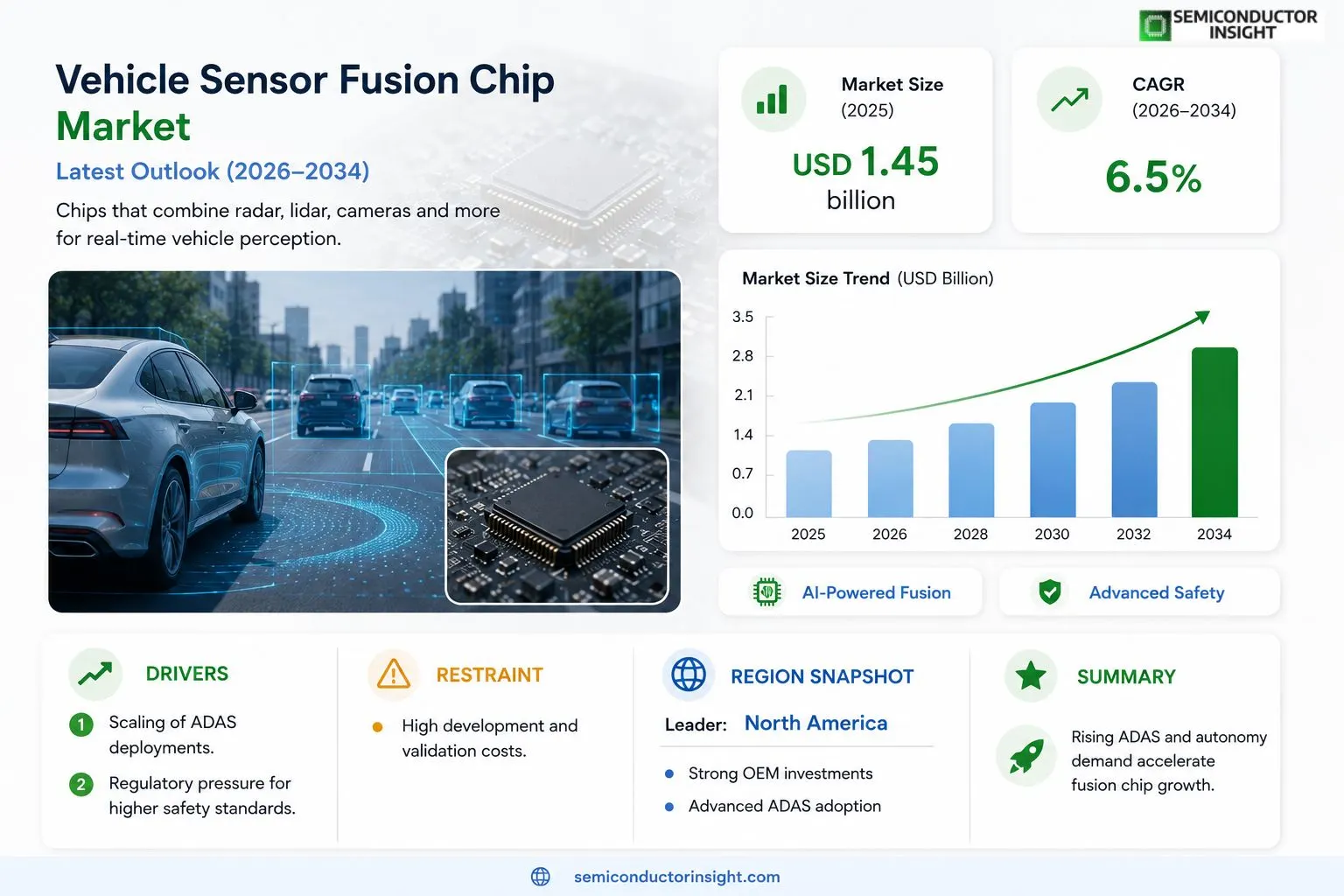
Global Vehicle Sensor Fusion Chip market size was valued at USD 1.45 billion in 2025. The market is projected to grow from USD 1.55 billion in 2026 to USD 2.78 billion by 2034, exhibiting a CAGR of 6.5% during the forecast period.
Vehicle sensor fusion chips are integrated semiconductor solutions that combine data from multiple automotive sensorssuch as radar, lidar, cameras, and ultrasonic unitsinto a coherent perception model for advanced driver‑assistance systems (ADAS) and autonomous driving functions. These chips employ high‑performance processors, AI accelerators, and specialized algorithms to filter noise, align timestamps, and generate reliable situational awareness in real time.The market is accelerating because automakers are scaling up ADAS deployments, while regulatory pressure pushes toward higher safety standards worldwide. Furthermore, the rollout of Level 3‑4 autonomous features demands more powerful fusion capabilities, prompting investments from key players like NVIDIA, Mobileye (Intel), Texas Instruments, NXP Semiconductors and Renesas Electronics.
MARKET DRIVERS
Rising Demand for Advanced Driver Assistance Systems (ADAS)
Vehicle Sensor Fusion Chip Market is being propelled by the rapid adoption of ADAS across passenger cars, where manufacturers seek to enhance safety through real‑time perception. Integration of radar, lidar, and camera data enables features such as emergency braking and lane‑keeping, creating a strong incentive for chip suppliers to deliver higher‑performance fusion solutions.
Integration of 5G Connectivity and Edge Computing
5G networks reduce latency for sensor data transmission, allowing chips to offload intensive processing to edge servers while maintaining instantaneous response. This synergy accelerates the rollout of connected vehicle platforms and fuels demand for more capable sensor fusion silicon.
➤ Industry analysts project a compound annual growth rate exceeding 12% through 2032, driven primarily by autonomous‑driving initiatives and regulatory safety mandates.
Automakers are also expanding their global production footprints, which increases the volume of chips required for new model lines. As a result, Vehicle Sensor Fusion Chip Market benefits from economies of scale and a broader supplier ecosystem.
MARKET CHALLENGES
High Development and Validation Costs
Designing sensor fusion chips that meet stringent automotive safety standards involves substantial R&D investment and extensive validation cycles. Small and mid‑size vendors often face barriers to entry due to these capital‑intensive requirements.
Other Challenges
Supply Chain Constraints
Global semiconductor shortages, combined with limited access to high‑precision manufacturing nodes, can delay product launches and increase bill‑of‑materials costs for vehicle OEMs.
MARKET RESTRAINTS
Regulatory and Safety Compliance Hurdles
Automotive safety regulations such as functional safety (ISO 26262) and emerging cyber‑security standards demand rigorous certification processes. Meeting these criteria adds time and expense, potentially limiting rapid market entry for innovative chip designs.
MARKET OPPORTUNITIES
Growth in Autonomous Vehicle Deployments
As autonomous vehicle pilots expand in major metros, the need for reliable, high‑density sensor fusion chips rises sharply. Companies that can deliver integrated solutions with low power consumption and robust performance are poised to capture significant market share in this emerging segment.
Vehicle Sensor Fusion Chip Market Trends
Integration of Multi‑Modal Sensors Drives Market Momentum
Automakers are expanding advanced driver‑assistance system (ADAS) deployments, creating a steady demand for chips that can fuse radar, lidar, camera and ultrasonic data. Vehicle Sensor Fusion Chip Market benefits from the need to reduce latency while delivering high‑resolution situational awareness, a prerequisite for safe autonomous driving. Recent silicon releases incorporate embedded AI accelerators that support real‑time sensor alignment, noise filtering and dynamic range adaptation, enabling higher perception accuracy without increasing power consumption. Regulatory pressure for stricter safety standards further pushes OEMs to adopt robust fusion solutions that can reliably interpret complex road environments.
Other Trends
Shift Toward Scalable Fusion Architectures
Chip makers are adopting modular designs that allow OEMs to add or remove sensor inputs without redesigning the entire silicon. This scalability reduces development cycles and aligns with the industry’s move toward Level 3‑4 autonomy, where vehicles must process larger data volumes from diverse sensor suites. Software‑defined sensor mapping and configurable data pipelines enable manufacturers to tailor fusion depth to specific vehicle segments, from entry‑level models to premium autonomous platforms. The result is a more cost‑effective deployment path that maintains performance consistency across varied hardware configurations.
Partnerships and Ecosystem Development
Strategic alliances between semiconductor firms and automotive tier‑1 suppliers are accelerating the rollout of standardized interfaces and software stacks. These collaborations simplify integration for vehicle platforms and enable faster validation of fusion algorithms through shared test benches and open‑source libraries. Joint road‑mapping initiatives focus on harmonizing data formats, timing protocols and safety‑critical verification processes, which reduces time‑to‑market for new ADAS and autonomous features. By fostering an ecosystem of compatible tools and certified components, Vehicle Sensor Fusion Chip Market is positioning itself for broader adoption across global fleets while maintaining rigorous functional safety compliance.
COMPETITIVE LANDSCAPEKey Industry Players
Vehicle Sensor Fusion Chip Market Competitive Overview
Vehicle Sensor Fusion Chip Market is dominated by a handful of technology powerhouses that leverage deep AI expertise and advanced silicon design. NVIDIA leads the segment with its Drive AGX platform, delivering high‑throughput GPU‑accelerated processing for multi‑modal perception in Level 3‑4 autonomous systems. Mobileye, under Intel, complements this space with its EyeQ series, integrating radar and camera data via dedicated AI accelerators. Texas Instruments and NXP Semiconductors provide cost‑effective system‑on‑chip (SoC) solutions that address mass‑market ADAS deployments, while Renesas Electronics focuses on automotive‑grade microcontrollers that embed sensor fusion functions for safety‑critical applications. Collectively, these leaders shape a tiered market structure where premium, high‑performance chips serve premium vehicle lines, and more integrated, lower‑cost SoCs compete on volume across mainstream models.Beyond the core tier, a diverse set of niche players contributes specialized capabilities that broaden the ecosystem. STMicroelectronics offers mixed‑signal front‑end integration that eases sensor interfacing. Infineon emphasizes robust power management and security features for safety‑critical fusion. Qualcomm’s Snapdragon Ride platform brings mobile‑class AI processing to automotive, while Bosch’s Sensortec division supplies ultra‑compact sensor arrays that feed fusion engines. Samsung Electronics provides advanced memory and AI‑optimized CPUs, and Ambarella delivers video‑centric fusion chips for vision‑heavy use cases. ON Semiconductor, Analog Devices, Microchip Technology, and Sony also supply critical analog front‑ends, precision timing, and imaging components that enhance overall system reliability. This layered competitive landscape drives rapid innovation, cost reduction, and feature expansion across Vehicle Sensor Fusion Chip Market.
List of Key Vehicle Sensor Fusion Chip Companies Profiled
- NVIDIA
- Mobileye (Intel)
- Texas Instruments
- NXP Semiconductors
- Renesas Electronics
- STMicroelectronics
- Infineon Technologies
- Qualcomm
- Bosch Sensortec
- Samsung Electronics
- Ambarella
- ON Semiconductor
- Analog Devices
- Microchip Technology
- Sony Semiconductor
Segment Analysis:
| Segment Category | Sub-Segments | Key Insights |
| By Type |
|
Processor‑based Fusion Chips are favored for their proven reliability and ease of integration into existing vehicle ECUs.
|
| By Application |
|
Autonomous Driving Platforms demand the most sophisticated data‑fusion capabilities.
|
| By End User |
|
OEMs prioritize long‑term roadmap alignment and robust supply‑chain stability.
|
| By Architecture |
|
Heterogeneous Multicore architectures are gaining traction because they balance compute density with power efficiency.
|
| By Integration Level |
|
Integrated SoC Solutions are preferred where space and weight constraints dominate design decisions.
|
Regional Analysis: North America
United States
The integration of vehicle sensor fusion chips is paramount for advanced driver-assistance systems, enabling features like adaptive cruise control, lane keeping assist, and automatic emergency braking. The demand for these applications is steadily increasing as consumers seek enhanced safety and convenience in their vehicles.
The pursuit of fully autonomous vehicles is a primary driver for the adoption of advanced sensor fusion technologies. These chips play a critical role in processing data from multiple sensors – cameras, radar, lidar – to create a comprehensive understanding of the vehicle’s surroundings.
The automotive industry’s complex global supply chain presents both opportunities and challenges for vehicle sensor fusion chip manufacturers. Reshoring initiatives and diversification of sourcing are key trends influencing the supply landscape in the U.S. market.
Stringent safety regulations and evolving standards for autonomous driving are significantly impacting the development and deployment of vehicle sensor fusion chips in the U.S. Compliance with these regulations is a crucial factor for market participants.
Europe
The European market for Vehicle Sensor Fusion Chip Market is characterized by a strong focus on safety and environmental regulations. The automotive industry in Europe is actively investing in ADAS and electric vehicle (EV) technologies, creating demand for advanced sensor fusion solutions. Key players are concentrating on developing chips that are energy-efficient and can handle the complex data streams generated by multiple sensors. Collaborations between European automotive manufacturers and technology companies are also gaining traction.
Asia-Pacific
Asia-Pacific, particularly China, represents a rapidly growing market for Vehicle Sensor Fusion Chip Market. The increasing production of electric vehicles and the growing adoption of autonomous driving technologies are driving demand for these chips. Government initiatives promoting the development of domestic automotive technology are further fueling market expansion. The region is witnessing a rise in local chip manufacturers and a growing emphasis on cost-effectiveness.
South America
Vehicle Sensor Fusion Chip Market in South America is at an early stage of development but holds significant potential for growth. The increasing affordability of vehicles and the growing awareness of safety features are expected to drive demand for ADAS technologies. The market is currently characterized by a limited number of players and a reliance on imports of sensor fusion chips.
Middle East & Africa
The Middle East & Africa region presents a relatively small, yet emerging market for Vehicle Sensor Fusion Chip Market. The automotive industry in these regions is experiencing growth, driven by increasing disposable incomes and infrastructure development. The demand for advanced driver-assistance systems is expected to rise as vehicle ownership increases and safety concerns grow.
Report Scope
This market research report provides a comprehensive analysis of the Vehicle Sensor Fusion Chip Market , covering the forecast period 2026–2034. It offers detailed insights into market dynamics, technological advancements, competitive landscape, and key trends shaping the industry.
Key focus areas of the report include:
- Market Overview: The report begins with an overview outlining its current market scenario, key growth indicators, and industry transformation drivers. It discusses macroeconomic factors, demand–supply balance, regulatory landscape, and the strategic role of semiconductors in powering advancements across industries such as automotive, telecommunications, consumer electronics, and industrial automation.
- Market Size & Forecast: Historical data and future projections for revenue, unit shipments, and market value across major regions and segments.
- Segmentation Analysis: Detailed breakdown by product type, technology, application, and end-user industry to identify high-growth segments and investment opportunities.
- Regional Insights: Insights into market performance across North America, Europe, Asia-Pacific, Latin America, and the Middle East & Africa, including country-level analysis where relevant.
- Competitive Landscape: Profiles of leading market participants, including their product offerings, R&D focus, manufacturing capacity, pricing strategies, and recent developments such as mergers, acquisitions, and partnerships.
- Technology Trends & Innovation: Assessment of emerging technologies, integration of AI/IoT, semiconductor design trends, fabrication techniques, and evolving industry standards.
- Market Drivers & Restraints: Evaluation of factors driving market growth along with challenges, supply chain constraints, regulatory issues, and market-entry barriers.
- Stakeholder Insights: Insights for component suppliers, OEMs, system integrators, investors, and policymakers regarding the evolving ecosystem and strategic opportunities.
Primary and secondary research methods are employed, including interviews with industry experts, data from verified sources, and real-time market intelligence to ensure the accuracy and reliability of the insights presented.
FREQUENTLY ASKED QUESTIONS:
What is the current market size of Vehicle Sensor Fusion Chip Market?
-> Vehicle Sensor Fusion Chip Market was valued at USD 1.45 billion in 2025 and is expected to reach USD 2.78 billion by 2034, exhibiting a CAGR of 6.5% during the forecast period.
Which key companies operate in Vehicle Sensor Fusion Chip Market?
-> Key players include NVIDIA, Mobileye (Intel), Texas Instruments, NXP Semiconductors, and Renesas Electronics, among others.
What are the key growth drivers?
-> Key growth drivers include scaling of ADAS deployments, regulatory pressure for higher safety standards, and the rollout of Level 3‑4 autonomous features that demand more powerful sensor‑fusion capabilities.
Which region dominates the market?
-> The market is globally distributed, with particularly strong activity in North America and Asia‑Pacific regions driven by major automotive OEM investments.
What are the emerging trends?
-> Emerging trends include integration of AI accelerators, advanced multi‑sensor fusion algorithms, and the development of chips optimized for real‑time perception in autonomous driving systems.

Get Sample Report PDF for Exclusive Insights
Report Sample Includes
- Table of Contents
- List of Tables & Figures
- Charts, Research Methodology, and more...
 Download Sample Report PDF