Vehicle Boost Inductor Market Insights
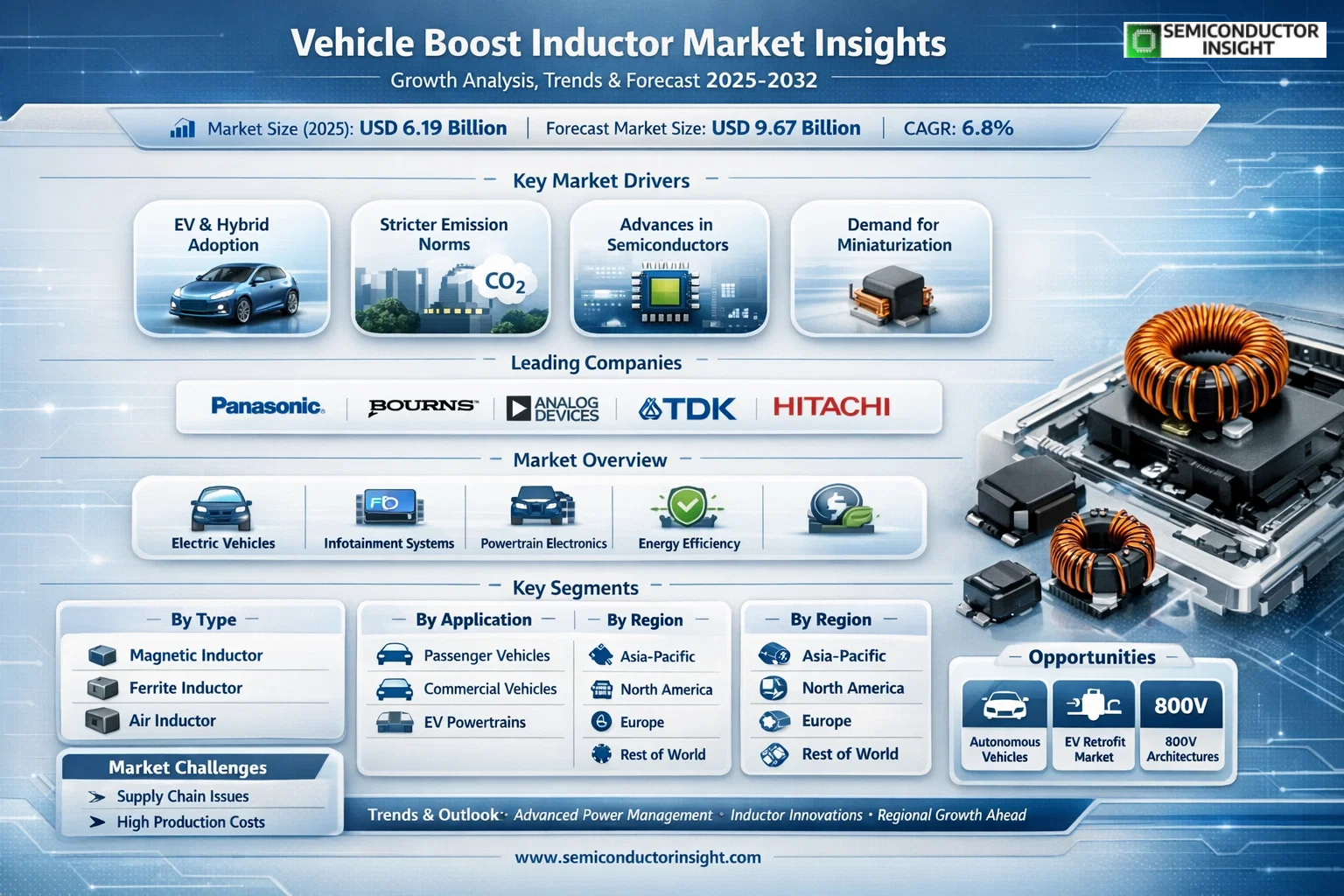
Global Vehicle Boost Inductor market size was valued at USD 6,187 million in 2025. The market is projected to reach USD 9,674 million by 2032, exhibiting a CAGR of 6.8% during the forecast period.
Vehicle boost inductors are specialized inductor components used in vehicle power management systems, primarily in boost converters. They efficiently step up input voltage to the required output levels, supporting critical on-board electronics like lighting, infotainment, and EV powertrains. Key types encompass magnetic inductors, ferrite inductors, and air inductors.
Vehicle Boost Inductor Market is witnessing steady expansion, fueled by surging electric vehicle production, demand for compact power electronics, and advancements in automotive semiconductors. While electrification drives core growth, challenges like supply chain constraints persist. However, key manufacturers including Panasonic, Bourns, Analog Devices, TDK Electronic, Hitachi, Murata Manufacturing, Eaton, Onsemi, and Vishay continue to innovate, holding significant market shares with diverse portfolios tailored to passenger and commercial vehicles.
MARKET DRIVERS
Electrification Surge in Automotive Sector
Vehicle Boost Inductor Market is propelled by the rapid shift toward electric vehicles (EVs) and hybrid electric vehicles (HEVs), where these components are essential for efficient voltage boosting in powertrains. With global EV sales surpassing 10 million units in 2023, demand for compact, high-efficiency inductors has intensified to support advanced battery management systems and inverters.
Stringent Emission Regulations
Government mandates, such as the EU’s Euro 7 standards and U.S. CAFE regulations, are driving automakers to adopt sophisticated electronics that reduce fuel consumption and emissions. Vehicle boost inductors play a critical role in enabling mild-hybrid systems, contributing to a projected market expansion at over 9% CAGR through 2030.
➤ Integration with 48V architectures in premium vehicles enhances power delivery efficiency by up to 20%, accelerating adoption across luxury segments.
Additionally, the push for lightweight materials in inductors aligns with OEMs’ goals for improved vehicle range, further boosting Vehicle Boost Inductor Market amid rising semiconductor integration.
MARKET CHALLENGES
Supply Chain Vulnerabilities
Vehicle Boost Inductor Market faces disruptions from raw material shortages, particularly magnetic cores and copper windings, exacerbated by geopolitical tensions and the 2022-2023 semiconductor crisis. This has led to production delays, with lead times extending by 30-40% for key suppliers.
Other Challenges
High Manufacturing Complexity
Precision winding and thermal management requirements increase costs, challenging scalability for mid-tier manufacturers. Intense R&D investments are needed to meet automotive-grade reliability standards like AEC-Q200.Competition from integrated power modules also pressures discrete inductor makers, forcing innovations in miniaturization without compromising performance in harsh under-hood environments.
MARKET RESTRAINTS
Elevated Material and Production Costs
Fluctuating prices of rare earth elements and copper restrain growth in Vehicle Boost Inductor Market, with costs rising 15-20% in 2023 due to supply constraints. This impacts profitability for manufacturers targeting cost-sensitive emerging markets like India and Southeast Asia.Regulatory compliance for RoHS and REACH adds layers of testing expenses, slowing market entry for smaller players and consolidating power among established firms like TDK and Murata.Moreover, the shift to wide-bandgap semiconductors like SiC and GaN demands redesigned inductors, creating short-term barriers as legacy designs phase out.
MARKET OPPORTUNITIES
Expansion in Autonomous and Connected Vehicles
Vehicle Boost Inductor Market stands to benefit from the proliferation of ADAS and Level 3+ autonomy, where high-voltage DC-DC converters require robust inductors for sensor fusion and computing power. With autonomous vehicle testing fleets growing 25% annually, opportunities abound for next-gen designs.Aftermarket retrofits for EV conversions present untapped potential, especially in Europe and North America, where incentives drive a 12% yearly increase in demand.Emerging 800V architectures in premium EVs offer scope for high-frequency inductors, promising efficiency gains of 5-10% and positioning the market for sustained double-digit growth post-2025.
Vehicle Boost Inductor Market Trends
Integration in Vehicle Power Management Systems
Vehicle Boost Inductor Market reflects key trends centered on the critical function of these components in boost converters within automotive power systems. These inductors elevate low input voltages to higher levels required for diverse on-board electronic equipment, supporting reliable operation in modern vehicles. Industry surveys of manufacturers, suppliers, and experts underscore sustained demand driven by expanding automotive electronics complexity. Trends indicate stable price dynamics alongside product innovations across types such as magnetic, ferrite, and air inductors, enabling better efficiency in power conversion. This evolution aligns with broader shifts in vehicle designs prioritizing advanced power management for enhanced performance and reliability in Vehicle Boost Inductor Market.
Other Trends
Competitive Dynamics Among Leading Manufacturers
Panasonic, Bourns, Analog Devices, TDK Electronic, Hitachi, Murata Manufacturing, Eaton, Onsemi, Vishay, and Eagtop Electronic represent pivotal players shaping Vehicle Boost Inductor Market. These firms command substantial revenue shares, with the top five holding a notable portion globally. Recent strategies emphasize development plans, including product enhancements and potential mergers to counter challenges like supply fluctuations and technological hurdles. Surveys reveal proactive responses to industry drivers, such as heightened demand from electronic integration, fostering competitive advancements tailored to market needs.
Shifts Across Applications and Regions
Application segments reveal distinct trajectories, with passenger vehicles demonstrating strong alignment to consumer trends in electronics-equipped automobiles, while commercial vehicles gain from logistics and fleet electrifications. Regionally, Asia emerges prominently with contributions from China, Japan, and South Korea, alongside Southeast Asia and India. North America, Europe encompassing Germany and France, and other areas like South America and Middle East & Africa exhibit varied potentials influenced by local automotive productions. These patterns, drawn from market analyses, highlight opportunities in diverse segments of Vehicle Boost Inductor Market, guiding strategic positioning amid global dynamics.
COMPETITIVE LANDSCAPE
Key Industry Players
Top Manufacturers in the Global Vehicle Boost Inductor Market
Vehicle Boost Inductor Market features a moderately concentrated competitive landscape dominated by established electronics and semiconductor leaders. Panasonic, Bourns, and Analog Devices emerge as frontrunners, leveraging their expertise in power management components to capture significant revenue shares. The global top five players, including TDK Electronic and Hitachi, collectively hold a substantial portion of the market, estimated through industry surveys on sales and revenue. This structure drives innovation in boost converters for automotive applications, supported by the market’s growth from USD 6187 million in 2025 to USD 9674 million by 2032 at a 6.8% CAGR, amid rising demand for efficient vehicle power systems in electric and hybrid segments.
Beyond the market leaders, a range of niche and regional players contribute to diversification, particularly in specialized inductor types like magnetic, ferrite, and air inductors for commercial and passenger vehicles. Companies such as Murata Manufacturing, Eaton, Onsemi, and Vishay offer robust portfolios with competitive pricing and advanced materials, while Asian firms like Eagtop Electronic, Tonhe Electronics, Sunlord Electronics, and Codaca Electronics focus on cost-effective solutions and rapid scalability. Emerging entities including Jinlai Electronic Technology, Click Technology, JingQuanHua Electronics, and Eaglerise Electric & Electronic are gaining ground through targeted innovations and supply chain strengths, enhancing overall market dynamism and fostering opportunities in high-growth regions like Asia-Pacific.
List of Key Vehicle Boost Inductor Companies Profiled
- Panasonic
- Bourns
- Analog Devices
- TDK Electronic
- Hitachi
- Murata Manufacturing
- Eaton
- Onsemi
- Vishay
- Eagtop Electronic
- Tonhe Electronics
- Sunlord Electronics
- Codaca Electronics
- Jinlai Electronic Technology
- Click Technology
- JingQuanHua Electronics
- Eaglerise Electric & Electronic
Segment Analysis:
| Segment Category | Sub-Segments | Key Insights |
| By Type |
|
Magnetic Inductor
|
| By Application |
|
Passenger Vehicle
|
| By End User |
|
Automotive OEMs
|
| By Powertrain Type |
|
Hybrid Electric Vehicles (HEV/PHEV)
|
| By Voltage Rating |
|
48V Mild Hybrid
|
Regional Analysis: Vehicle Boost Inductor Market
Asia-Pacific
China and Japan host major fabrication centers for Vehicle Boost Inductor components, leveraging advanced automation and precision winding techniques. These hubs benefit from proximity to automotive assembly lines, enabling just-in-time delivery and reduced logistics costs. Investments in smart factories further streamline production, enhancing output quality for high-current applications in EV powertrains.
Leading OEMs like Toyota, Honda, and BYD drive demand through integrated supply chains, specifying custom inductors for efficient voltage boosting. Strategic partnerships with component makers accelerate development cycles, aligning inductor performance with vehicle-specific power requirements and regulatory norms.
Innovations in nanocrystalline materials and multi-layer winding boost inductor efficiency, reducing energy losses in high-voltage EV systems. Research initiatives focus on SiC-compatible designs, improving thermal dissipation and enabling smaller footprints for space-constrained architectures.
Localized ecosystems minimize import dependencies, with vertical integration from raw materials to final assembly. Collaborative networks among tier-1 suppliers enhance responsiveness to fluctuating OEM demands, ensuring steady Vehicle Boost Inductor availability amid global shifts.
North America
North America exhibits strong growth in Vehicle Boost Inductor Market, propelled by pioneering electric vehicle adoption and technological leadership. The U.S. and Canada host innovative OEMs like Tesla and GM, which prioritize high-performance inductors for advanced power electronics in long-range EVs. Regulatory frameworks emphasizing emissions reduction spur demand for efficient boost converters. The region benefits from R&D ecosystems in Silicon Valley and Detroit, fostering developments in lightweight, high-frequency inductors using advanced magnetic materials. Supply chains are diversifying with nearshoring efforts to counter vulnerabilities, while collaborations between universities and industry drive next-gen designs. Market dynamics highlight a focus on premium segments, including autonomous vehicles, where robust inductors ensure reliable power delivery under variable loads. Challenges like raw material sourcing are addressed through strategic alliances, positioning North America as a key innovator rather than volume leader.
Europe
Europe’s Vehicle Boost Inductor Market thrives on stringent environmental mandates and a mature automotive sector. Germany, France, and the UK lead with OEMs such as Volkswagen, BMW, and Renault, integrating sophisticated inductors into hybrid and full-EV platforms for optimized energy management. EU policies accelerate transition to electrified fleets, boosting demand for compact, high-efficiency components. Innovation centers in Stuttgart and Paris advance toroidal and planar inductor technologies, enhancing compatibility with GaN devices. Supply networks emphasize sustainability, with recycled materials gaining traction. Regional dynamics reflect balanced growth across passenger and commercial vehicles, supported by cross-border collaborations that standardize specifications and reduce development costs. Emphasis on lifecycle assessments drives eco-friendly designs, solidifying Europe’s role in premium, regulation-compliant Vehicle Boost Inductor solutions.
South America
South America is an emerging player in Vehicle Boost Inductor Market, with Brazil and Mexico at the forefront amid rising vehicle electrification. Local production ramps up to support flex-fuel hybrids and entry-level EVs, where cost-effective inductors are essential for voltage stabilization. Government incentives and trade agreements facilitate technology transfers from global leaders. Manufacturing clusters in Sao Paulo integrate inductors suited to rugged terrains, focusing on durability. Market expansion is fueled by urban mobility trends and infrastructure investments, though challenges like economic volatility necessitate resilient supply strategies. Dynamics show gradual localization, blending imported high-tech with affordable adaptations to capture mass-market potential in the Vehicle Boost Inductor segment.
Middle East & Africa
The Middle East & Africa region shows nascent but promising development in Vehicle Boost Inductor Market, driven by diversification from oil dependency towards green mobility. UAE, South Africa, and Saudi Arabia invest in EV infrastructure, spurring demand for reliable inductors in luxury and fleet applications. Partnerships with Asian suppliers bridge technology gaps, enabling assembly of boost systems for harsh climates. Focus areas include heat-resistant designs for desert operations. Market dynamics hinge on pilot projects and policy shifts, with growth tempered by infrastructural hurdles but accelerated by sovereign funds targeting sustainable tech. Emerging ecosystems position the region for future contributions to global Vehicle Boost Inductor advancements.
Report Scope
This market research report provides a comprehensive analysis of Vehicle Boost Inductor Market, covering the forecast period 2026–2034. It offers detailed insights into market dynamics, technological advancements, competitive landscape, and key trends shaping the industry.
Key focus areas of the report include:
- Market Overview: The report begins with an overview outlining its current market scenario, key growth indicators, and industry transformation drivers. It discusses macroeconomic factors, demand–supply balance, regulatory landscape, and the strategic role of semiconductors in powering advancements across industries such as automotive, telecommunications, consumer electronics, and industrial automation.
- Market Size & Forecast: Historical data and future projections for revenue, unit shipments, and market value across major regions and segments.
- Segmentation Analysis: Detailed breakdown by product type, technology, application, and end-user industry to identify high-growth segments and investment opportunities.
- Regional Insights: Insights into market performance across North America, Europe, Asia-Pacific, Latin America, and the Middle East & Africa, including country-level analysis where relevant.
- Competitive Landscape: Profiles of leading market participants, including their product offerings, R&D focus, manufacturing capacity, pricing strategies, and recent developments such as mergers, acquisitions, and partnerships.
- Technology Trends & Innovation: Assessment of emerging technologies, integration of AI/IoT, semiconductor design trends, fabrication techniques, and evolving industry standards.
- Market Drivers & Restraints: Evaluation of factors driving market growth along with challenges, supply chain constraints, regulatory issues, and market-entry barriers.
- Stakeholder Insights: Insights for component suppliers, OEMs, system integrators, investors, and policymakers regarding the evolving ecosystem and strategic opportunities.
Primary and secondary research methods are employed, including interviews with industry experts, data from verified sources, and real-time market intelligence to ensure the accuracy and reliability of the insights presented.
FREQUENTLY ASKED QUESTIONS:
What is the current market size of Vehicle Boost Inductor Market?
-> Global Vehicle Boost Inductor Market was valued at USD 6187 million in 2025 and is projected to reach USD 9674 million by 2032, at a CAGR of 6.8% during the forecast period.
Which key companies operate in Vehicle Boost Inductor Market?
-> Key players include Panasonic, Bourns, Analog Devices, TDK Electronic, Hitachi, Murata Manufacturing, Eaton, Onsemi, Vishay, Eagtop Electronic, among others.
What are the key growth drivers?
-> Key growth drivers include demand for efficient power management systems in vehicles, adoption of boost converters for on-board electronics, and industry trends in automotive applications.
Which region dominates the market?
-> Asia is the fastest-growing region, driven by markets in China, Japan, and South Korea, while North America holds significant share with the U.S. market.
What are the emerging trends?
-> Emerging trends include advancements in magnetic inductors and ferrite inductors, growth in applications for passenger and commercial vehicles, and developments in vehicle boost converter technologies.

Get Sample Report PDF for Exclusive Insights
Report Sample Includes
- Table of Contents
- List of Tables & Figures
- Charts, Research Methodology, and more...
 Download Sample Report PDF