Vapor Concentration Monitors Market Insights
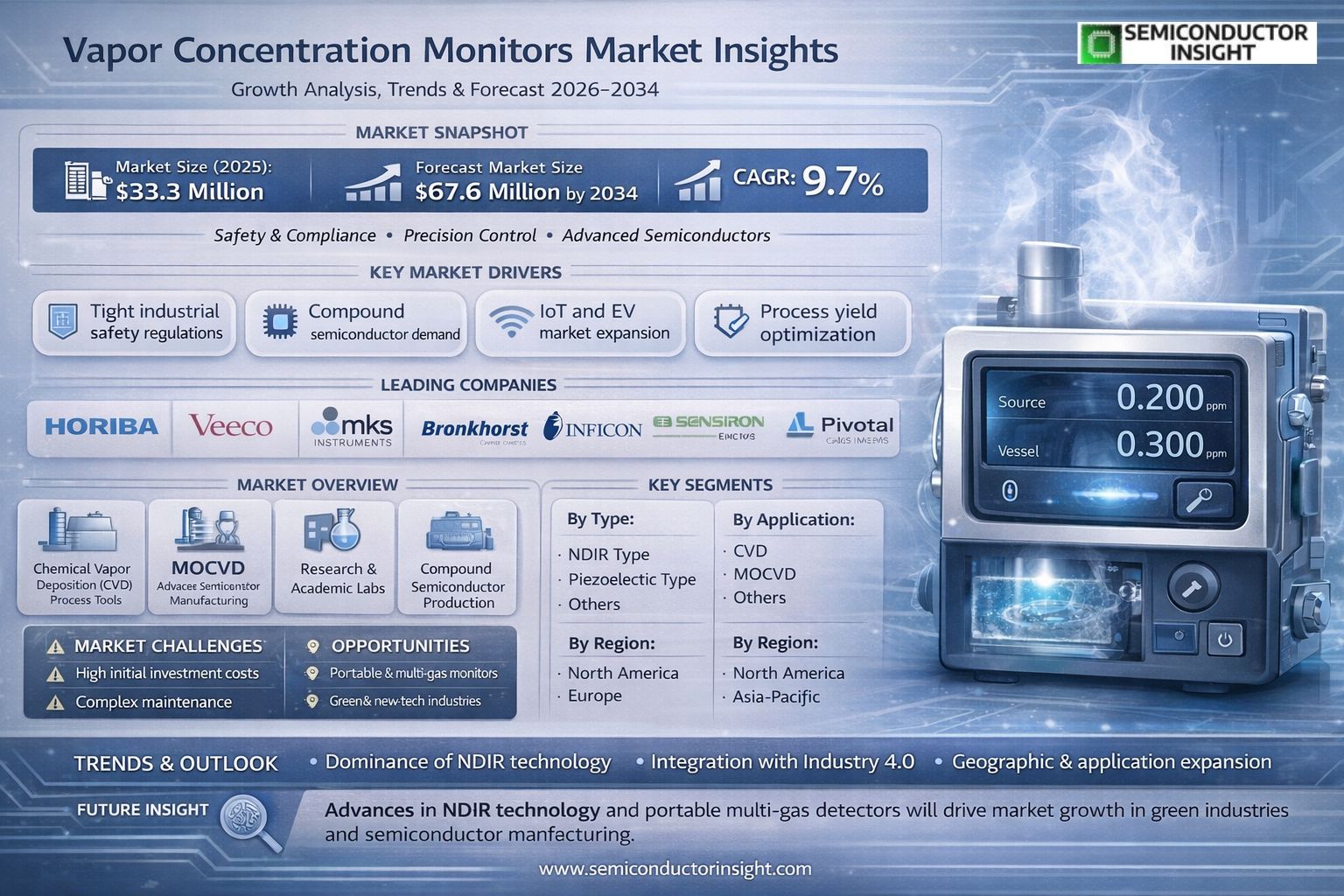
Global vapor concentration monitors market size was valued at USD 33.3 million in 2025. The market is projected to grow from USD 36.5 million in 2026 to USD 67.6 million by 2034, exhibiting a CAGR of 9.7% during the forecast period.
Vapor concentration monitors are specialized instruments crucial for precise process control and safety in advanced manufacturing environments. These devices facilitate accurate monitoring and reproducible delivery control of chemical precursor vapors and dopant gases, encompassing critical processes such as Chemical Vapor Deposition (CVD) and Metal-Organic Chemical Vapor Deposition (MOCVD). The technology types include Non-Dispersive Infrared (NDIR), Piezoelectric, and other sensing methods.
The market is experiencing robust growth due to several factors, including the escalating demand for semiconductor devices, significant investment in compound semiconductor production for applications like LEDs and power electronics, and increasingly stringent process yield requirements. Furthermore, the expansion of the Internet of Things (IoT) and electric vehicle markets is driving demand for more sophisticated chips, which in turn fuels the need for precise deposition monitoring tools. Initiatives by key players are also expected to fuel market growth through technological advancements aimed at improving sensitivity and integration with fab automation systems. HORIBA Ltd., Veeco Instruments Inc., MKS Instruments Inc., and Bronkhorst High-Tech B.V. are some of the key players that operate in the market with a wide range of portfolios.
MARKET DRIVERS
Stringent Industrial Safety and Environmental Regulations
Global regulations, such as OSHA’s PELs and the EU’s ATEX directives, mandate strict monitoring of hazardous airborne substances in industrial settings. This compliance-driven demand is a primary force propelling the adoption of vapor concentration monitors across sectors like chemical processing, oil & gas, and pharmaceuticals to ensure workplace safety and environmental protection.
Advancements in Sensor Technology and IoT Integration
The integration of advanced sensors, including PID and laser-based detectors, with IoT platforms enables real-time, remote monitoring and predictive maintenance. This evolution enhances the functionality, accuracy, and connectivity of vapor concentration monitors, making them more valuable for industrial automation and smart facility management.
➤ Increasing industrialization and the expansion of the manufacturing sector in developing economies are generating sustained demand for reliable air quality monitoring solutions, directly benefiting the Vapor Concentration Monitors Market.
The focus on worker health and the prevention of costly industrial incidents related to solvent or toxic vapor exposure further solidifies the need for these critical monitoring systems, supporting steady market growth.
MARKET CHALLENGES
High Initial Investment and Maintenance Costs
Advanced vapor concentration monitors often represent a significant capital expenditure for end-users. Beyond the initial purchase, ongoing costs for calibration, sensor replacement, and specialized technician training can be substantial, posing a barrier to adoption, particularly for smaller and medium-sized enterprises.
Other Challenges
Technical Limitations in Harsh Environments
Deploying monitors in extreme conditions—such as high temperatures, corrosive atmospheres, or areas with high levels of particulate matter—can impact sensor longevity and accuracy, requiring more rugged and expensive designs.
Market Fragmentation and a Lack of Standardization
The presence of numerous regional and global players with varying product specifications can lead to a fragmented Vapor Concentration Monitors Market. The absence of universal communication protocols or performance standards complicates system integration and benchmarking for end-users.
MARKET RESTRAINTS
Economic Volatility and Fluctuating Industrial Capital Expenditure
Economic downturns or uncertainty directly impact industrial investment cycles. During periods of constrained capital expenditure, purchases of non-essential or higher-end monitoring equipment are often delayed or canceled, temporarily restraining growth in the Vapor Concentration Monitors Market as companies prioritize core operational spending.
Dependence on Mature End-Use Industries
The market’s heavy reliance on established sectors like oil & gas and traditional chemical manufacturing makes it susceptible to the cyclical nature and long-term transformation of these industries, potentially limiting rapid expansion in favor of incremental, replacement-driven demand.
MARKET OPPORTUNITIES
Emergence of Compact, Portable, and Multi-Gas Monitors
The demand for personal, wearable monitors and compact, handheld multi-gas detectors is creating a significant growth avenue. These products cater to the needs of first responders, field technicians, and workers in confined spaces, expanding the reach of the Vapor Concentration Monitors Market beyond fixed installations.
Expansion into New Applications and Green Industries
Beyond traditional heavy industry, new applications are arising in semiconductor fabrication, lithium-ion battery production, pharmaceutical research, and renewable energy (e.g., biogas, hydrogen). Monitoring processes in these high-growth, tech-driven sectors presents substantial opportunities for specialized vapor concentration monitoring solutions.
Data Analytics and Cloud-Based Service Models
The shift towards offering monitoring-as-a-service, leveraging cloud platforms for data aggregation and advanced analytics, allows vendors to create recurring revenue streams. This model provides customers with actionable insights into emission trends and compliance reporting, adding significant value to core monitoring hardware in the Vapor Concentration Monitors Market.
Vapor Concentration Monitors Market Trends
Dominant Shift Towards NDIR Technology
A primary market trend is the significant and growing adoption of Non-Dispersive Infrared (NDIR) type monitors. This technology offers high precision and reliable measurement for precursor vapors and dopant gases, making it the preferred choice for sophisticated semiconductor manufacturing processes like CVD and MOCVD. The shift is driven by the critical need for process reproducibility and yield optimization in advanced electronics fabrication. Manufacturers are consistently improving NDIR sensor design to enhance sensitivity and reduce calibration frequency, solidifying its market leadership position among Vapor Concentration Monitors.
Other Trends
Integration with Industry 4.0 and Smart Manufacturing
The industry is witnessing a strong trend towards the integration of Vapor Concentration Monitors with Industrial Internet of Things (IIoT) platforms and advanced process control systems. Modern monitors are increasingly equipped with digital communication protocols, enabling real-time data streaming for predictive analytics and remote monitoring. This connectivity allows for tighter control over deposition processes, automated adjustments, and proactive maintenance, directly contributing to improved operational efficiency and reduced downtime in production facilities.
Geographic and Application-Specific Market Evolutions
Market trends show a clear geographic expansion in demand, with Asia-Pacific, particularly China, Japan, and South Korea, emerging as a high-growth region. This aligns directly with Global concentration of semiconductor fabrication capacity. Concurrently, the application scope for Vapor Concentration Monitors is broadening beyond traditional CVD and MOCVD. Emerging applications in sectors such as advanced LED production, specialized optical coatings, and high-purity thin-film manufacturing are creating new, diversified demand streams. This evolution requires manufacturers to offer application-specific calibration and monitoring solutions.
COMPETITIVE LANDSCAPE
Key Industry Players
A concentrated market driven by precision and process control technology
Global vapor concentration monitors market exhibits a moderately concentrated structure, with the top five players accounting for a significant revenue share as of 2025. This concentration is attributed to the high technical barriers associated with developing accurate and reliable monitoring systems for advanced semiconductor and thin-film deposition processes like CVD and MOCVD. Leading players such as HORIBA, Veeco Instruments, and MKS Instruments leverage their deep expertise in process instrumentation, analytical solutions, and integration capabilities to dominate the competitive landscape. Their focus on R&D for NDIR and piezoelectric sensing technologies, coupled with extensive global support networks, reinforces their market position and caters to the stringent demands of major semiconductor fabrication facilities. This creates an environment where technological innovation, proven reliability, and strong customer partnerships are key differentiators.
Beyond the dominant tier, several other significant and niche players contribute to market dynamism by offering specialized solutions or targeting specific application segments. Companies like Bronkhorst excel in precise fluid delivery and control, providing integrated solutions that complement vapor monitoring. Other manufacturers focus on cost-competitive offerings for emerging markets or develop monitors tailored for specific chemical precursors, thus addressing the fragmented yet growing demand from various research institutions and smaller-scale production environments. Ongoing market expansion is fostering competition, with players seeking growth through strategic mergers, acquisitions, and the development of multi-gas monitoring capabilities to enhance their product portfolios.
List of Key Vapor Concentration Monitors Companies Profiled
- HORIBA
- Veeco Instruments
- MKS Instruments
- Bronkhorst High-Tech B.V.
- Inficon
- Sensirion AG
- ATMI (now part of Entegris, Inc.)
- Pivotal Systems
- KROHNE Messtechnik GmbH
- CS Clean Systems AG
- amsys GmbH & Co. KG
- Kinetics (a Unit of Emerson Electric Co.)
- Membrapor AG
- WONIK QnC
Segment Analysis:
| Segment Category | Sub-Segments | Key Insights |
| By Type |
|
NDIR Type is the dominant technology segment. This is driven by its high sensitivity and accuracy for detecting infrared-absorbing vapors, which is critical for semiconductor-grade processes. Its robustness in harsh industrial environments and compatibility with a wide range of precursor chemicals in advanced fabrication tools underpins its leadership. Furthermore, the technology offers reliable, drift-free performance, which is essential for maintaining process yield and reproducibility. |
| By Application |
|
MOCVD (Metal-Organic Chemical Vapor Deposition) represents a critical and high-growth application segment. The demand is fuelled by the extensive use of MOCVD in manufacturing advanced semiconductor devices, particularly light-emitting diodes (LEDs), laser diodes, and power electronics, where precise control of vaporized metal-organics is paramount. This application’s stringent requirements for uniform film thickness and quality make vapor concentration monitors an indispensable process control component. The adoption in cutting-edge photonics and compound semiconductor manufacturing further strengthens its leading position. |
| By End User |
|
Semiconductor & Electronics Foundries are the primary end-users driving the market. These high-volume production facilities require continuous, real-time monitoring to ensure process integrity, minimize wafer scrap, and optimize the use of expensive precursor materials. The relentless push toward smaller semiconductor nodes and novel materials like gallium nitride (GaN) and silicon carbide (SiC) creates a non-negotiable demand for precise vapor concentration control. Market growth is intrinsically linked to capital expenditure cycles and fab expansions within this sector. |
| By Technology Integration |
|
Integrated Process Tool Solutions are the leading integration method. Equipment manufacturers and foundries prioritize solutions that are seamlessly embedded into new CVD and MOCVD tool designs to guarantee optimal performance and reduce integration complexity. This trend is driven by the need for holistic process control, predictive maintenance capabilities, and streamlined data collection for Industry 4.0 analytics. Integration allows for closed-loop control systems that automatically adjust process parameters, enhancing overall equipment effectiveness (OEE). |
| By Monitoring Capability |
|
Real-time In-line Measurement capability is the defining feature of leading-edge monitors. This segment’s dominance is absolute as it provides immediate feedback on vapor concentration directly within the process line, enabling dynamic process corrections that safeguard product quality. It eliminates the delays and potential inaccuracies associated with offline sampling, which is crucial in fast-paced semiconductor manufacturing. This capability is foundational for achieving high yield, minimizing hazardous chemical usage, and meeting stringent safety and environmental compliance standards in real-time. |
Regional Analysis: Global Vapor Concentration Monitors Market
North America
The cornerstone of the North American market is its comprehensive regulatory framework. Compliance with Clean Air Act mandates and stringent Permissible Exposure Limits (PELs) set by OSHA creates non-negotiable demand. Industries proactively adopt vapor concentration monitors not just for compliance but also for liability protection and corporate sustainability reporting, ensuring market resilience.
There is a pronounced preference for high-performance, low-maintenance monitoring technologies. Tunable Diode Laser Absorption Spectroscopy (TDLAS) and cavity ring-down spectroscopy are increasingly favored for their precision and ability to operate in harsh environments. The integration of these monitors with plant-wide Distributed Control Systems (DCS) for centralized safety management is a key trend.
Demand is strongest in the chemical & petrochemical sector for fugitive emission monitoring, followed by oil & gas for fenceline and facility monitoring. The semiconductor and pharmaceutical industries also represent high-growth niches, requiring ultra-pure environments and precise solvent vapor monitoring during manufacturing processes, driving demand for specialized vapor concentration monitors.
The region benefits from a dense ecosystem of established global manufacturers, specialized engineering firms, and service providers. This ecosystem facilitates innovation, provides strong technical support and calibration services, and enables the development of tailored solutions for complex applications, further entrenching the advanced nature of the Vapor Concentration Monitors Market here.
Europe
The European Vapor Concentration Monitors Market is characterized by some of the world’s most ambitious environmental directives, such as the Industrial Emissions Directive (IED) and stringent national implementations like Germany’s TA Luft. This creates a consistent, regulation-driven demand similar to North America, but with a distinct emphasis on greenhouse gas monitoring alongside industrial pollutants. The market is advanced, with a strong focus on precision, data integrity for regulatory reporting, and the adoption of green technologies. The presence of major chemical and automotive manufacturing hubs in Western Europe sustains core demand, while growing emphasis on circular economy and solvent recovery processes in Eastern Europe is opening new application areas. European end-users show high acceptance of premium, reliable monitoring systems, favoring suppliers who can demonstrate compliance with regional certification standards and provide comprehensive lifecycle support.
Asia-Pacific
Asia-Pacific represents the most dynamic and fastest-growing region for the Vapor Concentration Monitors Market, driven by rapid industrialization, increasing foreign investments, and gradually tightening environmental regulations. Countries like China, Japan, South Korea, and India are key growth engines. The initial demand is heavily concentrated on basic monitoring for compliance in new industrial zones and expanding petrochemical complexes. However, the market is bifurcating; while cost-effective portable and fixed-point detectors see high volume growth, there is a parallel, rapidly expanding demand for high-end systems in advanced electronics manufacturing and specialty chemicals. Local manufacturing of monitors is increasing, influencing competitive dynamics. The long-term trajectory depends heavily on the enforcement stringency of environmental policies and the growing industrial safety awareness, positioning the Asia-Pacific Vapor Concentration Monitors Market for significant evolution.
South America
The Vapor Concentration Monitors Market in South America is developing, with growth primarily tied to the region’s extensive mining, oil & gas extraction, and agri-processing industries. Market dynamics are uneven, with countries like Brazil and Chile having more established regulatory frameworks and consequently stronger demand for monitoring equipment in industrial and port facilities. The primary driver is often operational safety and the need to mitigate community impact near industrial sites, rather than sophisticated regulatory reporting. Demand leans towards robust, easy-to-maintain systems suited for challenging environments. Economic volatility can impact capital investment cycles for such equipment, but the essential nature of safety and baseline environmental protection provides a steady, if gradual, growth foundation for vapor concentration monitor adoption across key industrial sectors.
Middle East & Africa
The market in the Middle East & Africa is primarily driven by the massive hydrocarbon industry, particularly in the GCC countries. Large-scale oil refineries, petrochemical plants, and gas processing facilities constitute the core application area for vapor concentration monitors, focusing on leak detection, fugitive emissions, and fenceline monitoring. The driver is a combination of operational safety, asset protection, and an increasing alignment with global environmental standards to maintain export market access. In Africa, growth is more nascent and localized to specific mining and industrial hotspots. The broader regional market shows a preference for very durable equipment capable of withstanding extreme climatic conditions. While the adoption rate of the latest analytical technologies is slower than in mature markets, the sheer scale of industrial projects in the region ensures a substantial and steady demand for reliable vapor concentration monitoring solutions.
Report Scope
This market research report provides a comprehensive analysis of Global Vapor Concentration Monitors Market, covering the forecast period 2026–2034. It offers detailed insights into market dynamics, technological advancements, competitive landscape, and key trends shaping the industry.
Key focus areas of the report include:
- Market Overview: The report begins with an overview outlining the current market scenario, key growth indicators, and industry transformation drivers. It discusses macroeconomic factors, demand–supply balance, regulatory landscape, and the strategic role of vapor concentration monitoring in enabling precision processes across key industries such as semiconductor manufacturing, advanced materials, and research & development.
- Market Size & Forecast: Historical data and future projections for revenue, unit shipments, and market value across major regions and segments.
- Segmentation Analysis: Detailed breakdown by product type (NDIR, Piezoelectric, Others), technology, application (CVD, MOCVD, Others), and end-user industry to identify high-growth segments and investment opportunities.
- Regional Insights: Insights into market performance across North America, Europe, Asia-Pacific, South America, and the Middle East & Africa, including country-level analysis.
- Competitive Landscape: Profiles of leading market participants, including their product offerings, R&D focus, manufacturing capacity, pricing strategies, and recent developments such as mergers, acquisitions, and partnerships.
- Technology Trends & Innovation: Assessment of emerging monitoring technologies, integration with process control systems, and evolving industry standards for vapor delivery.
- Market Drivers & Restraints: Evaluation of factors driving market growth along with challenges, supply chain constraints, regulatory issues, and market-entry barriers.
- Stakeholder Insights: Insights for manufacturers, suppliers, system integrators, investors, and policymakers regarding the evolving ecosystem and strategic opportunities.
Primary and secondary research methods are employed, including interviews with industry experts, data from verified sources, and real-time market intelligence to ensure the accuracy and reliability of the insights presented.
FREQUENTLY ASKED QUESTIONS:
What is the current market size of Vapor Concentration Monitors Market?
-> Global Vapor Concentration Monitors Market was valued at USD 33.3 million in 2025 and is projected to reach USD 67.6 million by 2034, growing at a CAGR of 9.7% during the forecast period.
Which key companies operate in Vapor Concentration Monitors Market?
-> Key players include HORIBA, Veeco Instruments, MKS Instruments, and Bronkhorst, among others. In 2025, Global top five players held a significant revenue share.
What are the key applications of Vapor Concentration Monitors?
-> These monitors are primarily used for accurate monitoring and reproducible delivery control of chemical precursor vapors and dopant gases in CVD and MOCVD process tools.
What are the major market segments by type?
-> The market is segmented by type, including NDIR Type, Piezoelectric Type, and Others. The NDIR Type segment is projected to reach a significant value by 2034.
Which regions are analyzed in the report?
-> The report provides detailed analysis for regions including North America, Europe, Asia, South America, and the Middle East & Africa. The U.S. and China are key country-level markets.

Get Sample Report PDF for Exclusive Insights
Report Sample Includes
- Table of Contents
- List of Tables & Figures
- Charts, Research Methodology, and more...
 Download Sample Report PDF