Valve driver analog control with dither for hydraulic systems Market Insights
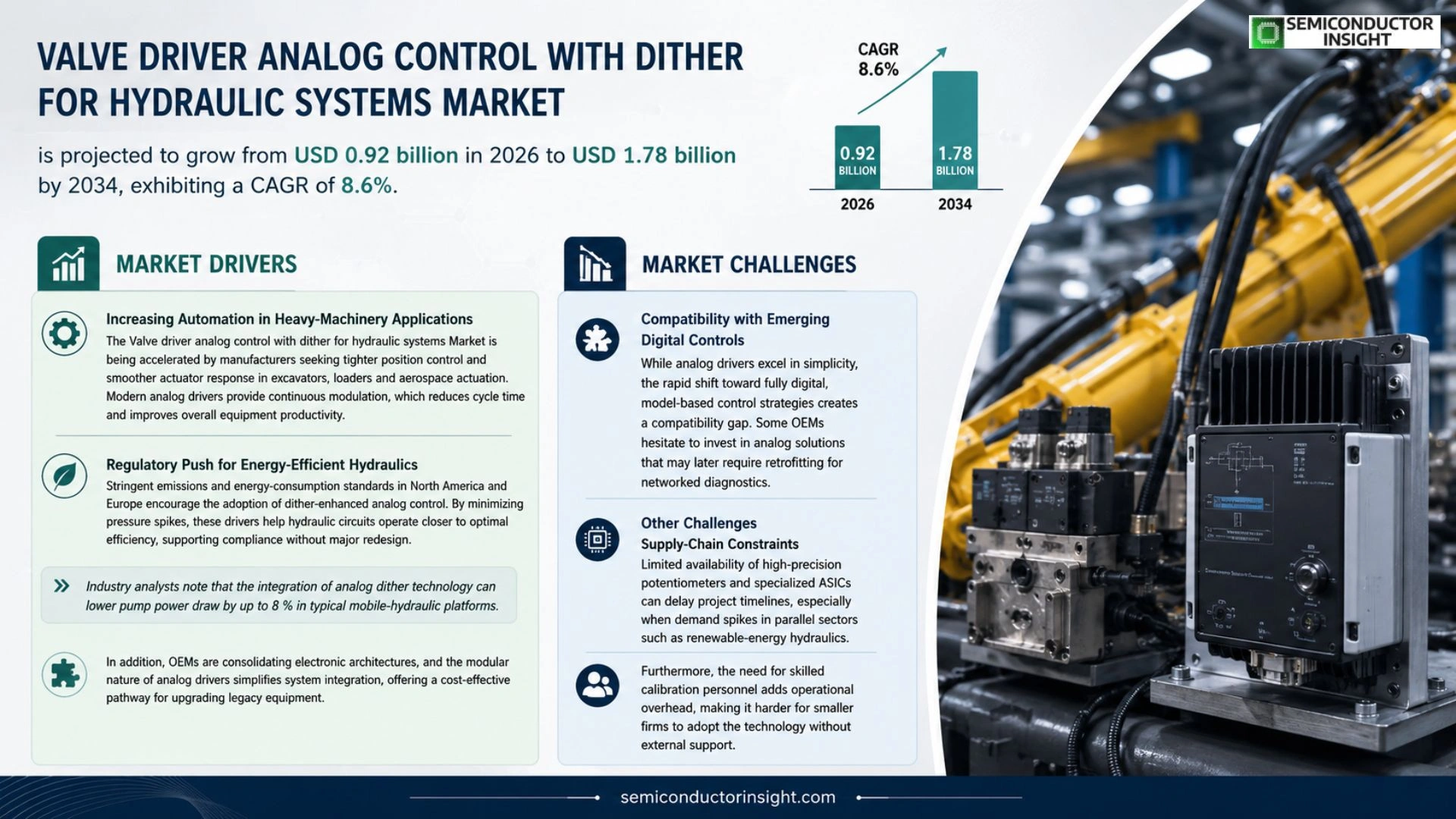
Global Valve driver analog control with dither for hydraulic systems market size was valued at USD 0.85 billion in 2025. The market is projected to grow from USD 0.92 billion in 2026 to USD 1.78 billion by 2034, exhibiting a CAGR of 8.6% during the forecast period.
Valve driver analog control with dither refers to an electronic actuator that modulates hydraulic valve position using a continuous analog signal combined with high‑frequency dithering pulses to reduce stick‑slip and improve flow stability.Dithering injects micro‑oscillations that linearize valve response, enabling finer torque control and lower energy consumption in mobile and industrial hydraulics.
The market is experiencing rapid expansion because manufacturers are seeking higher precision and lower emissions in heavy‑equipment applications.Furthermore, the rise of Industry 4.0 drives integration of smart controllers that communicate via CAN or Ethernet/IP.However, cost sensitivity remains a challenge for small‑scale OEMs.Key players such as Parker Hannifin, Bosch Rexroth, Eaton Corporation and Danfoss are investing in next‑generation driver ASICs and partnering with system integrators to
MARKET DRIVERS
Increasing Automation in Heavy‑Machinery Applications
Valve driver analog control with dither for hydraulic systems Market is being accelerated by manufacturers seeking tighter position control and smoother actuator response in excavators, loaders and aerospace actuation. Modern analog drivers provide continuous modulation, which reduces cycle time and improves overall equipment productivity.
Regulatory Push for Energy‑Efficient Hydraulics
Stringent emissions and energy‑consumption standards in North America and Europe encourage the adoption of dither‑enhanced analog control. By minimizing pressure spikes, these drivers help hydraulic circuits operate closer to optimal efficiency, supporting compliance without major redesign.
➤ Industry analysts note that the integration of analog dither technology can lower pump power draw by up to 8 % in typical mobile‑hydraulic platforms.
In addition, OEMs are consolidating electronic architectures, and the modular nature of analog drivers simplifies system integration, offering a cost‑effective pathway for upgrading legacy equipment.
MARKET CHALLENGES
Compatibility with Emerging Digital Controls
While analog drivers excel in simplicity, the rapid shift toward fully digital, model‑based control strategies creates a compatibility gap. Some OEMs hesitate to invest in analog solutions that may later require retrofitting for networked diagnostics.
Other Challenges
Supply‑Chain Constraints
Limited availability of high‑precision potentiometers and specialized ASICs can delay project timelines, especially when demand spikes in parallel sectors such as renewable‑energy hydraulics.
Furthermore, the need for skilled calibration personnel adds operational overhead, making it harder for smaller firms to adopt the technology without external support.
MARKET RESTRAINTS
Higher Initial Capital Outlay
Analog drivers with integrated dither circuits typically carry a higher unit cost than basic on‑off valves, which can deter cost‑sensitive projects, especially in commodity‑grade construction equipment.
In addition, the perceived risk of integrating a less‑common technology into critical hydraulic loops can lead decision‑makers to prefer proven digital alternatives, despite comparable long‑term operating savings.
Finally, regulatory certification processes for safety‑critical hydraulic components can extend time‑to‑market, further restraining rapid adoption.
MARKET OPPORTUNITIES
Growth in Renewable‑Energy Hydraulics
Wind‑turbine pitch‑control and hydro‑power valve regulation increasingly rely on precise flow modulation, opening a niche for analog drivers with dither to deliver low‑noise, high‑resolution performance.
Emerging markets in Asia‑Pacific are investing heavily in smart‑factory hydraulic systems, where the blend of analog simplicity and digital monitoring creates a compelling value proposition for local manufacturers.
Additionally, collaborations between component suppliers and system integrators are spawning modular kits that embed dither functionality, reducing engineering effort and accelerating time‑to‑revenue for end users.
Valve driver analog control with dither for hydraulic systems Market Trends
Precision Control and Energy Efficiency Driving Growth
The market is increasingly shaped by the need for tighter torque regulation and reduced hydraulic losses. By inserting high‑frequency micro‑oscillations, the analog driver with dither linearizes valve response, delivering smoother flow and measurable energy savings in both mobile and stationary equipment. End users in construction, mining and agricultural machinery report up to a 12 % reduction in fuel consumption when retrofitting legacy valves with dither‑enabled drivers. This efficiency gain aligns with stricter emissions legislation worldwide, prompting OEMs to prioritize analog‑dither technology as a core component of next‑generation hydraulic platforms. As a result, system designers are embedding these drivers early in the product development cycle to secure compliance and competitive advantage.
Other Trends
Smart Connectivity and Industry 4.0 Integration
Manufacturers are layering digital communication protocols such as CAN, Ethernet/IP and emerging TSN standards onto analog drivers, creating a seamless bridge between hydraulic actuation and supervisory control systems. Real‑time diagnostic data,pressure, position and dither pulse characteristics,are now streamed to cloud‑based analytics platforms, enabling predictive maintenance and fleet‑wide performance benchmarking. This connectivity supports condition‑based servicing schedules, which, according to field reports, can lower unplanned downtime by roughly 8 % in large‑scale operations. Leading suppliers like Parker Hannifin and Bosch Rexroth have rolled out modular driver ASICs that expose standardized APIs, fostering rapid integration with third‑party automation suites and accelerating adoption of smart‑factory concepts.
Cost Management and OEM Adoption Challenges
Despite clear performance benefits, the upfront cost of high‑precision analog drivers remains a barrier for smaller equipment manufacturers. Budget‑constrained OEMs often weigh the long‑term energy savings against the immediate expense of redesigning hydraulic circuits and procuring advanced ASICs. To mitigate this, several vendors are offering tiered product portfolios, ranging from entry‑level modules with basic dither functionality to premium versions equipped with full‑scale digital control loops. Collaborative financing arrangements and joint‑development programs are emerging as practical pathways for niche players to access the technology without jeopardizing cash flow. Consequently, the market is witnessing a gradual but steady diffusion of dither‑enabled drivers across a broader spectrum of hydraulic applications.
COMPETITIVE LANDSCAPE
Key Industry Players
Valve driver analog control with dither for hydraulic systems: Market Competitive Overview
The market is currently led by a handful of global engineering powerhouses,Parker Hannifin, Bosch Rexroth, Eaton Corporation and Danfoss,each commanding a sizeable share of the valve‑driver segment. These firms leverage deep hydraulic expertise, extensive OEM networks, and sizable R&D budgets to develop next‑generation ASIC‑based drivers that embed high‑frequency dithering algorithms for superior flow stability and energy efficiency. Their product portfolios are increasingly integrated with Industry 4.0 communication standards such as CAN, Ethernet/IP, and IoT‑ready diagnostics, enabling predictive maintenance and tighter system control. Strategic moves in the last two years include joint ventures with sensor providers, acquisitions of niche actuator specialists, and the rollout of modular driver families that can be scaled from mobile construction equipment to large‑scale industrial machinery. This concentration of capability creates a moderately consolidated market structure, with the four leaders driving the bulk of revenue growth projected to reach USD 1.78 billion by 2034.
Beyond the dominant quartet, a diverse set of niche players enriches the competitive landscape with application‑specific innovations. Moog Inc. and HYDAC focus on high‑precision aerospace and marine hydraulics, offering custom‑tuned driver stacks that exploit dither for ultra‑smooth valve positioning. Festo and SMC bring a strong electromechanical heritage to the segment, delivering compact, plug‑and‑play driver modules suited for automation and robotics. Companies such as Kawasaki Heavy Industries, Nissei Plastic Industrial and Yuken specialize in compact hydraulic solutions for mobile platforms, while Brevini Power Transmission and HydraForce emphasize rugged designs for heavy‑duty construction and mining equipment. These firms differentiate through rapid prototyping, specialized certifications, and strategic partnerships with regional OEMs, allowing them to capture niche market slices despite the overarching dominance of the larger players.
List of Key Hydraulic Valve Driver Companies Profiled
- Parker Hannifin
- Bosch Rexroth
- Eaton Corporation
- Danfoss
- Moog Inc.
- HydraForce
- HYDAC
- Festo
- SMC Corporation
- Kawasaki Heavy Industries
- Nissei Plastic Industrial
- Yuken
- Brevini Power Transmission
Segment Analysis:
| Segment Category | Sub-Segments | Key Insights |
| By Type |
|
Dither‑enabled drivers
|
| By Application |
|
Mobile construction equipment
|
| By End User |
|
OEM equipment manufacturers
|
| By Technology |
|
ASIC‑based driver platforms
|
| By Adoption Trend |
|
Industry 4.0 integration
|
Regional Analysis: Valve driver analog control with dither for hydraulic systems Market
The EU’s Machinery Directive and upcoming Ecodesign regulations compel manufacturers to adopt energy‑saving hydraulic solutions, prompting wider integration of analog driver control with dither mechanisms to achieve lower vibration and improved efficiency.
Major OEMs such as Bosch Rexroth and Parker Hannifin have formed strategic alliances with component suppliers, ensuring seamless compatibility of analog drivers across diverse hydraulic platforms.
European firms are early adopters of dither‑based control, leveraging its ability to reduce stick‑slip and enhance positioning accuracy in high‑precision industrial equipment.
Despite strong growth, the market faces hurdles related to legacy system retrofits and the need for specialized engineering expertise to integrate analog driver solutions effectively.
North America
North America remains a substantial contributor to Valve driver analog control with dither for hydraulic systems Market, driven primarily by the United States’ industrial automation sector. The region benefits from a robust R&D ecosystem and a high propensity for early technology adoption among manufacturers of construction, aerospace, and defense equipment. Companies emphasize reliability and compliance with ISO standards, encouraging the deployment of analog drivers that provide precise flow control under varying load conditions. While the market is mature, growth is sustained by ongoing upgrades of legacy hydraulic systems and the emergence of smart‑factory initiatives that integrate advanced driver modules for real‑time performance monitoring.
Asia‑Pacific
The Asia‑Pacific region exhibits rapid expansion due to expanding manufacturing hubs in China, India, and Southeast Asia. Rising demand for heavy‑duty machinery in infrastructure and renewable energy projects fuels interest in analog control solutions that enhance system longevity while curbing energy consumption. Local suppliers are increasingly collaborating with European technology leaders to bring dither‑enabled drivers to market, allowing them to meet both cost pressures and performance expectations. Although price sensitivity is high, the strategic focus on quality and efficiency is driving a gradual shift away from conventional on‑off hydraulic controls.
South America
South America’s market activity is anchored by Brazil’s agribusiness and mining sectors, which rely on robust hydraulic systems for heavy equipment. The region’s emphasis on operational uptime drives interest in analog driver technologies that reduce wear and extend component life. However, fragmented supply chains and limited local manufacturing capacity create reliance on imported solutions, tempering the overall market pace. Companies that can offer localized support and training are better positioned to capture growth as regional industries modernize.
Middle East & Africa
In the Middle East & Africa, oil‑field services, petrochemical plants, and large‑scale construction projects generate demand for reliable hydraulic control. The harsh climatic conditions accentuate the need for analog drivers with dither capability, which mitigate temperature‑induced performance drift. While market penetration is still emerging, strategic partnerships between multinational OEMs and regional distributors are fostering awareness and adoption. Investment in infrastructure and the drive toward energy‑efficient operations are expected to catalyze further market development over the forecast horizon.
Report Scope
This market research report provides a comprehensive analysis of the Valve driver analog control with dither for hydraulic systems Market , covering the forecast period 2026–2034. It offers detailed insights into market dynamics, technological advancements, competitive landscape, and key trends shaping the industry.
Key focus areas of the report include:
- Market Overview: The report begins with an overview outlining its current market scenario, key growth indicators, and industry transformation drivers. It discusses macroeconomic factors, demand–supply balance, regulatory landscape, and the strategic role of semiconductors in powering advancements across industries such as automotive, telecommunications, consumer electronics, and industrial automation.
- Market Size & Forecast: Historical data and future projections for revenue, unit shipments, and market value across major regions and segments.
- Segmentation Analysis: Detailed breakdown by product type, technology, application, and end-user industry to identify high-growth segments and investment opportunities.
- Regional Insights: Insights into market performance across North America, Europe, Asia-Pacific, Latin America, and the Middle East & Africa, including country-level analysis where relevant.
- Competitive Landscape: Profiles of leading market participants, including their product offerings, R&D focus, manufacturing capacity, pricing strategies, and recent developments such as mergers, acquisitions, and partnerships.
- Technology Trends & Innovation: Assessment of emerging technologies, integration of AI/IoT, semiconductor design trends, fabrication techniques, and evolving industry standards.
- Market Drivers & Restraints: Evaluation of factors driving market growth along with challenges, supply chain constraints, regulatory issues, and market-entry barriers.
- Stakeholder Insights: Insights for component suppliers, OEMs, system integrators, investors, and policymakers regarding the evolving ecosystem and strategic opportunities.
Primary and secondary research methods are employed, including interviews with industry experts, data from verified sources, and real-time market intelligence to ensure the accuracy and reliability of the insights presented.
FREQUENTLY ASKED QUESTIONS:
What is the current market size of Valve driver analog control with dither for hydraulic systems Market?
-> Valve driver analog control with dither for hydraulic systems market is projected to grow from USD 0.92 billion in 2026 to USD 1.78 billion by 2034.
Which key companies operate in Valve driver analog control with dither for hydraulic systems Market?
-> Key players include Parker Hannifin, Bosch Rexroth, Eaton Corporation, and Danfoss, among others.
What are the key growth drivers?
-> Key growth drivers include demand for higher precision, lower emissions in heavy‑equipment applications, and Industry 4.0 integration of smart controllers.
Which region dominates the market?
-> North America and Europe are currently the largest markets, with rapid growth observed in the Asia‑Pacific region.
What are the emerging trends?
-> Emerging trends include integration of high‑frequency dithering with ASIC‑based drivers, CAN/Ethernet‑IP communication, and advanced energy‑efficiency algorithms.

Get Sample Report PDF for Exclusive Insights
Report Sample Includes
- Table of Contents
- List of Tables & Figures
- Charts, Research Methodology, and more...