USB4 retimer chip with DisplayPort Alt Mode 2.0 Market Insights
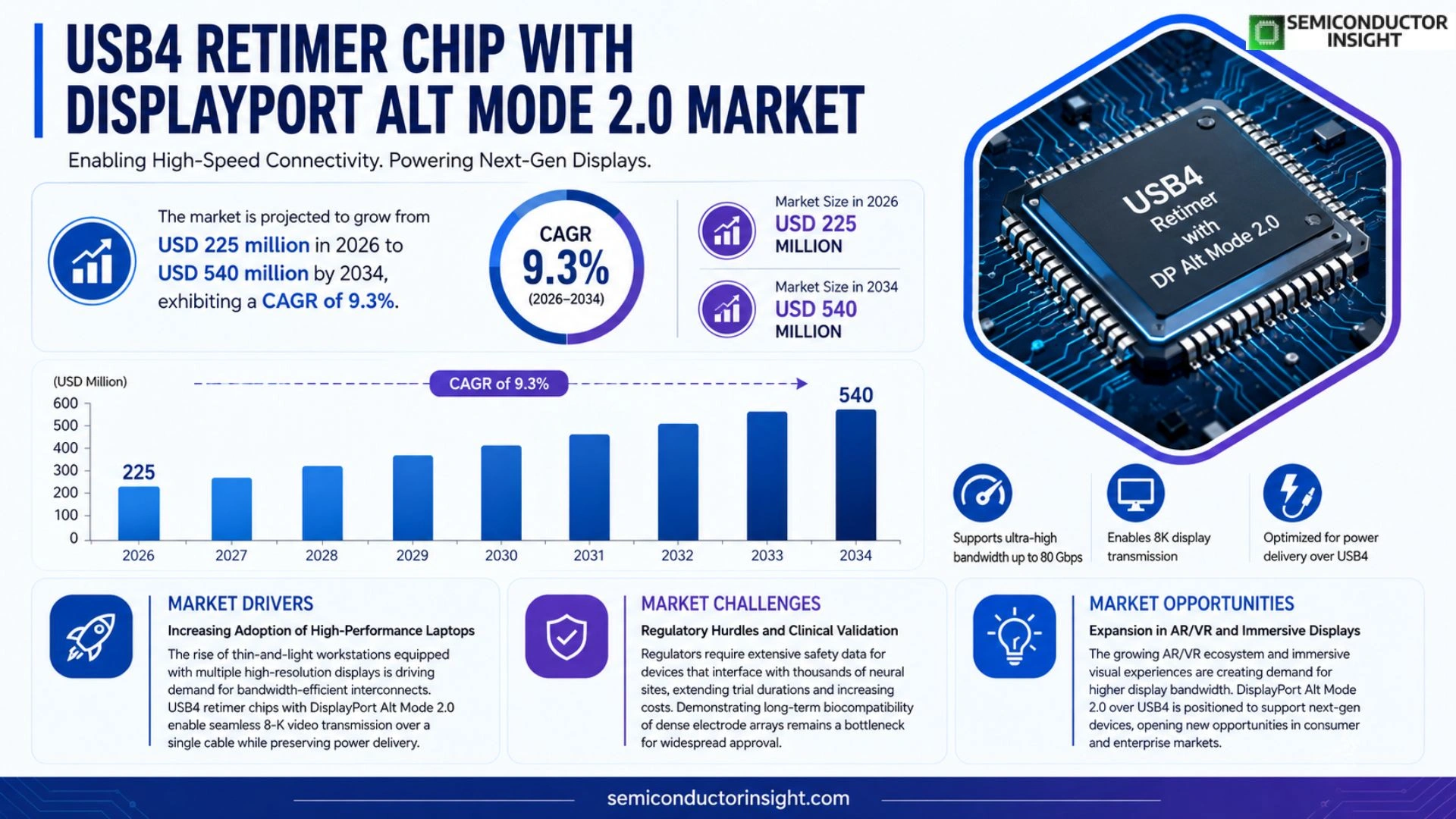
Global USB4 retimer chip with DisplayPort Alt Mode 2.0 market size was valued at USD 210 million in 2025. The market is projected to grow from USD 225 million in 2026 to USD 540 million by 2034, exhibiting a CAGR of 9.3% during the forecast period.
A USB‑C‑compatible retimer chip equipped with DisplayPort Alt Mode 2.0 restores and reshapes high‑speed signals across the USB‑Type‑C interface, ensuring reliable transmission of up to 40 Gb/s video and data streams while supporting dual‑display configurations up to 8K resolution.
The market is accelerating because laptop manufacturers are standardising on USB‑4 for next‑generation thin‑and‑light devices, while enterprise workstations demand robust multi‑monitor setups that rely on DP Alt Mode 2.0 bandwidth. Furthermore, the rollout of Thunderbolt 4 compliant platforms drives higher adoption of advanced retimers that mitigate signal loss over longer cables.
MARKET DRIVERS
Increasing Adoption of High‑Performance Laptops
The rise of thin‑and‑light workstations equipped with multiple high‑resolution displays is driving demand for bandwidth‑efficient interconnects. USB4 retimer chip with DisplayPort Alt Mode 2.0 Market benefits from this trend because it enables seamless 8‑K video transmission over a single cable while preserving power delivery.
Expansion of External GPU and Docking Solutions
Enterprise and creative‑professional users are investing in external GPU enclosures and docking stations that rely on robust signal integrity. The retimer architecture ensures low jitter and reliable link training, which is a critical factor for adoption.
➤ “Signal‑recovery technology embedded in modern retimers is a decisive advantage for manufacturers seeking to meet the 40 Gbps target of USB4.”
In addition, the move toward unified connectivity standards reduces inventory complexity, allowing OEMs to replace legacy HDMI/DP controllers with a single USB4 retimer solution that supports DisplayPort Alt Mode 2.0.
MARKET CHALLENGES
Cost Sensitivity in Mass‑Market Devices
While performance benefits are clear, integrating advanced retimer chips adds to bill‑of‑materials costs. Price‑competitive segments, such as entry‑level notebooks, may defer adoption until the cost gap narrows.
Other Challenges
Manufacturing Yield Constraints
The high‑frequency silicon required for 40 Gbps operation can experience lower yields, leading to supply‑chain bottlenecks that affect rollout schedules.
MARKET RESTRAINTS
Limited Availability of Backward‑Compatible Devices
Older peripherals that only support legacy DisplayPort versions cannot fully exploit the bandwidth of the latest retimer chips, creating a transitional market where mixed‑generation equipment coexists.
Regulatory and Certification Overhead
Compliance testing for high‑speed USB4 implementations adds time and expense, especially in regions with stringent electromagnetic‑compatibility (EMC) standards.
MARKET OPPORTUNITIES
Emergence of 8‑K Content Creation Workflows
Content creators are increasingly adopting 8‑K video capture and editing pipelines, which require reliable 40 Gbps links. Retimer chips that support DisplayPort Alt Mode 2.0 are well‑positioned to capture this growing niche.
Integration with AI‑Accelerated Edge Devices
Edge AI platforms demand high‑throughput data transfer for sensor fusion and model updates. Embedding a USB4 retimer simplifies board design and reduces latency, opening new OEM partnerships.
USB4 retainer chip with DisplayPort Alt Mode 2.0 Market Trends
Adoption Driven by Laptop Thinnest Designs and Enterprise Workstations
The transition to USB‑4 as the default interconnect for next‑generation laptops is accelerating because manufacturers prioritize thin‑and‑light chassis without sacrificing bandwidth. By integrating a USB‑C‑compatible retimer that supports DisplayPort Alt Mode 2.0, OEMs can reliably deliver up to 40 Gb/s video and data streams across compact cable assemblies. Enterprise workstations benefit equally, as the retimer enables stable dual‑display configurations at 8K resolution, meeting the demands of graphics‑intensive applications. Concurrently, the rollout of Thunderbolt 4‑compatible platforms creates a ripple effect: system designers select retimers that compensate for signal loss over longer cables, ensuring consistent performance across heterogeneous environments. This convergence of laptop miniaturization and high‑performance workstation requirements forms the core growth engine for the USB4 retainer chip market.
Other Trends
Strategic Portfolio Expansion by Key Semiconductor Players
Industry leaders such as Texas Instruments, Synopsys, NXP Semiconductors, and Microchip Technology have announced new silicon families that incorporate advanced equalization and clock‑data recovery features tailored for DisplayPort Alt Mode 2.0. These releases are often accompanied by strategic partnerships with device manufacturers, enabling co‑development of reference designs that shorten time‑to‑market. Collaborative programs also focus on expanding firmware ecosystems, allowing developers to fine‑tune retimer parameters for specific use‑cases such as high‑refresh‑rate gaming laptops or AI‑accelerated workstations. By broadening product portfolios and deepening ecosystem support, these firms reinforce the overall confidence in the USB4 retainer chip supply chain, fostering a more resilient market environment.
Signal Integrity Enhancements Through Advanced Retimer Architectures
Modern retimer architectures emphasize multi‑stage equalization and adaptive jitter mitigation, which are critical when transmitting 40 Gb/s signals over passive USB‑Type‑C cables. The inclusion of programmable gain control and real‑time monitoring allows systems to dynamically respond to variations in cable length and connector quality, preserving error‑free video delivery up to 8K resolution. As display standards evolve and content creators demand higher pixel densities, the retimer’s role expands from mere signal restoration to an active enabler of next‑generation visual experiences. Looking ahead, continued refinement of silicon processes and algorithmic intelligence is expected to further reduce latency and power consumption, positioning the USB4 retainer chip with DisplayPort Alt Mode 2.0 as a cornerstone of future high‑performance computing platforms.
COMPETITIVE LANDSCAPE
Key Industry Players
USB4 Retimer Chip with DisplayPort Alt Mode 2.0 Competitive Overview
USB‑4 retimer segment is dominated by a handful of silicon powerhouses that command the majority of high‑volume shipments for laptop OEMs and enterprise workstation makers. Texas Instruments leads the market with its DP‑Alt‑Mode‑enabled retimer families, leveraging a broad analog portfolio and deep relationships with Tier‑1 device manufacturers. Synopsys provides a complementary design‑IP suite that accelerates time‑to‑market for custom ASIC implementations, while NXP Semiconductors differentiates through integrated power‑management blocks that reduce bill‑of‑materials for thin‑and‑light devices. Microchip Technology’s recent acquisition of a specialized DP‑2.0 retimer line has expanded its footprint in the embedded and automotive spaces, reinforcing the tiered market structure where a few Tier‑1 vendors supply the bulk of volume, and a broader ecosystem of niche players fills specialized applications.
Beyond the Tier‑1 leaders, a diverse set of niche innovators contributes significant value in specialized form‑factors and performance envelopes. Analog Devices and Maxim Integrated (now part of ADI) focus on ultra‑low‑noise retimers for high‑precision display rigs. Broadcom and Qualcomm supply retimer solutions bundled with Thunderbolt 4 controllers for premium ultrabooks. MediaTek and Skyworks target cost‑sensitive consumer electronics, embedding DP‑Alt‑Mode functionality in system‑on‑chips. Marvell, Renesas, and Cypress (Infineon) address industrial and automotive segments where ruggedization and extended temperature ranges are critical. Collectively, these companies expand the competitive landscape, driving incremental innovation and price pressure across USB‑4 retimer market.
List of Key USB4 Retimer Chip with DisplayPort Alt Mode 2.0 Companies Profiled
- Texas Instruments
- Texas Instruments
- Synopsys
- Synopsys
- NXP Semiconductors
- NXP Semiconductors
- Microchip Technology
- Microchip Technology
- Broadcom Inc.
- Analog Devices
- MediaTek
- Qualcomm
- Marvell Technology Group
- Skyworks Solutions
- Renesas Electronics
- Cypress Semiconductor (Infineon)
- Maxim Integrated
Segment Analysis:
| Segment Category | Sub-Segments | Key Insights |
| By Type |
|
Integrated Retimers
|
| By Application |
|
Enterprise Workstation Systems
|
| By End User |
|
Enterprise IT Departments
|
| By Architecture |
|
Silicon‑Level Integration
|
| By Device Category |
|
High‑Performance Graphics Workstations
|
Regional Analysis: North America
North America
The North American market is characterized by a strong emphasis on performance and premium features, which aligns well with the capabilities of USB4 retimer chips. The adoption is widespread across various sectors, including consumer electronics, professional workstations, and data centers. The region’s well-established supply chain and distribution networks further contribute to the ease of market penetration for manufacturers of these chips. Future growth is expected to be fueled by the increasing adoption of 8K displays and the expansion of the gaming market.
The consumer electronics segment represents the largest application area for USB4 retimer chips in North America. The demand is heavily influenced by the release of new devices with enhanced display capabilities and faster data transfer speeds.
Professional workstations in North America are increasingly adopting USB4 retimer chips for their high-performance video and graphics applications. The need for reliable and high-speed connections is paramount in these environments.
The data center sector is witnessing a growing interest in USB4 retimer chips for their ability to support high-bandwidth connections for servers and storage devices. The demand is driven by the increasing need for efficient data transfer and connectivity.
The gaming peripheral market in North America is a significant driver for USB4 retimer chip adoption. Gamers demand high-resolution displays and low-latency connections for an immersive experience.
Europe
Europe exhibits steady growth in USB4 retimer chip market. The region’s strong industrial base and focus on technological advancement are key factors. While adoption rates may be slightly lower than in North America, demand is steadily increasing across various sectors, including automotive and industrial automation. Regulatory initiatives promoting energy efficiency and connectivity are also influencing market trends. The European market is characterized by a diverse range of players and a strong emphasis on quality and reliability.
Asia-Pacific
Asia-Pacific represents a high-growth potential market for USB4 retimer chips. The region’s burgeoning consumer electronics industry, particularly in China and Southeast Asia, is driving significant demand. The increasing adoption of 4K and 8K displays, coupled with the expansion of the gaming market, is fueling market growth. Government initiatives promoting technological innovation and infrastructure development are also contributing to the region’s growth.
South America
South America is an emerging market for USB4 retimer chips. The region’s growing economy and increasing disposable incomes are driving demand for consumer electronics and high-performance computing devices. The adoption of USB4 technology is expected to accelerate in the coming years as awareness and affordability increase.
Middle East & Africa
The Middle East & Africa market for USB4 retimer chips is relatively nascent but holds significant potential. The region’s increasing investments in infrastructure development, particularly in the areas of telecommunications and entertainment, are expected to drive demand for these chips. The growing adoption of smart devices and the expansion of the gaming market are also contributing to market growth.
Report Scope
This market research report provides a comprehensive analysis of the USB4 retimer chip with DisplayPort Alt Mode 2.0 Market , covering the forecast period 2026–2034. It offers detailed insights into market dynamics, technological advancements, competitive landscape, and key trends shaping the industry.
Key focus areas of the report include:
- Market Overview: The report begins with an overview outlining its current market scenario, key growth indicators, and industry transformation drivers. It discusses macroeconomic factors, demand–supply balance, regulatory landscape, and the strategic role of semiconductors in powering advancements across industries such as automotive, telecommunications, consumer electronics, and industrial automation.
- Market Size & Forecast: Historical data and future projections for revenue, unit shipments, and market value across major regions and segments.
- Segmentation Analysis: Detailed breakdown by product type, technology, application, and end-user industry to identify high-growth segments and investment opportunities.
- Regional Insights: Insights into market performance across North America, Europe, Asia-Pacific, Latin America, and the Middle East & Africa, including country-level analysis where relevant.
- Competitive Landscape: Profiles of leading market participants, including their product offerings, R&D focus, manufacturing capacity, pricing strategies, and recent developments such as mergers, acquisitions, and partnerships.
- Technology Trends & Innovation: Assessment of emerging technologies, integration of AI/IoT, semiconductor design trends, fabrication techniques, and evolving industry standards.
- Market Drivers & Restraints: Evaluation of factors driving market growth along with challenges, supply chain constraints, regulatory issues, and market-entry barriers.
- Stakeholder Insights: Insights for component suppliers, OEMs, system integrators, investors, and policymakers regarding the evolving ecosystem and strategic opportunities.
Primary and secondary research methods are employed, including interviews with industry experts, data from verified sources, and real-time market intelligence to ensure the accuracy and reliability of the insights presented.
FREQUENTLY ASKED QUESTIONS:
What is the current market size of USB4 retimer chip with DisplayPort Alt Mode 2.0 Market?
-> USB4 retimer chip with DisplayPort Alt Mode 2.0 market is projected to grow from USD 225 million in 2026 to USD 540 million by 2034.
Which key companies operate in USB4 retimer chip with DisplayPort Alt Mode 2.0 Market?
-> Key players include Texas Instruments, Synopsys, NXP Semiconductors, and Microchip Technology, among others.
What are the key growth drivers?
-> Key growth drivers include standardisation of USB‑4 by laptop manufacturers, demand for robust multi‑monitor workstations, and the rollout of Thunderbolt 4 platforms that require advanced retimers.
Which region dominates the market?
-> The source does not specify a single dominant region; growth is observed globally across major markets.
What are the emerging trends?
-> Emerging trends include development of high‑speed retimer silicon, integration of DP Alt Mode 2.0 with Thunderbolt 4 ecosystems, and expanding support for dual‑8K display configurations.

Get Sample Report PDF for Exclusive Insights
Report Sample Includes
- Table of Contents
- List of Tables & Figures
- Charts, Research Methodology, and more...
 Download Sample Report PDF