MARKET INSIGHTS
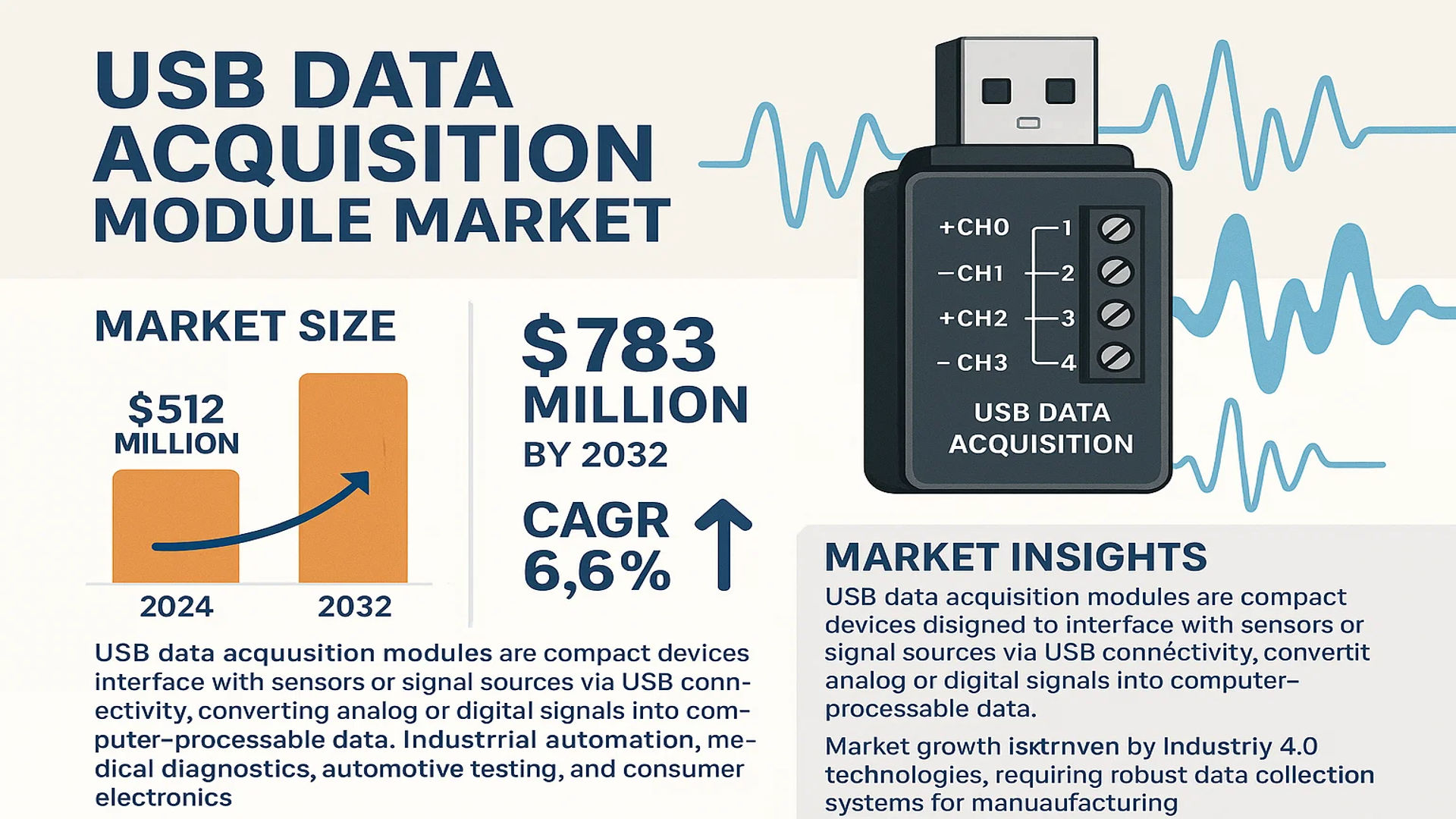
The global USB Data Acquisition Module market was valued at 512 million in 2024 and is projected to reach US$ 783 million by 2032, at a CAGR of 6.6% during the forecast period.
USB data acquisition modules are compact devices designed to interface with sensors or signal sources via USB connectivity, converting analog or digital signals into computer-processable data. These modules perform critical functions including signal conditioning, data conversion, and transmission, enabling real-time monitoring and analysis. Their versatility makes them indispensable across applications such as industrial automation, medical diagnostics, automotive testing, and consumer electronics.
Market growth is driven by increasing adoption of Industry 4.0 technologies, which require robust data collection systems for smart manufacturing. While North America currently dominates with 38% market share due to advanced industrial infrastructure, Asia-Pacific is emerging as the fastest-growing region with a projected 7.9% CAGR, fueled by expanding electronics manufacturing in China and India. Key players like Omega Engineering and National Instruments are innovating with high-precision 24-bit modules to meet demand from aerospace and healthcare sectors where measurement accuracy is critical.
MARKET DYNAMICS
MARKET DRIVERS
Accelerated Industrial Automation Investments Fuel USB DAQ Module Adoption
The global push towards Industry 4.0 and smart manufacturing is driving unprecedented demand for USB data acquisition modules. With industrial automation investments projected to grow at nearly 8% annually through 2030, manufacturers increasingly rely on plug-and-play USB DAQ solutions for real-time monitoring and predictive maintenance. These modules enable seamless integration with programmable logic controllers (PLCs) while reducing wiring complexity by up to 40% compared to traditional DAQ systems. The automotive sector’s transition to electric vehicle production, requiring more sophisticated battery and thermal monitoring, is creating particularly strong demand for high-resolution 24-bit USB DAQ modules.
Rise of Edge Computing Expands Application Scope
USB DAQ modules are becoming critical components in distributed edge computing architectures, which are growing at over 20% CAGR as industries reduce cloud dependency for latency-sensitive applications. Modern USB 3.0 and USB-C modules now offer sample rates exceeding 1 MS/s with onboard processing capabilities, making them ideal for field applications from oil rig monitoring to mobile medical diagnostics. The aerospace sector’s adoption of portable testing solutions has increased USB DAQ usage by 35% in aircraft maintenance operations alone since 2022.
Miniaturization Trend in Electronics Boosts Compact DAQ Demand
Consumer electronics manufacturers’ relentless drive towards smaller form factors has created tremendous opportunities for compact USB DAQ solutions. The market for handheld test equipment incorporating USB DAQ modules is projected to surpass $2 billion by 2027. Leading semiconductor test companies now embed these modules directly into validation fixtures, reducing bench space requirements while maintaining laboratory-grade measurement accuracy. In medical wearables, USB-connected miniature DAQ modules enable real-time biometric data collection from prototype devices during clinical trials.
MARKET RESTRAINTS
Cybersecurity Vulnerabilities in USB Interfaces Raise Deployment Concerns
While USB interfaces offer convenience, they introduce significant cybersecurity risks that are restraining market growth in sensitive applications. Studies show USB-based attacks on industrial systems increased by 52% in 2023, causing many critical infrastructure operators to limit USB DAQ adoption. The healthcare sector faces particular challenges meeting HIPAA compliance requirements with portable DAQ solutions, as patient data collection demands rigorous encryption that many entry-level modules lack.
Legacy System Integration Challenges Limit Upgrade Cycles
Many manufacturing facilities operate aging equipment with proprietary communication protocols that cannot interface with modern USB DAQ modules. Retrofitting these systems often requires expensive signal conditioning hardware, adding 30-50% to total implementation costs. In process industries, long equipment lifecycles averaging 15-20 years mean adoption of USB-based monitoring solutions progresses slower than the technology evolves.
Supply Chain Disruptions Impact Component Availability
The global semiconductor shortage continues affecting USB DAQ module production, particularly for high-precision analog front-end components. Lead times for specialized ADCs used in 24-bit modules remain at 45-60 weeks, forcing manufacturers to redesign products around available components. This has created a bifurcated market where basic 16-bit modules remain readily available while premium products face allocation constraints.
MARKET OPPORTUNITIES
Emerging IIoT Standards Create New Deployment Paradigms
The maturation of Industrial Internet of Things (IIoT) protocols like OPC UA and MQTT is enabling USB DAQ modules to function as intelligent edge nodes. Next-generation modules incorporating these standards can preprocess data before transmission, reducing network load by up to 70% in large-scale deployments. Smart agriculture applications are demonstrating particularly strong potential, with wireless USB DAQ systems enabling real-time soil and crop monitoring across expansive acreage.
Medical Device Innovation Expands Diagnostic Applications
The point-of-care diagnostics market’s projected 9.2% CAGR through 2030 is driving development of specialized USB DAQ modules for medical applications. Recent FDA clearances for portable ultrasound and EEG systems utilizing USB 3.2 Gen 2×2 DAQ modules demonstrate the technology’s healthcare potential. Manufacturers are now developing medically-certified modules with isolated inputs and proprietary algorithms for real-time biomarker analysis.
AI-Enhanced DAQ Solutions Unlock Predictive Insights
Integration of machine learning directly into USB DAQ modules represents a transformative opportunity. Modern modules with embedded TensorFlow Lite can now detect equipment anomalies locally rather than transmitting raw data to the cloud, reducing bandwidth requirements by 90% for condition monitoring applications. This capability is driving adoption in renewable energy operations where remote wind turbines and solar arrays benefit from edge-based predictive maintenance.
MARKET CHALLENGES
USB Protocol Fragmentation Complicates System Design
The rapid evolution of USB standards from 2.0 through USB4 creates interoperability challenges for DAQ module manufacturers. While USB-C physical connectors have helped, significant protocol differences between generations force engineers to maintain multiple product variants. Automotive and aerospace customers in particular require extended lifecycle support for older USB versions, increasing R&D costs by 20-25% for full product line maintenance.
Power Constraints Limit High-Channel-Count Deployments
USB’s inherent power delivery limitations pose challenges for complex DAQ systems. While USB Power Delivery (USB-PD) helps, simultaneously operating multiple high-speed ADC channels often requires external power supplies – negating key plug-and-play advantages. Test labs report 60% of measurement inaccuracies in USB DAQ systems stem from insufficient or noisy power delivery through the USB interface.
Thermal Management Issues in Compact Designs
As USB DAQ modules shrink to meet portable application demands, thermal dissipation becomes increasingly problematic. High-performance ADCs and FPGAs in 24-bit modules can generate over 5W of heat in surface-mount packages smaller than 100mm². Without adequate cooling, measurement drift exceeding 0.1%/°C makes long-duration data logging unreliable in field environments.
USB DATA ACQUISITION MODULE MARKET TRENDS
Growing Industrial Automation Demand Drives Market Expansion
The increasing adoption of industrial automation has significantly fueled the demand for USB data acquisition modules (DAQs), as they play a critical role in monitoring and controlling manufacturing processes in real time. Industries are rapidly shifting toward Industry 4.0 and IoT-enabled smart factories, where seamless data collection and processing are essential. USB DAQs provide an efficient plug-and-play solution for converting analog signals into digital data, making them indispensable in automation environments. Recent advancements have led to the development of high-speed, multi-channel DAQs, enhancing their applicability in complex industrial setups. The market for industrial automation is projected to grow at a CAGR of 7.2%, further accelerating the integration of USB DAQs in manufacturing and process control systems.
Other Trends
Integration of AI and Edge Computing
The integration of artificial intelligence (AI) and edge computing technologies with data acquisition modules is revolutionizing data processing capabilities. Advanced USB DAQs now support machine learning algorithms for predictive maintenance, anomaly detection, and process optimization. The shift toward edge computing minimizes latency by processing data locally, reducing dependency on cloud servers, and ensuring faster decision-making in critical applications like robotics and autonomous systems. With edge device shipments expected to surpass 50 billion units by 2030, USB DAQs equipped with AI capabilities are positioned for significant adoption in smart manufacturing and R&D sectors.
Rising Adoption in Medical Diagnostics & Research
The healthcare and life sciences sectors are increasingly incorporating USB data acquisition modules into diagnostic equipment, patient monitoring systems, and laboratory instrumentation. High-precision 24-bit DAQs are being used in medical imaging, electrocardiography (ECG), and biotechnology research, where accurate data capture is paramount. The growing emphasis on telemedicine and remote patient monitoring systems has further driven the need for compact, portable DAQs with reliable data transmission. The global medical devices market is anticipated to grow by 5.2% annually, reinforcing the demand for USB DAQs in applications such as EEG monitoring, ultrasound, and portable diagnostic devices.
Expansion in Automotive Testing & Validation
Automotive manufacturers and testing labs are leveraging USB DAQs for real-time vehicle diagnostics, emissions testing, and performance validation. The rise of electric vehicles (EVs) and autonomous driving technologies has intensified the requirement for high-resolution data acquisition to monitor battery management systems (BMS), powertrain efficiency, and sensor calibration. With EV sales projected to account for 30% of global vehicle sales by 2030, the demand for precision DAQs in automotive R&D is expected to grow substantially, supported by advancements in 24-bit resolution and high-speed sampling modules.
COMPETITIVE LANDSCAPE
Key Industry Players
Market Leaders Accelerate Innovation to Capture Growing USB DAQ Demand
The global USB data acquisition module market features a mix of established industrial automation providers and specialized measurement solution developers. Omega Engineering holds a dominant position, with its comprehensive product line spanning from industrial-grade 16-bit modules to high-precision 24-bit systems for laboratory applications. The company’s strength lies in its vertically integrated manufacturing capabilities and strong distribution network across North America and Europe.
Bosch Rexroth and Beckhoff Automation have emerged as key competitors, particularly in industrial automation applications. Bosch’s recent integration of IoT capabilities into their USB DAQ modules and Beckhoff’s EtherCAT-compatible solutions reflect the industry’s shift toward connected measurement systems. Both companies reported double-digit growth in their measurement technology segments in 2023.
Meanwhile, Adlink Technology has gained traction in the Asia-Pacific region through strategic partnerships with local automation providers. Their focus on ruggedized USB modules for harsh industrial environments has helped them capture significant market share in China’s manufacturing sector.
The competitive intensity is further heightened by specialized players like Lorenz Messtechnik and Applied Measurements, who differentiate through niche applications. Lorenz’s high-speed data acquisition modules are widely adopted in automotive testing, while Applied Measurements dominates in precision load cell measurement applications.
List of Key USB Data Acquisition Module Manufacturers
- Omega Engineering (U.S.)
- Bosch Rexroth (Germany)
- Beckhoff Automation (Germany)
- Lorenz Messtechnik GmbH (Germany)
- Adlink Technology (Taiwan)
- Applied Measurements Ltd. (U.K.)
- Contemporary Control Systems (U.S.)
- Kyowa Electronic Instruments (Japan)
- Hydronix (U.K.)
- DVTEST (Russia)
- Unipulse Corporation (Japan)
- Helvar (Finland)
Segment Analysis:
By Type
16-bit Modules Lead the Market Due to Balanced Cost-Performance Ratio
The market is segmented based on type into:
- 16-bit
- 24-bit
- Others
By Application
Industrial Automation Dominates Due to Widespread IoT Integration
The market is segmented based on application into:
- Automotives
- Industrial Automation
- Medical Devices
- Electronics and Consumer Products
- Aerospace
- Research and Education
- Others
By End User
Manufacturing Sector Holds Largest Share Owing to Process Optimization Needs
The market is segmented based on end user into:
- Manufacturing
- Healthcare
- Energy
- Research Institutions
- Others
By Channel Count
Multi-Channel Modules Gain Traction for Complex Monitoring Applications
The market is segmented based on channel count into:
- Single-channel
- Multi-channel
- 2-8 channels
- 8-16 channels
- 16+ channels
Regional Analysis: USB Data Acquisition Module Market
Asia-Pacific
The Asia-Pacific region dominates the global USB Data Acquisition Module market, with China at the forefront due to its expansive manufacturing sector and rapid industrialization. China alone accounts for approximately 35% of global demand, driven by the widespread adoption of automation in automotive, electronics, and industrial applications. The country’s investments in smart manufacturing under the “Made in China 2025” initiative have significantly boosted demand for high-precision data acquisition solutions. Meanwhile, India shows promising growth potential, fueled by government-led digitization efforts across industries. Cost sensitivity remains a key market characteristic, leading to strong demand for mid-range 16-bit modules, though 24-bit variants are gaining traction in medical and aerospace applications where accuracy is critical. Regional players are increasingly shifting from legacy systems to USB-based data acquisition to meet modern industry requirements.
North America
North America represents the second-largest market for USB Data Acquisition Modules, characterized by technological sophistication and stringent quality standards. The U.S. leads regional adoption, particularly in aerospace, defense, and advanced manufacturing sectors where precision and reliability are paramount. The region shows strong preference for 24-bit modules, which currently hold over 40% market share in the high-end segment. Research institutions and universities also contribute significantly to demand, utilizing these modules for scientific measurement applications. While the market is mature, continuous innovation in USB-C and Thunderbolt compatible devices is creating new growth opportunities. Regulatory requirements for medical devices and industrial equipment further drive the need for certified data acquisition solutions with accurate signal conditioning capabilities.
Europe
Europe maintains a stable position in the USB Data Acquisition Module market, supported by its robust industrial automation and automotive sectors. Germany stands out as the regional leader, with manufacturers prioritizing high-performance modules for quality control and process optimization in Industry 4.0 implementations. The EU’s emphasis on energy efficiency and smart manufacturing continues to stimulate demand for advanced data acquisition in renewable energy and building automation applications. Waterproof and explosion-proof variants see particular demand in harsh industrial environments. Though growth is moderate compared to Asia-Pacific, the European market maintains steady expansion through technological upgrades and replacement of older data acquisition systems with USB-based solutions that offer plug-and-play convenience and computer integration.
South America
The South American market, while smaller in scale compared to other regions, is experiencing gradual growth in USB Data Acquisition Module adoption. Brazil leads regional demand, primarily from oil and gas operations and agricultural equipment monitoring applications. Budget constraints lead to preference for basic 16-bit modules, though industries requiring process validation and quality assurance are increasingly investing in higher-resolution options. Infrastructure limitations in some countries affect market penetration, but growing awareness of predictive maintenance benefits and IIoT applications is driving steady market expansion. Local manufacturers are partnering with global players to provide customized solutions for regional industrial needs, particularly in mining and food processing sectors.
Middle East & Africa
The Middle East & Africa region represents an emerging market for USB Data Acquisition Modules, with growth concentrated in oil-rich Gulf nations and select African industrial hubs. The UAE and Saudi Arabia lead adoption, particularly for condition monitoring in energy sector applications. While market maturity lags behind other regions, increasing investments in smart city projects and industrial automation create new opportunities. South Africa shows potential as an emerging manufacturing base driving localized demand. The market currently favors cost-effective solutions, though there’s growing recognition of high-precision modules for critical infrastructure monitoring. Challenges include limited technical expertise in some areas and the predominance of legacy systems, but gradual modernization efforts are expected to sustain long-term market growth.
Report Scope
This market research report provides a comprehensive analysis of the Global USB Data Acquisition Module Market, covering the forecast period 2024–2032. It offers detailed insights into market dynamics, technological advancements, competitive landscape, and key trends shaping the industry.
Key focus areas of the report include:
- Market Size & Forecast: Historical data and future projections for revenue, unit shipments, and market value across major regions and segments. The global USB Data Acquisition Module market was valued at USD 512 million in 2024 and is projected to reach USD 783 million by 2032, growing at a CAGR of 6.6% during the forecast period.
- Segmentation Analysis: Detailed breakdown by product type (16-bit, 24-bit, others), application (automotive, industrial automation, medical devices, electronics, aerospace, research), and end-user industry to identify high-growth segments.
- Regional Outlook: Insights into market performance across North America, Europe, Asia-Pacific, Latin America, and Middle East & Africa. The U.S. market size is estimated at USD million in 2024, while China is projected to reach USD million by 2032.
- Competitive Landscape: Profiles of leading market participants including Omega, Bosch, Helvar, Beckhoff Automation, and Contemporary Control Systems, analyzing their product portfolios, market share, and strategic developments.
- Technology Trends & Innovation: Assessment of emerging USB interface standards, integration with IoT platforms, and advancements in signal processing technologies.
- Market Drivers & Restraints: Evaluation of factors including industrial automation growth, demand for portable data acquisition solutions, and challenges related to cybersecurity in connected devices.
- Stakeholder Analysis: Strategic insights for component suppliers, system integrators, OEMs, and investors regarding market opportunities and competitive positioning.
The research methodology combines primary interviews with industry experts and secondary data from verified sources, ensuring the accuracy and reliability of market insights.
FREQUENTLY ASKED QUESTIONS:
What is the current market size of Global USB Data Acquisition Module Market?
-> USB Data Acquisition Module market was valued at 512 million in 2024 and is projected to reach US$ 783 million by 2032, at a CAGR of 6.6% during the forecast period.
Which key companies operate in Global USB Data Acquisition Module Market?
-> Key players include Omega, Bosch, Helvar, Beckhoff Automation, Contemporary Control Systems, and Adlinktech, among others.
What are the key growth drivers?
-> Key growth drivers include increasing industrial automation, demand for portable data solutions, and growth in IoT applications.
Which region dominates the market?
-> North America currently leads in market share, while Asia-Pacific is projected to be the fastest-growing region.
What are the emerging trends?
-> Emerging trends include USB-C adoption, cloud-based data acquisition, and integration with AI analytics platforms.

Get Sample Report PDF for Exclusive Insights
Report Sample Includes
- Table of Contents
- List of Tables & Figures
- Charts, Research Methodology, and more...
 Download Sample Report PDF