MARKET INSIGHTS
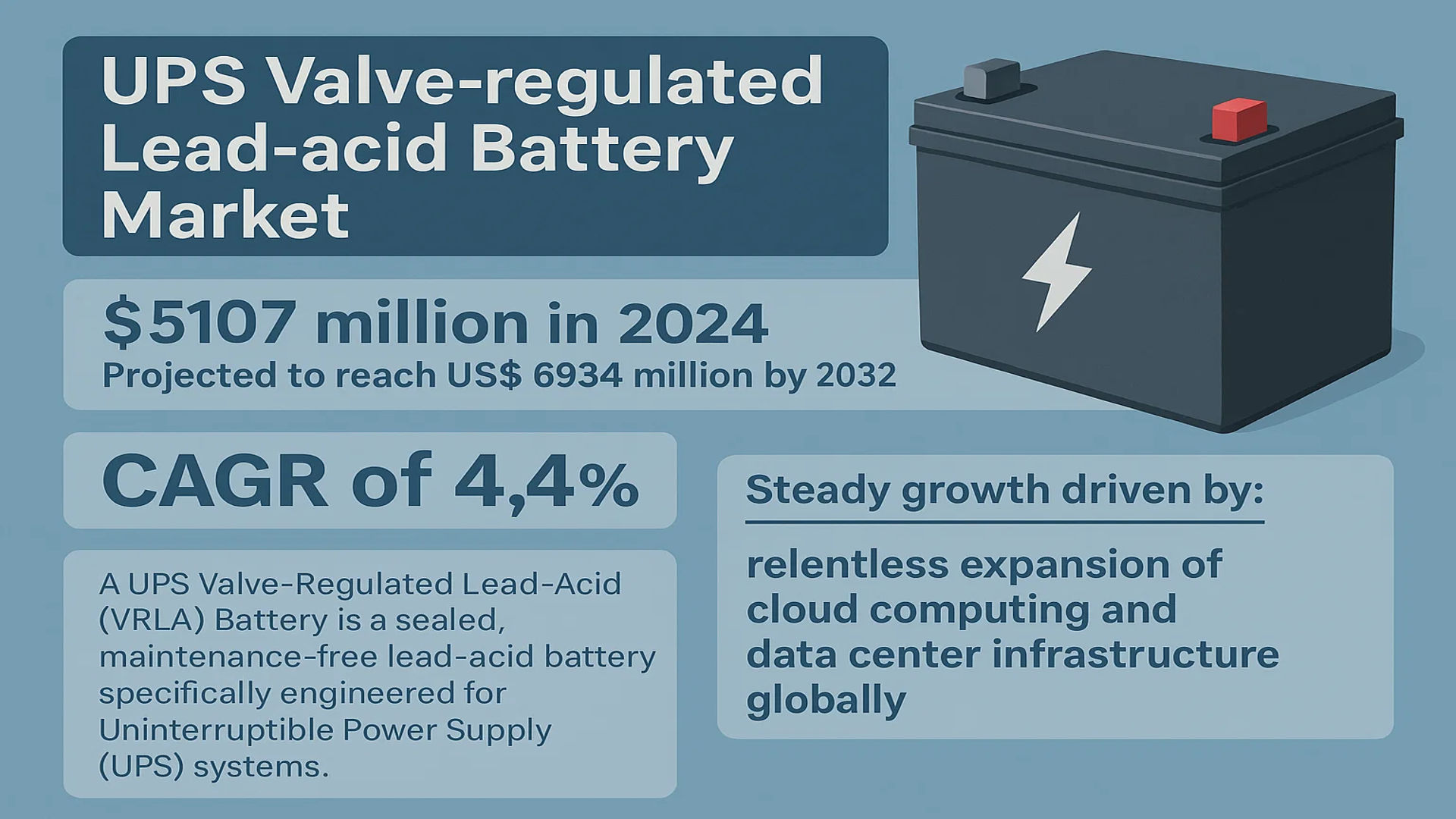
The global UPS Valve-regulated Lead-acid Battery Market was valued at 5107 million in 2024 and is projected to reach US$ 6934 million by 2032, at a CAGR of 4.4% during the forecast period.
A UPS Valve-Regulated Lead-Acid (VRLA) Battery is a sealed, maintenance-free lead-acid battery specifically engineered for Uninterruptible Power Supply (UPS) systems. It provides critical backup power during mains electricity failures, ensuring the continuous and reliable operation of essential infrastructure such as data centers, telecommunications networks, medical equipment, and industrial automation systems.
The market is experiencing steady growth driven by the relentless expansion of cloud computing and data center infrastructure globally. For instance, as of early 2021, there were over 8,000 data centers worldwide, with the United States alone accounting for approximately 33% of this total. This massive infrastructure directly fuels demand for reliable UPS systems and their integral VRLA batteries. Furthermore, increased government subsidies and significant investments by market players in hyperscale data centers, particularly in the Asia Pacific region which dominates the market, are key growth drivers. Leading manufacturers such as Clarios, EnerSys, and GS Yuasa continue to innovate and expand their portfolios to meet this rising demand.
MARKET DYNAMICS
MARKET DRIVERS
Rising Demand from Data Centers and IT Infrastructure to Propel Market Growth
The exponential growth in data generation and cloud computing services is driving substantial investments in data center infrastructure globally, which in turn fuels demand for reliable uninterruptible power supply systems. Valve-regulated lead-acid batteries serve as the backbone for UPS systems in data centers, providing critical backup power during grid failures. The global data center market has been expanding at a remarkable pace, with over 8,000 facilities operational worldwide as of recent assessments. North America alone accounts for approximately 33% of all data centers, creating significant demand for VRLA batteries. The increasing reliance on digital infrastructure across industries, coupled with the expansion of 5G networks and edge computing capabilities, continues to drive substantial investments in data center construction and upgrades, thereby accelerating the adoption of UPS VRLA batteries.
Expansion of Telecommunications Infrastructure to Boost Market Development
The global telecommunications sector is undergoing rapid transformation with the deployment of 5G technology and network modernization initiatives. Telecommunications infrastructure requires highly reliable backup power solutions to maintain network continuity during power outages. Valve-regulated lead-acid batteries provide essential power backup for cell towers, base stations, and communication equipment, ensuring uninterrupted service delivery. The ongoing rollout of 5G networks across developed and developing economies has created substantial demand for UPS systems equipped with VRLA batteries. Network operators are investing significantly in infrastructure upgrades to support increased data traffic and low-latency applications, driving consistent demand for reliable battery backup solutions that can operate in diverse environmental conditions.
Furthermore, government initiatives supporting digital infrastructure development and rural connectivity programs are contributing to market expansion. Many countries have implemented national broadband plans and digital transformation strategies that require robust telecommunications infrastructure with reliable power backup systems.
➤ For instance, numerous national regulatory authorities have mandated minimum uptime requirements for telecommunications services, compelling operators to invest in reliable UPS systems with adequate battery backup capacity.
Additionally, the growing adoption of Internet of Things devices and smart city initiatives worldwide is further driving the need for expanded telecommunications infrastructure with reliable power backup solutions.
Increasing Industrial Automation and Critical Process Applications to Drive Market Growth
The global trend toward industrial automation and Industry 4.0 implementation has significantly increased the need for reliable power backup solutions in manufacturing and process industries. Valve-regulated lead-acid batteries provide critical power protection for automated production lines, control systems, and sensitive industrial equipment. Modern manufacturing facilities increasingly rely on uninterrupted power to prevent production losses, equipment damage, and data corruption. The manufacturing sector’s growing emphasis on operational efficiency and reduced downtime has driven investments in robust power protection systems. Process industries such as oil and gas, chemicals, and pharmaceuticals particularly depend on UPS systems with VRLA batteries to ensure continuous operation of critical control systems and safety instrumentation.
Moreover, the expansion of industrial infrastructure in emerging economies and the modernization of manufacturing facilities in developed regions contribute to sustained market demand. The increasing complexity of industrial processes and the higher financial impact of power interruptions further emphasize the importance of reliable battery backup solutions.
MARKET RESTRAINTS
Environmental Regulations and Lead Content Restrictions to Hinder Market Expansion
The valve-regulated lead-acid battery market faces significant challenges from increasingly stringent environmental regulations governing lead usage, battery manufacturing processes, and disposal requirements. Lead-acid batteries contain substantial amounts of lead and sulfuric acid, both of which are subject to strict environmental controls and handling regulations. Regulatory bodies worldwide have implemented comprehensive frameworks governing battery manufacturing, transportation, recycling, and disposal. These regulations often require substantial investments in environmental compliance, waste management systems, and worker safety measures. The compliance costs associated with meeting these regulatory requirements can significantly impact manufacturing economics and product pricing.
Additionally, growing environmental awareness and sustainability initiatives have led to increased scrutiny of lead-based products. Some regions have implemented restrictions on lead usage in certain applications, while others have established extended producer responsibility programs that mandate battery recycling and proper disposal. These regulatory developments create operational complexities and additional cost burdens for market participants.
Furthermore, the evolving regulatory landscape requires continuous adaptation and investment in compliance measures, which can particularly challenge smaller manufacturers and limit market entry for new participants.
MARKET CHALLENGES
Competition from Alternative Battery Technologies to Challenge Market Position
The UPS VRLA battery market faces increasing competition from emerging battery technologies, particularly lithium-ion solutions, which offer several performance advantages. Lithium-ion batteries provide higher energy density, longer service life, faster charging capabilities, and reduced maintenance requirements compared to traditional lead-acid batteries. While VRLA batteries maintain cost advantages in certain applications, the declining prices of lithium-ion technology and improving economic viability are eroding this competitive edge. The total cost of ownership calculations increasingly favor lithium-ion solutions in applications where space constraints, weight considerations, or frequent cycling requirements are important factors.
Other Challenges
Technological Obsolescence Concerns
The rapid pace of battery technology development creates challenges for VRLA battery manufacturers to maintain relevance in the market. Continuous innovation in alternative chemistries and energy storage solutions requires significant research and development investments to improve VRLA battery performance characteristics and address evolving customer requirements.
Supply Chain Vulnerabilities
The VRLA battery market depends on stable supplies of lead and other raw materials, creating vulnerability to price fluctuations and supply disruptions. Lead mining and production face environmental and regulatory challenges that can impact material availability and pricing, affecting manufacturing costs and product competitiveness.
MARKET OPPORTUNITIES
Growing Investments in Renewable Energy Integration to Create New Market Opportunities
The global transition toward renewable energy sources and distributed power generation presents significant opportunities for UPS VRLA battery applications. Renewable energy systems often require energy storage solutions to manage intermittency and ensure power quality. Valve-regulated lead-acid batteries can provide reliable backup power and energy storage functionality in hybrid renewable energy systems, particularly in off-grid and critical power applications. The increasing deployment of solar and wind power generation systems, coupled with growing investments in microgrid and distributed energy infrastructure, creates new application areas for VRLA batteries beyond traditional UPS applications.
Additionally, the modernization of power grids and development of smart grid infrastructure require enhanced power quality management and backup power solutions. VRLA batteries can play important roles in grid stabilization, frequency regulation, and backup power applications within modern energy infrastructure projects.
Furthermore, the growing emphasis on energy resilience and business continuity planning across various sectors drives demand for comprehensive power protection solutions that incorporate battery energy storage systems.
Emerging Market Expansion and Infrastructure Development to Drive Future Growth
Rapid economic development and infrastructure expansion in emerging markets present substantial growth opportunities for the UPS VRLA battery market. Developing economies are investing significantly in telecommunications infrastructure, data center construction, industrial development, and healthcare facilities modernization. These developments create robust demand for reliable power backup solutions to support critical infrastructure and ensure operational continuity. The ongoing digital transformation across emerging economies, coupled with increasing electrification rates and improving economic conditions, drives sustained demand for UPS systems with reliable battery backup.
Moreover, government initiatives supporting industrial development, digital infrastructure, and healthcare modernization in emerging markets further accelerate the adoption of power protection solutions. The relatively cost-effective nature of VRLA technology compared to alternative solutions makes it particularly suitable for price-sensitive emerging markets while still meeting performance requirements.
Additionally, the growing middle class and increasing disposable incomes in developing regions drive demand for improved services and infrastructure, creating positive ripple effects across multiple end-use sectors that utilize UPS systems with VRLA batteries.
UPS VALVE-REGULATED LEAD-ACID BATTERY MARKET TRENDS
Accelerated Digitalization and Data Center Expansion Driving Market Growth
The global UPS VRLA battery market is experiencing robust growth, primarily fueled by the unprecedented expansion of data centers and IT infrastructure worldwide. As digital transformation accelerates across industries, the demand for reliable, uninterrupted power has become non-negotiable. The market, valued at approximately $5.1 billion in 2024, is projected to reach $6.9 billion by 2032, growing at a steady CAGR of 4.4%. This growth trajectory is largely attributed to the hyperscale data center boom, particularly in the Asia-Pacific region, which commands a dominant share of the global market. While North America maintains a significant presence with over 33% of the world’s data centers, the Asia-Pacific region is witnessing the fastest growth rate due to substantial government subsidies and massive investments in digital infrastructure. The increasing reliance on cloud services, edge computing, and 5G networks further amplifies the need for dependable backup power solutions, making VRLA batteries an essential component in modern power continuity systems.
Other Trends
Technological Advancements in Battery Design and Efficiency
Manufacturers are continuously innovating to enhance the performance and lifespan of VRLA batteries, addressing critical industry demands for higher energy density and reduced total cost of ownership. Recent developments include improvements in plate design, electrolyte composition, and internal structure that have extended the typical service life of these batteries from 3-5 years to 5-7 years under optimal conditions. Furthermore, advancements in charging algorithms and battery monitoring systems have significantly improved the reliability and predictability of these power storage units. The integration of smart battery management systems that provide real-time health monitoring and predictive maintenance alerts has become increasingly standard, reducing unexpected failures and downtime. These technological enhancements are particularly crucial for applications where battery failure could result in substantial financial losses or operational disruptions, such as in financial trading floors or healthcare facilities.
Sustainability and Environmental Considerations Shaping Market Dynamics
Environmental regulations and sustainability initiatives are increasingly influencing the VRLA battery market, driving both challenges and opportunities for manufacturers. While lead-acid batteries face competition from emerging technologies like lithium-ion, their established recycling infrastructure presents a significant advantage. The lead-acid battery industry maintains one of the highest recycling rates of any consumer product, with approximately 99% of lead being recycled in North America and Europe. However, manufacturers must navigate increasingly stringent regulations regarding lead usage, transportation, and disposal. This regulatory environment has prompted investments in cleaner production technologies and closed-loop manufacturing processes. Additionally, the development of more efficient recycling methods has reduced the environmental footprint of these batteries while ensuring a stable supply of recycled materials. The industry’s response to these environmental pressures is creating a more sustainable product lifecycle while maintaining the cost-effectiveness that makes VRLA batteries attractive for UPS applications across various sectors.
COMPETITIVE LANDSCAPE
Key Industry Players
Strategic Expansion and Product Innovation Drive Market Leadership
The global UPS Valve-regulated Lead-acid Battery market exhibits a semi-consolidated competitive structure, characterized by the presence of numerous international giants, regional powerhouses, and specialized niche manufacturers. This dynamic is fueled by the critical nature of uninterrupted power supply across data centers, telecommunications, healthcare, and industrial sectors worldwide. Market leadership is often determined by manufacturing scale, technological innovation, geographic reach, and the ability to serve diverse application segments with reliability and efficiency.
Clarios (formerly Johnson Controls’ power solutions business) maintains a formidable position as a global leader, leveraging its extensive manufacturing footprint and longstanding relationships with major OEMs and data center operators. Their scale allows for significant cost advantages and consistent supply, which is crucial for large-scale infrastructure projects. Similarly, EnerSys and GS Yuasa are pivotal players, renowned for their high-performance battery solutions and stronghold in both the North American and Asia-Pacific markets. Their growth is heavily supported by the relentless expansion of hyperscale data centers, which require massive, reliable battery banks.
Established players like Exide Technologies and East Penn Manufacturing also command significant market share, attributed to their robust distribution networks and reputation for durability in demanding applications such as industrial manufacturing and telecommunications. Their strategies often focus on deepening penetration in existing markets while exploring growth in emerging economies.
Meanwhile, the competitive intensity is increasing as companies like Amara Raja and Leoch International Technology Ltd. aggressively expand their global footprint through strategic investments and capacity expansions. These players are strengthening their market presence by focusing on R&D to enhance battery life and efficiency, while also engaging in strategic partnerships and acquisitions to access new technologies and customer bases. This ensures their continued growth and ability to challenge established leaders, particularly in cost-sensitive markets.
List of Key UPS Valve-regulated Lead-acid Battery Companies Profiled
- Clarios (U.S.)
- Exide Technologies (U.S.)
- CSB Energy Technology Co., Ltd. (Taiwan)
- GS Yuasa International Ltd. (Japan)
- EnerSys (U.S.)
- East Penn Manufacturing Company, Inc. (U.S.)
- FIAMM Energy Technology S.p.A. (Italy)
- Sebang Global Battery Co., Ltd. (South Korea)
- Hankook AtlasBX Co., Ltd. (South Korea)
- Amara Raja Batteries Ltd. (India)
- C&D Technologies, Inc. (U.S.)
- MIDAC S.p.A. (Italy)
- ACDelco (U.S.)
- Banner Batteries (Austria)
- First National Battery (South Africa)
Segment Analysis:
By Type
AGM VRLA Battery Segment Dominates the Market Due to Superior Performance and Cost-Effectiveness
The market is segmented based on type into:
- AGM VRLA Battery
- GEL VRLA Battery
By Application
Data Centers & IT Infrastructure Segment Leads Due to Exponential Growth in Cloud Computing and Digitalization
The market is segmented based on application into:
- Data Centers & IT Infrastructure
- Telecommunications
- Medical Equipment
- Industrial & Manufacturing
- Security & Surveillance Systems
By End User
Enterprise Segment Commands Significant Share Owing to Critical Need for Uninterrupted Power in Business Operations
The market is segmented based on end user into:
- Enterprise
- Telecom Service Providers
- Healthcare Facilities
- Industrial Sector
- Residential
By Capacity
Medium Capacity Batteries (5-20 KVA) Hold Major Market Share Driven by Widespread Use in Commercial and Small Data Center Applications
The market is segmented based on capacity into:
- Small Capacity (Up to 5 KVA)
- Medium Capacity (5-20 KVA)
- Large Capacity (Above 20 KVA)
Regional Analysis: UPS Valve-regulated Lead-acid Battery Market
Asia-Pacific
The Asia-Pacific region dominates the global UPS VRLA battery market, accounting for the highest consumption volume and revenue share. This dominance is primarily driven by massive data center construction, rapid digitalization, and extensive government support for infrastructure development. China and India are the key growth engines, with China alone hosting numerous hyperscale data center projects. Government subsidies and significant investments from both public and private sectors in IT infrastructure are accelerating market expansion. While cost sensitivity keeps conventional battery solutions prevalent, there is a noticeable shift toward more efficient and longer-lasting AGM batteries, particularly in tier-1 data centers. The region’s growing urbanization, increasing internet penetration, and expansion of 5G networks further fuel demand for reliable backup power solutions across telecommunications, industrial, and commercial sectors.
North America
North America represents a mature yet steadily growing market for UPS VRLA batteries, largely due to its well-established data center infrastructure. The United States holds approximately 33% of the world’s data centers, creating substantial, consistent demand for high-quality backup power solutions. The market is characterized by stringent performance requirements, with a strong preference for advanced AGM batteries that offer higher reliability and longer service life. Key drivers include the need for business continuity in sectors like finance, healthcare, and cloud services. Recent investments in data center modernization and the expansion of edge computing facilities are providing additional growth opportunities. Environmental regulations and a focus on sustainability are also encouraging the adoption of more efficient battery technologies, though VRLA remains popular for its cost-effectiveness and proven performance.
Europe
Europe’s UPS VRLA battery market is driven by strict regulatory standards, particularly EU directives on energy efficiency and electronic waste, which encourage the use of maintenance-free and environmentally compliant batteries. The region has a significant number of data centers, especially in Germany, the UK, and the Nordic countries, where cold climates naturally benefit battery life and performance. There is a growing emphasis on green data centers, which influences procurement toward batteries with better energy density and lower environmental impact. While the market is highly competitive with the presence of major global manufacturers, local compliance and certification requirements create barriers for new entrants. Steady demand from the industrial, healthcare, and telecommunications sectors supports market stability, with innovation focused on enhancing cycle life and reducing total cost of ownership.
South America
The South American market for UPS VRLA batteries is emerging, with growth potential tied to gradual economic development and infrastructure improvements. Brazil and Argentina are the primary markets, driven by increasing investments in data storage, telecommunications, and industrial automation. However, economic volatility and currency fluctuations often hinder large-scale investments in advanced power backup systems. Cost sensitivity leads to a higher reliance on standard VRLA products, with slower adoption of premium batteries. The market faces challenges such as inconsistent power quality and a lack of stringent regulations, which can delay the shift toward more efficient solutions. Nonetheless, the ongoing digital transformation in banking, retail, and public services offers promising opportunities for market expansion over the long term.
Middle East & Africa
The Middle East & Africa region is an emerging market with varied growth trajectories across countries. Nations like the UAE, Saudi Arabia, and Israel are investing heavily in smart city projects, data centers, and industrial diversification, driving demand for reliable UPS systems. In contrast, many African countries face infrastructural and economic challenges that limit market growth. The region shows a strong preference for durable and temperature-resistant batteries due to harsh climatic conditions. While the adoption of VRLA batteries is increasing, the market is still in a developing phase, with growth constrained by budget limitations and fragmented regulatory frameworks. Long-term potential exists, particularly in urban centers and industrial zones, where the need for uninterrupted power is critical for economic activities.
Report Scope
This market research report provides a comprehensive analysis of the global and regional UPS Valve-regulated Lead-acid Battery markets, covering the forecast period 2025–2032. It offers detailed insights into market dynamics, technological advancements, competitive landscape, and key trends shaping the industry.
Key focus areas of the report include:
- Market Size & Forecast: Historical data and future projections for revenue, unit shipments, and market value across major regions and segments.
- Segmentation Analysis: Detailed breakdown by product type (AGM, GEL), application, and end-user industry to identify high-growth segments and investment opportunities.
- Regional Outlook: Insights into market performance across North America, Europe, Asia-Pacific, Latin America, and the Middle East & Africa, including country-level analysis where relevant.
- Competitive Landscape: Profiles of leading market participants, including their product offerings, R&D focus, manufacturing capacity, pricing strategies, and recent developments such as mergers, acquisitions, and partnerships.
- Technology Trends & Innovation: Assessment of emerging technologies, advancements in battery chemistry, and evolving industry standards for improved efficiency and lifespan.
- Market Drivers & Restraints: Evaluation of factors driving market growth along with challenges, supply chain constraints, regulatory issues, and market-entry barriers.
- Stakeholder Analysis: Insights for component suppliers, OEMs, system integrators, investors, and policymakers regarding the evolving ecosystem and strategic opportunities.
Primary and secondary research methods are employed, including interviews with industry experts, data from verified sources, and real-time market intelligence to ensure the accuracy and reliability of the insights presented.
FREQUENTLY ASKED QUESTIONS:
What is the current market size of Global UPS Valve-regulated Lead-acid Battery Market?
-> UPS Valve-regulated Lead-acid Battery Market was valued at 5107 million in 2024 and is projected to reach US$ 6934 million by 2032, at a CAGR of 4.4% during the forecast period.
Which key companies operate in Global UPS Valve-regulated Lead-acid Battery Market?
-> Key players include Clarios, Exide Technologies, EnerSys, GS Yuasa, East Penn Manufacturing, CSB Energy Technology, and Leoch, among others.
What are the key growth drivers?
-> Key growth drivers include increasing data center construction, rising demand for uninterrupted power in critical infrastructure, and growth in telecommunications and industrial automation.
Which region dominates the market?
-> Asia-Pacific is the dominant and fastest-growing region, driven by massive data center investments, while North America remains a significant market due to its extensive existing data center infrastructure.
What are the emerging trends?
-> Emerging trends include development of longer-life VRLA batteries, integration with renewable energy systems, and heightened focus on recyclability and environmental compliance.

Get Sample Report PDF for Exclusive Insights
Report Sample Includes
- Table of Contents
- List of Tables & Figures
- Charts, Research Methodology, and more...
 Download Sample Report PDF